B2B Brand Differentiation: Why Brands Can Become Too Familiar to Be Interesting –
B2B marketing has spent years pursuing one of the most widely accepted principles of brand building: become familiar. Familiarity creates recognition, recognition can build trust, and trust can increase the likelihood that buyers will consider a company when a need eventually arises. The logic is especially relevant in B2B, where purchases often involve significant investment, operational risk, long decision cycles, and multiple stakeholders. But there is a point where familiarity stops creating an advantage and starts creating indifference. When buyers already know what a brand is going to say before it says it, recognition can remain high while curiosity gradually disappears.
Effective B2B brand differentiation is not about being different for the sake of attention; it is about creating a meaningful reason for buyers to remember your company.
Strong thought leadership can become a powerful tool for B2B brand differentiation because it gives the market a reason to associate the company with a distinctive point of view.
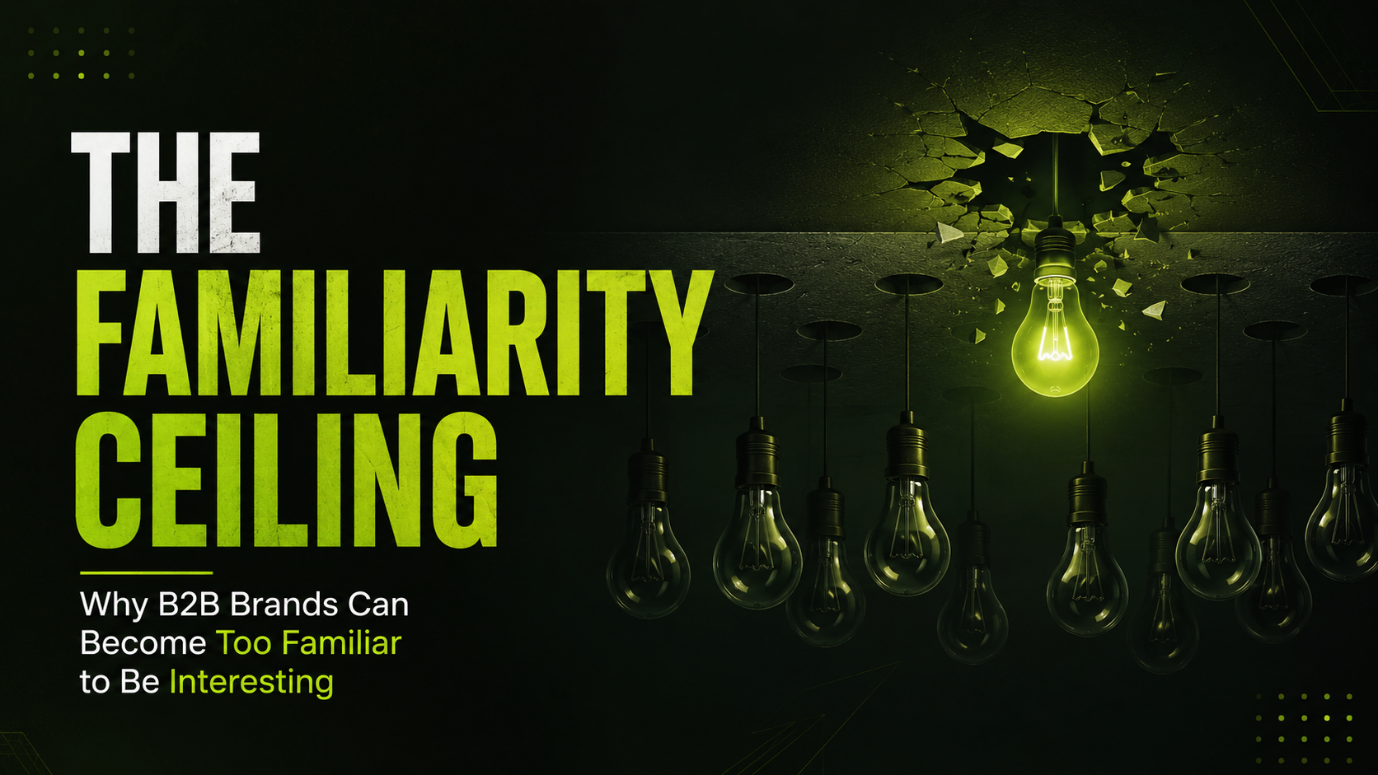
This is what we can call the Familiarity Ceiling: the point at which repeated exposure stops increasing a B2B brand’s influence because the audience has already formed a stable expectation of what the brand will communicate. The same claims appear across campaigns, the same themes dominate thought leadership, the same visual language appears across social platforms, and the same promises are delivered in slightly different formats. Nothing is necessarily wrong with the marketing. It simply becomes predictable. In an increasingly crowded B2B environment, that predictability can make even a well-established brand easier to ignore.
Why B2B Brands Become Too Familiar –
The problem is particularly relevant in B2B because consistency is often treated as an unquestionable virtue. Companies want their messaging to remain aligned across websites, sales decks, events, LinkedIn posts, whitepapers, webinars, email campaigns, advertising, and executive communication. Brand guidelines are designed to make sure everyone uses the same language and reinforces the same positioning. Consistency absolutely matters, but consistency of identity is not the same as repetition of ideas.
As AI-generated content becomes more common, B2B brand differentiation will increasingly depend on original expertise, proprietary insights, and ideas that cannot easily be replicated.
A brand can remain strategically consistent while continuously challenging its audience with new perspectives. The danger appears when organizations confuse brand consistency with intellectual repetition. If every piece of content simply reinforces what the audience already knows about the company, the brand may remain recognizable while becoming increasingly easy to overlook. The audience understands the category, the product, and the promise, but has little reason to stop and think about what the company uniquely contributes to the conversation.
Familiarity Is Valuable, But It Is Not Enough –
B2B buyers are naturally cautious. Enterprise purchases can involve financial commitments, implementation complexity, organizational disruption, security concerns, and reputational consequences. A familiar vendor can therefore feel safer than an unknown alternative. But familiarity alone rarely provides a compelling reason to reconsider an existing approach. A buyer who already knows that a company provides cybersecurity software, procurement technology, industrial automation, HR systems, or B2B data services does not necessarily need another explanation of what the company does.
The more important question is whether the brand can help the buyer see the problem differently. This is where many established B2B brands struggle. They become extremely good at explaining their category and increasingly less effective at challenging the assumptions within it. Their marketing communicates information, but it does not necessarily create a new way of thinking. Over time, this creates a form of marketing stability where engagement may remain acceptable, but the brand’s ability to create surprise, discussion, and intellectual interest begins to decline.
Recognition Is Not the Same as Memorability –
One of the most important ideas in B2B brand differentiation is the distinction between recognition and memorability. Recognition means a buyer knows who you are. Memorability means the buyer remembers something specific and meaningful about what you believe. A company can have strong brand awareness and still struggle to answer the question: What does the market remember us for?
The strongest B2B brands aim to create an intellectual association. They want buyers to think, “Whenever I think about this problem, that company has a distinctive perspective on it.” That perspective becomes more valuable than simple product awareness because it can influence consideration before a formal buying process begins. The brand is no longer remembered only as a supplier. It becomes associated with an idea, a way of thinking, or a particular interpretation of how the market is changing.
The Problem With Generic B2B Marketing –
B2B buyers are exposed to enormous volumes of similar communication. Technology companies talk about efficiency, agility, automation, scalability, intelligence, connectivity, security, and transformation. Consulting companies discuss business transformation. AI companies promise productivity and automation. Software platforms promise better visibility, faster decisions, and improved performance.
The problem is not that these claims are necessarily incorrect. The problem is that everyone is saying them. When an entire category repeats the same vocabulary, the language becomes associated with the category rather than with an individual company. Buyers become familiar with the market’s messaging, but not necessarily with a brand’s unique intellectual position. This is why effective B2B brand differentiation requires more than repeating category language louder than competitors.
A differentiated B2B brand needs more than a value proposition. It needs a point of view about its market, customers, technology, or industry. A strong point of view identifies something that is changing, questions an assumption, or explains an emerging issue in a way that is useful to the audience.
For example, a company could ask:
- What if the metric everyone tracks is measuring the wrong thing?
- What if a process considered efficient is creating hidden costs?
- What if technology designed to reduce complexity is creating a new type of dependency?
- What if the traditional B2B buying process is changing?
- What if the biggest risk is not adopting new technology, but becoming unable to reverse the decisions made with it?
Questions like these create intellectual tension. They give buyers something to consider rather than simply another product message. The goal is not to be controversial for attention. The goal is to introduce a useful idea that makes the audience think, “I had not considered the problem that way before.”
Thought Leadership Should Change the Conversation –
This is where B2B thought leadership becomes important. Thought leadership should not simply be educational content with a sophisticated headline. It should help buyers understand what a change means, why an assumption may no longer hold, or what they should be considering next.
Consider the difference between saying, “AI can help businesses improve productivity and automate repetitive work,” and arguing that “AI may fundamentally change how organizations define productivity.” The first statement provides information. The second creates a discussion. It opens questions about measurement, organizational design, workforce planning, technology investment, and business performance.
That is the real opportunity for B2B thought leadership. Brands can move beyond explaining what they sell and start helping buyers interpret what is happening around them. When a company consistently contributes useful perspectives to an industry conversation, it can become associated with the thinking behind a problem rather than simply the product used to solve it.
How AI Is Changing B2B Content Differentiation –
AI makes the Familiarity Ceiling even more important. Generative AI has dramatically reduced the time and cost required to produce competent content. Companies can now create articles, social posts, emails, reports, scripts, summaries, and campaign variations at extraordinary speed. This creates a new challenge for B2B marketers: when everyone can produce acceptable content, acceptable content becomes less valuable.
The competitive advantage therefore shifts from content production to intellectual selection. AI can help a company say more things, more quickly, but it does not automatically determine which ideas deserve attention. The important questions become: Which assumptions should the brand challenge? Which questions are buyers not asking yet? Which ideas can the company uniquely contribute? Which perspectives are strong enough to influence a conversation?
This does not mean B2B companies should publish less simply for the sake of publishing less. It means content should be organized around stronger ideas. One distinctive thesis can become a research report, webinar, executive discussion, sales enablement asset, LinkedIn series, customer conversation, and industry presentation. The value comes from the strength of the idea and its ability to travel across contexts.
How B2B Brands Can Break Through the Familiarity Ceiling –
Breaking through the Familiarity Ceiling does not require abandoning consistency or completely reinventing a brand. Instead, companies need to maintain a stable strategic identity while creating an evolving intellectual perimeter around it.
A practical approach includes:
- Challenge category assumptions: Identify beliefs in your industry that deserve to be questioned.
- Develop a distinctive point of view: Decide what your company believes about the market and why.
- Create ideas instead of endless content: Build multiple assets around strong, original theses.
- Give sales a conversation starter: Use thought leadership to open discussions before introducing the product.
- Build intellectual associations: Become known for specific ideas, frameworks, or perspectives.
- Use AI strategically: Let AI improve production efficiency without allowing it to determine your strategic voice.
The objective is not to create controversy or novelty for its own sake. Differentiation works when the idea is relevant, credible, and useful to the people you want to influence.
Consistency Still Matters –
Breaking through the Familiarity Ceiling does not mean abandoning the messages that have made a brand recognizable. Core positioning requires repetition because memory needs reinforcement. The mistake is assuming that consistency means saying the same thing forever.
A stronger model is stable identity with evolving perspectives. The brand can consistently stand for the same fundamental value while continually exploring new implications, challenges, and ideas around that value. The stable centre creates recognition, while the evolving perimeter creates curiosity.
This balance is particularly important for established B2B companies. New brands naturally create curiosity because buyers do not yet know what to expect. Established brands have already taught their audiences what to expect. Their challenge is therefore not simply becoming louder. It is becoming more intellectually distinct.
Measure Influence, Not Just Familiarity –
The Familiarity Ceiling also requires B2B marketers to rethink measurement. If a brand measures success primarily through impressions, reach, frequency, and follower growth, it may accidentally optimize for saturation rather than influence.
The more valuable question is whether the market is beginning to associate the company with meaningful ideas. Are executives referencing the company’s perspective? Are salespeople using its frameworks in conversations? Are customers sharing its arguments internally? Are prospects mentioning its content? Are competitors responding to its ideas? Are industry discussions beginning to use concepts introduced by the brand?
The future of B2B brand building will not be about choosing between consistency and creativity. It will be about combining them. Brands need a consistent identity, but they also need a reason for their audience to remain curious.
In a world where AI can generate an endless supply of competent content, distinctive thinking will become increasingly valuable. The brands that stand out will not necessarily be those that publish the most. They will be those that have something worth remembering.
Ultimately, successful B2B brand differentiation comes from combining a recognizable brand identity with ideas that continually give buyers something new to consider.
Conclusion –
The Familiarity Ceiling does not mean familiarity is becoming irrelevant. Recognition still matters, particularly in complex B2B markets where trust and perceived safety influence buying decisions. But recognition alone is no longer enough.
Once buyers already know who you are, the next challenge is giving them a reason to remember what you think.
That is the heart of B2B brand differentiation. The strongest brands maintain a consistent identity while continuously bringing new perspectives to the market. They do not chase controversy, and they do not reinvent themselves every quarter. Instead, they build a recognizable position and surround it with ideas that challenge, clarify, and move the conversation forward.
Recognition gets a brand into the buyer’s mental field. Distinctive thinking gives the buyer a reason to stay there.
Frequently Asked Questions
The Familiarity Ceiling is the point at which repeated exposure to a B2B brand stops increasing its influence because buyers already know what to expect from its messaging. Recognition may remain high, but curiosity and attention can decline.
B2B brand differentiation helps companies stand apart in crowded markets where competitors often use similar messaging, claims, and positioning. A differentiated brand gives buyers a specific reason to remember and consider the company.
A B2B brand can become more memorable by developing a distinctive point of view, challenging industry assumptions, creating original frameworks, and consistently connecting the brand with meaningful ideas rather than only product features.
Brand recognition means buyers know or recognize a company. Brand memorability means they remember something specific about it. A company can have high recognition without having a distinctive idea associated with its brand.
AI makes it easier and faster to produce content, increasing the amount of information competing for buyer attention. As generic content becomes more abundant, original insights, expert perspectives, proprietary research, and strong points of view become more important for differentiation.
No. Effective thought leadership does not need to be controversial. It needs to provide a useful perspective that challenges or expands how buyers understand an important problem. The strongest ideas create clarity rather than controversy for its own sake.