
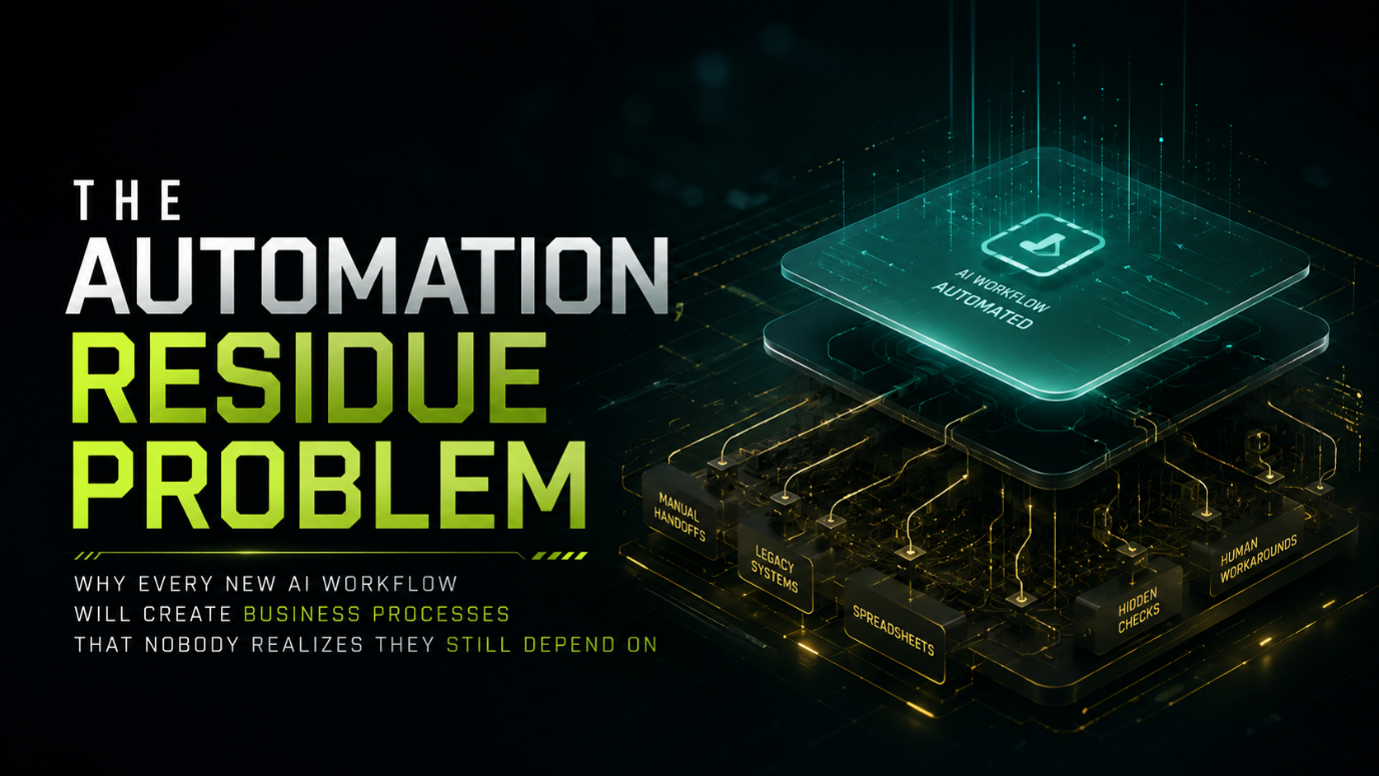
Every enterprise automation project begins with an understandable objective: remove repetitive work, reduce manual effort, accelerate processes, eliminate unnecessary steps, and allow employees to focus on higher-value activities. The organization identifies a workflow, maps the steps, introduces software or AI, automates the visible tasks, and measures the resulting efficiency. On paper, the process appears complete. But beneath the newly automated workflow, something often remains. A spreadsheet that someone still checks manually.
An approval that exists only because a previous system was unreliable. A human verification step that was never formally documented. A customer-service workaround that employees use when the automated system produces an unusual result. These remnants create what can be called the Automation Residue Problem: the collection of hidden processes, dependencies, exceptions, manual controls, and institutional workarounds that survive underneath an automated workflow even after the organization believes the original process has been eliminated.
The Automation Residue Problem exists because automation usually focuses on the process that management can see. Organizations map the official workflow, identify repetitive activities, determine where technology can replace human effort, and then measure how much of the visible process has disappeared. But businesses rarely operate exactly according to their official process maps. Employees develop workarounds because systems have limitations, customers behave unpredictably, approvals take too long, data is incomplete, or certain edge cases were never considered when the process was designed. Over time, these workarounds become part of how the business actually functions even though they may never appear in documentation. Automation can therefore remove the official workflow without removing the invisible ecosystem that grew around it.
The Automation Residue Problem creates a dangerous illusion of simplification. A company may announce that a process has been automated by 80 percent while employees continue performing dozens of manual actions behind the scenes. The difference may not be obvious because those actions happen infrequently or are distributed across multiple teams. One employee checks a spreadsheet every Friday. Another manually validates unusual transactions. Someone in operations monitors a system alert and intervenes when a workflow fails. A finance employee reconciles two systems because their data structures do not perfectly match. None of these activities may appear significant individually. Collectively, however, they can represent a critical operational dependency.
Why Automation Residue Is Difficult to Detect
One of the most important aspects of the Automation Residue Problem is the work that exists precisely because automation is imperfect. Enterprise systems are designed around standard conditions, but businesses operate through exceptions. A workflow may successfully process 95 percent of cases automatically while the remaining 5 percent require human intervention. That 5 percent can contain the most complicated, expensive, or consequential situations. If an organization measures automation only by the percentage of transactions processed automatically, it may conclude that the system is highly successful while underestimating the importance of the human expertise concentrated in the exception layer.
How AI Workflow Automation Creates Hidden Dependencies
The Automation Residue Problem becomes more significant with AI because AI-driven workflows are increasingly capable of handling tasks that previously required human judgment. An AI agent can classify information, generate responses, route requests, update records, summarize documents, recommend actions, and coordinate across systems. The promise is that entire workflows can become autonomous rather than simply automated. But autonomy can also make residue harder to see. A traditional automation rule is usually predictable: if X happens, do Y.
An AI system may make decisions dynamically based on context. When it encounters an unusual situation, employees may create additional checks, fall-back procedures, or monitoring mechanisms to compensate for uncertainty. These controls may become permanent without anyone explicitly deciding that they should.
This creates a paradox: the more intelligent the automation becomes, the harder it may be to understand what humans are still doing around it. When a deterministic system fails, the failure is often easier to diagnose. When an AI workflow produces an unexpected result, employees may respond by adding human oversight rather than modifying the underlying system. Over time, the organization can develop a hybrid process in which the AI performs most of the work but humans continuously monitor, correct, verify, and occasionally override it. The company may call this automation while operationally it remains a complex human-machine collaboration.
The problem is not necessarily that human involvement is bad. In many high-impact processes, human oversight is exactly what organizations should want. The problem arises when the organization does not know that the oversight exists, why it exists, or what would happen if it disappeared. A manual verification step that was intentionally designed as a safety control is very different from a manual verification step that exists because nobody trusts the automated output. The first represents governance. The second represents automation residue.
This distinction matters enormously when organizations attempt to scale AI. Before expanding an AI workflow from one department to ten, leaders need to understand what humans are doing around the current system. If employees are manually correcting outputs, reconciling data, monitoring exceptions, or maintaining parallel processes, those activities are part of the real operating model. Scaling the technology without understanding them can simply scale hidden complexity.
How Automation Changes the Work Itself
The Automation Residue Problem often accumulates because automation projects are usually evaluated against the old process rather than the new system of work. A company may compare the number of hours required before and after automation and declare success. But a more useful question is what new activities were introduced as a consequence of automation. Did employees start monitoring new dashboards? Did someone become responsible for reviewing AI-generated outputs? Did the organization create additional compliance checks? Did customer-facing teams develop new escalation procedures? Did managers begin reviewing AI decisions? Did IT create additional integration maintenance? Automation does not simply remove work. It can also redistribute work.
This is particularly important because the work that disappears is usually visible while the work that emerges is often distributed. Before automation, ten employees may have spent one hour each completing a process. After automation, the process may require only one person to monitor the system, another to review exceptions, and a third to maintain the data connection. The total workload may still be significant, but because it has been fragmented across roles, the organization may perceive the process as essentially automated. The residue becomes organizationally invisible.
The Automation Residue Problem can also be amplified by AI agents through integration complexity. An agent may connect a CRM, ERP, email platform, customer-support system, analytics environment, and internal knowledge base. Each integration may be useful, but each creates a dependency. If one system changes its API, data structure, permissions, or workflow logic, the agent may behave differently. Employees then create monitoring mechanisms or manual checks to ensure the process continues to work. The organization has effectively created a new operational infrastructure around the AI system. This infrastructure becomes part of the residue.
What Is the Automation Residue Problem?
Another important part of the Automation Residue Problem is human trust. Employees do not automatically trust automation simply because it is technically capable. If an AI system makes occasional mistakes, people may continue reviewing its output even after the system becomes statistically reliable. This creates what might be called trust residue. The technology is capable of performing the task, but the organization has developed habits around verifying it. Removing the human check may be technically possible but culturally difficult.
In some cases, the human check may be unnecessary. In others, it may represent an essential control. Organizations need to know which is which.The Automation Residue Problem occurs when hidden manual processes, human interventions, workarounds, exception handling, and system dependencies remain after a business workflow has been automated. While the visible process may appear streamlined, these hidden activities can continue to influence operational efficiency, cost, risk, and decision-making.
How to Measure Automation Residue
This is why measuring the Automation Residue Problem should be part of automation maturity, rather than measuring only the percentage of tasks automated. A more sophisticated measurement would examine the dependency surface surrounding the automation. How many manual interventions remain? How many exception paths exist? How many people understand the fall-back process? How many parallel spreadsheets or shadow systems are still being maintained? How many approvals remain? How often do employees override the automated workflow? How frequently does the system require correction? These measures reveal the operational reality beneath the automation headline.
The issue becomes especially serious when the people responsible for residue leave the organization. Hidden processes often survive because a small number of employees know how to manage them. One employee may know which spreadsheet must be updated before a monthly report works correctly. Another may know how to correct a failed integration. Another may recognize when an AI-generated output should not be trusted. If these individuals leave, the organization can suddenly discover that an apparently automated process depends on knowledge that was never documented. Automation has reduced visible labour while increasing hidden dependency on specific individuals.
This is where organizational memory and automation intersect. Companies need to document not just how an automated workflow is supposed to operate but how it behaves when things go wrong. Exception handling, escalation procedures, override rules, monitoring responsibilities, system dependencies, and known failure modes should become part of the operational knowledge base. Otherwise, the organization may automate the happy path while leaving the difficult path dependent on tribal knowledge.
Using AI to Identify Automation Residue
AI can also help identify residue by analysing patterns of human intervention. If an AI workflow repeatedly generates certain exceptions that employees manually correct, those patterns can be detected. If employees consistently modify certain outputs, the system may reveal a gap in the workflow. If a manual spreadsheet is repeatedly referenced alongside an automated system, that may indicate an unresolved data dependency. AI observability can therefore become more than monitoring model performance. It can become a way of understanding how humans and automation actually interact.
However, organizations should resist the temptation to eliminate every human intervention simply because it appears inefficient. Some residue exists for good reasons. A financial transaction may require human approval because the consequences of an error are significant. A sensitive customer communication may need review. A high-impact employment decision may require human judgment. A security action may deliberately require confirmation. These are not failures of automation. They are examples of intentional human control. The objective is not maximum automation. It is deliberate automation.
This distinction creates a useful principle for enterprise technology leaders: every human step surrounding an automated workflow should have a clearly understood purpose. If a person is reviewing something, the organization should know whether they are adding judgment, providing governance, compensating for poor system quality, or simply following an outdated habit. If nobody can explain why the step exists, it is a candidate for investigation. If the step exists because the consequences of failure are significant, it should be explicitly designed and documented rather than treated as an accidental leftover.
How Automation Residue Affects AI ROI
The Automation Residue Problem also changes how organizations should calculate the return on AI investments. A company may calculate savings based on the number of employee hours eliminated from the original process. But if employees spend part of those hours monitoring, correcting, reconciling, and managing the new system, the true economic benefit is lower. Organizations need to measure the entire operating model before and after automation. Otherwise, they risk celebrating automation savings that exist mainly on process diagrams.
There is a strategic opportunity hidden inside this problem as well. Organizations that understand their automation residue can identify where the next generation of efficiency will come from. Once the hidden dependencies are visible, some can be eliminated, others can be redesigned, and others can be intentionally converted into governance controls. This turns residue from a problem into a diagnostic tool. The leftover work reveals where the original automation model failed to capture the complexity of the real business.
How Organizations Can Reduce the Automation Residue Problem
Ultimately, the future of enterprise automation will depend on how effectively organizations understand and manage the Automation Residue Problem. The strongest companies will map not only the automated path but also the exceptions, dependencies, human interventions, trust mechanisms, fall-back processes, and invisible work surrounding it. Reducing the Automation Residue Problem requires organizations to identify every manual intervention, exception path, workaround, approval, and dependency surrounding an automated workflow. Leaders should determine whether each activity represents unnecessary operational work or intentional human control. This analysis helps organizations simplify workflows without removing important governance and risk controls.
The most dangerous business process may not be the one nobody automated. It may be the one everyone believes has already been automated. As AI takes over more visible workflows, the real competitive advantage will come from understanding what still happens underneath them, and deciding deliberately whether that human residue should disappear, evolve, or remain.