
Artificial intelligence has rapidly moved from a futuristic concept to a core business tool in the B2B world. Companies are investing heavily in systems powered by Artificial Intelligence to improve efficiency, automate processes, and gain better insights from data. Despite this momentum, a large number of B2B organizations fail to implement AI successfully or achieve meaningful return on investment.
The issue is not the lack of technology. In fact, AI tools today are more advanced and accessible than ever before. The real challenge lies in how businesses approach adoption, integration, and execution within their existing systems and culture.
Unrealistic Expectations from AI
One of the most common reasons for failure is unrealistic expectations. Many B2B companies assume that AI will instantly transform their operations, automate complex workflows, and generate perfect insights without much effort.
In reality, AI systems require time, training, and structured implementation. They improve gradually as they learn from high-quality data and continuous feedback. When companies expect immediate results, even successful implementations are often perceived as failures.
This gap between expectation and reality leads to frustration, early abandonment of projects, and wasted investments.
Poor Data Quality and Fragmented Systems
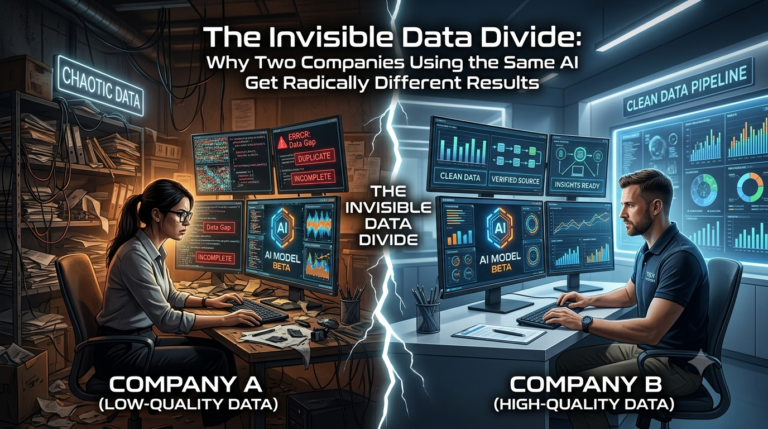
AI depends heavily on data. Without clean, structured, and consistent data, even the most advanced models fail to deliver accurate results. Unfortunately, many B2B companies operate with fragmented systems where customer data, sales records, and marketing information are stored across multiple platforms.
Even when companies use tools like Salesforce, they often fail to maintain proper data hygiene across departments. Duplicate records, outdated information, and inconsistent inputs reduce the reliability of AI outputs.
As a result, AI systems end up generating misleading insights, which further reduces trust in the technology.
Lack of Clear Business Use Cases
Another major issue is the absence of clearly defined use cases. Many organizations adopt AI because it is trending, not because they have identified a specific business problem to solve.
Successful AI implementation always begins with a focused objective—such as improving lead scoring accuracy, reducing customer churn, or automating repetitive support tasks. Without this clarity, AI becomes an experimental tool rather than a business driver.
Companies that fail in this area often spread AI across too many functions without achieving depth in any one area.
Resistance to Organizational Change
Technology adoption is not just a technical challenge—it is a human one. In many B2B companies, employees are accustomed to traditional workflows and may be skeptical of AI-driven systems.
Sales teams may ignore AI-based recommendations. Marketing teams may not trust automated insights. Operations teams may continue relying on manual processes because they feel more reliable.
This resistance creates a gap between AI capability and actual usage. Even well-designed systems fail when employees do not fully adopt them in daily workflows.
Over-Reliance on Tools Instead of Strategy
A common misconception is that buying AI software is enough to achieve transformation. Many companies invest in advanced tools without redesigning their processes.
However, AI is not a plug-and-play solution. It requires changes in how decisions are made, how workflows are structured, and how teams interact with data. Without aligning AI with business strategy, organizations end up with expensive tools that are underutilized.
True success comes when AI is embedded into core business operations, not treated as an add-on feature.
Integration Challenges with Existing Systems
Most established B2B companies already operate with multiple systems for CRM, finance, marketing, and operations. Integrating AI into this existing ecosystem is often complex.
Without proper integration, AI tools operate in isolation and fail to influence real business decisions. The real value of AI is unlocked only when it is connected to end-to-end systems and can access real-time data across departments.
This is where many companies struggle, especially those with legacy infrastructure.
Lack of Skilled Talent and Leadership Alignment
AI implementation requires both technical expertise and strong business understanding. Many companies lack professionals who can bridge this gap effectively.
Technical teams may focus on model performance, while business leaders focus on outcomes. If these two perspectives are not aligned, AI projects lose direction.
Leadership also plays a critical role. Without a clear understanding of AI capabilities and limitations, decision-makers may either overinvest or underutilize the technology.
Conclusion
The struggle to implement AI successfully in B2B companies is not caused by the technology itself but by how it is approached. Issues such as poor data quality, unclear objectives, lack of adoption, and weak integration are far more impactful than the limitations of AI tools.
Companies that succeed with AI are those that treat it as a long-term transformation rather than a quick fix. They start with clear use cases, invest in clean and structured data, align teams across departments, and integrate AI into core business processes.
Ultimately, AI is not just a tool—it is a strategic capability. Its success depends entirely on how well a business is prepared to adopt, adapt, and evolve with it.