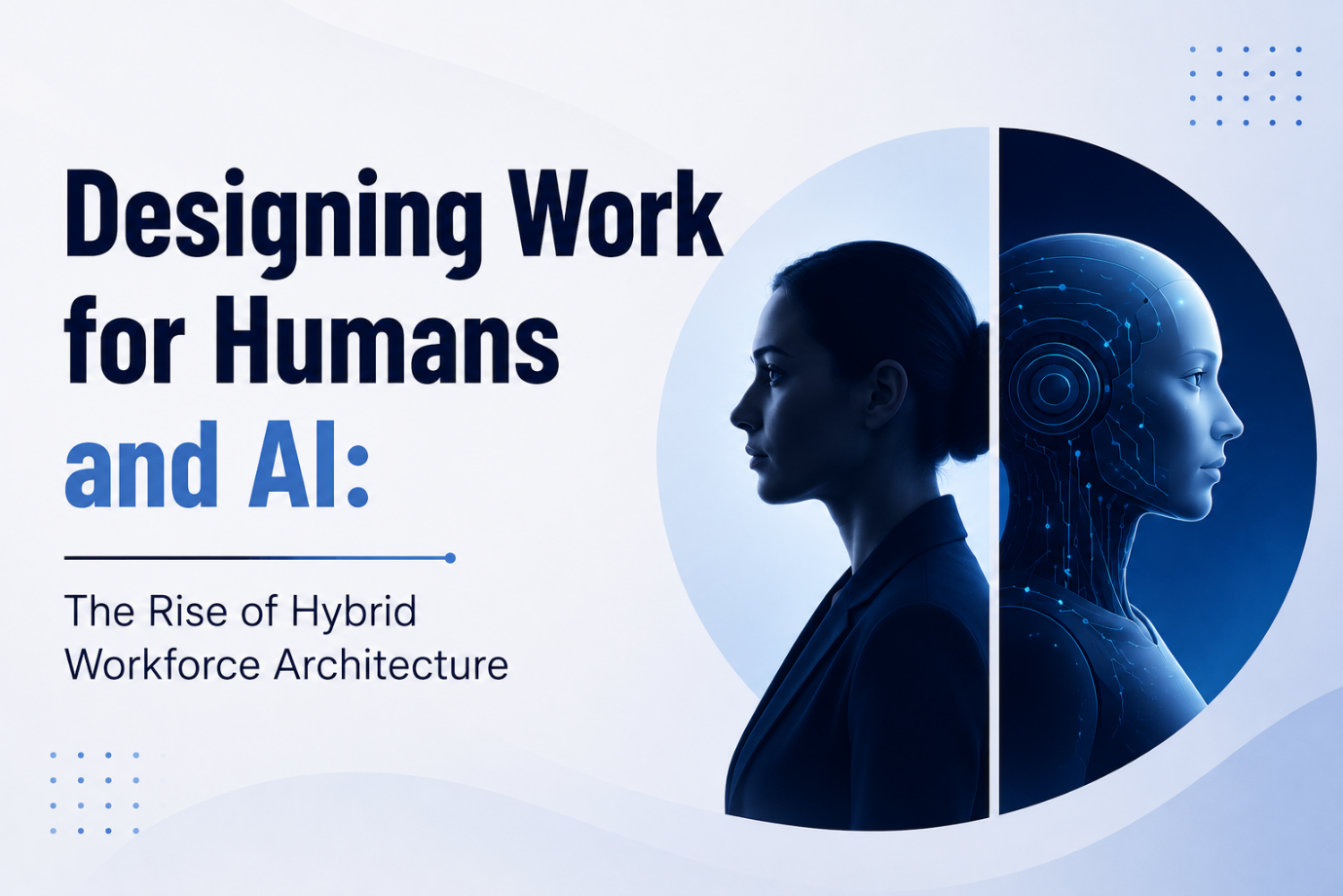
Discover how Designing Work for humans and AI is helping enterprises build hybrid workforce architectures that improve productivity, innovation, and long-term business resilience.
Introduction: Designing Work Is the New Enterprise Imperative-
Designing Work is rapidly becoming one of the most important priorities for organizations embracing artificial intelligence. For years, conversations about AI in the workplace have been framed around a simple—and often misleading—question: Will AI replace human jobs? While this narrative attracts attention, it overlooks a far more significant transformation already underway inside enterprises.
The future of work is not being built around replacement; it is being built around designing work that combines human expertise with intelligent systems. Organizations are realizing that competitive advantage comes not from removing people from processes but from creating operating models where humans and AI work together as interconnected contributors. This shift is giving rise to what can be described as hybrid workforce architecture—the deliberate practice of designing work across human capability and machine capability.
Why Designing Work Matters More Than Replacing Jobs-
Traditional workforce models were designed for environments where people performed the majority of execution, coordination, decision-making, and knowledge management tasks. Technology primarily existed to support human activity.
Today, artificial intelligence fundamentally changes this relationship. Intelligent systems can generate content, identify patterns, summarize information, automate workflows, support business decisions, predict outcomes, and increasingly operate across multiple business functions. As a result, designing work is no longer about deciding which jobs disappear but about determining which aspects of work are best performed by humans and which can be enhanced by AI.
This shift represents a fundamental change in how organizations think about productivity, capability, and value creation.
From Fixed Job Roles to Capability-Based Work-
Another major outcome of designing work is the evolution from static job descriptions to dynamic capability systems.
Historically, organizations hired employees into predefined roles with fixed responsibilities and clear reporting structures. In hybrid workforce environments, however, responsibilities become modular and distributed across both people and intelligent systems.
A single business process may now involve human creativity, AI-driven analysis, automated execution, and human governance operating simultaneously. Rather than asking whether an HR manager or marketing manager can be automated, organizations are beginning to redesign workflows by allocating responsibilities according to capabilities instead of job titles.
This capability-based approach creates greater flexibility while allowing businesses to respond more quickly to changing market conditions.
How Designing Work Is Transforming Enterprise Functions-
The impact of designing work is already visible across every major business function as organizations rethink how work is created, managed, and delivered.
Human Resources:
In Human Resources, AI is increasingly supporting candidate screening, résumé summarization, workforce analytics, and hiring pipeline management. These capabilities reduce administrative effort and enable HR professionals to dedicate more time to relationship building, talent assessment, employer branding, and strategic workforce planning.
Sales:
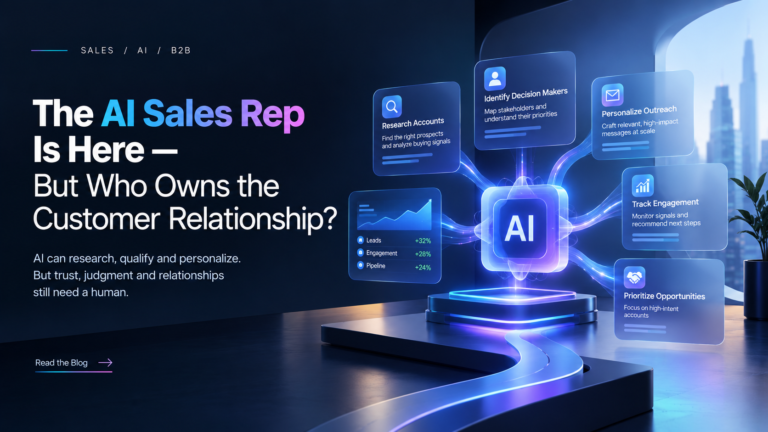
Sales organizations are also redesigning work by allowing AI to analyze customer signals, forecast deal progression, recommend next actions, and personalize communications. This enables sales professionals to spend less time on repetitive administrative work and more time building trust, understanding customer needs, and developing long-term client relationships.
Finance:
Within finance teams, AI processes large volumes of transactional data, identifies anomalies, and generates predictive insights that support faster decision-making. Finance leaders, meanwhile, continue to provide business judgment, evaluate strategic scenarios, and guide organizational investment decisions.
Across every department, designing work is shifting value creation away from repetitive execution toward interpretation, collaboration, innovation, and strategic decision-making.
Why AI Alone Doesn’t Create Transformation-
Many organizations assume that introducing AI automatically leads to higher productivity. In reality, technology alone rarely transforms an enterprise.
Without redesigning workflows, AI often increases organizational complexity rather than reducing it. Employees receive more information but less clarity. Teams adopt multiple AI tools without changing the way they collaborate, while leaders automate isolated tasks yet continue operating through outdated approval structures and organizational hierarchies.
This is why designing work should be viewed as an organizational transformation initiative rather than simply a technology implementation project. Enterprises that rethink operating models alongside AI adoption are significantly more likely to achieve meaningful business outcomes.
Role Decomposition: The Foundation of Designing Work-
At the center of hybrid workforce architecture lies the concept of role decomposition, one of the most important principles in designing work for the AI era.
Instead of treating jobs as indivisible units, organizations break work into individual activities, decisions, interactions, and deliverables. Each component is then evaluated according to whether it requires creativity, emotional intelligence, contextual judgment, compliance oversight, strategic reasoning, computational speed, or operational scale.
Tasks that benefit from consistency and automation naturally become AI-supported, while work involving ambiguity, leadership, ethics, negotiation, and relationship building continues to be led by people.
This structured approach enables organizations to redesign work deliberately instead of reacting to automation trends.
Leadership in the Age of Hybrid Workforce Architecture-
As organizations continue designing work around human and AI collaboration, leadership expectations are evolving.
Managers are no longer responsible only for supervising employees. Increasingly, they must orchestrate environments where people, AI systems, and automated workflows contribute together toward shared business objectives.
Performance management also changes. Success is measured less by individual activity and more by collective capability, customer outcomes, innovation, and business value. Leaders who understand both organizational behavior and technological capability will be better positioned to lead future-ready enterprises.
Building Skills for the AI-Powered Workplace-
The employee experience is also changing as designing work reshapes organizational priorities.
Previously, professional expertise was built through accumulating knowledge and controlling access to information. In AI-enabled workplaces, information is more accessible and execution becomes significantly faster.
Competitive advantage increasingly comes from asking better questions, exercising stronger judgment, collaborating across disciplines, interpreting AI-generated insights, and translating those insights into meaningful business action.
Consequently, learning and development strategies are shifting away from simply teaching employees how to use AI tools. Instead, organizations are investing in adaptability, systems thinking, communication, critical reasoning, and decision intelligence—capabilities that remain uniquely human.
Conclusion-
The organizations that will lead the next era of enterprise growth are unlikely to be those that automate the greatest number of jobs. Instead, they will be the organizations that excel at designing work to maximize both human potential and AI capability.
Hybrid workforce architecture is not about reducing the role of people—it is about increasing the value people create by allowing intelligent systems to complement human strengths. As AI continues to evolve, the defining question for enterprise leaders will no longer be how many employees they have, but how effectively they are designing work that enables humans and AI to succeed together.
The future workplace is not human or AI. It is human with AI, operating through a new architecture of work that is more intelligent, adaptive, and resilient than ever before.