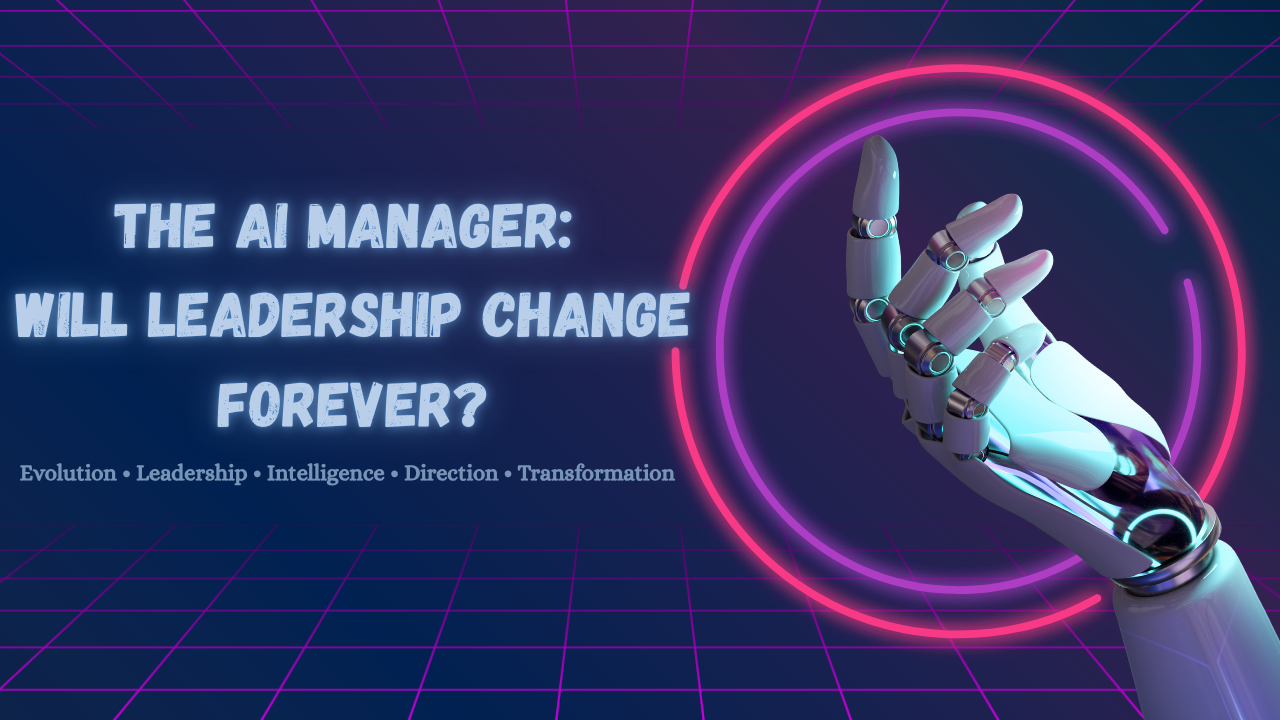
The AI Manager: Leadership Has Always Evolved, Leadership has always evolved in response to changes in the way businesses operate. Every major shift in history has redefined what organizations expect from managers and decision-makers. Industrial growth demanded operational control and hierarchy. The digital revolution pushed leaders toward speed, collaboration, and agility. Globalization required managers to coordinate across cultures, markets, and increasingly complex business structures. Today, artificial intelligence is introducing another transformation, one that may become one of the most significant leadership shifts in modern business history.
The AI Manager: The Future of Work and Modern Management
The AI Manager is becoming a defining concept in modern leadership because it integrates artificial intelligence directly into decision-making and operational workflows. As organizations scale, the AI Manager helps leaders reduce complexity and focus on higher-level strategy instead of routine administrative tasks.
The AI Manager is not just a tool but a transformation in how decisions are made in organizations. By combining predictive analytics and machine learning, the AI Manager supports leaders in making informed choices that are backed by data rather than guesswork.
Trust Will Define Successful AI-Driven Organizations-
For decades, leadership has been closely associated with experience, judgment, communication, and the ability to make informed decisions under uncertainty. Managers built influence through accumulated knowledge and their ability to guide teams toward outcomes. Their role often involved gathering information, evaluating alternatives, aligning stakeholders, solving operational challenges, and creating direction. But modern organizations now operate at a scale and speed where traditional management approaches are becoming increasingly difficult to sustain.
Businesses today generate an unprecedented amount of information. Every interaction produces data. Teams leave behind collaboration signals. Customers create behavioural insights. Projects generate performance metrics. Markets change in real time. Leaders are expected to interpret financial indicators, workforce performance, customer expectations, operational efficiency, competitive positioning, and technological change simultaneously. The challenge is no longer access to information, it is managing information overload.
Artificial intelligence is emerging as an answer to this challenge-
Unlike previous generations of business technology that primarily automated tasks, AI is increasingly supporting judgment and decision-making. Modern systems can summarize meetings, analyse productivity trends, forecast outcomes, identify operational risks, recommend resource allocation, detect engagement patterns, generate reports, and surface strategic opportunities continuously. Instead of waiting for managers to request insights, intelligent systems are becoming proactive participants in organizational workflows.
This evolution has given rise to an important idea: the AI Manager-
The phrase often creates immediate concern because it suggests replacing leaders with algorithms. In reality, the shift is more nuanced. The AI Manager is not a machine occupying a leadership position it represents a new operating model where management functions are increasingly supported, enhanced, and accelerated by intelligent systems.
Management traditionally focuses on execution, coordination, planning, monitoring, and resource optimization. Leadership extends beyond operations and includes vision, trust-building, influence, motivation, and navigating uncertainty. AI may significantly improve management efficiency, but leadership contains human dimensions that remain difficult to automate.
What AI changes most dramatically is how leaders spend their time-
Historically, managers dedicated substantial effort to collecting updates, preparing reports, monitoring execution, coordinating stakeholders, and consolidating information before making decisions. Many leadership responsibilities became administrative rather than strategic. AI reduces this burden by turning large volumes of data into actionable intelligence.
As operational complexity decreases, leadership expectations increase.
Managers are increasingly expected to think more strategically, make faster decisions, develop talent more effectively, and create environments where teams can perform sustainably.
This transition is already visible across industries.
AI-driven workforce analytics helps managers understand team capacity and engagement. Intelligent planning systems improve forecasting and resource allocation. Decision-support platforms identify trends that may otherwise remain invisible. Performance systems increasingly provide continuous feedback rather than periodic evaluation.
As a result, leaders gain something increasingly valuable: time.
The question becomes what they choose to do with it.
Some organizations may attempt to maximize efficiency further. Others may invest that capacity into stronger relationships, better coaching, innovation, and long-term thinking.
The most successful leaders of the future are unlikely to become more technical than everyone else. Instead, they may become more human.
This may sound contradictory in an AI-driven environment, but automation changes the value of uniquely human capabilities.
Traditional management structures often rewarded leaders for having answers. Seniority frequently implied expertise and certainty. AI changes this dynamic because information becomes increasingly distributed.
Future leaders may gain influence not because they know more than everyone else, but because they help organizations interpret complexity and make better decisions collectively.
This requires a different leadership mind-set.
Leaders will increasingly need to become comfortable working with recommendations instead of assumptions. They will need to challenge outputs rather than accept them automatically. They will need to understand where data ends and judgment begins.
One of the most important risks organizations face is over-dependence on AI-supported decisions.
Data can reveal patterns, but it cannot fully understand culture, emotion, politics, context, ambition, fear, or human motivation.
Employees do not follow leaders because they optimize metrics.
They follow leaders because they trust decisions.Trust becomes especially important as AI becomes more integrated into management practices. Employees may become uncomfortable if promotion decisions, performance assessments, workload distribution, or team structures appear entirely algorithm-driven.
The AI Manager: Building Future-Ready Organizations
Organizations that invest in AI leadership, workforce development, and digital transformation will be better positioned for future success. The ability to integrate technology with human capability is becoming a key competitive advantage.
If intelligent systems recommend actions, managers still own outcomes.
Ethics becomes another defining leadership capability.
Questions around fairness, transparency, inclusion, privacy, and accountability become increasingly important as organizations adopt AI-driven decision environments.
Leadership in the future may involve balancing competing priorities: efficiency versus trust, automation versus autonomy, intelligence versus intuition.
The strongest leaders will not reject AI and they will not blindly depend on it.
They will integrate it thoughtfully.
Another important implication is the changing relationship between managers and employees.
As repetitive coordination becomes automated, managers may spend more time developing capability, creating alignment, mentoring talent, and strengthening culture.
Leadership could become more personalized.
Managers may gain deeper visibility into employee development and create more adaptive experiences.
This does not mean becoming overly data-driven, it means becoming more intentional.
Looking ahead, organizations may eventually stop thinking about AI as a separate management tool and begin treating intelligence as embedded infrastructure.At that point, leadership itself may be redefined.Not because people disappear.But because the expectations placed on leaders fundamentally change.
Future leadership may become less about controlling work and more about creating systems where people and technology perform together effectively.
Conclusion-
Artificial intelligence is not likely to eliminate leadership, but it may permanently transform how leadership is practiced. Managers will increasingly rely on intelligent systems to process complexity, improve visibility, and accelerate decisions, while human leaders continue to provide direction, context, trust, and accountability. The organizations that thrive in the coming decade will not be those that automate leadership, they will be the ones that elevate leadership by removing operational friction and strengthening human capability. In a world where intelligence becomes increasingly accessible, the leaders who stand out will not be those who know the most. They will be the ones who help people move forward with clarity, confidence, and purpose.