Artificial intelligence has sparked a new debate across the technology industry: Will AI agents replace Software-as-a-Service (SaaS)? As autonomous AI systems become more capable of completing tasks independently, many believe the traditional SaaS model could become obsolete. However, the reality is more nuanced. Rather than replacing SaaS, AI agents are transforming it into a smarter, more efficient, and more valuable ecosystem for businesses.
AI Agents and SaaS Are Evolving Together –
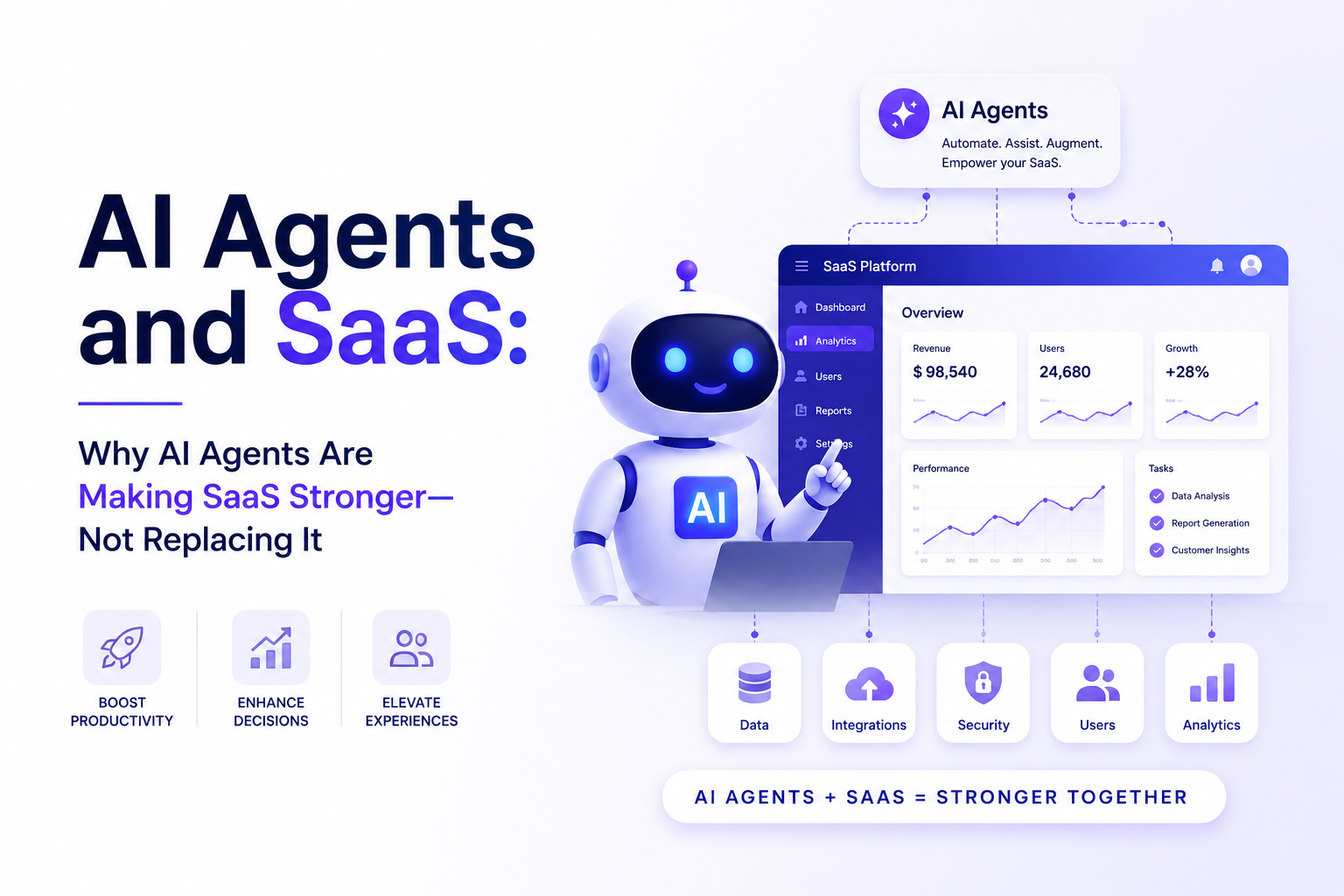
AI Agents and SaaS are becoming increasingly interconnected. AI agents rely on SaaS applications for access to enterprise data, business workflows, customer information, and operational systems. Instead of functioning as standalone platforms, AI agents act as intelligent assistants that automate complex tasks within existing SaaS environments.
Businesses still need CRM systems, ERP platforms, HR software, finance tools, and collaboration applications. AI agents simply make these systems more productive by reducing manual work and enabling faster decision-making.
Enterprise AI Is Changing Software Consumption –
Enterprise AI is shifting the way organizations interact with software. Instead of navigating multiple dashboards and interfaces, employees can now instruct AI agents to perform actions across several applications simultaneously.
For example, a sales manager could ask an AI agent to:
- Retrieve customer information from a CRM.
- Generate a personalized proposal.
- Schedule a follow-up meeting.
- Update the sales pipeline.
- Notify the finance team.
Previously, these tasks required switching between multiple SaaS platforms. AI agents now orchestrate the entire workflow while SaaS applications remain the underlying infrastructure.
AI-powered SaaS Creates More Business Value –
AI-powered SaaS is becoming the next evolution of enterprise software. Software vendors are embedding generative AI, predictive analytics, and intelligent automation directly into their platforms.
Organizations are benefiting from:
- Faster decision-making
- Personalized customer experiences
- Automated business processes
- Improved employee productivity
- Better data-driven insights
Instead of replacing software, AI significantly enhances its capabilities, allowing companies to achieve greater efficiency without changing their core systems.
SaaS Industry Trends 2026 Show Strong Growth –
SaaS Industry Trends 2026 indicate that enterprise software continues to experience healthy demand despite the rapid rise of AI.
Several trends are shaping the market:
- AI-first SaaS platforms are attracting increased investment.
- Existing SaaS providers are integrating AI copilots and autonomous agents.
- Businesses are prioritizing workflow automation over software replacement.
- Cloud-based enterprise applications remain the foundation of digital transformation.
The market is evolving from “software users” to “software supervisors,” where employees manage AI-assisted workflows rather than manually completing every task.
Agentic AI Is Redefining Productivity –
Agentic AI represents the next generation of intelligent enterprise software. Unlike traditional chatbots, agentic AI systems can plan, execute, monitor, and improve multi-step workflows with minimal human intervention.
Examples include:
- Customer service agents resolving support tickets automatically.
- HR agents managing employee onboarding.
- Finance agents preparing monthly reports.
- Marketing agents optimizing campaigns in real time.
- Procurement agents handling supplier communications.
Each of these AI agents still depends on SaaS applications to access business data and execute tasks securely.
Why SaaS Is Becoming Stronger –
AI Agents and SaaS together offer several advantages for enterprises:
- Existing SaaS investments remain valuable.
- AI increases employee productivity without replacing core software.
- Businesses can automate repetitive work while maintaining governance.
- Vendors can differentiate through intelligent features instead of basic functionality.
- Organizations gain faster access to insights through natural-language interactions.
Rather than eliminating SaaS, AI agents are increasing the return on software investments by making enterprise applications easier to use and more effective.
Challenges Businesses Should Consider –
Enterprise AI adoption also introduces new challenges:
- Data privacy and governance
- AI accuracy and hallucinations
- Regulatory compliance
- Cybersecurity risks
- Integration complexity across multiple SaaS platforms
Companies adopting AI agents should establish governance frameworks, monitor AI outputs, and ensure human oversight for critical business decisions.
What Businesses Should Expect Next –
AI-powered SaaS is expected to evolve toward autonomous business operations where AI agents coordinate multiple enterprise systems seamlessly. Organizations will increasingly evaluate software not only by its features but also by the intelligence built into it.
Software vendors that successfully combine cloud infrastructure, secure data management, and AI-driven automation are likely to lead the next phase of enterprise innovation.
Final Thoughts –
AI Agents and SaaS are not competitors—they are complementary technologies shaping the future of enterprise software. AI agents rely on SaaS platforms to access business data, automate workflows, and deliver actionable insights. As organizations continue investing in digital transformation, SaaS is evolving into a more intelligent and efficient ecosystem rather than fading away.
For businesses, the message is clear: the future belongs to AI-enhanced SaaS, where software becomes more intuitive, automation becomes more capable, and employees can focus on strategic, high-value work instead of repetitive tasks.
FAQs
No. AI agents enhance SaaS by automating workflows and improving user productivity. SaaS remains the core infrastructure that stores data and powers business operations.
AI-powered SaaS combines traditional cloud software with artificial intelligence to deliver automation, predictive insights, and natural-language interactions.
Agentic AI can independently execute multi-step business processes, helping organizations improve efficiency, reduce manual work, and accelerate decision-making.
Yes. SaaS vendors that successfully integrate AI capabilities into their platforms are well positioned to grow as enterprise demand for intelligent software continues to increase.