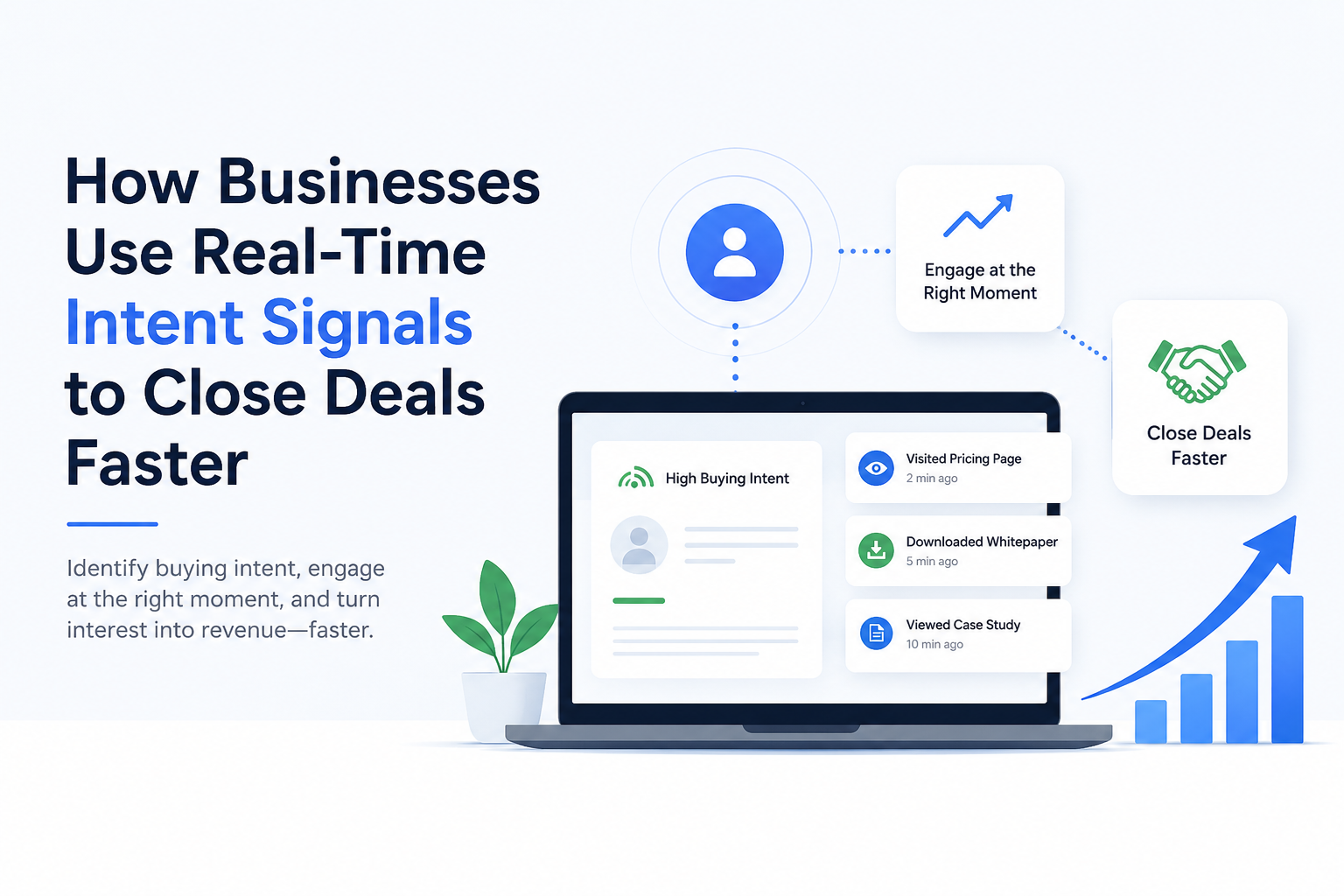
How Businesses Use Real-Time Intent Signals to Close Deals Faster
In today’s highly competitive digital marketplace, businesses can no longer rely solely on cold outreach, generic marketing campaigns, or delayed follow-ups to drive sales. Modern buyers research products, compare vendors, read reviews, and evaluate solutions long before they speak with a sales representative. This shift in buyer behavior has created a growing need for businesses to identify potential customers at the exact moment they show interest in a product or service.
This is where real-time intent signals are transforming modern sales and marketing strategies.
Real-time intent signals help businesses understand when prospects are actively researching solutions, engaging with relevant content, or demonstrating buying behavior. By identifying these signals early, organizations can engage potential customers faster, personalize communication more effectively, and significantly improve conversion rates.
As competition increases across industries, companies that successfully leverage intent data are gaining a major advantage in closing deals more quickly and efficiently.
Understanding Real-Time Intent Signals –
Intent signals are behavioral indicators that suggest a person or organization may be interested in purchasing a product or service. These signals are collected from various digital activities such as website visits, content downloads, webinar registrations, search behavior, email engagement, social media interactions, and product comparisons.
Real-time intent signals focus specifically on current or recent buying behavior. Instead of relying on outdated lead lists or static demographic data, businesses can identify prospects who are actively researching solutions at that moment.
For example, if a company repeatedly visits pricing pages, downloads technical documentation, attends a product webinar, and searches for implementation guides, these activities may indicate strong purchase intent.
Sales and marketing teams use this information to prioritize leads and engage buyers before competitors do.
Why Traditional Lead Generation Is No Longer Enough –
Traditional lead generation methods often focus on collecting large volumes of contacts without understanding whether those leads are genuinely interested in buying. As a result, sales teams spend significant time contacting unqualified prospects who may not be ready to engage.
Modern buyers also expect faster and more personalized communication. Delayed outreach or generic messaging can quickly reduce interest and push prospects toward competitors.
Real-time intent signals solve this problem by helping businesses identify high-interest prospects earlier in the buying journey. Instead of contacting every lead equally, organizations can focus their efforts on individuals or companies already demonstrating active research behavior.
This targeted approach improves efficiency while reducing wasted sales effort.
How Intent Data Improves Sales Speed –
One of the biggest advantages of intent-based selling is faster engagement. Timing plays a critical role in modern sales cycles. Businesses that reach out while a prospect is actively researching solutions are far more likely to start meaningful conversations.
When sales teams receive real-time alerts about buyer activity, they can respond immediately with relevant information, personalized demos, or targeted recommendations.
For example, if a prospect spends time reviewing cloud migration content, a technology company can quickly offer a consultation focused specifically on cloud transformation challenges. This level of contextual engagement increases the likelihood of moving the buyer further into the sales funnel.
Faster engagement often leads to shorter sales cycles because prospects receive the information they need at the right moment.
The Role of AI in Intent Signal Analysis –
Artificial Intelligence is playing a major role in helping businesses process and interpret intent data. Modern AI-powered platforms can analyze massive volumes of digital interactions and identify patterns that humans might overlook.
AI systems can evaluate:
- Website engagement behavior
- Search activity
- Content consumption patterns
- Email interaction rates
- CRM activity
- Social engagement signals
- Third-party research behavior
By combining these data points, AI platforms can predict which leads are most likely to convert and recommend the best timing for outreach.
This allows sales teams to focus on high-priority opportunities instead of manually sorting through large numbers of leads.
How Marketing Teams Use Intent Signals –
Marketing departments are increasingly using intent data to improve campaign targeting and personalization. Instead of launching broad campaigns aimed at general audiences, marketers can create highly focused content for prospects already showing interest in specific topics.
For example, if intent data reveals increased research activity around cybersecurity compliance, a company can launch targeted campaigns featuring compliance-related webinars, whitepapers, or case studies.
This strategy improves campaign relevance and increases engagement rates because the messaging aligns directly with current buyer interests.
Intent signals also help marketers optimize advertising spend by focusing budgets on audiences with stronger purchasing intent rather than broad, low-conversion traffic sources.
Sales and Marketing Alignment Through Intent Data –
One of the long-standing challenges in many organizations is the disconnect between sales and marketing teams. Marketing often focuses on generating leads, while sales teams prioritize lead quality and conversion potential.
Real-time intent signals help bridge this gap by providing both teams with shared visibility into buyer behavior.
Marketing teams can identify high-engagement prospects earlier, while sales representatives receive valuable context about what prospects are researching before initiating conversations.
This alignment improves lead qualification, enhances communication strategies, and creates a more efficient revenue generation process.
Organizations with strong sales and marketing collaboration often achieve faster deal closures and higher customer acquisition rates.
Intent Signals in B2B Sales Environments –
Intent data has become especially important in B2B sales because enterprise buying decisions are often complex and involve multiple stakeholders. Buyers typically conduct extensive research before engaging vendors directly.
Real-time intent signals allow businesses to identify organizations entering active buying cycles. Companies can monitor signals such as:
| Intent Signal | What It Indicates | Sales Opportunity |
|---|---|---|
| Multiple visits to pricing pages | Strong product evaluation interest | Schedule a product demo |
| Downloading technical documents | Researching implementation details | Offer technical consultation |
| Webinar attendance | Active solution exploration | Follow up with personalized content |
| Increased searches for industry solutions | Early buying-stage research | Start educational outreach |
| Repeated email engagement | Growing interest in offerings | Prioritize direct sales contact |
This visibility helps B2B sales teams approach buyers with more informed and relevant conversations.
Enhancing Customer Experience With Intent Data –
Customers increasingly expect personalized experiences throughout the buying journey. Generic outreach often feels disconnected from actual customer needs.
Intent data enables businesses to create more tailored interactions by understanding what prospects are actively interested in. This allows companies to deliver:
- Personalized product recommendations
- Relevant educational content
- Customized demonstrations
- Industry-specific case studies
- Timely follow-up communication
These personalized experiences improve trust and make buyers feel understood, which can significantly influence purchasing decisions.
Real-Time Intent Signals and Competitive Advantage –
Businesses that effectively leverage intent data often gain a competitive edge because they can identify opportunities before competitors recognize them.
In many industries, the first company to engage a prospect meaningfully has a higher chance of influencing the buying decision. Real-time intent monitoring allows organizations to respond faster and position themselves as proactive solution providers.
Companies that ignore intent-based strategies may continue relying on slower, less targeted sales approaches that struggle to compete in fast-moving digital markets.
As intent data platforms become more advanced and accessible, intent-driven selling is rapidly becoming a standard practice rather than a specialized strategy.
Challenges Businesses Must Consider –
Although intent signals offer significant advantages, businesses must also manage several challenges carefully.
One challenge is data accuracy. Not all buyer activity indicates immediate purchase intent. Organizations must avoid overreacting to weak or misleading signals.
Privacy and compliance are also major concerns. Businesses must ensure intent data collection practices comply with regulations such as GDPR and other data protection laws.
Another challenge is integrating intent data across multiple systems including CRM platforms, marketing automation tools, analytics systems, and sales workflows.
Without proper integration and strategy, organizations may struggle to convert intent insights into meaningful sales actions.
The Future of Intent-Driven Sales –
The future of sales and marketing will become increasingly data-driven and predictive. As AI, machine learning, and behavioral analytics continue to evolve, businesses will gain even deeper visibility into customer intent patterns.
Future intent platforms may predict purchasing decisions earlier, automate personalized engagement strategies, and provide real-time recommendations to sales representatives during customer interactions.
Organizations may also combine intent data with internal AI assistants to automate lead prioritization, outreach planning, and customer engagement workflows.
As digital competition intensifies, companies that successfully combine intent intelligence with AI-driven sales strategies will likely outperform traditional lead-generation models.
Conclusion –
Real-time intent signals are changing how businesses identify, engage, and convert potential customers. Instead of relying on outdated lead-generation methods, organizations can now focus on prospects actively researching solutions and demonstrating genuine buying behavior.
By using intent data effectively, businesses can improve sales speed, personalize customer engagement, optimize marketing campaigns, and align sales and marketing operations more efficiently.
As AI and behavioral analytics continue to advance, intent-driven selling will become an essential part of modern business strategy. Companies that adopt these technologies early will likely gain stronger customer relationships, faster deal cycles, and a significant competitive advantage in increasingly competitive markets.