“Artificial intelligence is transforming how enterprise buyers discover, evaluate, and trust businesses. As AI-powered search becomes the primary gateway to information, corporate websites are evolving beyond marketing into centralized knowledge platforms. Organizations that structure and manage their knowledge effectively will gain greater visibility, credibility, and competitive advantage in the AI-driven digital landscape.“
Introduction –
Enterprise Knowledge Platform is redefining how enterprises build their digital presence. For more than two decades, corporate websites served as the primary destination for marketing, lead generation, and customer engagement. Businesses invested heavily in SEO, website design, and conversion optimization because attracting visitors directly influenced revenue growth.
That approach worked well when buyers relied on search engines to compare vendors and browse multiple websites before making purchasing decisions. Today, however, AI-powered search is changing that behavior. Buyers increasingly expect immediate, contextual answers instead of navigating through dozens of web pages.
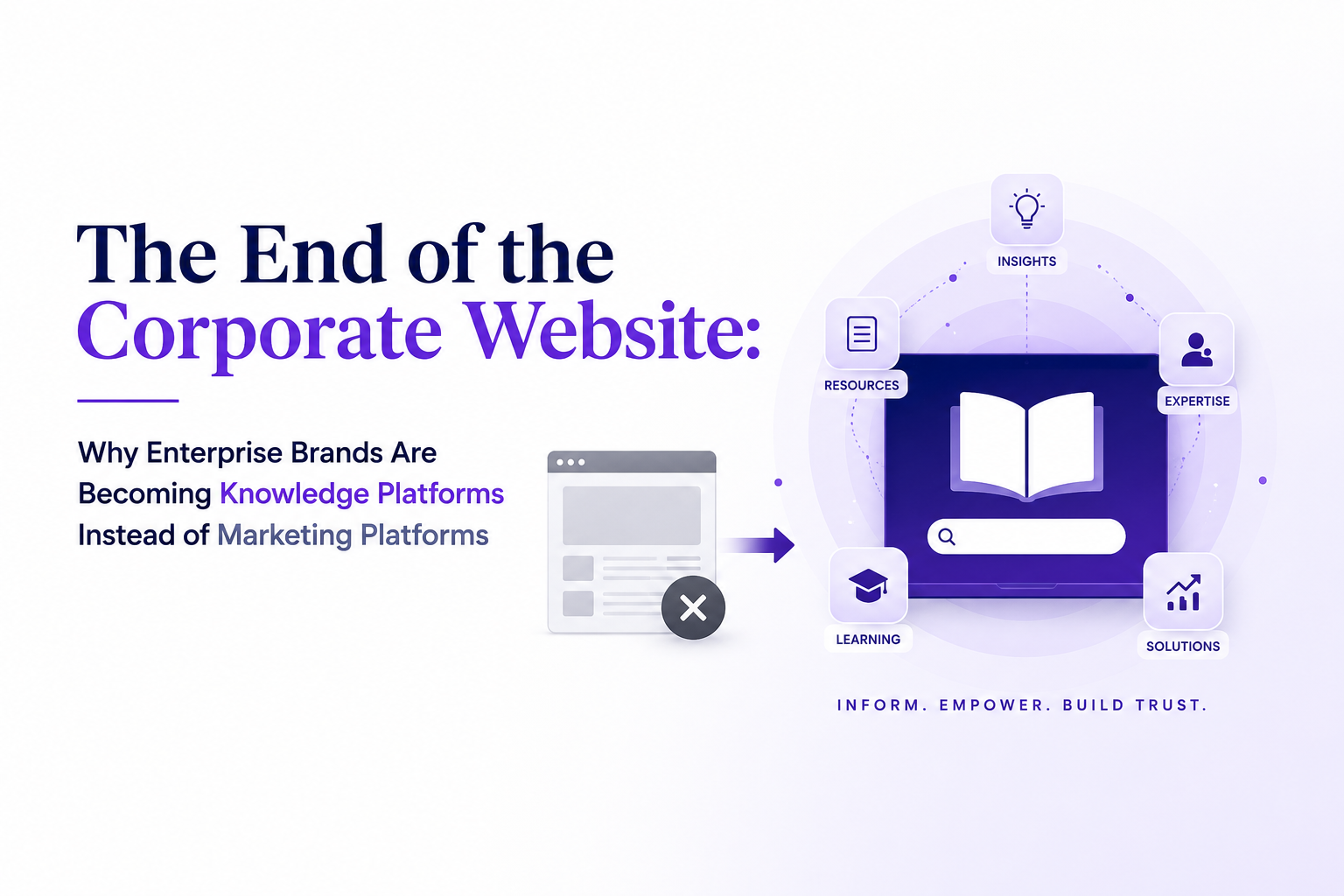
As organizations adopt generative AI and intelligent search assistants, the role of the corporate website is expanding beyond marketing. It is becoming a centralized knowledge platform that delivers accurate information to customers, employees, partners, and AI systems alike.
Why This Shift Matters –
Several technology trends are accelerating this transformation:
- AI assistants now answer complex business questions without requiring users to visit multiple websites.
- Enterprise buyers expect faster, more personalized access to information.
- Search engines increasingly prioritize structured and authoritative content.
- Organizations need a single source of truth that serves both humans and AI systems.
- Knowledge has become a strategic asset that extends beyond traditional marketing.
These changes require enterprises to rethink what their websites are designed to achieve. Instead of focusing only on attracting visitors, businesses must ensure their expertise is organized, connected, and easily discoverable across every digital channel.
The companies that invest in knowledge-first strategies today will be better positioned to compete in an AI-driven future. Their information will be easier to discover, more trusted by intelligent systems, and more valuable to customers throughout the buying journey.
Why the Traditional Corporate Website Is Losing Relevance –
For years, the corporate website was considered the center of every digital strategy. Marketing campaigns, product launches, investor updates, customer resources, and lead generation activities all directed users to a single destination.
This model depended on one assumption: people would visit your website before making a business decision.
That assumption is becoming less reliable.
Modern buyers often begin their research with AI assistants instead of search engines. Rather than clicking through multiple websites, they ask conversational questions and receive summarized answers within seconds. AI systems analyze information from trusted sources, compare alternatives, and present recommendations without requiring users to explore each vendor individually.
Corporate Website vs. Enterprise Knowledge Platform –
| Corporate Website | Enterprise Knowledge Platform |
|---|---|
| Marketing-focused | Knowledge-focused |
| Drives website traffic | Powers AI and search discovery |
| Campaign-based content | Structured, reusable knowledge |
| Visitor-centric | Customer, employee & AI-centric |
| Measures clicks and conversions | Measures trust, visibility & accessibility |
Key Takeaway: In the AI era, organizations will compete on the quality of their knowledge—not just the quality of their websites.
How Buyer Behavior Has Changed –
- Ask AI tools for product comparisons.
- Request implementation recommendations.
- Evaluate security and compliance capabilities.
- Compare pricing models and integration options.
- Research industry-specific use cases before contacting sales.
As a result, many purchasing decisions begin long before a prospect visits a corporate website. The website still plays an important role, but it is no longer the first point of interaction.
This shift means enterprises must optimize for knowledge discovery, not just website traffic. Every product page, implementation guide, technical article, API reference, and customer success story should contribute to a connected knowledge ecosystem that AI systems can understand and recommend.
Why the Traditional Corporate Website Is Losing Relevance –
For years, the corporate website was the center of every enterprise’s digital strategy. It was designed to attract visitors, showcase products, generate leads, and communicate the brand’s value proposition. Every marketing campaign, product launch, webinar, and press release ultimately directed users back to the company’s website.
This approach was effective because buyers actively searched for information by visiting multiple websites. A well-designed website with strong SEO could significantly influence purchasing decisions.
Today, that behavior is changing.
Enterprise buyers are no longer dependent on websites to gather information. Instead, they rely on AI-powered search engines, intelligent assistants, and enterprise copilots that provide direct, contextual answers within seconds. The buying journey is becoming faster, more conversational, and increasingly driven by AI.
The AI-Driven Buying Journey –
Modern B2B buyers expect immediate access to accurate information. Rather than browsing dozens of web pages, they ask AI assistants detailed business questions and receive personalized recommendations.
A typical buyer may ask:
- Which ERP solution integrates best with SAP?
- What CRM platform is best for manufacturing companies?
- Which cybersecurity solution supports ISO 27001 compliance?
- How long does cloud migration typically take?
- Which vendor offers the fastest implementation?
Instead of displaying ten blue links, AI platforms summarize information from multiple trusted sources and deliver concise answers. This significantly reduces the need to visit individual corporate websites during the early stages of research.
Key Takeaways –
The traditional corporate website is not disappearing.
Its role is simply evolving.
Rather than serving only as a marketing destination, it is becoming the publishing layer for enterprise knowledge. Every page should contribute to a connected ecosystem that supports search engines, AI assistants, customer portals, sales teams, and business partners.
Organizations that recognize this shift early will improve not only their online visibility but also customer trust, operational efficiency, and long-term competitiveness.
Conclusion –
The decline of the traditional corporate website does not mean its importance is fading. Instead, its purpose is expanding. As AI transforms how information is discovered, enterprises must move beyond creating isolated marketing pages and begin building structured knowledge ecosystems.
The organizations that succeed in the coming years will be those that treat knowledge as a strategic business asset. By organizing expertise into an Enterprise Knowledge Platform, businesses can improve AI visibility, deliver consistent customer experiences, empower employees, and remain competitive in an increasingly intelligent digital landscape.
Frequently Asked Questions (FAQs)
An Enterprise Knowledge Platform is a centralized system that organizes and manages an organization’s knowledge, including product information, technical documentation, customer resources, compliance content, and best practices. It enables both people and AI systems to access consistent and reliable information.
AI-powered search and intelligent assistants are changing how buyers discover information. Instead of browsing multiple websites, users expect direct answers. A knowledge platform ensures enterprise information is structured, accurate, and easily discoverable by AI.
AI search reduces dependence on traditional website visits by delivering summarized answers from trusted sources. This means organizations must optimize their knowledge—not just their webpages—to remain visible in AI-driven search experiences.
A marketing website focuses on campaigns, promotions, and lead generation. An Enterprise Knowledge Platform serves as a long-term repository of structured organizational knowledge that supports customers, employees, partners, and AI systems across multiple channels.