The Internet’s Hidden Backbone Is More Fragile Than It Looks
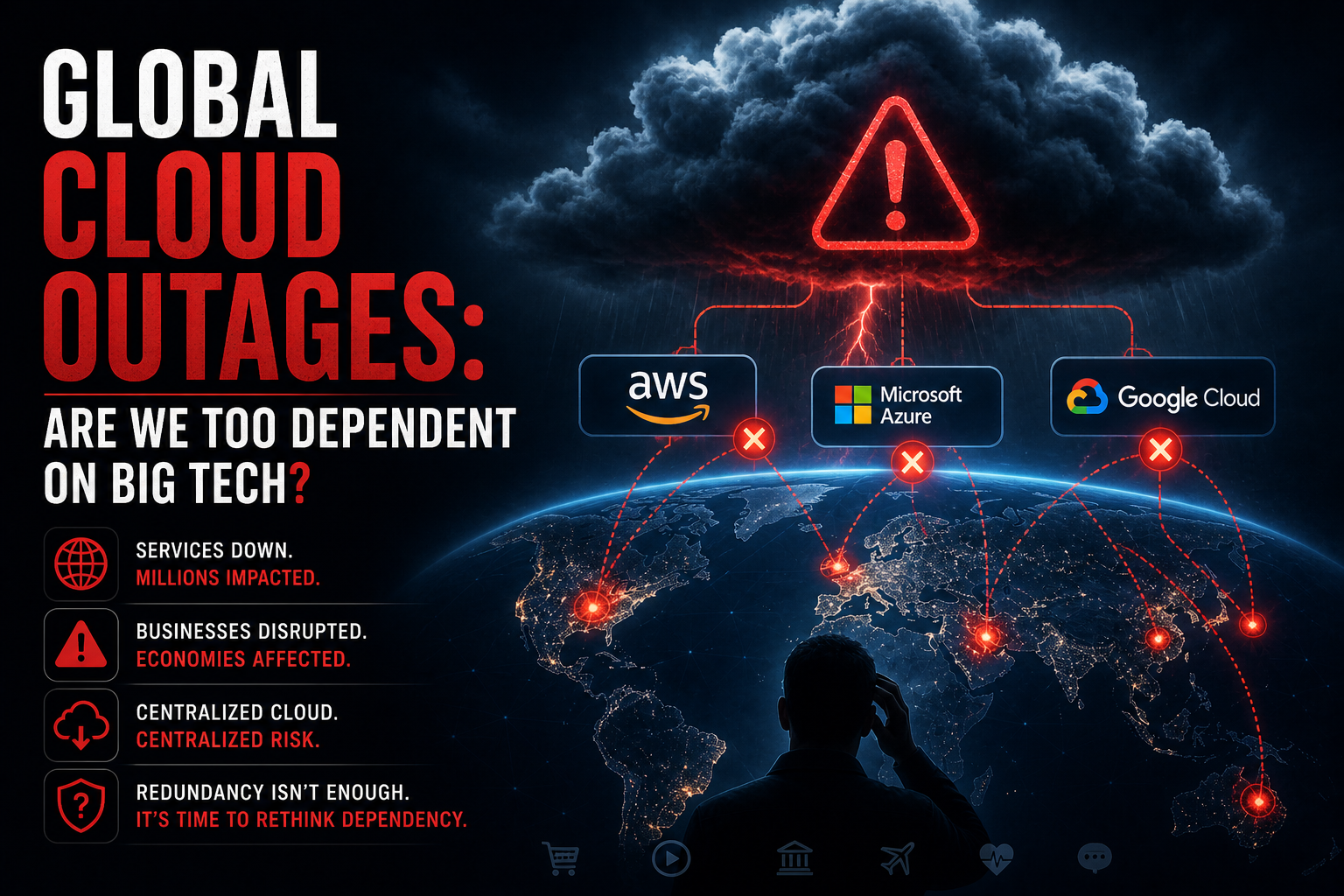
Modern digital life runs on cloud infrastructure that powers everything from banking apps to social media platforms and streaming services. Most of this backbone is controlled by a small group of tech giants, including Amazon Web Services, Microsoft Azure, and Google Cloud. These platforms handle massive global workloads that billions of users depend on daily. However, recent large-scale disruptions have shown that even a small technical failure can ripple across the internet. In 2025 alone, multiple outages affected global services for hours and sometimes days. One major AWS disruption alone impacted millions of users and thousands of companies worldwide. Such incidents reveal a critical truth: the modern internet is deeply centralized. When one provider fails, entire digital ecosystems can stall. This raises serious concerns about over-dependence on a few cloud providers.
- Internet depends heavily on a few cloud giants
- AWS, Azure, and Google Cloud dominate infrastructure
- Outages can impact millions globally
Recent Outages Exposed a Global Weakness
The scale of recent cloud failures has made the issue impossible to ignore. In October 2025, a major AWS outage disrupted services like streaming platforms, financial apps, and communication tools worldwide. Similar incidents affected Microsoft Azure just days later, impacting services such as Microsoft 365 and Xbox. These outages were caused by issues like DNS failures and configuration errors—small technical problems with massive consequences. Reports show that cloud outages in 2025 alone affected millions of users and caused billions in economic disruption. The problem is not limited to one company but reflects systemic fragility in cloud architecture. Even highly advanced systems are vulnerable to human error and network failures. These events highlight how deeply modern economies rely on uninterrupted cloud services.
- Multiple global outages occurred in 2025
- AWS and Azure both experienced major failures
- Causes included DNS and configuration errors
- Millions of users were affected globally
Why Cloud Dependency Has Become a Risk
Businesses adopted cloud computing for scalability, cost efficiency, and speed. But over time, this convenience has created heavy dependency on centralized systems. Many organizations now build critical infrastructure entirely on a single cloud provider. This means a failure in one region or service can disrupt entire business operations. Experts warn that modern cloud systems are not just services—they are critical infrastructure. Even short downtime can affect industries like healthcare, banking, and transportation. A single outage can halt payments, delay logistics, and disrupt communication tools. This level of dependency creates a “single point of failure” risk at a global scale. While cloud providers invest heavily in redundancy, no system is fully immune to outages. The trade-off between efficiency and resilience is becoming increasingly visible.
- Heavy reliance on single providers creates risk
- Cloud systems are now critical infrastructure
- Outages can disrupt essential services
The Industry Response: Building Resilience
In response to repeated outages, companies are now focusing on improving resilience strategies. One major trend is multi-cloud adoption, where businesses distribute workloads across multiple providers. Another approach is hybrid infrastructure, combining cloud services with on-premise systems. Cloud providers are also investing in better redundancy, automation, and failover systems. For example, companies like Microsoft and others are improving global load balancing and regional isolation to reduce cascading failures. Organizations are also developing better monitoring tools to detect failures early. Despite these improvements, complexity remains a major challenge. More interconnected systems can sometimes increase the risk of cascading failures. The goal is no longer zero downtime, but faster recovery and minimized impact.
- Shift toward multi-cloud strategies
- Hybrid infrastructure is gaining popularity
- Improved redundancy and failover systems
- Better monitoring and automation tools
Are We Too Dependent on Big Tech?
The growing frequency of cloud outages raises an important question: has global digital infrastructure become too dependent on a few tech giants? On one hand, these companies provide unmatched scalability, innovation, and reliability at scale. On the other hand, centralization creates systemic risk where one failure can affect millions of users. Countries and enterprises are now reconsidering digital sovereignty and infrastructure independence. Some argue for decentralization, while others believe improving resilience within existing systems is more realistic. The truth likely lies somewhere in between. Complete independence from big tech is not practical in today’s digital economy. However, reducing dependency and increasing redundancy is essential. The future will likely involve a balanced approach combining multiple providers, local infrastructure, and stronger global standards.
Conclusion
Global cloud outages have revealed a hidden vulnerability in the modern internet: extreme dependence on a small number of powerful providers. While cloud computing has enabled massive innovation and efficiency, it has also created a tightly connected system where failures can cascade globally. The challenge ahead is not to abandon cloud technology, but to make it more resilient, distributed, and fault-tolerant. As digital systems become even more essential to everyday life, ensuring stability will be just as important as innovation. The question is no longer whether we rely on big tech—but how safely we can continue to do so.