
Introduction
Artificial Intelligence has become more than just a technological advancement—it is now a strategic priority shaping global power. Countries are investing billions into AI research, infrastructure, and talent to secure leadership in what many consider the most important technological race of the 21st century.
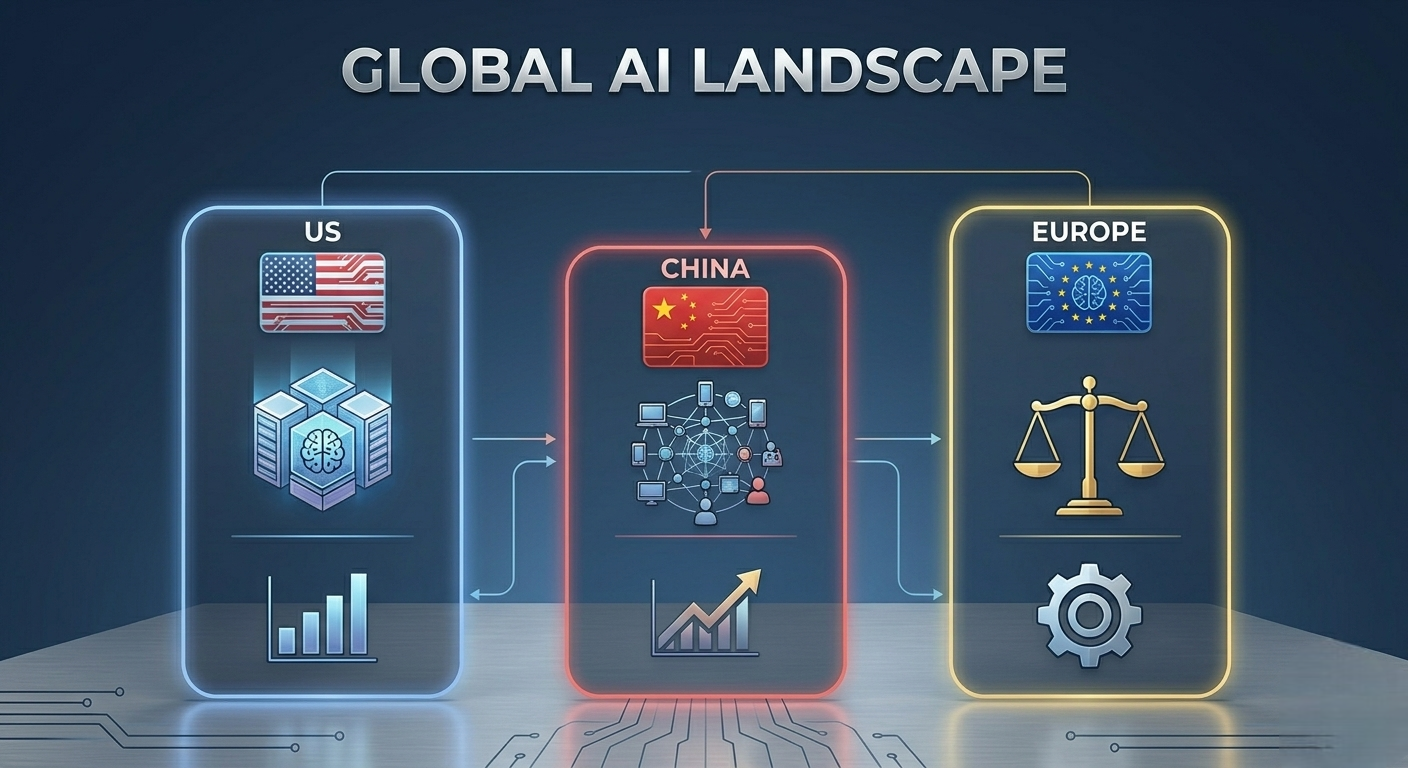
At the center of this competition are three major players: the United States, China, and Europe. Each region brings unique strengths, strategies, and challenges to the table. Their competition is not only about innovation but also about economic dominance, national security, and global influence.
Why the AI Race Matters
The global AI race is not just about building smarter machines—it is about controlling the future of industries, economies, and geopolitical power. AI has the potential to transform sectors such as healthcare, finance, defense, manufacturing, and transportation.
Countries leading in AI will likely gain advantages in:
- Economic growth and productivity
- Military and defense capabilities
- Technological innovation
- Global influence and policymaking
As a result, governments and private organizations are aggressively investing in AI to stay ahead.
The United States: Innovation and Private Sector Leadership
The United States remains a dominant force in AI, largely due to its strong ecosystem of technology companies, startups, and research institutions. Major tech firms continue to lead in developing advanced AI models, cloud infrastructure, and enterprise solutions.
One of the biggest strengths of the US is its innovation-driven private sector. Companies invest heavily in research and development, pushing the boundaries of what AI can achieve. Additionally, access to top global talent and venture capital has accelerated the growth of AI startups.
However, the US also faces challenges, including increasing regulatory pressure and competition for skilled professionals.
China: Scale, Speed, and Government Support
China has rapidly emerged as a global AI powerhouse. Its approach is driven by strong government support, large-scale data availability, and a focus on rapid implementation.
The Chinese government has made AI a national priority, investing heavily in research, infrastructure, and education. This centralized strategy allows China to move quickly and deploy AI solutions at scale across industries.
Key strengths of China include:
- Massive datasets from a large population
- Strong government backing and funding
- Rapid adoption of AI in industries
- Integration of AI into smart cities and public services
Despite its progress, China faces challenges related to global trust, data privacy concerns, and international collaboration.
Europe: Ethical AI and Regulatory Leadership
Europe takes a different approach to AI, focusing on ethics, regulation, and responsible innovation. Rather than competing purely on speed or scale, European nations aim to build trustworthy and transparent AI systems.
The region has introduced strict regulations to ensure AI is developed and used responsibly. This includes frameworks for data protection, fairness, and accountability.
Europe’s strengths include:
- Leadership in AI governance and regulation
- Strong academic research institutions
- Focus on ethical and human-centric AI
- Collaboration across countries
However, Europe sometimes struggles to match the pace of innovation and investment seen in the US and China.
Key Areas of Competition
The global AI race is being fought across multiple dimensions, each critical to long-term dominance.
1. AI Research and Innovation
Breakthroughs in machine learning, natural language processing, and robotics are key to leadership.
2. Data and Infrastructure
Access to high-quality data and powerful computing infrastructure is essential for training advanced models.
3. Talent Acquisition
Skilled AI researchers and engineers are in high demand, making talent a major competitive factor.
4. Semiconductor and AI Chips
Control over chip manufacturing and AI hardware plays a crucial role in performance and scalability.
5. Regulation and Standards
Setting global AI standards can influence how technology is adopted worldwide.
Collaboration vs Competition
While the AI race is highly competitive, there is also a growing need for collaboration. Global challenges such as climate change, healthcare, and cybersecurity require cooperative AI efforts.
At the same time, geopolitical tensions can limit collaboration, leading to fragmented ecosystems where countries develop their own AI standards and technologies.
This balance between competition and cooperation will shape the future of AI development.
Impact on Businesses and IT Industry
The global AI race is not just a government-level issue—it directly affects businesses and the IT industry.
Organizations must adapt to:
- Rapid technological changes driven by global competition
- Different regulatory environments across regions
- Increased demand for AI-driven solutions
- Opportunities for innovation and global expansion
Companies that understand these dynamics can position themselves more effectively in the global market.
The Future of the Global AI Race
Looking ahead, the competition between the US, China, and Europe is expected to intensify. Each region will continue to invest heavily in AI to strengthen its position.
Future developments may include:
- More advanced autonomous systems
- Expansion of AI into new industries
- Increased regulation and governance frameworks
- Greater focus on AI ethics and transparency
- Continued competition for talent and resources
The outcome of this race will likely shape the global economy and technological landscape for decades to come.
Conclusion
The global AI race between the United States, China, and Europe is a defining feature of the modern technological era. Each region brings unique strengths—innovation, scale, and ethics—creating a dynamic and competitive environment.
While the race presents challenges, it also drives rapid progress and innovation. For businesses, IT professionals, and policymakers, understanding this competition is essential to navigating the future of technology.
As AI continues to evolve, the balance of power may shift, but one thing is certain: the race for AI dominance is far from over, and its impact will be felt across every aspect of society.