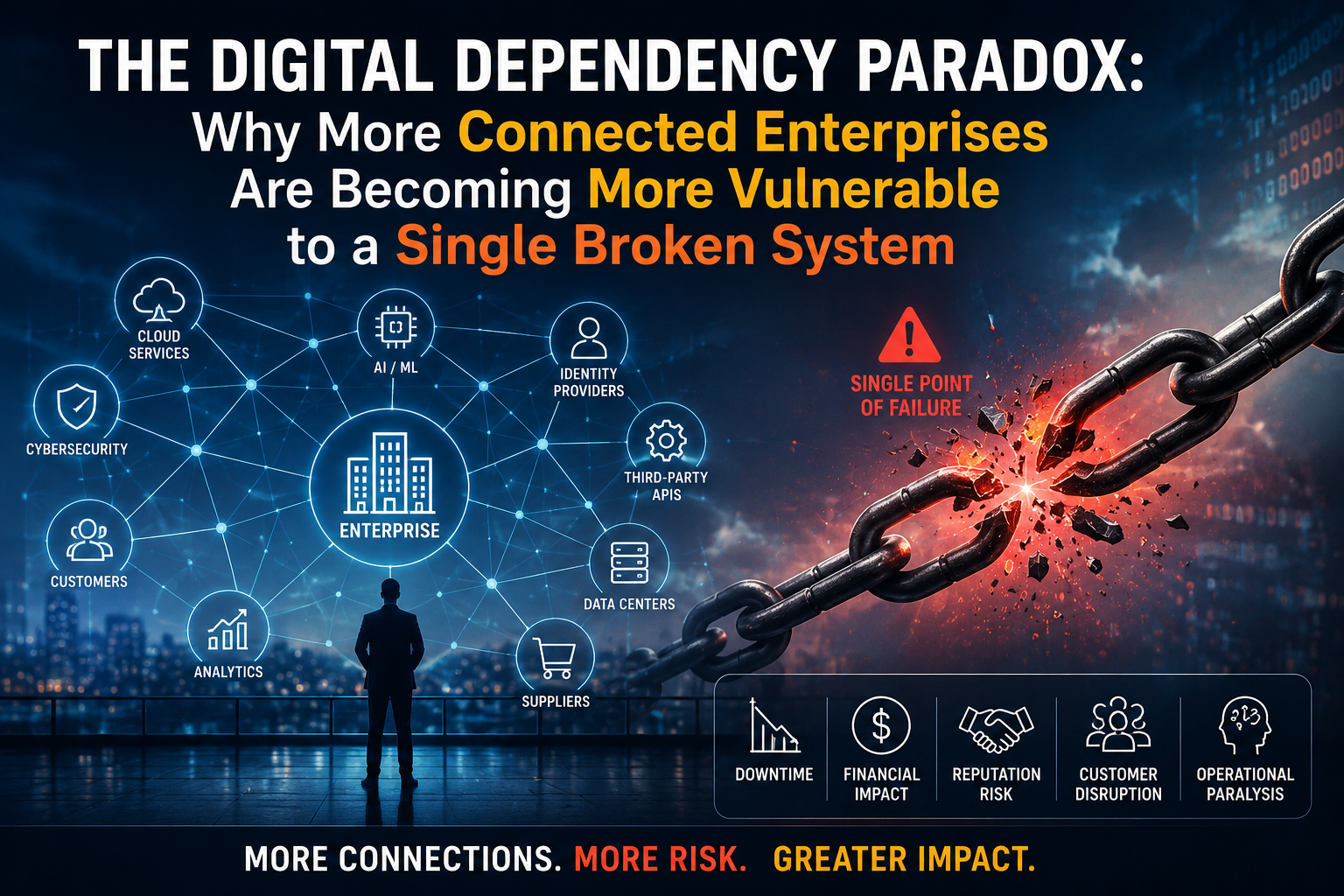
The Digital Dependency Paradox is becoming an increasingly important challenge for modern enterprises. Enterprise technology has spent the last two decades moving toward greater connectivity. Businesses have connected CRM platforms with marketing automation, ERP systems with finance and procurement, HR platforms with payroll and workforce analytics, cloud applications with identity systems, and customer platforms with operational infrastructure. APIs, integration platforms, cloud computing, data pipelines, and automation have created an enterprise environment where information can move almost instantly between systems that once operated independently. This interconnectedness has delivered enormous benefits: faster processes, fewer manual tasks, better visibility, improved customer experiences, and the ability to coordinate complex operations at unprecedented speed.
Yet beneath this progress is an increasingly important paradox. The more connected an organization becomes, the more dependent its operations become on the continued availability and reliability of the systems connecting everything together. A single identity provider failure can prevent employees from accessing dozens of applications. A cloud outage can disrupt multiple business functions simultaneously. A broken API can stop automated workflows across departments. A compromised integration can propagate errors throughout an entire technology ecosystem. Enterprises are therefore entering what can be described as the Digital Dependency Paradox, where technological connectivity creates extraordinary efficiency while simultaneously creating new forms of systemic vulnerability.
Understanding the Digital Dependency Paradox
The traditional enterprise technology model was relatively fragmented. If one application stopped working, other departments could often continue operating because systems were isolated. Finance could use its financial platform while marketing continued working in its campaign tools and operations maintained separate systems for managing production. This fragmentation created inefficiency, but it also created a degree of operational independence.
Modern digital transformation intentionally eliminates that independence. Businesses connect systems because disconnected information creates delays and duplicated work. Yet every integration creates a dependency. When dozens or hundreds of systems become connected, failures can travel across organizational boundaries with unprecedented speed. The enterprise becomes more efficient during normal conditions but potentially more fragile during abnormal conditions. This growing exposure is at the heart of the Digital Dependency Paradox, where greater integration can increase both efficiency and operational fragility.
This creates a fundamental challenge for CIOs and technology leaders: connectivity is no longer simply an architecture decision; it is a resilience decision. Every new integration changes the organization’s dependency map. Connecting a CRM to an ERP may improve customer order visibility, but it also creates a dependency between revenue operations and financial infrastructure. Integrating HR systems with identity management improves employee access control, but a failure in that identity layer can prevent thousands of employees from accessing critical applications. Connecting AI agents to enterprise workflows can dramatically increase automation, but it also means that an error generated by one intelligent system could trigger actions across multiple downstream platforms. Digital efficiency and operational resilience can no longer be evaluated separately.
The Digital Dependency Paradox and AI Enterprise Risk
The Digital Dependency Paradox becomes even more significant as AI agents gain the ability to interact with multiple enterprise systems. Artificial intelligence is accelerating this paradox because AI agents are designed to operate across multiple systems rather than within isolated applications. An autonomous procurement agent may retrieve information from inventory systems, evaluate suppliers through external platforms, access financial records, generate purchase orders, and communicate with logistics software.
A customer service agent may connect CRM data with billing, product information, support documentation, and fulfilment systems. Each additional connection expands the agent’s capabilities but also expands the potential impact of failure. An error is no longer confined to one application. It can propagate through the network and create consequences across multiple business processes before humans recognize what is happening.
Digital Dependency Paradox and Enterprise Cybersecurity
The traditional approach to cybersecurity is also being challenged by this environment. Security teams historically protected individual applications, endpoints, networks, and databases. In highly interconnected enterprises, however, the relationships between systems become equally important. A secure application connected to an insecure third-party service can become an entry point into the broader organization. A compromised API credential may provide access to multiple downstream systems. An over privileged AI agent may unintentionally expose sensitive information across departmental boundaries.
Security therefore increasingly requires understanding not just where data exists but how systems interact with one another. The enterprise dependency graph becomes part of the security perimeter. This is another dimension of the Digital Dependency Paradox: connectivity can expand an organization’s capabilities while also expanding its attack surface.
This is particularly important for identity infrastructure. Modern enterprises increasingly depend on centralized identity providers to authenticate employees across dozens or hundreds of cloud applications. Centralized identity improves security and user experience by reducing password complexity and simplifying access management. Yet it also creates concentration risk. If the identity layer becomes unavailable, employees may suddenly lose access to nearly every business application simultaneously. A system designed to simplify enterprise access can therefore become one of the most critical points of operational dependency. The same pattern appears across cloud infrastructure, networking, payment systems, communication platforms, and integration services.
Managing Digital Dependency and Vendor Risk
The Digital Dependency Paradox also changes how organizations should think about vendor management. Companies increasingly rely on external technology providers for infrastructure, cybersecurity, analytics, communication, payment processing, AI capabilities, and business applications. Traditional vendor evaluation often emphasizes functionality, pricing, security certifications, and service-level agreements. In a highly interconnected environment, organizations must also evaluate dependency concentration.
How many business processes rely on this provider? How many systems would be affected by an outage? Can operations continue manually if the service becomes unavailable? How quickly can the organization switch to an alternative? What happens if the vendor itself depends upon another provider that experiences disruption? Vendor risk increasingly becomes ecosystem risk. Vendor concentration therefore represents a critical component of the Digital Dependency Paradox, particularly when multiple business processes depend on the same provider.
Digital Dependency Paradox and IT Resilience
Business continuity planning must evolve accordingly. Traditional disaster recovery strategies often focused on restoring individual applications or infrastructure components after an outage. Modern enterprises require scenario-based resilience planning that considers cascading failures. Technology teams need to understand what happens when an identity service fails, when a cloud region becomes unavailable, when an API begins returning incorrect data, when an AI agent makes repeated erroneous decisions, or when a critical third-party provider experiences a prolonged disruption. Recovery is no longer simply about bringing systems back online. It is about preventing one failure from becoming an organizational chain reaction. Addressing the Digital Dependency Paradox requires organizations to prepare for cascading failures rather than treating every technology outage as an isolated incident.
Observability for the Digital Dependency Paradox
Observability becomes increasingly important in this environment. Organizations need visibility into not only individual system performance but also the relationships connecting systems together. A business process may appear healthy while one underlying dependency is gradually deteriorating. By the time the failure becomes visible to employees or customers, multiple downstream systems may already be affected. Advanced observability platforms can map dependencies, monitor data flows, identify unusual patterns, and detect potential cascading failures before they become business-critical incidents. The objective shifts from monitoring applications to understanding the health of the entire digital ecosystem.
From Maximum Connectivity to Intentional Connectivity
The Digital Dependency Paradox challenges the assumption that maximum connectivity always represents maximum digital maturity. The paradox also affects enterprise architecture philosophy. For years, integration was treated as an unquestioned objective of digital transformation. The more connected systems became, the more digitally mature an organization was considered. Future architecture decisions will likely become more nuanced. Not every system needs to be connected to every other system. Strategic isolation can sometimes improve resilience.
Critical business functions may require independent infrastructure, alternative communication channels, redundant authentication methods, or manual fall-back processes. The goal is no longer maximum connectivity. It is intentional connectivity, connecting systems where integration creates meaningful value while preserving independence where failure concentration creates unacceptable risk.
This does not mean organizations should reverse digital transformation. Connectivity remains one of the most powerful drivers of enterprise productivity. The challenge is learning to manage the risks created by that connectivity. Businesses need dependency maps, resilience testing, architectural redundancy, clear ownership of integrations, automated rollback mechanisms, strong access controls, and predefined human intervention processes. Most importantly, leadership must understand that digital infrastructure is no longer a collection of separate technology assets. It is a living ecosystem in which changes to one component can influence the performance of the entire organization.
AI and Machine-Speed Cascading Errors
AI will make this ecosystem even more dynamic. Intelligent systems can create new integrations, modify workflows, make decisions, and respond to changing conditions without direct human intervention. This creates enormous opportunities for operational efficiency but introduces a new category of risk: machine-speed cascading errors. A human employee may make one incorrect decision during a workday. An autonomous system can repeat the same incorrect decision hundreds of times before detection. Organizations deploying AI therefore need containment mechanisms that prevent errors from spreading across connected systems. Autonomy without boundaries can transform efficiency into systemic exposure.
Ultimately, the Digital Dependency Paradox represents the next challenge of enterprise digital transformation. Businesses have spent years making their technology environments faster, smarter, and more interconnected. The next phase requires making those environments resilient enough to remain functional when individual components inevitably fail. The most digitally mature enterprise of the future will not be the one with the most connected systems. It will be the one that knows exactly which connections it cannot afford to lose, and has already designed what happens when they fail.