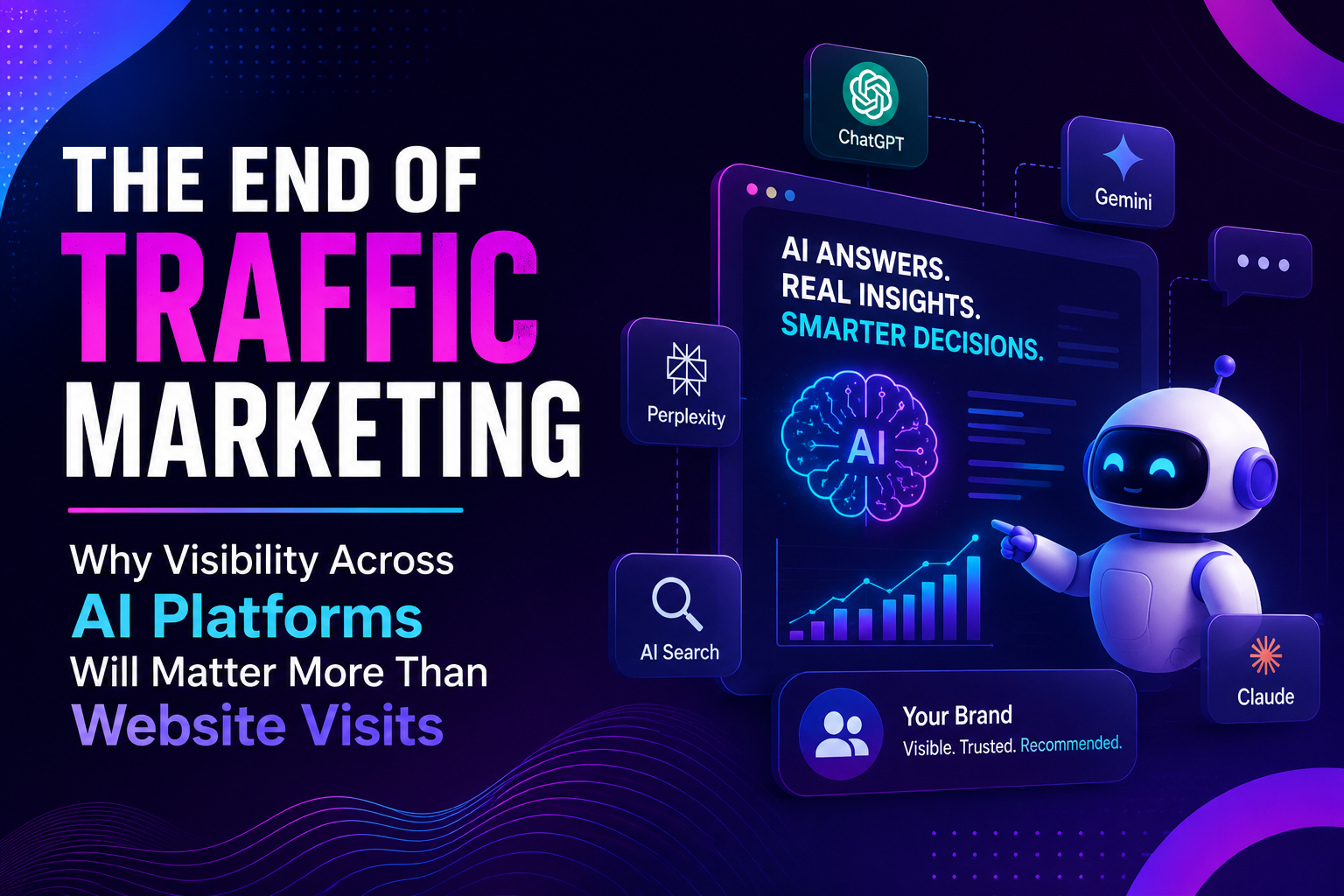
AI Visibility is becoming the new measure of digital marketing success. For years, businesses focused on increasing website traffic, but AI-powered search and conversational assistants are changing how buyers discover brands. Today, being cited and recommended by AI platforms can influence purchasing decisions long before a prospect visits your website.
For nearly three decades, digital marketing has revolved around one universal metric, website traffic. Marketing teams celebrated increasing visitor counts, optimized every webpage for search engine rankings, invested heavily in paid advertising, and measured success by clicks, sessions, impressions, and conversions. The underlying assumption was simple: the more people who visited a company’s website, the greater the opportunity to generate leads and revenue. Entire industries emerged around this philosophy, giving rise to search engine optimization (SEO), performance marketing, content marketing, landing page optimization, and sophisticated analytics platforms.
Today’s enterprise buyers no longer rely exclusively on traditional search engines to answer business questions. Executives, procurement professionals, IT leaders, HR managers, and marketing decision-makers increasingly interact with AI-powered assistants capable of providing direct answers without requiring users to browse multiple websites. Whether the platform is a conversational AI assistant, an enterprise knowledge system, an intelligent procurement solution, or an AI-powered search engine, the behavior is remarkably similar. Instead of typing a short keyword into a search engine and opening ten different tabs, users ask complete business questions and receive comprehensive responses within seconds. They expect summarized insights, vendor comparisons, implementation recommendations, product evaluations, and strategic guidance immediately. This evolution significantly reduces the importance of generating website visits while increasing the importance of becoming part of the AI-generated answer itself.
AI Visibility: Why It Matters More Than Website Traffic
AI Visibility is becoming a critical factor in how businesses build digital influence and attract enterprise buyers. While website traffic has traditionally been the primary measure of online success, AI-powered platforms are changing how customers discover information, evaluate solutions, and make purchasing decisions. Today, organizations need to ensure their expertise, products, and insights are recognized by AI systems that generate recommendations and answers. Companies with strong AI Visibility can influence buyer decisions even before prospects visit their websites, making knowledge authority, content quality, and digital trust more important than simply increasing visitor numbers.
One of the most important consequences of this transition is the declining relationship between website traffic and business influence. Organizations may experience fewer direct visits while simultaneously becoming more influential within AI-generated recommendations. When an executive asks an AI platform to recommend enterprise cybersecurity vendors, marketing automation providers, CRM solutions, or demand generation partners, the AI may summarize insights from numerous authoritative sources without directing users to every individual website. If a company’s expertise contributes to the final recommendation, it has influenced the buying decision regardless of whether a website visit occurred. This phenomenon challenges decades of marketing assumptions that equated higher traffic with greater success.
How AI Visibility Is Changing the Future of B2B Marketing
AI Visibility is transforming B2B marketing strategies by shifting the focus from attracting clicks to becoming a trusted source of information. Enterprise buyers increasingly use AI assistants to research vendors, compare solutions, and understand industry challenges. As a result, businesses must create authoritative content, publish original insights, and optimize their digital presence for AI-driven discovery. The brands that successfully improve AI Visibility will have a stronger advantage in shaping conversations, building credibility, and influencing purchasing decisions in the AI-first marketing landscape.
AI Visibility: The New Standard for Digital Marketing Success
AI Visibility is becoming a major priority as businesses move beyond traditional search engine rankings. Customers are increasingly using AI-powered platforms to discover information, compare solutions, and make decisions.
Companies now need AI Search Optimization strategies that help their expertise appear in AI-generated answers, recommendations, and conversational search results.
Unlike traditional SEO, the goal is no longer only ranking webpages. Modern marketing requires businesses to build authority, trust, and recognition across AI-driven discovery platforms.
A successful AI Marketing Strategy requires businesses to move beyond traffic generation and focus on digital influence. Companies must combine AI Visibility, content authority, AI Search Optimization, and data-driven insights to become trusted sources within AI ecosystems. Organizations that invest in expert content, original research, customer knowledge, and consistent messaging will have a stronger advantage as AI platforms increasingly influence enterprise buying decisions.
Marketing leaders must also reconsider how success is measured in this evolving landscape. Traditional dashboards emphasized impressions, click-through rates, bounce rates, session duration, keyword rankings, and conversion funnels. While these metrics remain useful, they no longer provide a complete picture of market influence. Future-oriented marketing teams should monitor brand mentions across AI platforms, citation frequency within AI-generated responses, share of voice across conversational search environments, knowledge graph completeness, content authority, engagement with proprietary research, and reputation across industry ecosystems. These indicators better reflect how organizations are influencing enterprise buying decisions before prospects ever reach their websites.
How Generative Engine Optimization (GEO) Improves AI Discovery
Generative Engine Optimization (GEO) is changing how companies approach content strategy in the AI era. By optimizing content for generative AI platforms, businesses can improve their chances of being referenced in AI-generated responses. GEO focuses on creating authoritative, structured, and reliable information that AI systems can interpret, summarize, and recommend to users during the research process.
The rise of AI-generated answers also changes the relationship between marketing and sales. Historically, marketing generated leads while sales converted opportunities into customers. As AI platforms become increasingly influential during early-stage research, marketing assumes greater responsibility for shaping buyer perceptions before direct conversations occur. Sales teams frequently encounter prospects who already possess AI-generated summaries comparing products, pricing expectations, implementation timelines, and competitive alternatives. Consequently, marketing content must provide depth, credibility, and strategic insight that supports consultative sales conversations rather than simply attracting clicks.
Thought leadership becomes one of the most valuable marketing assets in this environment. Organizations capable of contributing original perspectives on emerging technologies, regulatory developments, industry challenges, and business transformation initiatives position themselves as trusted authorities rather than product vendors. Executive blogs, research reports, benchmark studies, expert commentary, and educational webinars generate intellectual capital that AI systems recognize as valuable knowledge sources. This intellectual authority influences AI-generated recommendations far more effectively than promotional advertising campaigns focused solely on product features.
Another critical implication involves content quality. The widespread availability of generative AI has dramatically increased content production across every industry. Thousands of articles covering identical topics are published daily, creating unprecedented information saturation. In response, enterprise buyers increasingly value expertise over quantity. Companies that publish fewer but substantially more insightful resources often achieve greater influence than organizations producing large volumes of repetitive content. Marketing success increasingly depends on originality, evidence-based analysis, practical implementation guidance, and measurable business outcomes rather than publishing frequency alone.
Collaboration across departments also becomes increasingly important. Marketing teams require close alignment with product management, customer success, sales, engineering, compliance, and executive leadership to produce authoritative content reflecting genuine organizational expertise. Technical documentation created by engineering teams, implementation insights from customer success managers, regulatory guidance from compliance specialists, and strategic perspectives from executive leadership collectively contribute to a comprehensive knowledge ecosystem. AI platforms evaluate this ecosystem holistically, making organizational collaboration a competitive advantage.
Brand reputation extends far beyond owned media channels in the AI era. Customer reviews, analyst coverage, industry awards, third-party research, conference presentations, community discussions, and professional publications all contribute to how AI systems understand a company’s market position. Marketing leaders must therefore invest in reputation management, customer advocacy, public relations, and industry engagement alongside traditional content initiatives. Every credible external reference strengthens organizational authority within AI-driven discovery environments.
The future of enterprise marketing will belong to organizations that prioritize influence over impressions. Visibility within AI-generated recommendations, trusted industry conversations, executive thought leadership, and authoritative knowledge repositories will increasingly outperform campaigns designed solely to maximize website traffic. Companies that continue measuring success exclusively through visitor counts risk overlooking the broader digital ecosystem where purchasing decisions are now formed. Marketing strategies must evolve from attracting attention to becoming indispensable sources of business knowledge.
This transformation does not signal the end of websites or SEO but rather their evolution within a much larger intelligence ecosystem. Corporate websites remain essential destinations for product information, customer engagement, and conversions. However, they no longer represent the beginning of every buyer’s journey. Increasingly, they become validation points after buyers have already developed informed opinions through AI-powered research and trusted knowledge sources. The organizations that understand this distinction will invest not only in attracting visitors but also in ensuring their expertise is discoverable, understandable, and recommendable across every AI platform influencing enterprise decision-making.
The era of traffic marketing is gradually giving way to the era of knowledge visibility. Enterprise marketers who embrace this shift will focus less on chasing clicks and more on creating authoritative information capable of shaping AI-generated conversations across the digital landscape. As intelligent platforms become the primary gateway to business knowledge, the brands that consistently educate, inform, and demonstrate expertise will define the next generation of B2B marketing success. In the years ahead, the companies that win will not necessarily be those with the most website visitors, but those whose knowledge becomes impossible for AI to ignore.