Why B2B Companies Are Building Private AI Models Instead of Using Public Tools
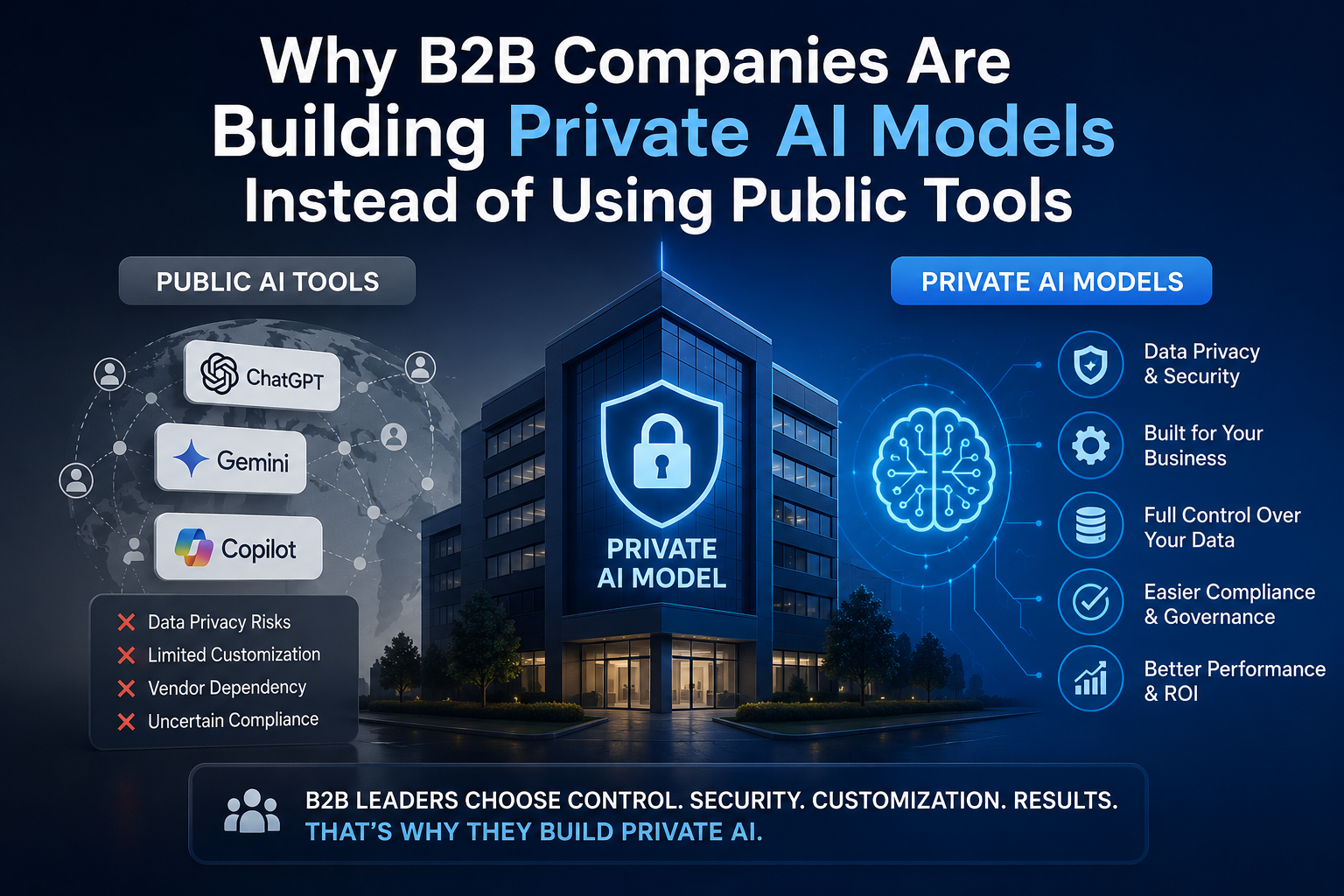
Why B2B Companies Are Building Private AI Models Instead of Using Public Tools has become one of the most important strategic shifts in enterprise technology today. As artificial intelligence becomes deeply integrated into business operations, organizations are increasingly moving away from generic public AI tools and investing in private, controlled, and enterprise-specific AI systems.
The shift is not just about technology preference. It reflects growing concerns around data security, compliance, customization, competitive advantage, and long-term scalability. While public AI tools offer convenience and accessibility, they often fall short in addressing the complex and sensitive needs of B2B enterprises.
Rising Concerns Around Data Security and Privacy
One of the biggest reasons B2B companies are shifting toward private AI models is data security. Public AI platforms typically process information on shared infrastructure, which raises concerns about how sensitive business data is handled.
For industries such as finance, healthcare, manufacturing, and enterprise SaaS, data protection is not optional—it is a regulatory requirement.
Key concerns include:
- Risk of sensitive data exposure
- Lack of control over data storage and usage
- Compliance challenges with regulations like GDPR and industry-specific laws
- Uncertainty around third-party data handling policies
As a result, organizations prefer private AI environments where data remains within their controlled infrastructure, reducing exposure and improving governance.
Need for Industry-Specific Customization
Public AI tools are designed for general-purpose use cases. While they are powerful, they often lack deep understanding of specific business domains.
B2B companies operate in highly specialized environments where industry context matters significantly. A generic AI model may not understand internal workflows, proprietary terminology, or complex enterprise processes.
Private AI models allow organizations to:
- Train models on internal business data
- Align outputs with industry-specific terminology
- Customize workflows based on internal operations
- Improve accuracy for domain-specific tasks
This level of customization leads to more reliable and actionable outputs compared to generic public tools.
Key Drivers Behind This Transformation
There are several reasons Why B2B Companies Are Building Private AI Models Instead of Using Public Tools is becoming a standard practice. Data privacy concerns, regulatory compliance, and the need for competitive differentiation are the strongest drivers.
As enterprises scale their AI usage, relying on public tools becomes less viable. This reinforces Why B2B Companies Are Building Private AI Models Instead of Using Public Tools as a long-term solution for secure and scalable AI adoption.
Competitive Advantage Through Proprietary Intelligence
In highly competitive B2B markets, data and intelligence are key differentiators. Companies are increasingly realizing that relying on public AI tools means using the same systems as competitors.
Private AI models help organizations build proprietary intelligence that cannot be easily replicated. This creates a strategic advantage in areas such as:
- Customer insights and behavior analysis
- Sales forecasting and pipeline optimization
- Operational efficiency improvements
- Product innovation and development
By controlling their own AI systems, businesses ensure that valuable insights remain internal rather than being part of shared external platforms.
Why B2B Companies Are Building Private AI Models Instead of Using Public Tools in 2026
The trend of Why B2B Companies Are Building Private AI Models Instead of Using Public Tools continues to grow as enterprises prioritize security, compliance, and full control over their AI systems. Unlike public AI tools, private models allow organizations to train systems on internal data, ensuring better accuracy and reduced risk of data exposure.
Many enterprises are now realizing that Why B2B Companies Are Building Private AI Models Instead of Using Public Tools is not just a technology shift but a strategic business decision. It helps companies protect sensitive information while still leveraging the power of artificial intelligence for decision-making and automation.
How This Shift Impacts Enterprise AI Strategy
Understanding Why B2B Companies Are Building Private AI Models Instead of Using Public Tools is essential for modern CIOs and digital leaders. This shift is reshaping enterprise AI strategy by moving away from generic tools toward fully customized, secure AI ecosystems.
Organizations that adopt this approach gain better control, improved governance, and stronger alignment with business goals. This is why Why B2B Companies Are Building Private AI Models Instead of Using Public Tools has become a key focus area in enterprise transformation strategies for 2026.
Compliance and Regulatory Requirements
As AI adoption grows, regulatory frameworks are becoming stricter. Enterprises must ensure that their AI systems comply with data protection laws and industry regulations.
Public AI tools may not always meet these requirements, especially in sectors where data sensitivity is high.
Private AI models help organizations achieve:
- Better audit control over data usage
- Clear governance frameworks for AI decisions
- Compliance with regional and global data laws
- Reduced legal and operational risks
This makes private AI adoption especially critical for regulated industries.
Integration with Internal Enterprise Systems
B2B organizations rely on complex technology ecosystems that include CRM systems, ERP platforms, data warehouses, and custom applications.
Public AI tools often operate independently and lack deep integration capabilities with internal systems.
Private AI models, on the other hand, can be directly embedded into enterprise workflows, enabling:
- Seamless integration with internal databases
- Real-time access to business data
- Automated decision-making within workflows
- Reduced dependency on external APIs
This tight integration improves efficiency and reduces operational friction.
Performance Optimization for Business-Specific Use Cases
Generic AI tools are optimized for broad usage, which can limit performance in specialized enterprise scenarios.
Private AI models allow organizations to optimize performance based on their specific needs, such as:
- Faster response times for internal applications
- Improved accuracy for niche datasets
- Reduced irrelevant or generic outputs
- Better alignment with business KPIs
This results in more consistent and reliable AI performance across business functions.
Reduced Dependency on Third-Party Platforms
Another important factor driving adoption of private AI models is the desire to reduce dependency on external vendors.
Public AI platforms can introduce risks such as:
- Pricing changes and subscription limitations
- API restrictions or usage caps
- Service downtime or availability issues
- Lack of long-term control over model updates
By building private AI systems, organizations gain greater autonomy and long-term control over their AI infrastructure.
Building Scalable AI Infrastructure for the Future
Many enterprises view private AI models as a long-term investment rather than a short-term solution. As AI becomes more deeply embedded into business operations, scalability becomes a critical requirement.
Private AI systems allow organizations to:
- Scale models based on internal demand
- Continuously train systems with new business data
- Adapt AI capabilities as business needs evolve
- Maintain performance consistency at enterprise scale
This ensures that AI systems remain aligned with long-term digital transformation goals.
Final Thoughts
The shift toward private AI models reflects a broader transformation in how B2B companies approach artificial intelligence. While public AI tools offer accessibility and speed, they often lack the control, customization, and security required for enterprise-grade use.
Organizations are increasingly recognizing that AI is not just a tool but a core business capability. As a result, they are investing in private AI systems that provide stronger governance, deeper integration, and long-term strategic value.
Ultimately, Why B2B Companies Are Building Private AI Models Instead of Using Public Tools comes down to one key factor: control. Businesses want to own their intelligence, protect their data, and build AI systems that align directly with their unique operational and strategic goals.