
AI Reputation Management: The New B2B Growth Strategy for 2026 –
AI Reputation Management is becoming a critical strategy for B2B companies as artificial intelligence transforms how buyers discover, evaluate, and choose business solutions. While traditional marketing focused on gaining human attention through search engines, advertising, and content campaigns, modern organizations must also consider how AI systems understand, interpret, and recommend their brands.
For years, B2B companies optimized their digital presence around search rankings, website traffic, and lead generation. However, the rise of generative AI and AI-powered search platforms has changed the buyer journey. Executives are increasingly using AI assistants to research vendors, compare technologies, and identify trusted providers before visiting company websites.
This shift has created a new challenge for businesses: becoming not only visible online but also accurately understood by intelligent systems. Companies that build strong digital authority, consistent messaging, and trustworthy reputation signals will have a greater opportunity to appear in AI-generated recommendations.
How Artificial Intelligence Is Changing the Future of Brand Visibility, Trust, and Enterprise Decision-Making
For more than two decades, B2B marketing strategies were designed around one central goal: capturing human attention. Companies invested heavily in search engine optimization, content marketing, digital advertising, public relations, webinars, events, and executive branding to ensure potential customers could discover and evaluate their solutions.
The traditional buyer journey was relatively predictable. A business executive identified a challenge, searched online for possible solutions, compared different vendors, reviewed customer stories, and eventually engaged with sales teams. Marketing success was measured through familiar indicators such as website traffic, keyword rankings, lead generation, engagement rates, and conversion performance.
However, enterprise buying behavior is rapidly changing. Artificial intelligence is becoming the first layer of information discovery, influencing how decision-makers research industries, compare solutions, and identify potential vendors. Instead of manually exploring dozens of websites, buyers increasingly rely on AI assistants to summarize markets, explain technologies, evaluate companies, and recommend relevant solutions.
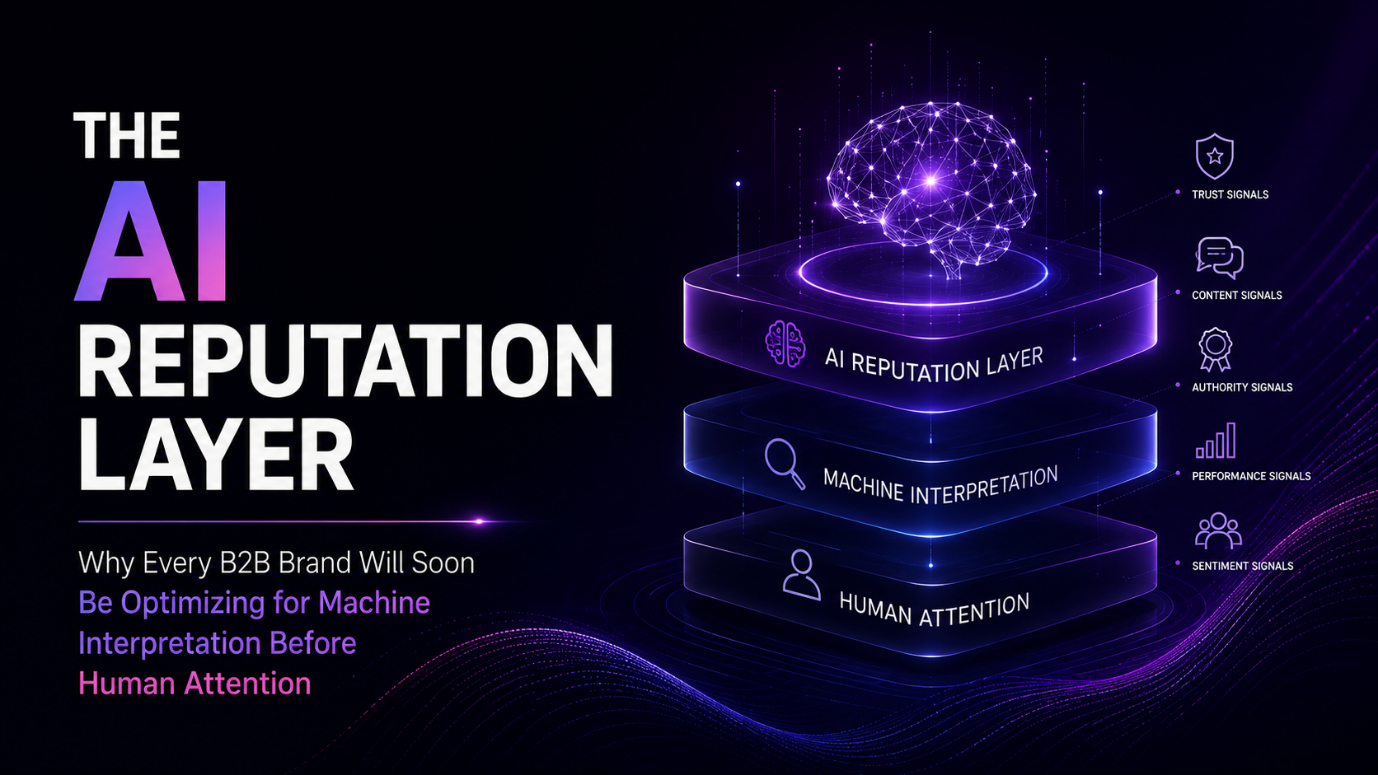
This shift introduces a new discipline for modern businesses: AI Reputation Management.
AI Reputation Management is the process of improving how artificial intelligence systems understand, evaluate, and represent a company’s expertise, credibility, products, and market position. As AI-powered search and recommendation systems become more influential, organizations must optimize not only for human audiences but also for the intelligent systems shaping buyer decisions.
The future competitive advantage will belong to companies that are not only visible online but also clearly understood by AI systems.
The Rise of AI-Driven B2B Brand Discovery –
Traditional search engines transformed how people accessed information by organizing billions of web pages into searchable results. Businesses competed for visibility by improving rankings, publishing content, earning backlinks, and optimizing technical website performance.
Generative AI is changing this model by moving from information retrieval to information interpretation. Instead of presenting users with hundreds of links, AI systems analyze multiple sources and provide summarized answers, recommendations, and comparisons.
For example, an enterprise buyer researching cybersecurity solutions may no longer begin with a traditional search query. Instead, they may ask an AI assistant:
“Which cybersecurity platforms are best suited for global enterprises?”
The AI system may evaluate:
- Company websites
- Product documentation
- Customer reviews
- Analyst reports
- Industry discussions
- Executive expertise
- Public reputation signals
The buyer receives a shortlist before visiting individual websites.
This creates a major shift in B2B marketing. Companies are no longer competing only for clicks and website visits. They are competing to become part of the AI-generated consideration set.
Organizations that AI systems understand clearly are more likely to be recommended. Companies with inconsistent messaging, limited digital authority, or weak reputation signals risk becoming invisible during the earliest stages of buyer research.
The Role of Data Transparency in AI Reputation Management

Data Transparency: Building AI Trust –
As artificial intelligence becomes more influential in B2B decision-making, data transparency is becoming an essential factor in building a trustworthy digital reputation. AI Reputation Management is not only about increasing visibility but also about ensuring that AI systems have access to accurate, reliable, and consistent information about a company.
What Is AI Reputation Management?
AI Reputation Management represents the next evolution of digital reputation strategy. While traditional reputation management focused on how customers, investors, and communities perceived a company, AI Reputation Management focuses on how intelligent systems interpret and communicate that perception.
AI models develop an understanding of organizations by analyzing patterns across multiple digital sources. They do not rely only on a company’s own marketing messages. Instead, they evaluate the broader information ecosystem surrounding the brand.
This includes:
- Website content and messaging consistency
- Customer reviews and testimonials
- Industry publications
- Executive thought leadership
- Product information
A company’s digital reputation is no longer built only through advertising campaigns. It is built through every publicly available signal that contributes to how AI systems understand the organization.
Why AI Reputation Management Matters for B2B Companies –
B2B purchasing decisions are complex and often involve multiple stakeholders, long evaluation cycles, and significant financial investment. Buyers want confidence that a vendor has expertise, credibility, and proven results before initiating conversations.
AI systems are increasingly becoming part of this evaluation process.
A company with strong AI reputation signals benefits from:
Greater Visibility During Early Research –
Many buyers now use AI tools before contacting vendors. If AI systems accurately understand a company’s products, expertise, and market category, the organization has a greater chance of appearing in relevant recommendations.
Early visibility matters because many purchasing decisions are influenced before a buyer ever interacts directly with a sales team.
Stronger Digital Trust –
AI systems increasingly prioritize evidence-based information. Organizations with credible customer stories, industry expertise, and consistent messaging create stronger trust signals.
Important trust indicators include:
- Verified customer outcomes
- Industry recognition
- Expert contributions
- Research-based content
- Independent mentions
Improved Competitive Positioning –
In traditional search results, companies could compete by ranking higher for specific keywords. In AI-driven search environments, the competition shifts toward being recognized as a trusted and relevant authority.
AI Reputation Management helps businesses improve their competitive positioning by strengthening how AI systems understand their expertise, solutions, and market authority. As AI-driven search and recommendation platforms become more influential in B2B decision-making, companies with a strong digital reputation are more likely to appear in relevant recommendations and comparisons. By combining consistent brand messaging, customer validation, authoritative content, and industry expertise, organizations can differentiate themselves from competitors and build stronger visibility in the evolving AI-powered marketplace.
How AI Systems Evaluate Brand Credibility –
Artificial intelligence systems analyze organizations differently from traditional search algorithms. Instead of focusing primarily on individual webpages, AI evaluates broader patterns that indicate expertise, authority, and reliability.
AI Reputation Management plays an important role in how artificial intelligence systems evaluate a company’s brand credibility. Unlike traditional search engines that mainly analyze keywords and website signals, AI systems examine a wider range of information sources to understand a company’s expertise, trustworthiness, and market position. They evaluate patterns across digital channels, including brand content, customer feedback, industry mentions, executive insights, and third-party validation, to determine how accurately and confidently a business can be represented.
Consistency Across Digital Channels –
Consistency plays a critical role in helping AI systems understand a company’s identity.
When messaging remains aligned across websites, social platforms, publications, and customer resources, AI can more accurately classify the organization.
For example, a technology company should maintain consistency between:
- Website positioning
- Product descriptions
- Executive profiles
- Social media communication
- Industry articles
- Customer case studies
Mixed signals can create uncertainty and make it harder for AI systems to accurately describe the company’s expertise.
Evidence-Based Brand Authority: Why AI Rewards Proof Over Promotion –
In traditional marketing, companies often relied on strong messaging to position themselves as industry leaders. Statements such as “market-leading platform,” “innovative technology provider,” or “trusted global solution” were commonly used to influence customer perception.
However, AI systems increasingly evaluate whether these statements are supported by meaningful evidence. Artificial intelligence models analyze information patterns across multiple sources to determine whether a company genuinely demonstrates expertise or simply promotes itself through marketing language.
This creates a major shift in B2B branding. Organizations must move from making claims about authority to building measurable proof of authority.
A strong AI reputation is supported by evidence such as:
- Original industry research and reports
- Customer success stories with measurable outcomes
- Technical documentation and product resources
- Executive insights and expert commentary
- Independent reviews and analyst recognition
- Contributions to industry discussions
When these signals consistently appear across digital platforms, AI systems gain stronger confidence in understanding the company’s expertise and market position.
The organizations that succeed in the AI-driven economy will not simply be the ones producing the most content. They will be the ones producing the most credible, useful, and verifiable information.
The Growing Importance of Executive Branding in AI Reputation Management –
Executive branding has traditionally been viewed as a way to humanize companies and strengthen relationships with customers. Leaders who share expertise through articles, conferences, interviews, and professional networks help build trust with their audience.
In the AI era, executive visibility serves another important purpose. Public expertise from company leaders contributes to the overall digital footprint that AI systems analyze when interpreting a brand.
When executives consistently discuss industry challenges, share valuable insights, and contribute meaningful perspectives, AI systems gain additional context about the organization’s knowledge and authority.
For example, an enterprise technology company may strengthen its AI reputation when its leadership team regularly contributes through:
- Industry research publications
- Technology conferences
- Expert interviews
- Professional networking platforms
- Podcasts and discussions
- Educational content
Conclusion: Why AI Reputation Management Will Define the Next Era of B2B Growth
The evolution of digital marketing has always been shaped by changes in how people discover information. Search engines transformed online visibility, social platforms changed brand communication, and now artificial intelligence is transforming how businesses are evaluated and recommended.
AI Reputation Management represents the next major shift in B2B branding. It moves organizations beyond traditional SEO and reputation strategies by focusing on how intelligent systems interpret expertise, credibility, customer trust, and market authority.
Companies can no longer rely only on promotional messaging or search rankings. They must build a complete digital reputation supported by valuable content, customer evidence, executive expertise, consistent communication, and meaningful industry contributions.
In the AI-driven buying environment, visibility will depend on more than being present online. It will depend on whether AI systems can accurately understand the organization and confidently recommend it to potential buyers.
Frequently Asked Questions About AI Reputation Management –
AI Reputation Management is the process of improving how artificial intelligence systems understand and represent a company’s brand, expertise, products, and reputation. It focuses on building strong digital signals through content, customer feedback, industry authority, and consistent brand information so AI platforms can accurately evaluate and recommend the business.
AI Reputation Management is important because B2B buyers are increasingly using AI tools to research vendors, compare solutions, and make purchasing decisions. Companies with strong AI visibility and credible digital signals have a better chance of being included in AI-generated recommendations and reaching potential customers earlier in the buying journey.
Traditional SEO focuses on improving website rankings through keywords, technical optimization, and backlinks, while AI Reputation Management focuses on helping intelligent systems understand a company’s overall authority, credibility, and relevance. SEO helps brands get discovered, whereas AI Reputation Management helps brands get understood and recommended.
Companies can improve their AI reputation by publishing valuable thought leadership content, maintaining consistent brand messaging, collecting customer proof, building executive visibility, and earning recognition from trusted third-party sources. These signals help AI systems develop a clearer understanding of the company’s expertise.
AI will not replace SEO but will expand the way businesses approach digital visibility. Traditional SEO will continue to support online discovery, while AI Reputation Management will become increasingly important for ensuring brands are accurately represented in AI-powered search and recommendation systems.