Introduction –
The business world has entered an era where information is no longer the ultimate competitive advantage. Artificial intelligence, real-time news platforms, social media, industry reports, and digital research tools have made information instantly available to almost everyone. Within minutes of a major announcement, businesses across the globe can access summaries, expert opinions, and AI-generated insights.
This shift has fundamentally changed how organizations build authority.
Today, success isn’t determined by who discovers information first—it’s determined by who explains its business impact first. This emerging reality is known as the Market Interpretation Economy, where organizations compete not on access to information but on their ability to interpret change and help customers make better strategic decisions.
For B2B companies, this represents one of the biggest shifts in thought leadership since the rise of digital marketing.
What Is the Market Interpretation Economy?
The Market Interpretation Economy is a business environment where interpretation creates more value than information itself.
In the past, companies gained credibility by publishing exclusive reports, proprietary research, and industry updates. Access to knowledge was limited, making information a valuable asset.
Today, that advantage has disappeared.
Artificial intelligence can summarize thousands of articles, compare market trends, and generate executive briefings within seconds. As a result, businesses receive nearly identical information at almost the same time.
What truly differentiates organizations now is their ability to answer questions such as:
- Why does this change matter?
- What business risks does it create?
- What opportunities will emerge?
- How should executives respond?
- What actions should companies take next?
Organizations that consistently answer these questions become trusted advisors rather than just content publishers.
The Rise of the Market Interpretation Economy –

Understanding the Market Shift
As businesses face constant technological, regulatory, and market changes, the ability to understand and explain these shifts has become a critical competitive advantage. The Market Interpretation Economy describes this new business environment where organizations create value by transforming complex information into meaningful insights, helping customers and decision-makers understand what changes mean for their future strategies.
Why Information Alone No Longer Creates Competitive Advantage –
For decades, business influence was closely tied to information ownership. Organizations invested significant resources in research teams, proprietary surveys, industry conferences, and exclusive market intelligence because access to knowledge itself created competitive value. Companies that discovered emerging trends early were often viewed as innovators, while those that published influential reports established themselves as industry leaders.
The digital revolution gradually reduced this advantage by making information easier to access through search engines, online publications, and global connectivity. Artificial intelligence has accelerated that transformation even further. Today, executives can ask an AI assistant to summarize the latest developments in cybersecurity, manufacturing, healthcare, enterprise software, or financial technology within seconds. The challenge is no longer obtaining information—it is filtering the noise and understanding the implications.
This shift has changed what business audiences expect from content. Decision-makers are overwhelmed by reports that repeat similar facts, predictions, and statistics. Instead of searching for another summary of industry news, they seek guidance that helps them prioritize actions, evaluate risks, and make confident strategic decisions. In other words, they are looking for organizations that can explain the meaning behind the information rather than simply presenting it.
Why Interpretation Has Become More Valuable Than Information –
The growing importance of interpretation reflects a broader change in executive decision-making. Leaders rarely lack access to data; what they often lack is clarity. They need trusted perspectives that connect market developments to real business outcomes, helping them distinguish between temporary disruptions and long-term transformation.
Organizations that excel at interpretation typically deliver value in several ways:
- They simplify complexity by translating technical or regulatory developments into practical business language.
- They connect trends with strategy, showing how emerging technologies or market shifts influence competitive positioning.
- They reduce uncertainty by helping decision-makers evaluate risks, opportunities, and likely future scenarios.
- They provide actionable insights that executives can apply when making investment, operational, or customer-focused decisions.
This capability cannot be easily replicated by automated content generation alone. While AI excels at organizing existing information, it cannot replace the judgment developed through years of customer engagement, operational experience, and industry expertise. That combination of knowledge and practical context is what makes interpretation increasingly valuable in the modern business environment.
Information vs. Interpretation: Understanding the Difference –
Although the terms are often used interchangeably, information and interpretation serve very different purposes in business communication. Information focuses on reporting events and presenting facts, while interpretation explains why those facts matter and how organizations should respond.
| Information | Interpretation |
|---|---|
| Explains what happened | Explains why it matters |
| Available through AI, news, and research | Built from expertise and business experience |
| Creates awareness | Builds strategic understanding |
| Easy for competitors to replicate | Difficult to imitate |
| Answers factual questions | Guides business decisions |
| Generates traffic | Builds long-term trust and authority |
This distinction is becoming increasingly important for B2B marketing. Buyers can obtain information from almost anywhere, but they are far more likely to remember and trust brands that consistently help them make sense of change. Over time, interpretation becomes more than a content strategy—it becomes a competitive advantage that shapes how customers perceive an organization’s expertise and credibility.
Why B2B Thought Leadership Must Evolve –
Traditional B2B content marketing often focused on consistency and publishing frequency. Marketing teams produced articles about industry news, explained new technologies, summarized research reports, and reacted quickly to major announcements. While these practices helped improve search visibility, they rarely created lasting differentiation because competitors were publishing similar content at almost the same pace.
Today’s buyers expect something more valuable. They are not looking for another explanation of a trend they have already seen on LinkedIn or in an AI-generated summary. They want expert perspectives that help them understand how market developments will influence their business strategy, customer relationships, and future investments.
This shift requires organizations to rethink the purpose of thought leadership. Instead of asking, “How quickly can we publish content about this topic?” successful brands are asking a more important question:
“What unique perspective can only our organization provide?”
The answer usually comes from experience rather than information. Companies that work closely with customers, implement technology at scale, or solve complex operational challenges possess insights that cannot be replicated through public research alone. When those experiences are translated into valuable content, thought leadership becomes both credible and difficult for competitors to imitate.
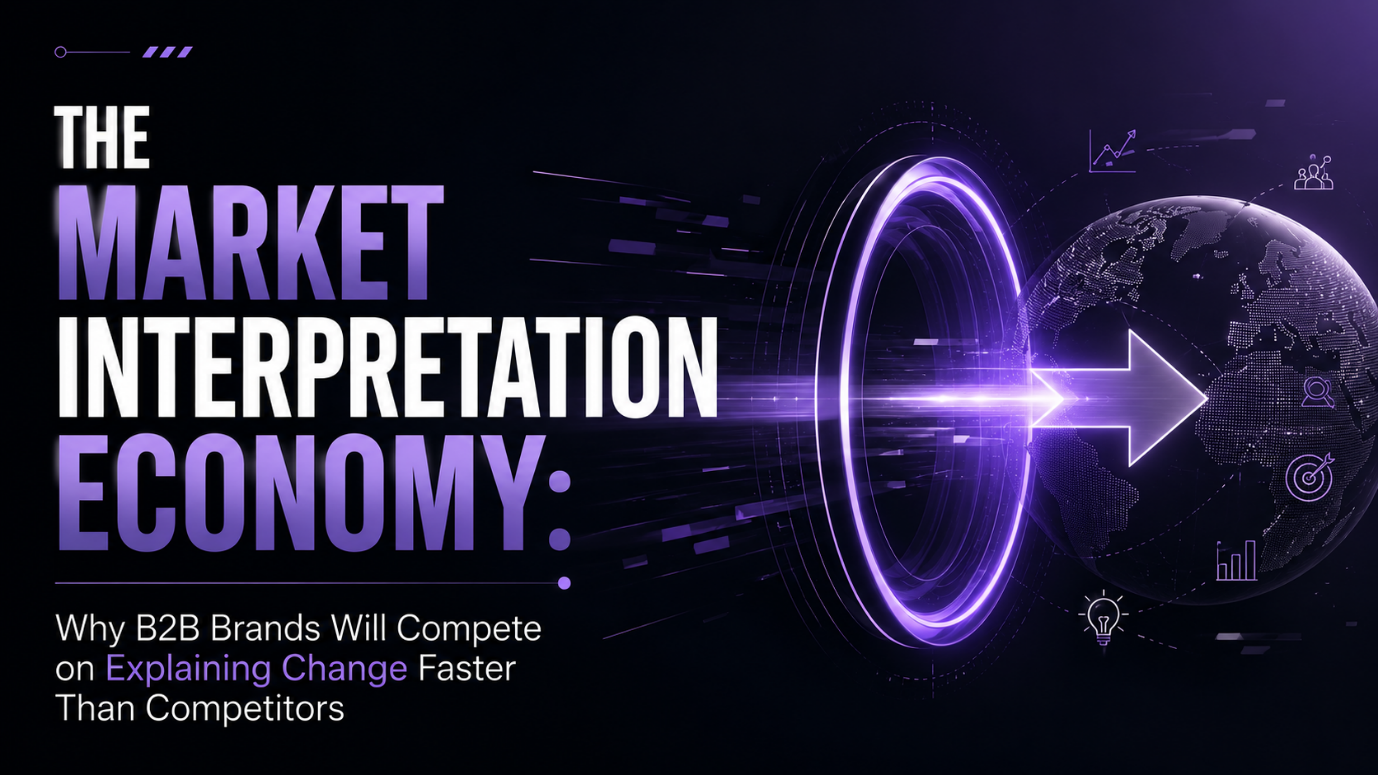
The Market Interpretation Economy: Why B2B Brands Will Compete on Explaining Change Faster Than Competitors
The future of B2B success will belong to brands that can quickly interpret market shifts and turn complexity into clarity.
As markets continue to change rapidly, B2B brands will compete not just by what they offer, but by how well they explain what is happening and what it means for customers. The ability to simplify change, share insights, and guide decisions will become a key competitive advantage.
The Rise of Interpretation-Led Content Marketing –
Interpretation-led content marketing focuses on helping customers understand the broader implications of change rather than simply describing the change itself. Instead of reporting facts, it connects those facts to strategic business outcomes, making content more relevant to senior decision-makers.
For example, imagine a major breakthrough in generative AI. A traditional blog might explain the new technology, list its features, and summarize industry reactions. An interpretation-led article would go much further by exploring how the innovation could reshape enterprise workflows, redefine customer expectations, influence hiring strategies, or create new competitive advantages over the next five years.
This deeper level of analysis transforms content into a strategic resource rather than a marketing asset. Executives return to brands that consistently provide meaningful perspectives because those insights help reduce uncertainty during periods of rapid change. Over time, this approach strengthens trust, improves brand authority, and creates stronger relationships with prospective customers long before a purchasing decision is made.
Some of the characteristics of interpretation-led content include:
- Connecting industry trends with real business outcomes.
- Explaining long-term implications rather than short-term events.
- Offering practical recommendations instead of generic observations.
- Combining market intelligence with first-hand organizational experience.
- Challenging conventional thinking through original perspectives.
Organizations that consistently create this type of content become recognized not just as vendors, but as strategic partners capable of guiding businesses through complex transformation.
Conclusion –
The Market Interpretation Economy marks a fundamental shift in how B2B brands earn trust, influence decisions, and build long-term competitive advantage. In an era where artificial intelligence can instantly summarize reports, track trends, and generate content, access to information is no longer a meaningful differentiator. What truly sets organizations apart is their ability to interpret change, connect it to business outcomes, and provide clear strategic direction when uncertainty is highest.
For B2B leaders, this means rethinking the purpose of thought leadership. Success is no longer measured by how quickly a company reacts to industry news or how frequently it publishes content. Instead, it is defined by the quality of its insights and its ability to help customers understand what emerging technologies, regulatory changes, and market disruptions mean for their business. Brands that consistently translate complexity into actionable guidance will become trusted advisors, strengthening relationships long before the sales conversation begins.
Frequently Asked Questions (FAQs)
The Market Interpretation Economy is a business environment where competitive advantage comes from interpreting market changes rather than simply sharing information. As AI makes information widely accessible, organizations that explain the business impact of trends, technologies, and regulations become more valuable to customers than those that only report the news.
Artificial intelligence can quickly collect, summarize, and distribute information, making factual content widely available. Interpretation adds value by providing context, strategic insights, and practical recommendations that help business leaders make informed decisions. This human expertise is much harder to replicate and creates stronger trust with audiences.
The Market Interpretation Economy shifts B2B marketing from content creation to insight creation. Instead of producing large volumes of news-based content, successful brands focus on delivering original perspectives, industry expertise, and strategic guidance that help customers navigate change and make confident business decisions.
Organizations can strengthen thought leadership by combining market intelligence with real-world experience, publishing original insights, encouraging executives to share informed perspectives, and creating content that explains the long-term implications of industry developments rather than simply reporting them.
AI is a powerful tool for research, analysis, and content generation, but it cannot replace human judgment, industry experience, or strategic decision-making. The most effective thought leadership combines AI-driven efficiency with the expertise and practical knowledge of business leaders to deliver meaningful and actionable insights.