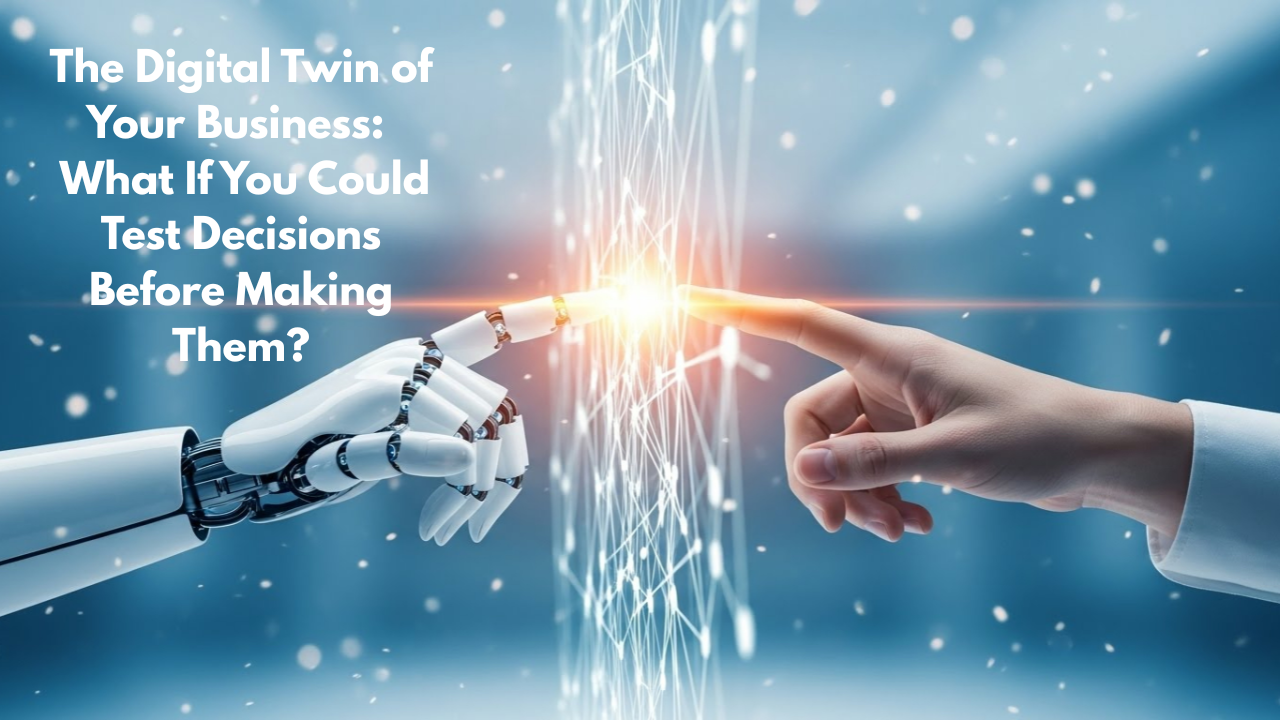
Imagine being able to test a major business decision before investing money, changing operations, or introducing a new strategy. What if your organization could understand how a new product launch might affect its supply chain, how a pricing adjustment could influence customer demand, or how hiring additional employees might impact productivity before making the actual decision?
Digital twins for business are making this possibility increasingly practical. What was once associated primarily with advanced engineering and industrial research is now becoming an important part of enterprise digital transformation. By creating virtual representations of physical assets, business processes, systems, and entire operations, organizations can explore different scenarios, identify potential problems, and make more informed decisions.
As businesses navigate rising operational costs, market uncertainty, supply chain disruptions, and changing customer expectations, the ability to experiment digitally before acting in the real world offers a valuable competitive advantage. Combining real-time data, artificial intelligence (AI), simulation technologies, and advanced analytics, digital twins are changing how organizations understand their operations and plan for the future.
What Are Digital Twins and How Do They Work in Business?
A digital twin is a virtual representation of a physical object, process, system, or environment that is connected to its real-world counterpart through data. Unlike a conventional digital model that primarily illustrates how something looks or is designed, a digital twin can continuously incorporate information about performance, operating conditions, behaviour, and changes over time.
For example, a manufacturing company could develop a digital twin of its production line using information collected from machines, sensors, equipment, and operational software. Managers could use this virtual representation to understand current production performance, identify bottlenecks, and simulate what might happen if they changed machine speeds, adjusted production schedules, or introduced additional equipment.
The concept extends far beyond manufacturing equipment. Businesses can create digital twins of buildings, warehouses, transportation networks, supply chains, and broader enterprise operations. By adopting digital twins for business, enterprises can build a more connected understanding of their operations, evaluate potential business scenarios, and identify opportunities for improvement before implementing changes.
The key difference is that a digital twin is not simply a digital copy. It is a connected and evolving representation designed to help organizations understand, monitor, simulate, and improve real-world performance. Understanding how digital twins for business work is essential for organizations exploring advanced digital transformation strategies. These virtual environments connect operational data with digital representations, helping businesses monitor performance, analyze changes, and simulate different business conditions.
How Does a Business Digital Twin Work?
A typical digital twin environment brings together several technology components that work together to create an operational representation.
- Physical assets and processes: These are the actual machines, buildings, business systems, or operations being represented.
- Data collection: Sensors, IoT devices, enterprise applications, and operational systems collect information from real-world environments.
- Data integration: Information from different sources is consolidated to create a more complete representation of the physical system.
- Digital modelling: Software creates a virtual representation of the asset, process, or environment.
- Analytics and AI: Advanced analytics and artificial intelligence help identify patterns, predict possible outcomes, and evaluate different scenarios.
- Simulation and optimization: Businesses can test proposed changes virtually and examine their potential impact before implementing them.
When these components work together, organizations gain a more detailed understanding of their operations and can use that information to support better business decisions.
7 Powerful Ways Digital Twins for Business Can Transform Enterprise Operations
Digital twins are becoming valuable because they allow organizations to move beyond traditional reporting and explore how their decisions could influence interconnected business systems. Instead of relying entirely on historical information and assumptions, companies can use simulations to examine different possibilities before committing resources.
Here are seven important ways enterprises can apply digital twin technology.
1. Test Business Decisions Before Making Major Investments
One of the most valuable advantages of digital twins for business is the ability to evaluate potential decisions in a controlled virtual environment.
Traditional business planning often depends on historical reports, financial projections, market research, and management experience. While these methods remain important, they may not fully capture how multiple operational variables interact with one another.
A digital twin allows organizations to simulate different scenarios and examine possible consequences without immediately affecting actual operations.
Consider a manufacturing company planning to expand its production capacity. Before purchasing additional machinery or expanding its facility, the organization could simulate different production configurations, evaluate resource requirements, estimate potential output, and identify operational limitations.
This approach can help decision-makers:
- Compare alternative investment scenarios.
- Understand operational and financial trade-offs.
- Identify potential risks before implementation.
- Evaluate resource requirements and capacity constraints.
- Make more informed strategic decisions.
Although simulations cannot guarantee that every real-world outcome will match the predicted results, they provide an additional layer of insight that can make investment planning more structured and informed.
2. Improve Manufacturing Efficiency and Predictive Maintenance
Manufacturing is one of the most established application areas for digital twin technology. Production environments involve interconnected machinery, expensive equipment, complex workflows, and strict operational requirements. A problem with one machine can affect an entire production line.
Digital twins can help manufacturers monitor equipment performance, identify unusual operating patterns, and understand when maintenance interventions may be required.
Instead of waiting for equipment to fail or relying exclusively on fixed maintenance schedules, organizations can analyze operational information to make maintenance planning more effective.
For example, a manufacturing business could create a digital twin of its production equipment to monitor operating temperatures, vibration patterns, machine utilization, and production performance. By comparing real-time information with expected operating conditions, the organization can investigate potential problems before they develop into major disruptions.
Businesses can also use manufacturing digital twins to:
- Simulate different factory layouts and production workflows.
- Evaluate how new machinery might affect existing operations.
- Identify production bottlenecks and equipment inefficiencies.
- Improve maintenance planning and equipment utilization.
- Explore opportunities to reduce unnecessary downtime.
Rather than reacting only after a disruption occurs, businesses can use digital twin simulations to prepare for different possibilities and build more resilient supply chain strategies. Through digital twins for business, supply chain leaders can explore alternative sourcing strategies, assess distribution challenges, and understand how disruptions could affect interconnected operations. Digital twins for business also enable manufacturers to evaluate production strategies, improve equipment utilization, and make better-informed operational decisions.
3. Strengthen Supply Chain Visibility and Risk Management
Modern supply chains involve multiple suppliers, manufacturers, warehouses, distributors, transportation providers, and customers operating across different locations. A disruption in one part of the network can quickly affect several other areas.
Managing these interconnected relationships becomes particularly challenging when organizations depend on traditional reports and disconnected supply chain systems.
A digital twin of a supply chain can provide a virtual representation of how goods, resources, and information move throughout the network. It can help businesses understand how transportation delays, supplier performance, inventory shortages, and changing customer demand influence overall operations.
For example, imagine a company that depends on a major supplier for essential manufacturing components. If that supplier experiences an unexpected disruption, the business could use its supply chain digital twin to explore alternative suppliers, evaluate inventory requirements, and compare different transportation routes.
This can help organizations:
- Identify supply chain vulnerabilities.
- Evaluate alternative sourcing strategies.
- Simulate transportation and distribution disruptions.
- Understand the impact of changing customer demand.
- Develop contingency plans for operational interruptions.
- Improve inventory and resource planning.
Rather than reacting only after a disruption occurs, businesses can use digital twin simulations to prepare for different possibilities and build more resilient supply chain strategies. Through digital twins for business, supply chain leaders can explore alternative sourcing strategies, assess distribution challenges, and understand how disruptions could affect interconnected operations.
4. Understand Customer Behaviour and Improve Business Experiences
Digital twins are not limited to machines, factories, and logistics networks. Businesses can also apply the concept to customer-facing environments and service operations.
For example, a retail organization could develop a digital representation of a physical store to examine how customer movement, product placement, staffing levels, and inventory availability influence the shopping experience.
By simulating different store layouts and operational configurations, managers can explore how proposed changes might affect customer movement and service delivery.
Similarly, organizations operating in hospitality, banking, telecommunications, and other service industries could use digital representations of their operational environments to understand customer journeys and identify service bottlenecks.
Potential applications include:
- Evaluating different store layouts and product placements.
- Understanding customer movement through physical environments.
- Exploring staffing requirements during busy periods.
- Identifying potential service delivery bottlenecks.
- Evaluating operational changes that could improve customer experiences.
These applications require appropriate data governance and privacy safeguards, particularly when customer-related information is involved. The objective should be to understand service performance and improve customer experiences without compromising personal information.
5. Optimize Energy Consumption and Facility Management
Commercial buildings, industrial facilities, and large enterprise campuses consume significant resources to maintain their operations. Managing energy consumption, equipment performance, occupancy, and environmental conditions can become increasingly complex across multiple locations.
Digital twins can help organizations create virtual representations of their facilities and examine how different operational conditions influence resource consumption.
For example, a commercial real estate company could use a building digital twin to monitor energy consumption, occupancy patterns, heating, ventilation, and air conditioning (HVAC) performance, and lighting systems.
Facility managers could simulate changes to operating schedules, temperature settings, and equipment configurations to understand their potential impact on energy usage and building performance.
Business applications include:
- Monitoring building energy consumption.
- Identifying inefficient equipment and operating conditions.
- Evaluating heating and cooling configurations.
- Understanding occupancy patterns.
- Planning facility maintenance and upgrades.
- Supporting resource efficiency initiatives.
For enterprises managing multiple offices, warehouses, or industrial facilities, these insights can support more consistent operational planning and resource management.
6. Improve Workforce Planning and Resource Allocation
Business performance depends not only on physical assets and technology but also on how effectively employees and other resources are allocated.
Organizations frequently need to make decisions about staffing levels, workforce schedules, department capacity, and operational responsibilities. These decisions can become complicated when several departments depend on shared resources.
Digital twins can help businesses model operational workflows and explore how different workforce configurations might influence productivity and service delivery.
For example, a logistics company could simulate how changing employee schedules might affect warehouse processing capacity during periods of higher demand. Similarly, a customer support organization could evaluate different staffing arrangements to understand how they might influence response times and workload distribution.
Possible applications include:
- Evaluating workforce capacity requirements.
- Simulating different staffing schedules.
- Identifying resource allocation challenges.
- Understanding operational dependencies between teams.
- Exploring the impact of increased or reduced business demand.
However, workforce simulations should be used responsibly. Productivity improvements must be balanced with employee well-being, workplace conditions, and organizational requirements. Technology should help managers make better decisions rather than reduce people to simple operational variables.
7. Use AI-Powered Simulations for Better Predictive Decision-Making
Artificial intelligence is expanding the potential of digital twins by helping organizations interpret large amounts of operational data and explore more complex scenarios.
Traditional simulations may rely heavily on predefined rules, mathematical models, and assumptions. AI-powered systems can complement these approaches by identifying patterns in historical and real-time information, estimating possible outcomes, and supporting advanced predictive analysis.
When integrated with digital twins, AI can help businesses understand why certain operational patterns occur, identify potential risks, and evaluate possible improvements.
For example, a retail business could combine a digital twin of its inventory and distribution operations with AI-based analytics to explore how changes in customer demand, warehouse capacity, and supplier availability might influence future inventory requirements.
AI-powered digital twins can support:
- Predictive analysis of operational performance.
- Identification of unusual patterns and potential risks.
- Scenario evaluation across interconnected systems.
- Resource and process optimization.
- More informed operational forecasting.
However, AI-generated predictions should never be treated as unquestionable facts. Their reliability depends on the quality of the underlying data, assumptions, algorithms, and simulation models. Combining artificial intelligence with digital twins for business creates additional opportunities for predictive decision-making. Enterprises can use these connected environments to analyze operational patterns, evaluate different scenarios, and identify potential improvements across business functions.
Businesses must validate their models, monitor prediction accuracy, and combine technological insights with human expertise and business judgment.
Digital Twins vs. Traditional Digital Models: What Is the Difference?
Although digital models and digital twins may appear similar, they serve different purposes in business and technology environments.
A traditional digital model represents an object, system, or process using digital information. It may be useful for visualization, design, planning, and documentation, but it does not necessarily receive continuous information from the real-world environment.
A digital twin goes further by connecting the virtual representation with real-world data. Depending on its design, it can monitor performance, reflect changing conditions, support simulations, and help evaluate potential operational improvements.
The following differences help explain why digital twins are becoming increasingly relevant to enterprise operations:
| Aspect | Traditional Digital Model | Digital Twin |
|---|---|---|
| Primary purpose | Digital representation | Connected operational representation |
| Data updates | Often manual or periodic | Can receive continuous or periodic real-world data |
| Real-time visibility | Not necessarily available | Supported through data integration |
| Simulation | May be limited or separately configured | Can support scenario-based simulation |
| Predictive capabilities | Not inherent | Can incorporate predictive analytics and AI |
| Business applications | Design and visualization | Monitoring, analysis, simulation, and optimization |
The distinction matters because enterprises increasingly need more than digital representations of their assets. They need connected systems that help them understand how operations behave and how proposed changes could influence business performance.
What Technologies Make Digital Twins Possible?
Digital twins are not built using a single technology. They depend on several interconnected capabilities that collect, process, analyze, and visualize information from physical and digital environments.
Understanding these technologies helps organizations evaluate the infrastructure required to develop and maintain an effective digital twin.
Internet of Things (IoT) and Connected Sensors
IoT devices and sensors collect information from physical assets and operational environments. They can monitor factors such as temperature, pressure, vibration, location, equipment utilization, and environmental conditions.
This information provides the data foundation needed to keep digital twins aligned with their real-world counterparts.
Artificial Intelligence and Machine Learning
AI and machine learning help organizations analyze operational information, recognize patterns, identify potential anomalies, and estimate possible future outcomes.
These technologies can make digital twins more useful for predictive analysis and complex scenario evaluation.
Cloud Computing and Data Infrastructure
Cloud platforms provide the computing resources and storage required to process large amounts of information from connected assets and enterprise systems.
They can also help organizations scale digital twin environments across multiple facilities, locations, and business functions.
Simulation and 3D Modelling
Simulation technologies and 3D modelling tools help create virtual representations of physical assets, production environments, buildings, and other complex systems.
Depending on the application, these models may represent physical appearance, operational behaviour, or both.
Enterprise Data Integration
Digital twins often need information from multiple enterprise applications, including ERP systems, manufacturing execution systems, supply chain platforms, and operational databases.
Integrating these sources helps create a more complete view of how different parts of the business interact.
When these technologies work together, organizations can build digital twin environments that support operational visibility, scenario planning, and data-driven decision-making.
Challenges Businesses Must Consider Before Implementing Digital Twins
Despite their potential, implementing digital twins is not a straightforward process. Organizations need reliable data, connected systems, suitable infrastructure, and employees who understand how to interpret the insights generated by these models.
A digital twin built on incomplete information or inaccurate assumptions can produce misleading results. Organizations planning to implement digital twins for business should first evaluate their existing data infrastructure, integration capabilities, cybersecurity requirements, and long-term technology objectives.
This is particularly important when businesses use simulations to support major investments, operational changes, or strategic planning.
Several challenges deserve attention before implementation.
1. Data Quality and Integration
Many organizations still operate with disconnected software platforms, outdated systems, inconsistent data formats, and manual processes.
Bringing information together from these environments can be difficult. Poor-quality data can affect the accuracy of digital twin representations and the reliability of their predictions.
Businesses should prioritize data standardization, integration, validation, and governance before expanding their digital twin initiatives.
2. Implementation Costs and Technical Complexity
Developing a digital twin requires investment in software, infrastructure, data integration, modelling, and ongoing maintenance.
The complexity can increase significantly when an organization attempts to create digital representations of entire facilities, supply chains, or enterprise-wide operations.
A practical starting point is to focus on a specific operational problem where the potential business value can be evaluated.
3. Cybersecurity and Data Privacy
Connected digital environments introduce additional considerations around cybersecurity, access management, and information protection.
Digital twins may process sensitive operational information, equipment data, business performance details, and customer-related information.
Organizations should establish appropriate security controls, access policies, encryption practices, and data governance frameworks to protect these environments.
4. Skills and Organizational Readiness
Digital twin initiatives require collaboration between technology teams, data specialists, operations managers, and business decision-makers.
Employees must understand how to interpret simulation results, identify limitations, and translate insights into practical action.
Without sufficient technical expertise and organizational support, even a sophisticated digital twin may fail to deliver meaningful business value.
5. Model Accuracy and Validation
A digital twin is only as reliable as the data, assumptions, and models supporting it.
Real-world environments change continuously, and simulations may not capture every operational variable or unexpected event.
Organizations should regularly validate their models against actual performance, review assumptions, and update representations as business conditions change.
How to Get Started with Digital Twin Implementation
Businesses do not need to begin by creating a digital representation of their entire organization. In many cases, starting with a specific operational challenge is more practical and provides a clearer way to evaluate the technology’s value.
A structured implementation approach can help reduce complexity and improve the chances of success. A structured digital twins for business strategy should begin with a clearly defined operational challenge and measurable business objectives rather than an organization-wide technology deployment. This approach can help reduce complexity and improve the chances of success.
Step 1: Identify a Business Problem
Start by identifying an operational or strategic challenge that could benefit from simulation and better data visibility.
Examples include:
- Frequent equipment downtime.
- Inefficient inventory management.
- Production delays and capacity constraints.
- High facility energy consumption.
- Supply chain disruptions.
- Resource allocation challenges.
The objective is to establish a clear business problem rather than adopt digital twin technology simply because it is innovative.
Step 2: Evaluate Existing Data and Systems
Review the information already available across enterprise applications, operational databases, connected equipment, and IoT devices.
Determine whether the organization has sufficient data to create an accurate representation of the selected process or asset.
Identify integration gaps, data quality issues, and infrastructure limitations that need to be addressed.
Step 3: Select the Right Technology Infrastructure
Choose the modelling, simulation, data integration, cloud, and analytics technologies that align with the business requirement.
The appropriate technology stack will depend on the complexity of the digital twin, the volume of information involved, security requirements, and integration with existing enterprise systems.
Step 4: Develop a Pilot Project
Instead of attempting an organization-wide deployment immediately, begin with a manageable pilot.
For example, a manufacturer could develop a digital twin of one production line to evaluate equipment performance and identify operational bottlenecks.
A focused pilot allows the organization to test its data infrastructure, validate its model, understand implementation challenges, and evaluate practical business outcomes.
Step 5: Measure Performance and Expand Gradually
Establish measurable performance indicators before implementation so that the business can evaluate whether the digital twin is delivering meaningful value.
Depending on the use case, relevant measures may include:
- Equipment downtime.
- Production efficiency.
- Inventory availability.
- Energy consumption.
- Maintenance costs.
- Order fulfilment performance.
- Operational capacity utilization.
Once the pilot demonstrates practical value, organizations can explore expanding the technology to additional processes, facilities, and business functions.
The Role of Human Decision-Making in a Digital Twin Environment
As digital twin technology becomes more advanced, it is important to recognize that better simulations do not automatically lead to better business decisions.
A digital twin can provide detailed insights, simulate scenarios, and identify potential operational risks. However, it does not automatically understand every organizational priority, business constraint, or human consequence.
For example, a simulation may recommend an operational change that improves efficiency but creates additional challenges for employees, customers, or business partners.
Decision-makers must therefore consider factors that may not be fully represented in the model, including organizational culture, customer relationships, regulatory requirements, employee well-being, and long-term strategic objectives.
Digital twins should support decision-making rather than replace the people responsible for making decisions.
The strongest results are likely to emerge when businesses combine the analytical capabilities of technology with the experience, creativity, and judgment of their employees.
The Future of Digital Twins in Enterprise Business
As digital transformation continues to evolve, digital twins are likely to become an increasingly important part of how organizations plan, operate, and compete. As adoption increases, digital twins for business could become an important component of enterprise technology strategies, connecting operational intelligence, predictive analytics, and intelligent automation.
Advancements in artificial intelligence, IoT connectivity, cloud computing, and simulation technologies are creating opportunities to develop more sophisticated representations of physical assets and interconnected business environments.
Organizations may increasingly use digital twins to explore scenarios that extend beyond individual machines or facilities. Instead, they could examine how decisions across manufacturing, inventory, transportation, staffing, and customer service influence one another.
For example, an enterprise planning to introduce a new product could potentially use connected digital representations of its manufacturing capacity, inventory systems, supplier network, and distribution operations to evaluate different launch scenarios.
Such an approach could help decision-makers understand operational dependencies, identify potential constraints, and prepare for alternative business conditions.
However, the future value of digital twins will depend on more than technological advancements. Data quality, system interoperability, cybersecurity, model validation, and organizational readiness will remain essential.
Businesses that approach implementation strategically and connect digital twin initiatives to measurable operational objectives will be better positioned to translate the technology into practical value.
Conclusion
Digital twins are changing how businesses understand their operations and approach complex decisions. Digital twins for business are changing how organizations understand their operations and approach complex decisions. By creating connected virtual representations of physical assets, processes, and enterprise systems, businesses can simulate different scenarios, identify potential problems, and evaluate operational changes before implementing them in the real world. By creating connected virtual representations of physical assets, processes, and enterprise systems, organizations can explore different scenarios, identify potential problems, and evaluate operational changes before implementing them in the real world.
From manufacturing and supply chain management to workforce planning, facility optimization, and predictive analytics, digital twins for business offer opportunities to improve visibility, reduce uncertainty, and support more informed decision-making.
However, successful implementation requires more than advanced technology. Organizations need reliable data, integrated systems, appropriate infrastructure, cybersecurity safeguards, and employees who can translate analytical insights into meaningful action.
The most important consideration is to focus on business outcomes rather than technological complexity. Companies do not need to replicate every aspect of their operations digitally to benefit from this approach. Starting with a clearly defined challenge and developing a focused pilot can provide a practical foundation for broader adoption.
Ultimately, the future of business decision-making may not depend on eliminating uncertainty entirely, but on finding better ways to understand and manage it. In an increasingly competitive business environment, the ability to test possibilities before committing resources could become one of the most valuable advantages available to modern enterprises.