Business continuity was once viewed as a contingency plan reserved for exceptional circumstances. Organizations prepared disaster recovery documents, maintained secondary data centres, scheduled backup procedures, and developed crisis management protocols that remained largely invisible until an unexpected disruption occurred. Whether the threat involved cyberattacks, infrastructure failures, natural disasters, supply chain interruptions, or operational outages, resilience was traditionally treated as an insurance policy, important but reactive. Responsibility largely rested with IT departments, while business leaders focused on growth, customer acquisition, and operational performance.
That distinction is rapidly disappearing. Digital businesses now operate in environments where disruption is no longer an occasional event but an ongoing reality. Cyber threats evolve daily, cloud environments scale continuously, artificial intelligence powers mission-critical operations, geopolitical events influence digital infrastructure, regulatory requirements become increasingly complex, and customers expect uninterrupted service regardless of external circumstances.
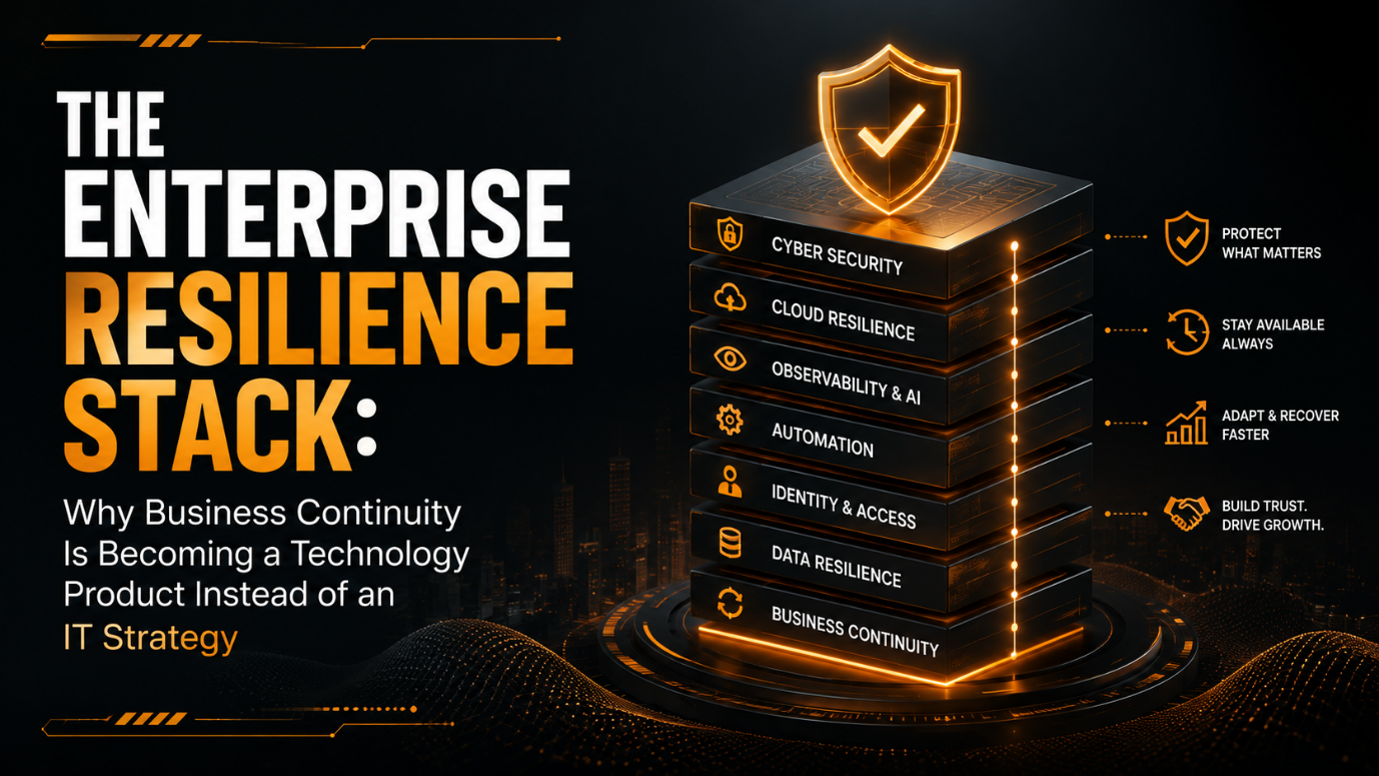
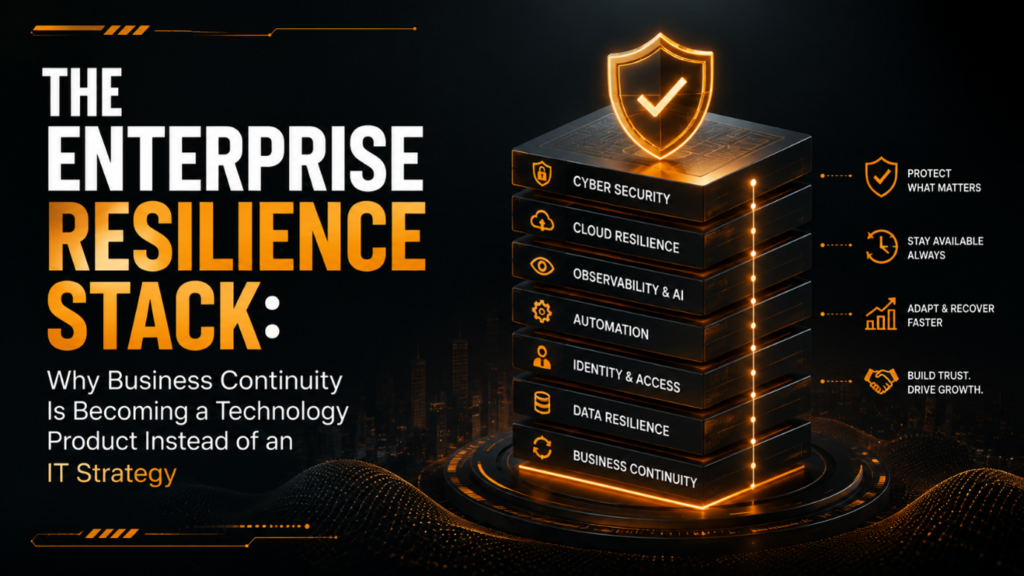
As a result, organizations are entering what can be described as the Enterprise Resilience Stack, where business continuity is no longer an isolated IT strategy but an integrated technology product embedded into every aspect of enterprise operations.The Enterprise Resilience Stack represents a new technology model where business continuity, cybersecurity, cloud computing, AI, automation, and observability work together to ensure uninterrupted business operations.
What Is the Enterprise Resilience Stack?
The transformation begins with a fundamental shift in how organizations define resilience. Historically, resilience meant restoring systems after failure. Modern enterprises increasingly recognize that recovery alone is insufficient because customers, employees, investors, and business partners expect disruptions to remain invisible. A digital banking platform cannot simply recover within several hours if customers expect transactions to be available continuously. An e-commerce company cannot postpone order processing during infrastructure failures without damaging customer trust.
A manufacturing business relying on connected supply chains cannot tolerate prolonged downtime because every delay creates cascading operational consequences. Business continuity has therefore evolved from minimizing downtime to preventing customers from experiencing disruption at all. This objective requires resilience to become an active operational capability rather than a passive emergency plan.
AI and the Enterprise Resilience Stack
Artificial intelligence is significantly accelerating this transformation by expanding both technological opportunities and operational dependencies. AI systems now optimize inventory, monitor cybersecurity threats, forecast demand, automate workflows, personalize customer experiences, manage predictive maintenance, and assist executive decision-making across countless industries. While these capabilities improve efficiency, they also introduce new layers of complexity. AI applications depend on reliable data pipelines, cloud infrastructure, identity management, API connectivity, governance frameworks, and computational resources functioning simultaneously. A failure within any supporting component may interrupt intelligent business processes extending far beyond traditional IT operations. Consequently, resilience increasingly requires protecting interconnected digital ecosystems rather than isolated technology assets.
Cybersecurity in the Enterprise Resilience Stack
Cybersecurity has become one of the foundational layers of the Enterprise Resilience Stack. Previous security strategies primarily focused on preventing unauthorized access or responding to attacks after detection. Modern resilience requires cybersecurity systems capable of continuous monitoring, autonomous threat detection, intelligent response, behavioural analysis, and predictive risk identification. AI-powered security platforms increasingly recognize unusual network activity, isolate compromised systems, validate user identities, and initiate defensive actions before human analysts intervene. Security therefore shifts from reactive protection toward continuous operational stability. The objective extends beyond stopping cyberattacks; it encompasses ensuring business processes continue functioning without interruption despite evolving threats.
Cloud Computing and the Enterprise Resilience Stack
Cloud computing represents another critical component of this integrated resilience model. Traditional infrastructure often relied on centralized environments vulnerable to localized failures. Modern cloud-native architectures distribute workloads across multiple regions, automatically balance computing resources, replicate critical data, and dynamically allocate capacity according to operational demand. Organizations no longer design infrastructure solely for efficiency; they design it for survivability. Applications increasingly assume that failures will occur and therefore incorporate redundancy, automatic failover, self-healing capabilities, and intelligent workload distribution from the beginning. Resilience becomes an architectural principle embedded into software rather than an additional feature introduced afterward.
Observability in the Enterprise Resilience Stack
Observability technologies further strengthen this evolving resilience ecosystem. Conventional monitoring focused primarily on identifying system failures after users experienced disruptions. Contemporary observability platforms continuously analyse application performance, infrastructure behaviour, network activity, user interactions, API dependencies, and operational metrics in real time. Artificial intelligence interprets these signals to predict emerging issues before they become visible to employees or customers. A gradual increase in database latency, unusual traffic patterns, declining application responsiveness, or subtle infrastructure inconsistencies can trigger automated interventions long before operational performance deteriorates significantly. Resilience therefore becomes predictive rather than reactive because organizations increasingly prevent incidents instead of merely responding to them.
Automation Within the Enterprise Resilience Stack
Automation serves as another defining layer within the Enterprise Resilience Stack. Previous generations of business continuity depended heavily on manual intervention. IT teams restored backups, restarted services, redirected traffic, validated infrastructure, and communicated with stakeholders throughout prolonged recovery processes. Modern automation dramatically reduces human dependency during operational disruption. Intelligent workflows automatically provision replacement infrastructure, redirect workloads, restore data, notify responsible teams, initiate compliance procedures, and document recovery actions without requiring continuous manual oversight. Automation transforms resilience from an operational response into an always-active business capability functioning continuously behind the scenes.
Identity Management in the Enterprise Resilience Stack
Identity and access management have also become essential resilience technologies. As organizations expand remote work, hybrid operations, AI agents, cloud applications, and partner ecosystems, identity increasingly determines whether business processes remain secure and accessible simultaneously. Intelligent identity platforms continuously evaluate user behaviour, authenticate requests dynamically, monitor risk levels, and adjust security controls without disrupting legitimate business activity. Business continuity therefore depends not only on infrastructure availability but also on ensuring trusted individuals and intelligent systems maintain uninterrupted access to critical resources regardless of changing security conditions.
Business Strategy and the Enterprise Resilience Stack
One of the most significant changes introduced by the Enterprise Resilience Stack is the integration of resilience directly into business strategy. Historically, resilience initiatives often competed with revenue-generating investments because their value appeared difficult to quantify. Executive teams viewed disaster recovery as operational insurance rather than competitive differentiation. Today, resilience directly influences customer trust, regulatory compliance, shareholder confidence, brand reputation, and long-term revenue stability. Customers increasingly evaluate vendors according to reliability as much as functionality. Investors examine operational resilience when assessing organizational maturity.
Regulatory authorities demand demonstrable continuity planning across critical industries. Business continuity therefore transitions from an internal operational requirement into a visible component of enterprise value creation.
Artificial intelligence also enables organizations to model resilience in ways previously impossible. Digital twins, predictive analytics, simulation environments, and scenario modelling allow enterprises to test infrastructure failures, supply chain disruptions, cyber incidents, regulatory changes, workforce shortages, and market volatility before these events occur in reality. Leadership teams can evaluate how operational decisions influence resilience across interconnected systems while identifying vulnerabilities requiring proactive investment. Business continuity evolves from documenting recovery procedures toward continuously optimizing organizational preparedness through intelligent simulation.
The Enterprise Resilience Stack also reshapes executive leadership responsibilities. Chief Information Officers, Chief Technology Officers, Chief Information Security Officers, and operational leaders increasingly collaborate because resilience extends beyond traditional departmental boundaries. Marketing depends on resilient digital channels. Sales depends on uninterrupted customer engagement platforms. Finance relies on continuously available transactional systems. Human Resources requires reliable workforce technologies. Every business function contributes to and depends upon organizational resilience. Leadership therefore shifts from managing isolated technology initiatives toward orchestrating enterprise-wide operational stability.
Perhaps the most important aspect of this transformation is its invisibility. Customers rarely notice resilient organizations because resilience succeeds by preventing visible disruption. Users assume digital services will remain available, transactions will complete successfully, AI systems will respond instantly, customer data will remain protected, and business interactions will proceed without interruption. The greatest achievement of modern resilience is that customers never recognize the countless failures prevented every day by intelligent infrastructure operating silently beneath the surface. Business continuity increasingly resembles a technology product continuously delivering confidence rather than an emergency strategy activated only during crises.
As enterprises become more interconnected, resilience itself becomes cumulative. Cybersecurity strengthens cloud operations. Observability improves automation. AI enhances predictive maintenance. Identity management supports governance. Cloud architecture enables recovery. Data governance reinforces compliance. Each component amplifies the effectiveness of every other component, creating a unified resilience ecosystem significantly stronger than the sum of its individual technologies. Organizations no longer purchase isolated resilience solutions; they construct integrated resilience stacks capable of protecting entire business ecosystems from continuously evolving disruption.
The Future of the Enterprise Resilience Stack
Ultimately, the Enterprise Resilience Stack represents one of the most important shifts occurring within modern enterprise technology. Competitive advantage is no longer determined solely by innovation, operational efficiency, or customer experience. It increasingly depends upon an organization’s ability to sustain all three regardless of uncertainty. Businesses that treat resilience as a strategic technology product rather than an IT contingency plan will respond more effectively to disruption, maintain stronger customer trust, accelerate digital transformation with greater confidence, and adapt continuously as technological complexity increases.
The future of enterprise technology will not belong only to the companies building the smartest AI, the fastest applications, or the most sophisticated digital platforms. It will belong to the organizations that build systems capable of continuing to perform when everything around them is changing, because resilience is no longer what businesses rely on after disruption. It is becoming the technology that ensures disruption never becomes the customer’s experience in the first place.