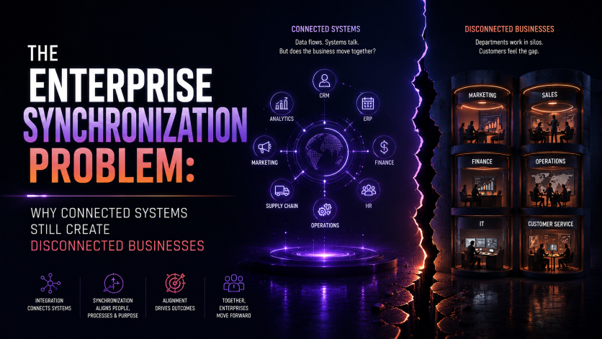
What Is Enterprise Synchronization?
Enterprise Synchronization is becoming a strategic priority for organizations seeking to align technology, people, and processes across the enterprise.For more than two decades, enterprise technology has pursued a single objective: integration. Organizations invested heavily in Enterprise Resource Planning (ERP) systems, Customer Relationship Management (CRM) platforms, Human Resource Management Systems (HRMS), cloud applications, APIs, middleware, marketing automation, business intelligence platforms, and countless SaaS solutions with the expectation that connecting business systems would naturally create connected businesses.
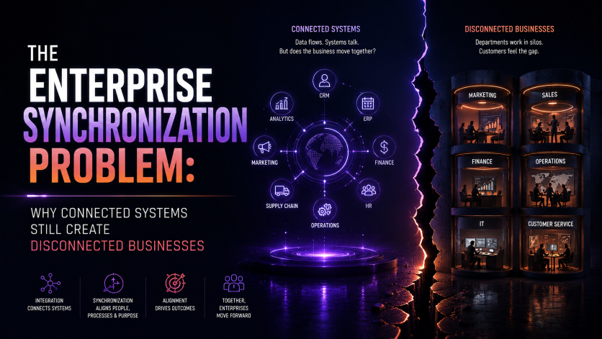
Today, many organizations have successfully achieved this technical integration. Customer data flows automatically between applications, financial systems communicate with procurement platforms, HR software synchronizes employee records, marketing automation shares leads with sales teams, and cloud infrastructure enables information to move across departments in real time. From a technological perspective, enterprises have never been more connected. Yet despite this remarkable progress, many businesses continue to experience operational fragmentation.
Departments pursue conflicting priorities, customer experiences remain inconsistent, decision-making is delayed, duplicate work persists, and cross-functional collaboration frequently depends on manual coordination. The problem is no longer that systems cannot communicate. The problem is that businesses themselves remain out of sync. This emerging challenge represents the Enterprise Synchronization Problem, where technical integration has advanced faster than organizational alignment.
Enterprise Synchronization vs. Enterprise Integration
Unlike traditional integration, Enterprise Synchronization ensures that every department works toward shared business goals rather than isolated objectives.Integration and synchronization are often treated as interchangeable concepts, but they represent fundamentally different capabilities. Integration focuses on connecting technology so that information can move between systems. Synchronization ensures that people, processes, decisions, objectives, and workflows move together toward shared business outcomes.
An integrated CRM can automatically transfer leads into a sales platform, but synchronization determines whether marketing generated the right prospects, whether sales understands campaign objectives, whether operations is prepared to deliver, whether customer success receives sufficient implementation context, and whether leadership measures success using common business metrics. Integration enables communication between software. Synchronization enables coordination between the people using that software.
The rapid growth of enterprise applications has unintentionally amplified this distinction. Organizations continue adding specialized tools designed to optimize individual functions. Marketing adopts advanced automation platforms, finance deploys predictive forecasting systems, HR introduces AI-powered talent solutions, customer service implements intelligent support assistants, while operations modernizes workflow automation. Each investment improves departmental efficiency, yet every additional application also creates another operational perspective with its own objectives, workflows, dashboards, and performance indicators. The enterprise becomes technologically sophisticated but strategically fragmented because optimization occurs locally rather than collectively. Every department performs better individually while the organization struggles to perform better as a unified system.
How AI Improves Enterprise Synchronization
AI plays a crucial role in Enterprise Synchronization by identifying workflow gaps, aligning decisions, and improving cross-functional collaboration.Artificial intelligence is making this challenge even more visible. AI thrives on connected data, making it exceptionally effective at analysing information across multiple enterprise systems. However, when organizational priorities remain misaligned, AI merely exposes existing fragmentation rather than resolving it. An AI-powered forecasting engine may recommend increasing production based on market demand, while finance simultaneously reduces operational budgets, procurement delays supplier approvals, and HR postpones hiring because each department optimizes different objectives. Every recommendation appears individually rational, yet collectively they create organizational friction. AI cannot synchronize decisions if the enterprise itself lacks synchronized priorities.
Enterprise Synchronization and Customer Experience
Organizations that invest in Enterprise Synchronization deliver more consistent customer experiences because every team operates with the same business context.This issue becomes particularly significant during customer journeys. Modern B2B customers rarely interact with a single department. They discover organizations through marketing campaigns, engage with sales representatives, negotiate with procurement teams, collaborate with implementation specialists, communicate with customer success managers, and receive ongoing support from service teams.
Although each interaction may be supported by connected technology, the overall customer experience often feels inconsistent because every department interprets customer needs differently. Marketing promises rapid implementation, sales negotiates customized agreements, operations prioritizes efficiency, while customer success focuses on long-term adoption. These perspectives are individually reasonable but collectively fragmented. Customers experience one company, while internally the organization behaves like multiple independent businesses.
One of the primary causes of the Enterprise Synchronization Problem is the persistence of departmental performance measurement. Organizations frequently reward teams according to localized objectives. Marketing measures lead generation, sales measures revenue, finance measures cost control, HR measures retention, IT measures uptime, and customer support measures resolution time. While these metrics remain valuable, they encourage departments to optimize for individual success rather than enterprise outcomes. Technology integration cannot overcome structural incentives encouraging different parts of the organization to move at different speeds toward different priorities. Synchronization therefore requires shared objectives extending beyond functional boundaries.
The rise of event-driven enterprise architecture offers an important step toward addressing this challenge. Traditional integration primarily transfers data between applications after specific actions occur. Event-driven systems go further by enabling entire organizations to respond collectively when meaningful business events take place. A new customer contract automatically triggers on boarding preparation, inventory planning, implementation scheduling, financial forecasting, workforce allocation, compliance reviews, and customer success engagement simultaneously rather than sequentially. The enterprise behaves like a coordinated ecosystem rather than a collection of isolated workflows. Information no longer simply moves between systems; coordinated action follows immediately across the organization.
Artificial intelligence may ultimately become one of the most powerful synchronization technologies rather than merely another automation tool. Instead of optimizing individual business functions independently, future AI systems could continuously monitor enterprise-wide objectives, detect conflicting priorities, identify operational bottlenecks, recommend cross-functional interventions, and coordinate workflows across departments. An AI platform might recognize that a delayed procurement decision threatens customer on boarding, automatically notify relevant stakeholders, adjust project schedules, update financial forecasts, and recommend resource reallocations before disruption occurs. Intelligence shifts from optimizing individual tasks to optimizing organizational coordination.
However, technology alone cannot solve synchronization challenges because synchronization is fundamentally a leadership responsibility. Executives often oversee highly integrated technology environments while managing organizations structured around independent departments with separate reporting relationships, budgets, incentives, and priorities. Leaders must increasingly design operating models emphasizing shared accountability rather than functional optimization. The objective changes from asking, “How efficiently does each department perform?” to “How effectively does the entire organization move together?” This perspective fundamentally redefines enterprise management in the AI era.
The Enterprise Synchronization Problem also transforms the role of data. Traditionally, organizations viewed data primarily as an informational asset supporting reporting and analytics. Increasingly, data functions as the operational language through which departments coordinate decisions. Accurate, timely, and consistently governed information enables synchronized action because every stakeholder works from the same understanding of business reality. Poor data quality therefore creates more than reporting errors; it creates organizational misalignment where departments make reasonable decisions based on inconsistent information. Synchronization depends as much on shared understanding as technological connectivity.
Customer expectations further accelerate the need for synchronization. Enterprise buyers increasingly expect organizations to operate as unified partners regardless of internal structure. Customers assume sales representatives understand implementation processes, support teams recognize previous commercial discussions, finance resolves billing issues without requiring repeated explanations, and executives possess complete visibility into ongoing relationships. Every disconnected interaction weakens customer confidence because it suggests the organization coordinates internally less effectively than its technology promises externally. Businesses therefore compete not only through product quality but also through the seamless coordination customers experience throughout their relationship.
Workforce dynamics also contribute to this transformation. Hybrid work, global teams, AI-assisted collaboration, and distributed decision-making reduce opportunities for informal coordination traditionally achieved through face-to-face conversations. Synchronization increasingly depends on intelligent workflows, shared digital environments, standardized processes, and transparent communication rather than physical proximity. Organizations capable of coordinating distributed teams effectively gain resilience that extends far beyond technology infrastructure.
Performance measurement will inevitably evolve alongside these changes. Future enterprises may increasingly evaluate synchronization through metrics such as cross-functional response time, decision alignment, workflow continuity, implementation coordination, customer journey consistency, and enterprise-wide execution speed rather than relying exclusively on departmental efficiency indicators. These measurements recognize that business value increasingly emerges from coordinated action instead of isolated excellence. A perfectly optimized department contributes limited value if the surrounding organization cannot move with comparable speed and direction.
The Future of Enterprise Synchronization
The Enterprise Synchronization Problem ultimately reflects the next stage of digital transformation. The first era focused on digitizing information. The second connected systems through integration. The third optimized individual processes using automation and artificial intelligence. The next competitive frontier is synchronizing entire enterprises so that technology, people, decisions, workflows, and strategic priorities operate as a single coordinated ecosystem. Organizations that achieve this level of alignment will respond to market changes faster, deliver more consistent customer experiences, implement innovation more efficiently, and adapt more effectively to continuous disruption.
The future of enterprise technology will therefore be defined not by how many systems an organization integrates but by how intelligently those systems enable the business to move together. Because in the next generation of digital transformation, competitive advantage will not belong to the companies with the most connected software. It will belong to the companies with the most synchronized business.