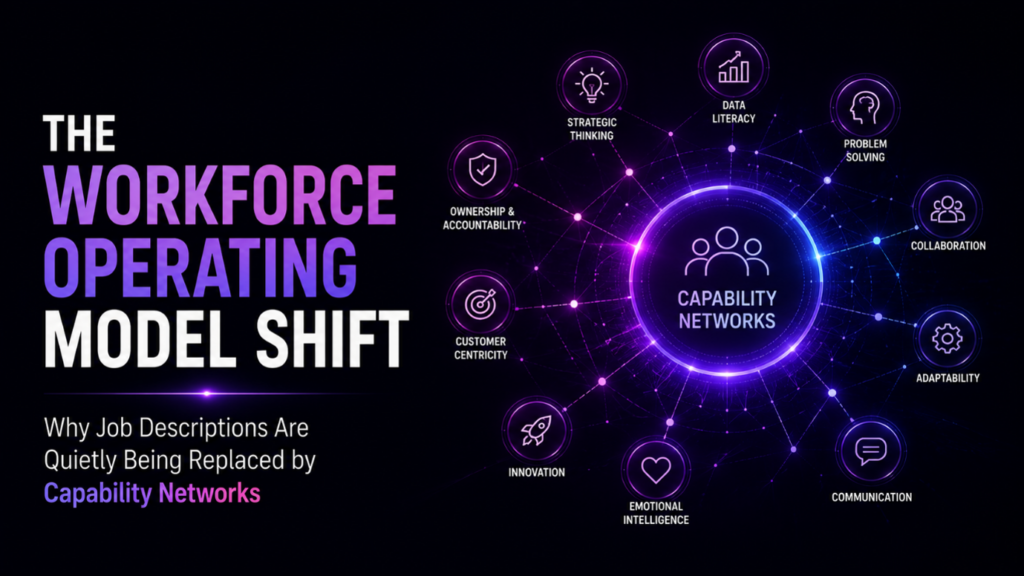
The Workforce Operating Model Shift is transforming how organizations structure talent, replacing traditional job descriptions with capability-driven workforce models. For more than a century, organizations have been built around one of the most stable concepts in management. Every employee was hired into a predefined role with clearly documented responsibilities, reporting structures, performance expectations, and departmental boundaries. Human Resources created organizational charts, managers assigned responsibilities based on titles, and careers progressed through increasingly senior versions of the same function. This operating model served businesses remarkably well during an era when markets changed gradually, technologies evolved predictably, and organizational structures remained relatively stable for years.
Today, however, that model is beginning to show significant limitations. Artificial intelligence, digital transformation, cross-functional work, and rapidly changing business priorities have made rigid job definitions increasingly incompatible with modern enterprise needs. Organizations are discovering that the work required tomorrow often bears little resemblance to the responsibilities defined during hiring. As a result, businesses are entering what can be described as the Workforce Operating Model Shift, where competitive advantage no longer depends on filling predefined roles but on dynamically deploying organizational capabilities wherever they create the greatest value.This rapid evolution is one of the primary drivers behind the Workforce Operating Model Shift.
What Is the Workforce Operating Model Shift?
One of the primary reasons for this transformation is the accelerating pace of business change. New technologies emerge every quarter, customer expectations evolve continuously, regulations shift unexpectedly, and entirely new business models appear faster than organizations can redesign their structures. A marketing executive today may need to understand artificial intelligence, data analytics, customer experience, automation platforms, and revenue operations alongside traditional branding expertise.
Sales professionals increasingly collaborate with customer success, product teams, and marketing throughout the buying journey. HR leaders now influence digital transformation, organizational design, workforce analytics, and AI governance rather than focusing exclusively on recruitment and employee engagement. The boundaries separating departments are steadily dissolving because business problems themselves have become cross-functional. Static job descriptions struggle to accommodate this level of continuous evolution.
How Artificial Intelligence Is Accelerating the Workforce Operating Model Shift
Artificial intelligence is significantly accelerating the Workforce Operating Model Shift by automating routine and knowledge-intensive tasks. AI is capable of performing many routine, repeatable, and knowledge-intensive activities that traditionally defined specific roles. Report generation, documentation, scheduling, data analysis, first-level customer support, market research, content creation, coding assistance, compliance monitoring, and administrative coordination are increasingly handled by intelligent systems. As AI absorbs these responsibilities, the remaining work becomes more strategic, collaborative, and contextual. Employees are no longer defined by repetitive tasks but by their ability to solve complex problems, connect diverse perspectives, and adapt to changing priorities. Consequently, organizations begin valuing capabilities rather than narrowly defined responsibilities.
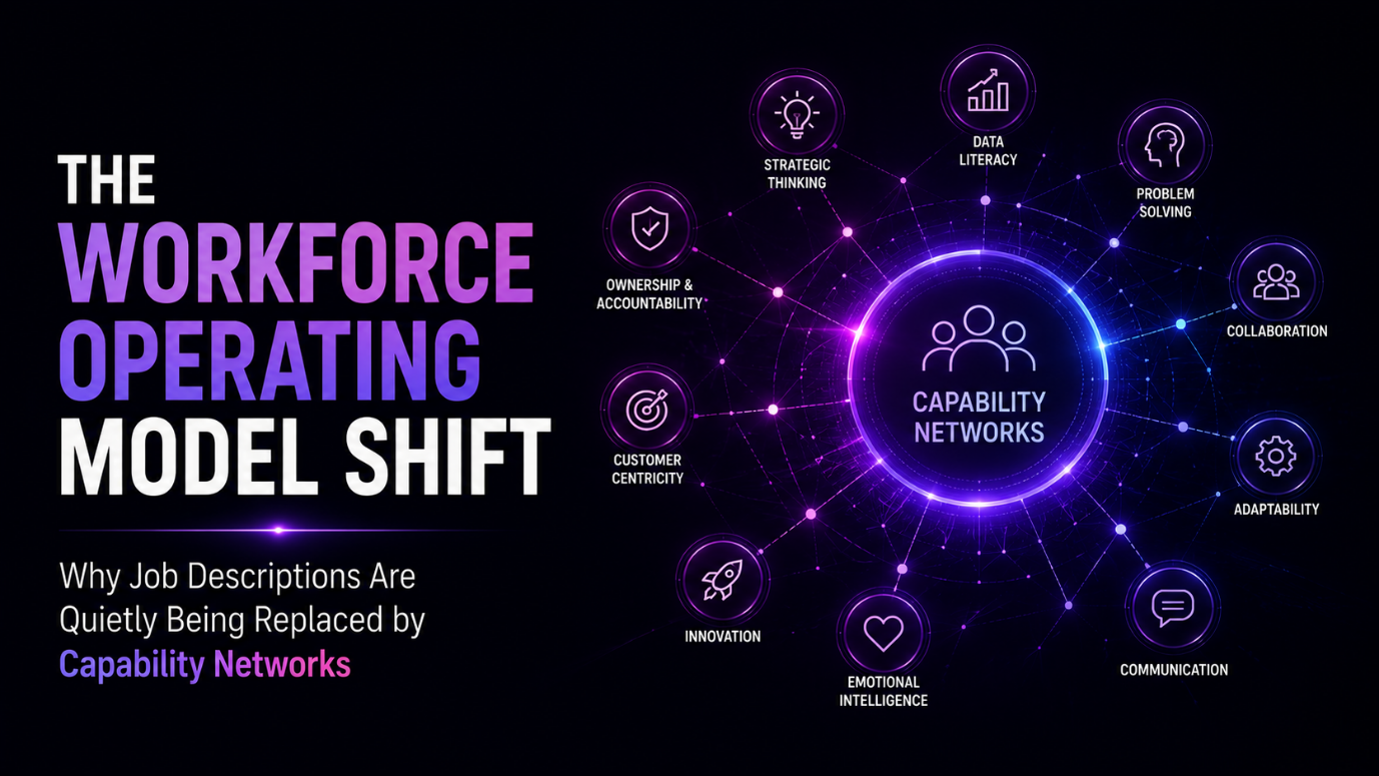
The Workforce Operating Model Shift introduces the concept of capability networks. Instead of viewing employees as fixed resources assigned permanently to individual departments, businesses increasingly view them as collections of capabilities that can be deployed across multiple initiatives. A finance professional with strong analytical thinking may contribute to product strategy. A marketing manager experienced in customer research may support HR’s employer branding initiatives.
An engineer with communication skills may participate in enterprise sales presentations. Rather than asking, “Which department owns this project?” organizations increasingly ask, “Which combination of capabilities will solve this problem most effectively?” Teams become fluid, assembling around business outcomes instead of organizational charts.Recruitment strategies are evolving because of the Workforce Operating Model Shift, with organizations prioritizing capabilities over fixed job roles.
How the Workforce Operating Model Shift Is Transforming Recruitment
The implications for recruitment are substantial. Traditional hiring focused heavily on matching candidates to detailed job descriptions listing specific responsibilities, years of experience, technical skills, and industry knowledge. While these criteria remain relevant, they no longer predict long-term success in rapidly changing organizations. Forward-thinking employers increasingly prioritize adaptability, learning agility, systems thinking, collaboration, communication, and problem-solving because these capabilities remain valuable regardless of how individual roles evolve. Candidates are hired not simply for today’s responsibilities but for their ability to contribute across tomorrow’s challenges. Recruitment gradually shifts from role matching toward capability identification.
Under the Workforce Operating Model Shift, learning and development undergo a profound transformation. Historically, employee training focused on deepening expertise within existing functional roles. Sales professionals attended sales training, marketers learned marketing technologies, HR teams studied employment regulations, and IT departments mastered technical systems. The Workforce Operating Model Shift requires a broader approach.
Employees increasingly develop adjacent capabilities that enable them to collaborate effectively across disciplines. Technical specialists strengthen business acumen, business leaders improve digital literacy, marketers learn data interpretation, finance professionals develop communication skills, and managers build AI fluency. Continuous capability expansion becomes more valuable than functional specialization alone because organizational priorities evolve faster than formal job structures can adapt.Leadership is becoming a key success factor in the Workforce Operating Model Shift.
Leadership in the Workforce Operating Model Shift
Leadership responsibilities change equally dramatically. Managers have traditionally supervised teams performing similar functions with relatively predictable workflows. In capability-driven organizations, leaders become orchestrators of talent rather than supervisors of departments. Their primary responsibility shifts toward identifying the right mix of capabilities required for emerging business priorities, enabling cross-functional collaboration, removing organizational barriers, and continuously reallocating talent where it generates the highest value. Leadership success increasingly depends on developing adaptable teams rather than maintaining rigid organizational structures.
Technology plays a critical enabling role in this new operating model. Workforce intelligence platforms, AI-powered skills mapping, internal talent marketplaces, and capability analytics allow organizations to understand not only employees’ official job titles but also their hidden strengths, experiences, certifications, interests, and adjacent competencies. AI can recommend internal project assignments, identify capability gaps, suggest learning pathways, and assemble multidisciplinary teams far more effectively than traditional organizational planning methods. Human Resources evolves from managing organizational structures to managing organizational capability ecosystems.These technologies are accelerating the Workforce Operating Model Shift across modern enterprises.
The Workforce Operating Model Shift also changes how career progression is defined. Traditional career paths followed hierarchical ladders, with employees advancing through increasingly senior titles within a single function. Future careers become portfolio-based rather than ladder-based. Employees accumulate experiences across departments, projects, industries, and technologies, creating diverse capability profiles instead of linear promotion histories. Career growth is measured not only by title changes but by expanding influence, broader business understanding, and increasing adaptability. Organizations benefit because employees develop holistic perspectives that improve innovation and cross-functional decision-making.
This transformation has significant cultural implications as well. Businesses built around rigid departmental identities often experience information silos, duplicated efforts, and limited collaboration. Capability-based organizations encourage openness, knowledge sharing, and continuous learning because employees are recognized for what they can contribute rather than where they formally belong. Collaboration becomes a structural advantage rather than an occasional initiative. Innovation accelerates because diverse expertise naturally converges around business challenges without being constrained by organizational boundaries.This collaborative culture is a defining characteristic of the Workforce Operating Model Shift.
Performance management inevitably evolves alongside this shift. Traditional appraisal systems measured employees against predefined role expectations established months or even years earlier. In rapidly changing environments, these measures become increasingly outdated. Organizations begin evaluating employees based on adaptability, collaboration, capability growth, strategic contribution, learning velocity, and organizational impact alongside traditional performance metrics. Success becomes less about fulfilling static responsibilities and more about enabling business resilience amid continuous change.Organizations embracing the Workforce Operating Model Shift are redefining performance management around adaptability and continuous learning.
Artificial intelligence reinforces this model because it democratizes access to knowledge across the organization. Employees no longer need to possess every technical answer themselves; AI provides immediate access to expertise, documentation, and analytical support. Human value therefore shifts toward interpreting information, exercising judgment, collaborating effectively, and applying capabilities creatively to unfamiliar situations. The competitive workforce is no longer composed of individuals who perform narrowly defined tasks exceptionally well. It consists of professionals capable of combining technology with human adaptability to solve increasingly complex business problems.AI continues to strengthen the Workforce Operating Model Shift by supporting intelligent decision-making and capability development.
Looking ahead, organizations will continue facing environments characterized by technological disruption, economic uncertainty, evolving customer expectations, and constant competitive change. Under these conditions, rigid organizational structures become liabilities rather than strengths. Businesses capable of deploying talent dynamically through capability networks will respond faster to market opportunities, innovate more effectively, and adapt more successfully than competitors dependent upon static workforce models. Businesses adopting the Workforce Operating Model Shift can respond more quickly to market changes and emerging opportunities.
Why the Workforce Operating Model Shift Is the Future of Work
Ultimately, the Workforce Operating Model Shift represents one of the most significant changes in the future of work. As the Workforce Operating Model Shift continues to reshape organizations, enterprises will move beyond traditional job descriptions toward intelligent capability networks. Companies that embrace the Workforce Operating Model Shift will build more agile, resilient, and innovative workforces, positioning themselves for long-term success in an AI-driven business environment.