AI answer verification is becoming essential for businesses that want to make reliable decisions using artificial intelligence. Teams can use AI to summarise lengthy documents, identify patterns in customer behaviour, compare business performance, draft marketing strategies, and support decisions across departments. What once required several tools and multiple rounds of analysis can now happen within minutes.
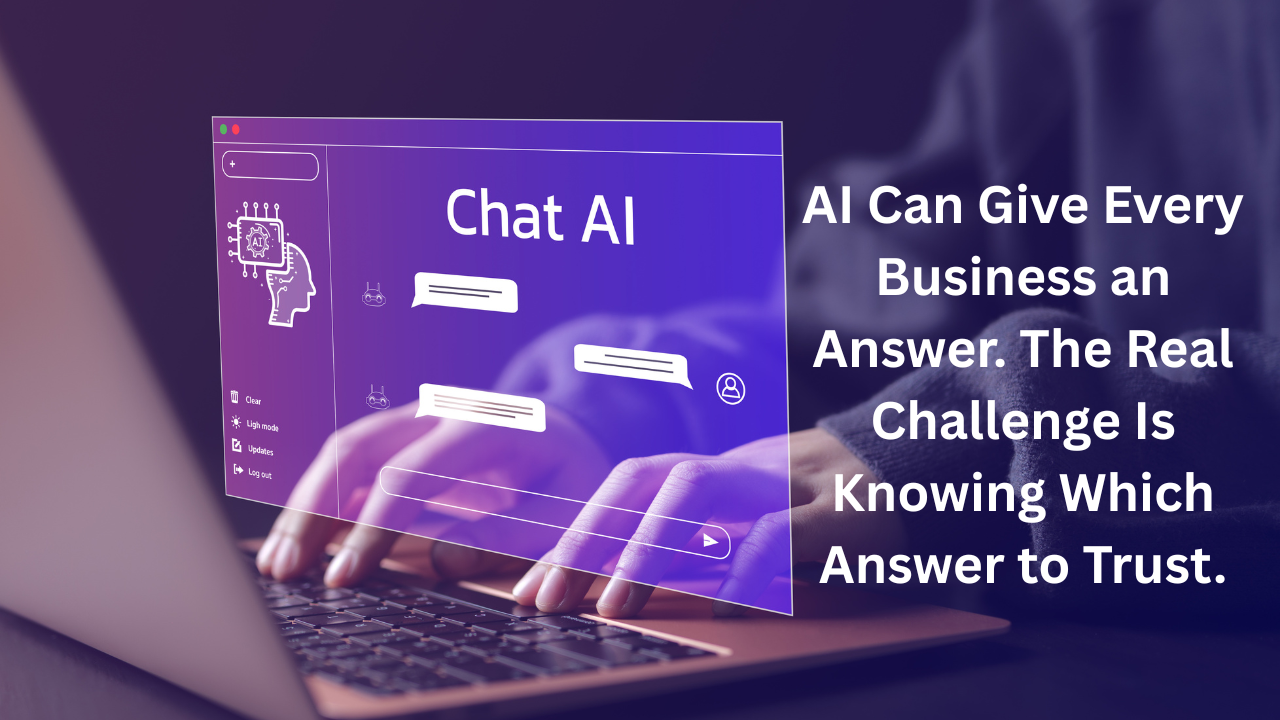
This speed is changing how organisations operate, but it is also creating a new challenge that many businesses are only beginning to understand: getting an answer quickly does not necessarily mean getting the right answer. As AI becomes more accessible, the real advantage will not belong only to companies that use it extensively, but to those that know how to evaluate its output, recognise its limitations, and apply it in the right business context.
Why AI Answer Verification Matters for Businesses
One of the biggest reasons AI-generated answers can be misleading is that they often sound confident even when the information behind them is incomplete, outdated, or incorrect. A well-written response can create the impression that a subject has been thoroughly analysed, even when important details have been missed. For example, a marketing team might ask an AI tool to recommend a campaign strategy for a new product and receive a detailed plan covering audience targeting, messaging, advertising channels, and expected results.AI answer verification helps businesses identify these issues before they affect important decisions.
The recommendations may appear logical, but they could overlook the company’s actual budget, the maturity of its target market, the strength of its competitors, or the specific concerns of its customers. Similarly, a finance team might use AI to interpret performance data without realising that an unusual transaction or a change in reporting methods has affected the results. In both situations, the problem is not necessarily the technology itself. The problem is treating a plausible answer as a verified conclusion without examining the assumptions behind it.
This is why context has become one of the most important factors in using AI effectively. Businesses do not make decisions based on information alone; they make decisions based on information connected to their goals, customers, resources, risks, and operating conditions. Two companies can analyse similar data and reach completely different conclusions because their circumstances are different. A strategy that works for a large organisation with an established customer base may not work for a growing company trying to enter a competitive market.
An AI tool can identify patterns and suggest possible explanations, but it may not automatically understand every internal factor that influences a decision. The quality of its recommendations depends heavily on the quality of the information it receives, the clarity of the question being asked, and the limitations of the system being used. When businesses provide vague instructions or incomplete data, they increase the likelihood of receiving generic recommendations that sound useful but offer little practical value. Better results begin when teams define the problem clearly, provide relevant information, and explain what a successful outcome should look like.Effective AI answer verification also ensures that recommendations align with business goals and real-world conditions.
Another challenge is that AI can make existing mistakes travel faster through an organisation. In the past, a weak assumption might have remained limited to one report or one department until someone questioned it. Today, an AI-generated insight can quickly become a presentation, a sales recommendation, a marketing campaign, or an operational decision. If the original information is inaccurate, the mistake can spread across several activities before anyone notices it.
Consider a sales team using AI to prioritise potential customers based on historical conversion data. If that data reflects an outdated sales process or excludes an important customer segment, the system may recommend focusing on the wrong opportunities. The team might then spend time pursuing accounts that are unlikely to convert while overlooking customers with stronger potential. Because the recommendation is supported by data and presented in a structured format, employees may be less likely to question it.
This makes verification an essential part of the process rather than a final step that can be skipped when deadlines are tight. AI can accelerate the movement of information, but businesses must ensure that accuracy keeps pace with speed. Consistent AI answer verification allows sales and marketing teams to check recommendations before committing valuable resources.
Human judgement remains important because business decisions involve more than finding patterns in data. They often require understanding emotions, relationships, organisational priorities, ethical concerns, and consequences that are difficult to measure. An AI system might recommend reducing customer support costs by automating a large share of customer interactions, but it may not fully account for the frustration customers experience when they cannot reach a person to resolve a complicated issue.
A recruitment tool might identify candidates whose profiles closely match a job description, but it may overlook transferable skills, potential for growth, or experience that has been described differently from the expected criteria. A financial model might suggest cutting a particular expense, while a manager understands that the spending is essential to maintaining employee morale or protecting a long-term customer relationship. These examples demonstrate why human oversight should not be viewed as an obstacle to automation. Human oversight is a critical part of AI answer verification because business decisions require context, accountability, and professional judgement.
It is the process through which recommendations are evaluated against real-world conditions, business values, and long-term objectives. The most effective approach is to let AI handle tasks where it can provide meaningful support while ensuring that people remain responsible for decisions that require deeper understanding and accountability.
Businesses also need to develop a culture in which employees feel comfortable questioning AI-generated recommendations. When a tool becomes part of everyday work, its output can gradually be treated as the default answer rather than one possible interpretation of the available information. Employees may accept a recommendation because it saves time, because it appears more analytical than their own judgement, or because challenging it seems unnecessary.
Over time, this can weaken critical thinking and create excessive dependence on automated systems. Organisations can avoid this by establishing clear expectations about when AI output must be checked, which sources should be used for verification, what information should never be entered into external tools, and who remains accountable for the final decision.
Teams should also be encouraged to ask practical questions: What evidence supports this recommendation? What information might be missing? Are there alternative explanations? What could happen if the recommendation is wrong? These questions do not reduce the value of AI; they help employees use it with greater confidence and discipline. Training should therefore focus not only on how to operate AI tools, but also on how to evaluate their output and recognise situations in which human expertise is essential. Regular AI answer verification also helps employees identify unreliable information and make more informed decisions.
The next stage of AI adoption will increasingly depend on how well businesses combine technological capability with reliable decision-making processes. Simply providing employees with access to AI tools is not enough to guarantee better results. Organisations must identify where AI can create genuine value, establish measurable goals, improve the quality of their data, and determine how its recommendations will be reviewed before being acted upon.
For routine tasks, verification may involve checking a few key facts or comparing the output with an approved source. For decisions involving significant financial commitments, customer privacy, recruitment, legal obligations, or business risk, the review process may need to be more structured and involve the appropriate specialists. Businesses should also assess outcomes rather than assume that faster execution automatically means improved performance.
If AI helps a team produce more reports but those reports do not improve decisions, the organisation may be measuring the wrong kind of progress. The objective should be to use technology to improve the quality, consistency, and relevance of work, not simply to increase the amount of output produced.
Ultimately, AI is changing the relationship between information and action. Access to answers is becoming easier, but understanding which answers deserve attention is becoming more important. As more businesses adopt similar tools, the ability to generate a report, draft a strategy, or summarise a dataset will become less of a competitive advantage on its own.
The difference will come from how intelligently organisations interpret the information available to them, how effectively they combine machine-generated insights with human experience, and how carefully they evaluate the consequences of their decisions.
Companies that treat AI as an unquestionable authority may move quickly in the wrong direction, while those that treat it as a capable assistant can use its speed without surrendering their responsibility to think critically. The real AI advantage is not having an answer for every question. By making AI answer verification part of everyday workflows, businesses can build greater confidence in AI-assisted decisions.It is knowing how to question the answers before turning them into action.