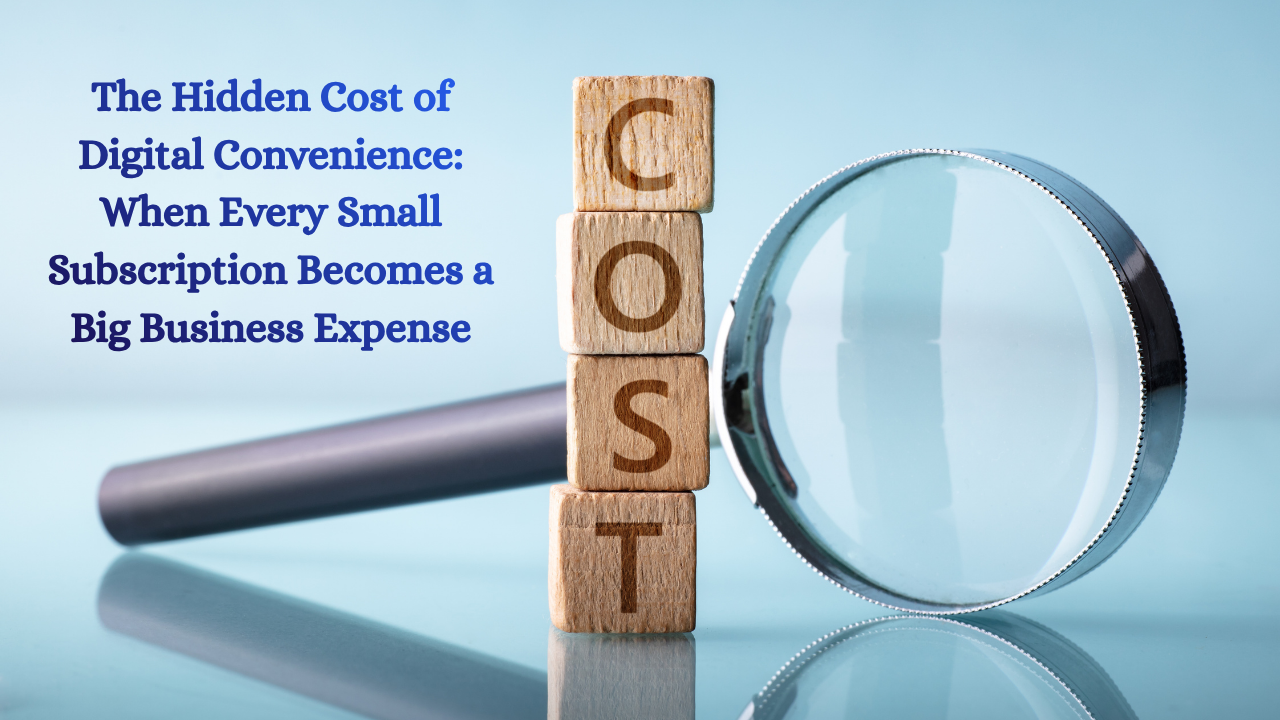
Businesses increasingly depend on digital tools to improve productivity, streamline workflows, manage customer relationships, and support data-driven decisions. From project management platforms and communication applications to analytics software and artificial intelligence tools, subscriptions have become an integral part of modern business operations. However, while each purchase may seem affordable on its own, the cumulative cost of maintaining multiple subscriptions can become a significant financial burden.
The challenge is not simply the amount businesses spend on technology. It is the lack of visibility into where that money goes, which applications deliver measurable value, and whether employees are paying for capabilities the organisation already has. Without a structured approach to software subscription management, seemingly minor recurring expenses can quietly expand across departments, creating unnecessary costs and operational complexity. Effective software subscription management enables businesses to understand their recurring technology expenses, identify unnecessary purchases, and make better decisions about software investments. It helps organisations control costs while ensuring that every application delivers meaningful business value.
For enterprise leaders, IT managers, finance teams, and procurement professionals, understanding these hidden expenses is essential. By reviewing software usage, eliminating unnecessary licences, consolidating overlapping applications, and establishing clear purchasing policies, businesses can maintain access to valuable technology while making smarter financial decisions.
Why Software Spending Becomes Difficult to Control
Software subscriptions often begin with a legitimate business requirement. A marketing team needs better campaign analytics, a sales department wants improved customer engagement tracking, or an operations team requires a new project management platform. Purchasing a specialised application can be a practical way to address an immediate challenge.
The difficulty emerges when these decisions happen independently. Each department may choose its preferred solution without knowing which tools other teams already use. Over time, the organisation develops a fragmented technology environment in which multiple applications perform similar functions, but no one has a complete picture of the total expenditure.
Effective software subscription management helps businesses move beyond individual purchasing decisions and evaluate technology spending across the organisation.
Common reasons for uncontrolled software spending include:
- Decentralised purchasing: Departments acquire applications using separate budgets and approval processes.
- Automatic renewals: Subscriptions continue even after their original purpose has disappeared.
- Overlapping functionality: Different applications provide similar features, creating unnecessary duplication.
- Temporary tools that become permanent: Applications purchased for short-term projects remain active indefinitely.
- Limited visibility: Finance and IT teams lack a central record of subscriptions, costs, owners, and usage.
For example, a marketing department might pay for an analytics platform while the sales team uses another application with comparable reporting capabilities. Both tools may be useful individually, but the organisation should assess whether maintaining both provides enough additional value to justify the combined expense.
The objective is not to eliminate every specialised application. It is to ensure that each subscription has a clear business purpose and an accountable owner. Software subscription management gives businesses better control over how applications are purchased, used, and renewed. By maintaining a central record of software expenses, organisations can identify unnecessary subscriptions, reduce duplicate purchases, and ensure that technology spending remains aligned with business goals. Implementing software subscription management allows organisations to monitor technology purchases across different departments. Instead of allowing each team to select applications independently, businesses can evaluate existing tools, compare available features, and make purchasing decisions that support their overall technology strategy.
The Real Financial Impact of Small Subscriptions
Small recurring payments can appear insignificant when reviewed individually. However, their cumulative effect becomes much more visible when organisations examine annual expenditure across multiple applications and departments.
Consider a business paying for 20 different applications, each costing ₹999 per month.
Illustrative subscription cost breakdown
Monthly expense
₹19,980
Annual expense
₹2,39,760
Calculation: 20 applications × ₹999 per month. Excludes taxes, additional licences, premium features, price increases, and indirect operating costs. Effective software subscription management helps finance teams understand the complete cost of maintaining business applications. By tracking recurring payments, additional licence fees, and implementation expenses, organisations can create more accurate budgets and identify opportunities to improve spending efficiency.
This example demonstrates how an apparently modest monthly commitment can become a meaningful annual expense. In a larger enterprise, the total may increase as departments add users, adopt additional platforms, and upgrade to higher subscription tiers.
The subscription price is only part of the financial picture. Businesses must also account for the resources required to implement, operate, and maintain their applications.
These additional costs may include:
- Employee onboarding and training.
- Implementation, configuration, and data migration.
- Integration development and ongoing maintenance.
- Time spent switching between applications and reconciling information.
- Administrative effort required to manage vendors, renewals, and access permissions.
A tool that appears inexpensive may deliver limited financial value if employees spend considerable time transferring data between disconnected systems. For this reason, SaaS cost optimization should consider the total cost of ownership rather than focusing exclusively on monthly invoices. Software subscription management helps businesses track monthly and annual expenses, identify unnecessary spending, and improve their technology budgets. Regular reviews also help companies understand whether their software investments justify their ongoing costs.
The Hidden Cost of Unused Software Licences
Unused licences are one of the most straightforward opportunities for reducing unnecessary technology expenditure. Many software providers charge according to the number of users, allowing organisations to purchase access for entire teams even when only some employees actively use the application.
Over time, circumstances change. Employees leave, responsibilities shift, projects end, and teams adopt different workflows. Yet software access may remain active long after the original requirement has disappeared.
Without regular monitoring, organisations can continue paying for licences that provide little or no business value. Effective software subscription management allows IT teams to identify unused licences, remove unnecessary access, and reassign available licences to employees who need them.

Why unused licences remain active
Several operational issues contribute to this problem:
- Unclear ownership: No individual is responsible for reviewing the subscription or its users.
- Employee transitions: Access is not removed when someone leaves or changes roles.
- Infrequent usage reviews: Organisations do not routinely compare licence allocations with actual activity.
- Automatic renewals: Inactive accounts remain billable because renewal dates pass without scrutiny.
- Changing business needs: Applications purchased for specific projects are retained after the work is complete.
Software licence management can address these issues by establishing a clear process for assigning, reviewing, reallocating, and removing access.
Before cancelling licences, organisations should confirm whether the application is needed for occasional but important tasks, whether other systems depend on it, and whether historical data must be retained. Low activity alone does not necessarily mean a tool is unnecessary.
A more reliable approach combines usage information with employee feedback, business requirements, and upcoming project plans. This helps businesses reduce waste without accidentally removing tools that support critical operations.
How Disconnected Applications Increase Operational Complexity
The cost of a fragmented technology stack extends beyond subscription fees. When employees rely on multiple applications to complete related tasks, information can become scattered across systems, making everyday work more difficult.
For instance, a sales team might store customer information in a CRM, discuss opportunities through messaging software, maintain activity reports in spreadsheets, and share proposals through a separate document platform. If these systems are poorly integrated, employees may need to enter the same information repeatedly or search across several applications to locate the latest update.
These inefficiencies can reduce the value businesses expect from their technology investments. A well-planned software subscription management strategy helps organisations evaluate whether their applications work effectively together. It also enables IT managers to identify overlapping features, simplify workflows, and reduce the operational burden created by disconnected software systems.

The business consequences of software sprawl
An unnecessarily complex technology environment can create several challenges:
- Data fragmentation: Information is distributed across multiple systems, making it harder to establish a consistent view of business activity.
- Duplicated effort: Employees repeatedly enter, update, or reconcile the same information.
- Integration overhead: Connecting applications introduces development, maintenance, and troubleshooting requirements.
- Reduced visibility: Managers struggle to evaluate performance when relevant information sits in disconnected platforms.
- Inconsistent processes: Different departments develop separate ways of working, complicating collaboration.
Consolidating applications can help, but replacing every specialised tool with one large platform is not always the right answer. Some applications provide capabilities that a broader enterprise system cannot adequately replicate.
The better approach is to assess the technology environment as a whole. Organisations should identify where integration is genuinely necessary, where capabilities overlap, and where a simpler workflow could eliminate the need for additional software.
How AI Adoption Is Creating New Subscription Challenges
Artificial intelligence is expanding the range of digital tools available to employees. Businesses can now explore applications for writing assistance, document summarisation, data analysis, presentation creation, image generation, customer support, and workflow automation.
These capabilities can improve productivity, but they also introduce another potential source of unmanaged subscription spending.
Different departments may independently adopt AI applications that offer similar features. Employees may purchase individual plans to solve immediate problems, while the organisation already has access to comparable capabilities through an approved enterprise platform.
The result can be duplicated spending and uncertainty about which tools employees should use. Software subscription management is becoming increasingly important as businesses introduce AI-powered applications into their daily operations. Reviewing these subscriptions helps organisations identify duplicate capabilities, monitor spending, and ensure that new tools meet business requirements without creating unnecessary financial or security risks.
Managing AI subscriptions responsibly
AI adoption also requires careful consideration of information security and governance. Before approving a tool, businesses should understand how it handles company information, what data retention policies apply, which access controls are available, and whether its terms meet relevant organisational requirements.
A practical review should ask:
- Does an existing application already provide the required AI capability?
- What specific business problem will the new tool solve?
- Will employees use it regularly enough to justify its cost?
- Is the application suitable for the data employees intend to process?
- How will the organisation measure productivity improvements or other benefits?
Software subscription management should support innovation rather than prevent it. A well-defined approval process gives employees room to experiment while helping the organisation avoid unnecessary duplication, uncontrolled spending, and avoidable security risks.
7 Powerful Ways to Improve Software Subscription Management
Controlling software expenditure requires more than cancelling a few unused applications. Businesses need a repeatable process that connects purchasing decisions, licence usage, financial oversight, and business outcomes.
The following strategies provide a practical starting point.
1. Create a central inventory of subscriptions
Begin by documenting every active software subscription across the organisation. Include applications purchased by IT, finance, marketing, sales, operations, and individual teams.
The inventory should record:
- Application and vendor name.
- Monthly and annual subscription costs.
- Number of purchased and assigned licences.
- Department and accountable application owner.
- Contract terms and renewal dates.
- Intended business purpose and available alternatives.
A central inventory creates visibility and gives decision-makers a reliable foundation for identifying unnecessary expenditure.
2. Review actual usage before renewing
Compare purchased licences with available usage information and employee requirements. Identify inactive accounts, underused subscriptions, and applications whose original purpose no longer exists.
Schedule reviews before renewal deadlines so teams have enough time to investigate alternatives and make informed decisions.
Where possible, reassign licences or adjust subscription tiers before purchasing additional access.
3. Identify overlapping applications
Compare tools that serve similar business functions, such as project management, communication, reporting, customer relationship management, and AI-assisted productivity.
Evaluate whether the applications offer genuinely different capabilities or simply duplicate features already available elsewhere.
Consolidation should be based on business fit, usability, security, integration requirements, and total cost—not solely on the number of applications.
4. Establish clear ownership and accountability
Every subscription should have an accountable owner responsible for confirming its purpose, reviewing usage, and participating in renewal decisions.
IT teams can maintain the technical inventory, finance can monitor spending, procurement can manage commercial terms, and department leaders can validate operational requirements.
This shared responsibility prevents subscriptions from continuing indefinitely simply because nobody knows who should review them.
5. Introduce a lightweight purchasing approval process
Employees should be able to request new applications without navigating unnecessarily complicated administrative procedures.
Before approving a purchase, ask:
- What business problem does the application solve?
- Is a suitable capability already available?
- What is the full annual cost?
- Who will use and manage the application?
- What security, privacy, or integration considerations apply?
- What outcomes will demonstrate that the investment is worthwhile?
These questions encourage responsible spending while allowing teams to access tools that genuinely improve their work.
6. Review contracts and negotiate where appropriate
Once the organisation understands its subscription requirements, procurement teams can assess opportunities to improve commercial terms.
Depending on the vendor and contract, these opportunities may include consolidating purchases, adjusting licence quantities, removing unnecessary add-ons, reviewing subscription tiers, or negotiating renewal terms.
Businesses should also examine whether existing enterprise agreements already include capabilities for which departments are paying separately.
Any consolidation or renegotiation should account for contract commitments, migration effort, data portability, and potential disruption.
7. Measure business value, not just cost savings
The lowest-cost technology environment is not necessarily the most effective one. Eliminating a useful application could increase manual work, reduce service quality, or create additional operational risks.
A stronger software subscription management programme measures both financial efficiency and business outcomes.
Useful indicators include:
- Total software expenditure by department and application.
- Licence utilisation and the number of inactive accounts.
- Number of overlapping applications.
- Renewal costs and spending against budget.
- Time saved through automation or improved workflows.
- Employee adoption and user satisfaction.
- Operational issues associated with disconnected systems.
Reviewing these indicators helps organisations determine whether their software investments continue to support business priorities.
Building a Sustainable Software Governance Strategy
Individual cost-saving actions are valuable, but lasting improvements require software spending to become part of regular business governance.
Organisations should establish a consistent review schedule, define purchasing responsibilities, and maintain clear records of applications, users, contracts, and renewal commitments. The process should be proportionate to the size of the business: a smaller organisation may manage subscriptions through a structured spreadsheet, while a larger enterprise may require dedicated SaaS management capabilities.
A practical governance framework should include the following elements:
- Visibility: Maintain an accurate view of software purchases, ownership, and usage.
- Accountability: Assign responsibility for each application and its renewal decisions.
- Consistency: Apply common purchasing and security requirements across departments.
- Flexibility: Allow justified exceptions when specialised tools deliver meaningful value.
- Continuous improvement: Reassess technology spending as teams, processes, and business priorities change.
Organisations should also communicate the purpose of these reviews clearly. Employees are more likely to support cost optimisation when they understand that the objective is to remove unnecessary complexity, not restrict access to useful tools.
Over time, this approach helps create a technology environment that is easier to manage, more transparent, and better aligned with organisational goals. Strong software subscription management also requires ongoing collaboration between IT, finance, procurement, and department managers. When these teams share information about application usage, contract renewals, and business priorities, organisations can make more consistent purchasing decisions and maintain better control over technology expenditure.
Conclusion
Digital convenience has become essential to modern business, but convenience-driven spending can quietly turn into a significant financial and operational challenge. Individual subscriptions may appear inexpensive, yet their combined costs, unused licences, overlapping features, integration requirements, and administrative overhead can place unnecessary pressure on business budgets.
Effective software subscription management gives organisations the visibility and accountability needed to address these challenges. By maintaining a central inventory, reviewing licence usage, consolidating overlapping applications, establishing clear purchasing policies, and measuring business value, companies can make more informed decisions about their technology investments.
The goal is not to reduce technology spending at any cost. It is to ensure that every application serves a genuine purpose and contributes to business performance. When organisations balance digital innovation with disciplined financial oversight, they can reduce waste, simplify operations, and continue adopting technology that delivers meaningful value. Ultimately, software subscription management helps businesses balance digital innovation with financial responsibility. By reviewing software investments regularly and prioritising applications that deliver measurable value, organisations can reduce waste, simplify operations, and build a more efficient technology environment.
Ultimately, the smartest technology strategy is not about using more tools—it is about getting more value from the right tools.
Frequently Asked Questions
1. What is software subscription management?
Software subscription management is the process of tracking, reviewing, and controlling an organisation’s software subscriptions, licences, costs, usage, and renewal commitments. It helps businesses maintain visibility over technology spending and ensure applications continue to deliver value.
2. Why do small software subscriptions become a significant business expense?
Small subscriptions accumulate across departments and employees. Additional expenses can arise from unused licences, overlapping applications, automatic renewals, integrations, training, and maintenance. Reviewing these costs collectively provides a clearer picture of the financial commitment.
3. How can businesses identify unused software licences?
Businesses can compare purchased licences with available usage reports, employee requirements, and account activity. Regular reviews help identify inactive accounts and opportunities to reassign licences or adjust subscription plans before renewal.
4. What is SaaS cost optimization?
SaaS cost optimization is the process of improving the financial efficiency of software-as-a-service investments. It may involve eliminating unnecessary subscriptions, reducing unused licences, consolidating overlapping applications, reviewing contracts, and improving software utilisation.
5. How often should companies review their software subscriptions?
The appropriate frequency depends on the organisation’s size, purchasing activity, and contractual commitments. A practical approach is to review usage periodically throughout the year and examine each subscription before its renewal date. Higher-cost or rapidly changing applications may require more frequent reviews.
6. Who should be responsible for managing software spending?
Responsibility is typically shared among IT, finance, procurement, and departmental leaders. IT maintains technical visibility, finance monitors budgets, procurement manages vendor terms, and application owners confirm whether tools remain necessary.
7. How can organisations reduce duplicate software without affecting productivity?
Start by identifying applications with overlapping capabilities and consulting the employees who use them. Compare functionality, security, integration requirements, and business needs before deciding whether to consolidate. Plan data migration and workflow changes carefully to avoid unnecessary disruption.
8. How should businesses manage AI subscription costs?
Businesses should maintain an inventory of approved AI tools, evaluate existing capabilities before purchasing new applications, review usage, and assess security and privacy requirements. They should also define measurable objectives to determine whether an AI subscription delivers sufficient business value.
9. What is the difference between software cost reduction and software cost optimization?
Software cost reduction focuses on lowering expenditure, while software cost optimization considers both spending and business outcomes. Optimization aims to eliminate waste without removing tools that support productivity, customer service, security, or critical business processes.
10. What is the first step toward better software subscription management?
The first step is to create a central inventory of active subscriptions, their costs, licence allocations, renewal dates, business purposes, and accountable owners. This provides the visibility needed to identify unnecessary expenditure and establish a structured optimisation plan.