Introduction
Data is the foundation of every successful artificial intelligence system. The performance, accuracy, and reliability of AI models depend heavily on the quality and quantity of the data used during training. However, in 2025, organizations are increasingly facing a major challenge—access to large, diverse, and high-quality real-world data is becoming difficult, expensive, and often restricted.
This is where synthetic data generation is emerging as a powerful solution. Instead of relying solely on real-world datasets, businesses are now creating artificial data that mimics real patterns, enabling faster, safer, and more scalable AI development.
What is Synthetic Data?
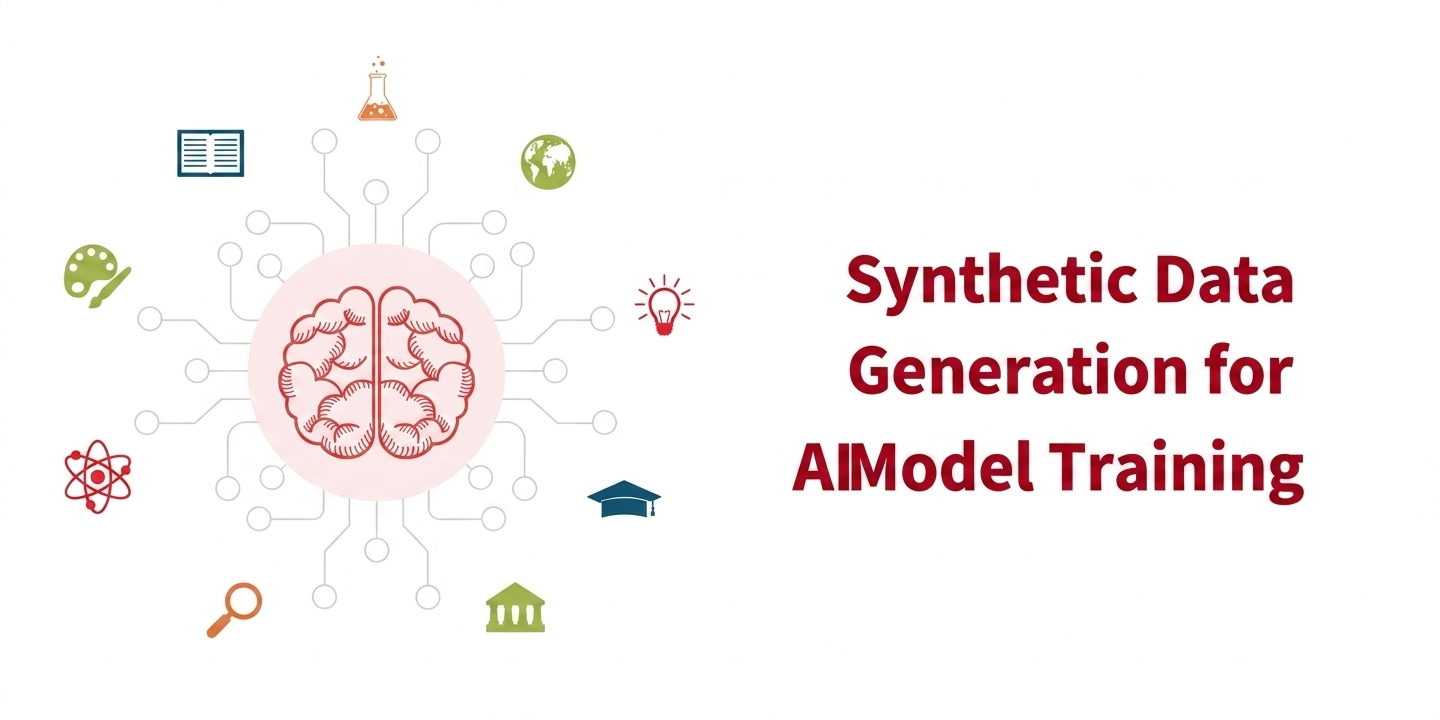
Synthetic data refers to artificially generated data that replicates the statistical properties and patterns of real-world data. It is not collected from actual events or users but is created using algorithms, simulations, or AI models.
Unlike traditional datasets, synthetic data can be generated on demand, tailored to specific use cases, and scaled without real-world limitations. It can include structured data such as tables, as well as unstructured data like images, text, and video.
At its core, synthetic data aims to answer a simple question: Can we train AI effectively without relying entirely on real data? Increasingly, the answer is yes.
Why Synthetic Data is Gaining Importance
The growing interest in synthetic data is driven by several practical challenges in modern AI development. Real-world data is often incomplete, biased, or difficult to obtain due to privacy regulations. In industries like healthcare and finance, strict compliance requirements make data sharing even more complex.
Synthetic data addresses these issues by providing a flexible and controlled alternative. It allows organizations to generate datasets without exposing sensitive information, while still preserving the patterns needed for training models.
Another important factor is scalability. As AI systems become more complex, the demand for training data grows exponentially. Synthetic data can be generated in large volumes quickly, enabling faster experimentation and model improvement.
How Synthetic Data is Generated
The process of generating synthetic data varies depending on the type of data and the intended use case. In many cases, advanced AI techniques such as generative models are used to learn patterns from real datasets and then create new, similar data points.
For example, in computer vision, simulation environments can generate thousands of labeled images under different lighting, angles, and conditions. In natural language processing, language models can produce realistic text data for training conversational systems.
The key objective is not to replicate real data exactly, but to create data that is statistically and contextually similar enough for AI models to learn effectively.
Key Advantages of Synthetic Data
One of the biggest advantages of synthetic data is its ability to overcome privacy concerns. Since the data is artificially generated, it does not directly correspond to real individuals, making it easier to comply with regulations.
It also improves data diversity. Real-world datasets often suffer from imbalance, where certain scenarios or categories are underrepresented. Synthetic data can be used to fill these gaps, ensuring that models are trained on a more balanced dataset.
Additionally, synthetic data reduces dependency on costly data collection processes. Instead of spending time and resources gathering data, organizations can generate it programmatically.
Some notable benefits include:
- Enhanced data privacy and regulatory compliance
- Ability to generate rare or edge-case scenarios
- Faster and more cost-effective data creation
- Improved model performance through balanced datasets
Use Cases Across Industries
Synthetic data is being adopted across a wide range of industries, each with unique data challenges.
In healthcare, synthetic patient data is used to train diagnostic models without exposing sensitive medical records. This allows researchers to innovate while maintaining strict privacy standards.
In autonomous driving, simulation environments generate synthetic road scenarios to train self-driving systems. These simulations can include rare events such as accidents or extreme weather conditions that are difficult to capture in real life.
In finance, synthetic transaction data helps detect fraud patterns without risking exposure of real customer information.
Even in retail and marketing, synthetic customer data is used to test recommendation systems and personalization algorithms.
Challenges and Limitations
Despite its advantages, synthetic data is not a perfect solution. One of the main challenges is ensuring that the generated data accurately represents real-world conditions. Poor-quality synthetic data can lead to models that perform well in testing but fail in real-world scenarios.
Another concern is bias replication. If the original dataset used to generate synthetic data contains biases, those biases can be carried forward into the synthetic dataset.
There is also the challenge of validation. Organizations need robust methods to verify that synthetic data is realistic, diverse, and suitable for training.
Finally, synthetic data often works best when combined with real data rather than replacing it entirely.
The Role of Synthetic Data in the Future of AI
As AI continues to evolve, synthetic data is expected to play a central role in model development. It will not replace real data completely, but it will significantly reduce the dependency on it.
In the future, we are likely to see hybrid approaches where synthetic and real data are used together to achieve optimal results. AI systems may even generate their own training data dynamically, adapting to new scenarios in real time.
This shift will make AI development more accessible, efficient, and scalable across industries.
Conclusion
Synthetic data generation is transforming the way AI models are trained. By providing a scalable, privacy-friendly, and cost-effective alternative to real-world data, it addresses some of the most critical challenges in modern AI development.
While it comes with its own set of limitations, its benefits are too significant to ignore. As technology advances, synthetic data will become an essential component of the AI ecosystem, enabling organizations to build smarter, more reliable, and more inclusive systems.
In 2025 and beyond, the question is no longer whether synthetic data should be used—but how effectively it can be integrated into the AI development lifecycle.