Introduction
For decades, traditional software architecture has been built on predictable logic, structured workflows, and clearly defined rules. Applications were designed to process inputs, execute deterministic code, and produce consistent outputs. This approach worked exceptionally well in a world dominated by transactional systems, enterprise applications, and static business logic.
However, in 2025, the rise of artificial intelligence—particularly generative AI and autonomous systems—is exposing the limitations of these traditional architectures. Modern applications are no longer just rule-based; they are data-driven, probabilistic, and continuously evolving. As a result, the old models of software design are struggling to keep up.
The Foundation of Traditional Software Architecture
Traditional software systems were designed with clarity and control in mind. Developers defined every possible rule, condition, and outcome. Systems followed a linear flow—input, processing, output—with minimal ambiguity.
These architectures relied heavily on:
- Monolithic or layered system designs
- Structured databases with predefined schemas
- Deterministic logic and rule-based processing
- Predictable testing and debugging methods
This approach ensured reliability and stability, making it ideal for applications like banking systems, ERP platforms, and enterprise software.
The Shift to AI-Driven Systems
The introduction of AI has fundamentally changed how software behaves. Instead of relying solely on predefined rules, AI systems learn patterns from data and make decisions based on probabilities.
This shift introduces a new paradigm where:
- Outputs are not always predictable
- Systems evolve as new data is introduced
- Decision-making is influenced by model training rather than fixed logic
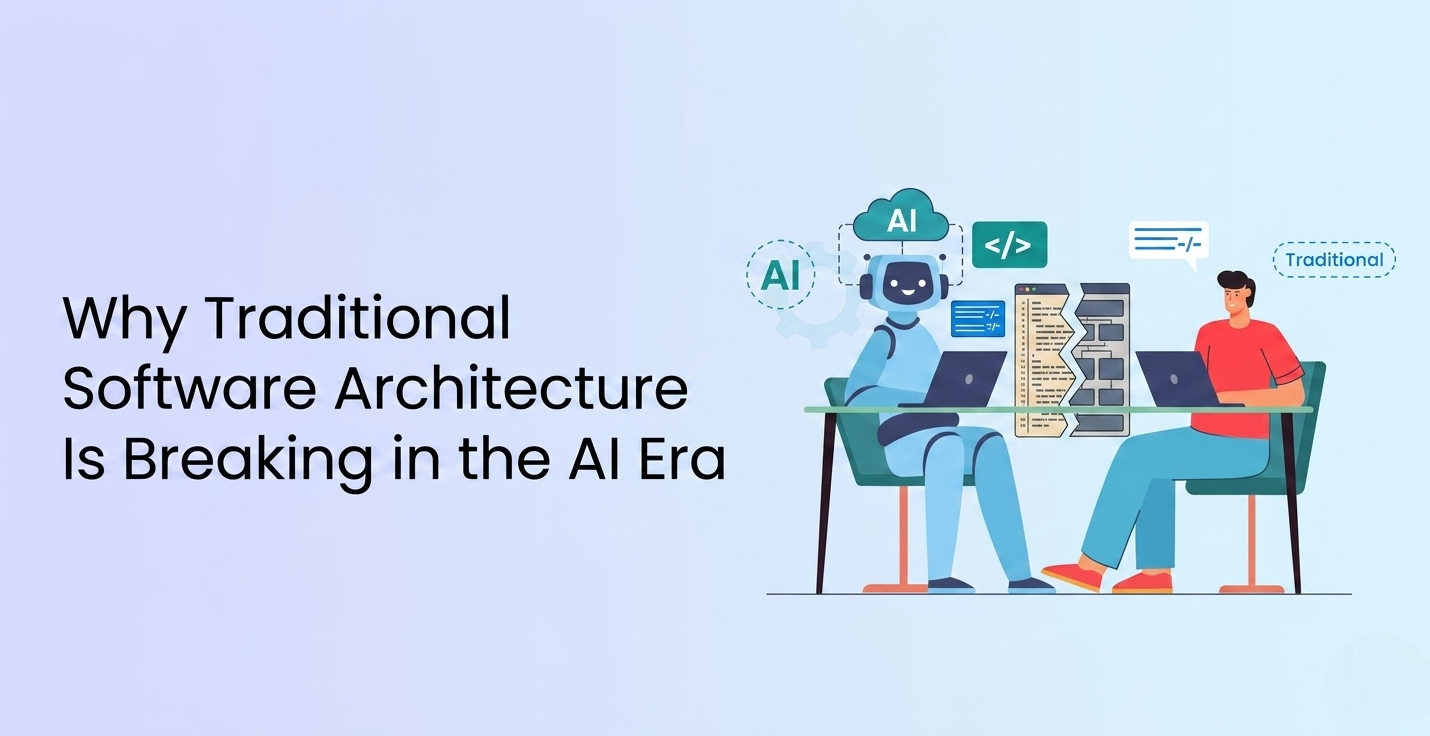
In simple terms, traditional systems “follow instructions,” while AI systems “learn behaviors.”
Why Traditional Architecture Is Struggling
1. Deterministic Systems vs Probabilistic Outputs
Traditional architectures expect consistent outputs for given inputs. AI models, however, may produce different results for the same input depending on context, training data, or model updates.
This breaks assumptions in system design, testing, and validation. It becomes difficult to guarantee outcomes, which is a cornerstone of traditional software engineering.
2. Static Code vs Dynamic Learning
In traditional systems, functionality is defined in code and changes only when developers update it. AI systems, on the other hand, evolve through training and data updates.
This creates challenges in:
- Version control for models vs code
- Tracking changes in behavior
- Ensuring consistency across deployments
Software is no longer static—it becomes a living system.
3. Data Becomes the Core Component
In AI-driven applications, data is as important as code—if not more. Traditional architectures treat data as an input, but in AI systems, data defines the system’s intelligence.
This shift requires:
- Robust data pipelines
- Continuous data validation
- Real-time data processing capabilities
Without proper data management, AI systems fail regardless of how well the code is written.
4. Integration Complexity with AI Models
Traditional systems were designed to integrate APIs and services with predictable behavior. AI models introduce uncertainty, latency, and variability.
For example:
- Response times may vary based on model complexity
- Outputs may require post-processing or validation
- External AI services may change behavior over time
This makes integration more complex and less reliable compared to traditional APIs.
5. Testing and Debugging Challenges
Testing traditional software involves verifying expected outputs against known inputs. With AI systems, defining “expected output” is not always straightforward.
Challenges include:
- Difficulty in creating test cases for probabilistic outputs
- Lack of clear failure points
- Complex debugging due to model opacity
This requires new approaches such as model evaluation metrics, confidence scoring, and continuous monitoring.
The Rise of New Architectural Patterns
As traditional models struggle, new architectural approaches are emerging to support AI-driven systems.
These include:
- Microservices with AI components, allowing flexible deployment of models
- Event-driven architectures, enabling real-time data processing
- MLOps pipelines, integrating model training, deployment, and monitoring
- Data-centric architectures, where pipelines are as important as application logic
These patterns are designed to handle the dynamic and evolving nature of AI systems.
The Role of AI-Native Infrastructure
Modern applications are increasingly being built as AI-native systems, where AI is not an add-on but a core component of the architecture.
This requires infrastructure that supports:
- High-performance computing for model training
- Scalable environments for inference
- Continuous monitoring and retraining pipelines
- Integration with data lakes and real-time streams
Traditional infrastructure is often not equipped to handle these demands efficiently.
Organizational and Skill Challenges
The shift is not just technical—it also impacts teams and workflows. Traditional software development roles are evolving, and new skills are required.
Organizations now need:
- Data engineers to manage pipelines
- ML engineers to build and deploy models
- MLOps specialists to maintain AI systems
- Cross-functional collaboration between data and development teams
This transformation adds complexity to both development and operations.
The Future of Software Architecture
The future lies in hybrid systems that combine the reliability of traditional software with the adaptability of AI.
We are moving toward architectures that:
- Blend deterministic and probabilistic components
- Continuously learn and adapt
- Treat data pipelines as first-class citizens
- Incorporate monitoring, feedback, and retraining loops
Software will no longer be just engineered—it will be trained, monitored, and evolved.
Conclusion
Traditional software architecture is not becoming obsolete, but it is no longer sufficient on its own. The rise of AI has introduced new requirements that challenge the foundations of how systems are designed and built.
In the AI era, software must be flexible, data-driven, and capable of handling uncertainty. Organizations that adapt to these changes by embracing new architectural patterns and AI-native approaches will be better positioned for the future.
Ultimately, the shift is not about replacing traditional architecture—it is about evolving it to meet the demands of intelligent, adaptive systems in a rapidly changing technological landscape.