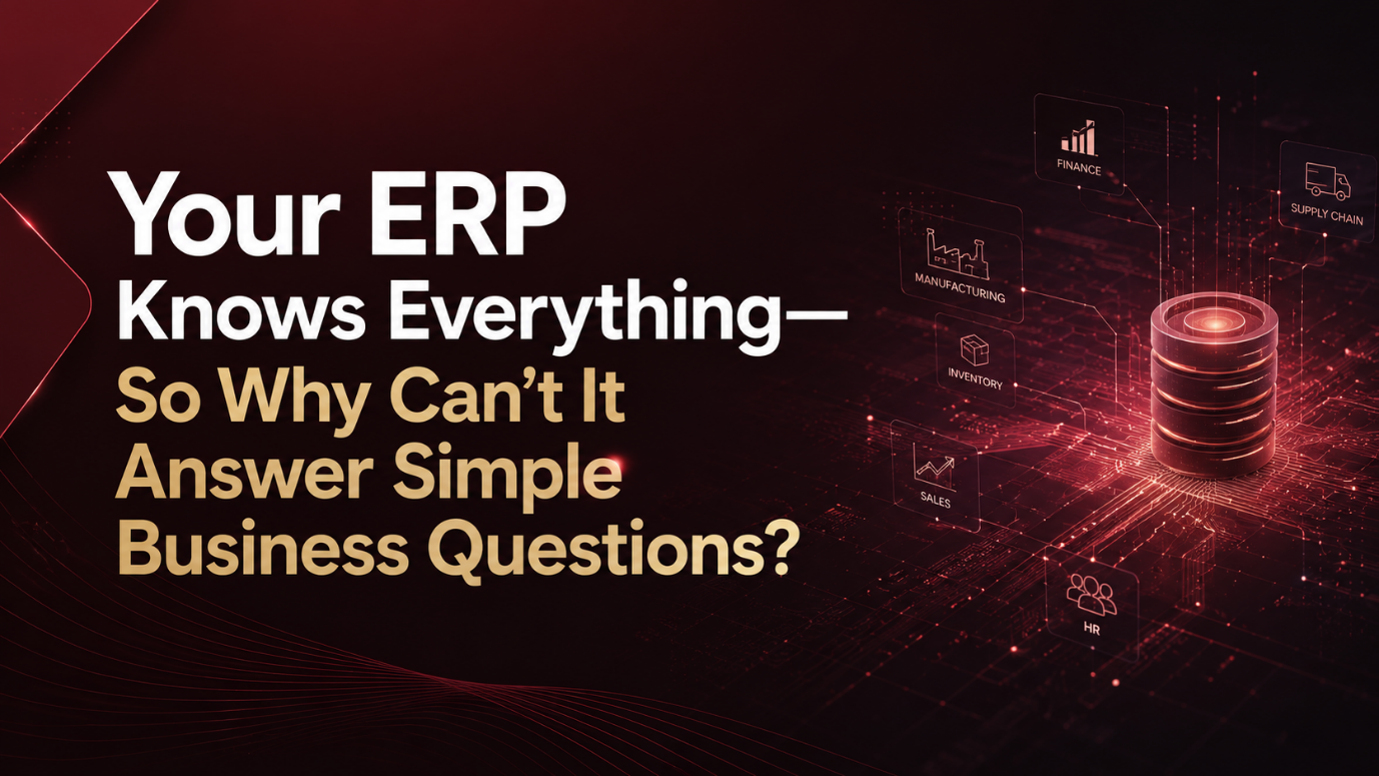
Intelligent ERP is rapidly transforming how organizations use enterprise software. While traditional ERP systems excel at managing transactions, they often struggle to answer simple business questions. Modern Intelligent ERP platforms combine artificial intelligence, semantic layers, enterprise knowledge graphs, and natural language querying to turn operational data into actionable business intelligence. As enterprises demand faster and smarter decision-making, Intelligent ERP is becoming the next evolution of enterprise technology.
What Is Intelligent ERP?
For decades, Enterprise Resource Planning (ERP) systems have been positioned as the digital backbone of modern organizations. Whether managing finance, procurement, manufacturing, supply chains, inventory, customer orders, payroll, or compliance, ERPs have become the single source of operational truth for enterprises worldwide. Billions of dollars are invested every year in implementing, upgrading, and maintaining these systems because they promise centralized data, standardized processes, and enterprise-wide visibility.
Yet despite storing enormous volumes of business information, most ERP systems still fail at one surprisingly simple task, answering straightforward business questions. Ask an executive, “Which customers are most likely to delay payments next quarter?”, “Why did production costs increase despite stable raw material prices?”, or “Which suppliers pose the highest operational risk today?” and the ERP rarely provides an immediate answer. Instead, organizations rely on multiple reports, dashboards, spreadsheets, analysts, and meetings before reaching a conclusion. The irony is striking: the system that knows almost everything about the business often struggles to explain what the business actually needs to know.
This disconnect highlights one of the biggest misconceptions in enterprise technology. Organizations assume that having more data automatically results in better decisions. In reality, data alone has never been the problem. Modern enterprises generate millions of records every day through transactions, invoices, purchase orders, manufacturing logs, customer interactions, inventory movements, warehouse operations, payroll activities, quality inspections, and financial reconciliations.
Every department continuously contributes to this expanding digital footprint. However, these records are primarily designed to execute business processes rather than answer strategic questions. ERP systems excel at recording what happened, but they rarely explain why it happened, what will happen next, or what decision should be made in response. As businesses become more dynamic and data-intensive, this limitation is becoming increasingly apparent.
Why Traditional ERP Systems Fall Short
The challenge lies in the fundamental architecture of traditional ERP systems. Most were designed decades ago with transaction processing as their primary objective. Every purchase order, sales invoice, production batch, employee record, and inventory adjustment is stored in structured tables optimized for accuracy, consistency, and compliance. This architecture ensures operational reliability but makes contextual reasoning incredibly difficult.
When a CEO asks, “Why are profit margins declining in the western region despite higher sales?” the answer is rarely located in a single database table. It requires connecting sales performance, procurement costs, logistics expenses, customer discounts, inventory turnover, supplier pricing, marketing investments, and economic conditions across multiple modules. Traditional ERP systems were never built to establish these complex relationships automatically.
As a result, organizations have developed an ecosystem of supporting technologies around their ERP. Business Intelligence platforms generate dashboards. Data warehouses consolidate information from multiple applications. Analytics teams build reports. Data engineers create pipelines. Finance teams maintain spreadsheets. Operations managers manually compare reports across departments. Every layer attempts to compensate for the ERP’s inability to answer business questions directly. While these solutions provide valuable insights, they also introduce delays, inconsistencies, and dependence on specialized expertise. Executives frequently wait days, or even weeks, for reports that answer questions they assumed their enterprise systems should have answered instantly.
One of the most significant barriers is that enterprise questions are rarely transactional, they are contextual. Employees do not think in database structures; they think in business language. A procurement manager wants to know which suppliers consistently create delivery bottlenecks. A sales director wants to identify customers showing early signs of churn despite increasing order volumes. A manufacturing head wants to understand why one factory consistently achieves higher productivity than another with identical machinery. These are relationship-based questions requiring systems to understand business context rather than simply retrieve records. Unfortunately, most ERP platforms remain dependent on predefined reports, filters, and SQL queries that require technical expertise to generate meaningful answers.
How Intelligent ERP Uses AI to Answer Business Questions
This limitation becomes even more problematic as enterprises embrace artificial intelligence. AI models are capable of analysing massive datasets, identifying patterns, generating predictions, and communicating in natural language. However, they require connected, contextual information rather than isolated transactional records. Feeding raw ERP tables into an AI model rarely produces meaningful business intelligence because the relationships between customers, suppliers, products, employees, financial metrics, and operational events remain fragmented.
AI cannot reason effectively if the underlying business context is missing. Consequently, organizations discover that implementing AI without modernizing enterprise knowledge structures simply accelerates access to disconnected information rather than delivering actionable intelligence.
Semantic Layers Power Intelligent ERP
This challenge has given rise to one of the most important developments in enterprise technology, the semantic layer. Unlike traditional databases that focus on storing information, semantic layers organize data according to business meaning rather than technical structure. Instead of viewing sales, procurement, inventory, finance, and manufacturing as isolated modules, semantic architectures connect them through relationships that reflect how businesses actually operate.
A product becomes connected to suppliers, customers, revenue, inventory, warranty claims, production costs, quality inspections, and market demand. A customer becomes associated with purchasing behaviour, payment history, support interactions, profitability, contract renewals, and service performance. This contextual understanding enables systems to answer complex questions using business logic rather than technical queries.
Enterprise Knowledge Graphs in Intelligent ERP
Closely related to semantic architecture is the growing adoption of enterprise knowledge graphs. Knowledge graphs transform enterprise information into interconnected networks rather than disconnected tables. Every entity within the organization, employees, departments, products, suppliers, projects, customers, assets, contracts, and transactions, is linked through meaningful relationships. This enables systems to move beyond simple reporting toward intelligent reasoning.
When an executive asks, “Which suppliers create the greatest operational risk?” the system considers delivery reliability, financial stability, dependency levels, production schedules, geopolitical risks, quality incidents, and historical performance simultaneously. Instead of generating multiple reports, the enterprise delivers a unified explanation supported by contextual evidence.
Natural Language Querying in Intelligent ERP
Natural Language Querying represents another transformative shift. Rather than requiring users to navigate dashboards, understand database schemas, or learn reporting software, employees increasingly expect to interact with enterprise systems as they would with a colleague. Questions such as “Show me our least profitable customers over the last six months,” “Which manufacturing plants have the highest maintenance costs?” or “Explain why customer acquisition costs increased this quarter” should no longer require multiple analysts or technical teams. AI-powered conversational interfaces are beginning to make this possible by translating human language into sophisticated analytical processes executed across enterprise data environments. The ERP evolves from being a transactional database into an intelligent business advisor.
How Intelligent ERP Benefits Different Business Functions
This evolution is particularly significant for sales organizations. Traditional CRM and ERP integrations often provide historical information but limited strategic guidance. Imagine an account manager preparing for a meeting with a global client. Rather than manually reviewing invoices, payment history, support tickets, inventory availability, pricing agreements, and previous communications, an intelligent enterprise platform could instantly summarize the customer’s relationship, identify commercial risks, predict purchasing trends, recommend cross-selling opportunities, and highlight unresolved operational issues. Sales conversations become more informed because organizational intelligence replaces fragmented data retrieval.
Marketing teams stand to benefit equally. Campaign performance is often analysed separately from operational outcomes, making it difficult to connect promotional investments with production capacity, customer profitability, inventory levels, and long-term retention. Intelligent enterprise systems can bridge these gaps by linking marketing performance with financial and operational metrics, enabling organizations to optimize campaigns based not only on lead generation but also on downstream business impact. Marketing decisions become increasingly aligned with enterprise strategy rather than isolated departmental objectives.
For finance leaders, the implications extend beyond reporting efficiency. Financial forecasting traditionally depends upon historical trends combined with manual assumptions about future conditions. However, connected enterprise intelligence allows forecasts to incorporate supplier risks, customer behaviour, workforce changes, production capacity, logistics disruptions, regulatory developments, and market signals simultaneously. Financial planning evolves from retrospective analysis toward dynamic scenario modelling supported by real-time operational intelligence.
Manufacturing organizations may experience some of the greatest transformation. Modern factories generate continuous streams of operational data through IoT sensors, production equipment, maintenance systems, quality inspections, and supply chain platforms. Yet much of this information remains disconnected from enterprise planning systems. Intelligent ERP ecosystems can correlate equipment performance with supplier quality, employee training, environmental conditions, maintenance schedules, customer demand, and inventory availability. Instead of merely reporting production output, enterprises gain insights into why performance changes occur and which actions will produce the greatest operational improvements.
Cybersecurity and compliance also become more effective when enterprise systems understand relationships rather than isolated transactions. Suspicious financial activities, procurement anomalies, unauthorized access patterns, and regulatory violations often emerge only when information from multiple systems is analysed together. Context-aware enterprise intelligence enables organizations to identify risks earlier because anomalies become visible within broader operational patterns rather than isolated datasets.
The Future of Intelligent ERP
Perhaps the most profound implication of this transformation is the changing role of enterprise software itself. For decades, ERP systems functioned primarily as systems of record, repositories that documented business activity with exceptional accuracy. The next generation of enterprise platforms will increasingly become systems of reasoning. Rather than simply storing information, they will explain relationships, recommend actions, predict outcomes, identify risks, and support decision-making through contextual intelligence. This shift represents one of the most significant evolutions in enterprise computing since the emergence of cloud technology.
Organizations that continue treating ERP as merely a transactional database risk falling behind competitors that transform enterprise data into enterprise intelligence. Competitive advantage will no longer depend solely on how much information a company collects but on how effectively it understands the relationships hidden within that information. Businesses capable of asking natural-language questions and receiving contextual, actionable answers will make faster decisions, respond more effectively to market changes, improve operational efficiency, and deliver superior customer experiences.
The future of enterprise technology is not about replacing ERP systems, it is about making them finally live up to their promise. Businesses have spent years building systems that remember every transaction. The next generation of intelligent enterprises will build systems that understand every transaction. When that transformation becomes reality, executives will no longer ask why their ERP cannot answer simple business questions. Instead, they will wonder how organizations ever managed to operate without enterprise systems capable of thinking alongside them.