For years, enterprise marketing operated on a straightforward assumption: more visibility creates more opportunity. Companies invested in reach, content volume, multiple channels, impressions, campaigns, webinars, newsletters, and thought leadership because repeated exposure was expected to build familiarity and eventually influence buying decisions.
But the digital environment has changed. Buyers now encounter corporate content, AI-generated articles, automated emails, social updates, advertising, reports, webinars, and personalized messages throughout their working day. The challenge is no longer simply reaching the audience. It is earning enough attention to become meaningful.
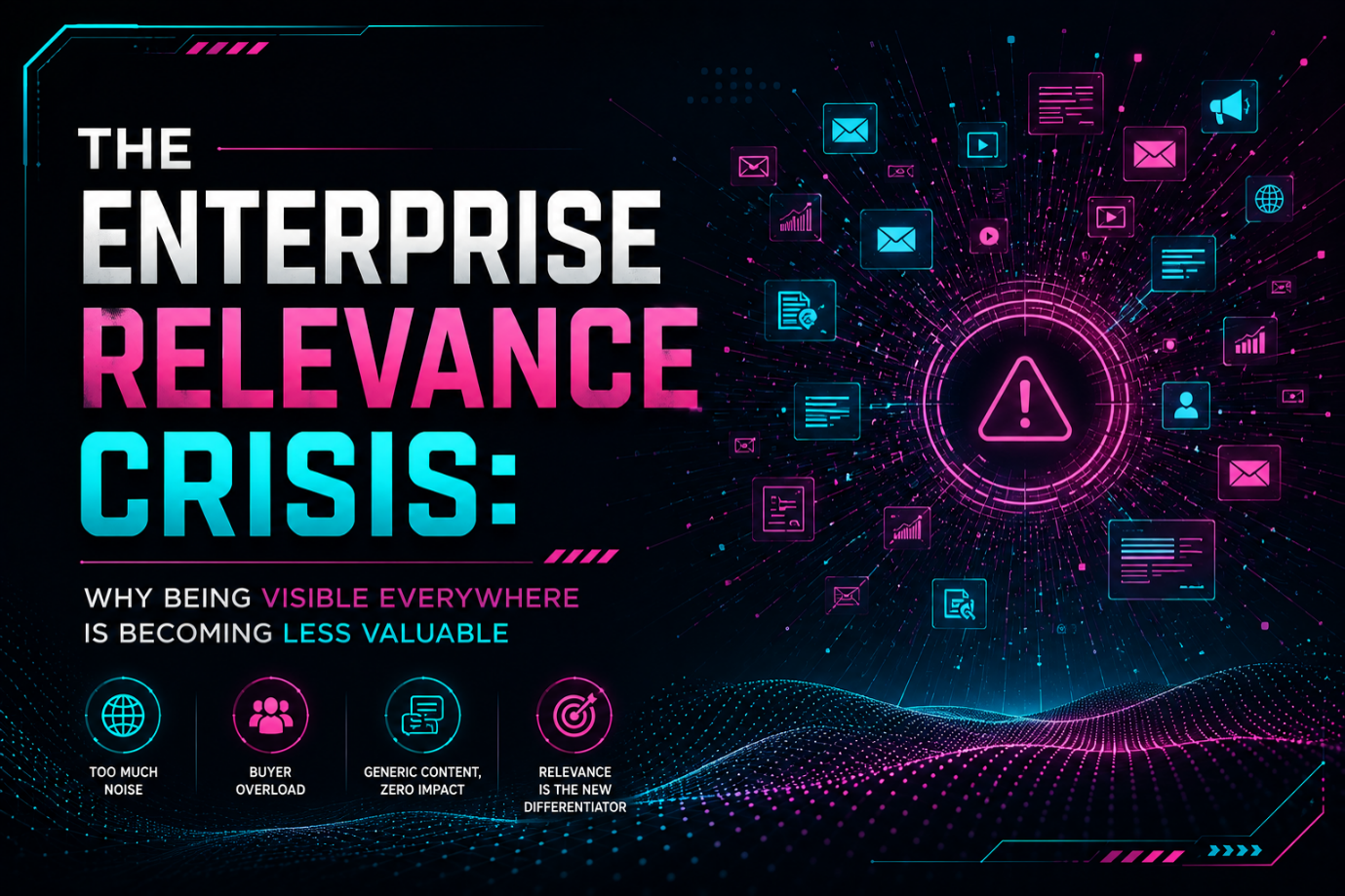
This is creating what can be described as an Enterprise Relevance Crisis. Organizations can be highly visible and highly active across digital channels while becoming less meaningful to the people they want to influence. As content becomes easier to produce, visibility becomes easier to manufacture—but relevance remains much harder to create. This Enterprise Relevance Crisis is forcing B2B marketing leaders to rethink how they create, distribute, and measure content.
What Is the Enterprise Relevance Crisis?
The Enterprise Relevance Crisis describes the growing gap between being visible to an audience and actually providing information that matters to that audience.
Historically, producing high-quality business content required considerable effort across research, writing, design, editing, distribution, and promotion. Those production costs naturally limited content volume. As a result, useful content could provide meaningful differentiation.
AI has changed that equation. Marketing teams can now create multiple articles, social posts, campaign variations, email sequences, summaries, and creative concepts much faster. This creates significant productivity opportunities, but it also means that more businesses can produce more content.
When everyone can increase output, output itself becomes less distinctive.
The result can be a digital environment filled with content that is:
- Professionally written but interchangeable
- Technically correct but lacking distinctive insight
- Consistent in messaging but repetitive in substance
- Widely distributed but weakly connected to buyer decisions
The central challenge becomes simple: when everyone can say something, saying it louder does not necessarily make it more valuable. Understanding the Enterprise Relevance Crisis is essential for organizations that want to turn content visibility into meaningful buyer engagement.
Why Visibility Alone Is Losing Its Strategic Value
Visibility still matters. A business cannot influence buyers if it is completely absent from the conversation. The problem is that visibility is increasingly becoming a baseline rather than a differentiator.
B2B buyers are not generally consuming enterprise content simply for entertainment. They are trying to solve problems, reduce risk, evaluate vendors, understand markets, justify investments, and make complex decisions.
Consider a technology leader evaluating a new enterprise platform. Another generic article explaining that “AI is transforming business” may not help that person make a decision. What they need is information that helps them understand how a specific technology change affects their organization, what risks it introduces, what alternatives exist, and what evidence should inform the decision.
That distinction changes how marketing effectiveness should be viewed.
Instead of asking:
- How many people saw the content?
- How many channels published it?
- How frequently did we post?
- How much content did we produce?
Organizations should increasingly ask:
- Did the content clarify an important problem?
- Did it help a buyer evaluate an option?
- Did it provide evidence or insight that was difficult to find elsewhere?
- Did it contribute to a meaningful business conversation?
The more complex the B2B buying decision becomes, the less useful generic visibility can be on its own. This is one of the central challenges created by the Enterprise Relevance Crisis: visibility is becoming easier to achieve, while meaningful buyer attention is becoming harder to earn.
1. How Knowledge Creation Can Solve the Enterprise Relevance Crisis
One of the most important responses to the Enterprise Relevance Crisis is changing the objective of content marketing. The Enterprise Relevance Crisis makes this distinction especially important because increasing content output does not necessarily increase buyer value.
The goal should not simply be to produce more content. It should be to create knowledge that helps the market understand something important.
This distinction matters because AI can make content production dramatically easier. If every competitor can generate a polished article on the same topic, the existence of another article is not necessarily meaningful differentiation.
Organizations can instead focus on developing material built around:
- Original observations
- Proprietary information where appropriate
- Customer insights
- Evidence-based analysis
- Expert interpretation
- Practical frameworks
- Specific operational experiences
For example, rather than publishing another generic article about enterprise AI adoption, a technology company could build content around a specific operational problem it repeatedly sees in customer environments. That creates an opportunity to contribute an actual perspective instead of simply restating a widely understood trend.
The strategic shift is from “What can we publish?” to “What do we know that could help the market make a better decision?”
2. Make B2B Content More Relevant to Decision Context
Relevance is contextual.
The same piece of information can be highly useful in one situation and almost irrelevant in another. A detailed guide to enterprise AI governance may be valuable to an organization preparing for deployment but less useful to a company that is still determining whether AI belongs in its broader strategy.
This means enterprise marketers need to think beyond demographic audience definitions.
A buyer’s decision context can be just as important as their role or industry.
A useful content strategy can consider whether the buyer is:
- Defining a problem
- Exploring possible approaches
- Comparing technologies
- Evaluating vendors
- Building an internal business case
- Addressing implementation concerns
- Managing operational risks
A content asset designed around a specific decision can provide considerably more practical value than a broad piece intended to attract everyone.
This is why the future of B2B marketing may increasingly involve producing knowledge for specific decisions, rather than simply producing content for broad audiences.
3. Use AI to Increase Insight, Not Just Output
AI is an important part of the relevance challenge because it reduces the effort required to produce content. But that does not mean its greatest marketing value is simply generating more articles.
The more strategic opportunity is using AI to support the creation, organization, analysis, and distribution of genuinely useful knowledge.
The underlying principle is important: automation can increase production efficiency, but efficiency alone does not create differentiation.
Marketing teams can therefore use AI to help with repetitive production tasks while investing human expertise in areas where distinctiveness matters.
For example, an enterprise technology organization could use automation to transform one strong proprietary insight into multiple formats:
- A detailed article
- An executive briefing
- A sales enablement asset
- A webinar discussion
- A social media perspective
- An email for a relevant buyer segment
The key is that the original insight must contain meaningful value. Otherwise, automation simply distributes the same generic idea more efficiently.
4. Rethink Content Repurposing
Repurposing is one of the most efficient practices in modern content marketing. A webinar can become a blog, the blog can become social content, and the social content can become an email.
But there is an important distinction between format efficiency and strategic value.
If the original idea is generic, reproducing it across five channels creates five versions of the same generic message. Visibility increases, but relevance does not necessarily increase.
A stronger approach is to begin with an insight that deserves to travel.
For example, a company might identify a recurring operational challenge among its customers and develop a detailed framework for understanding it. That framework can then be adapted to different formats without losing its central value.
The content engine becomes:
Strong insight → multiple useful formats
rather than:
More formats → hoping one contains a strong insight
This distinction can help marketing teams avoid confusing publishing activity with audience value.
5. Use B2B Thought Leadership to Address the Enterprise Relevance Crisis
The Enterprise Relevance Crisis is also changing what thought leadership needs to accomplish. Measuring these signals can help organizations determine whether they are actually overcoming the Enterprise Relevance Crisis, rather than simply increasing content production.
Traditional thought leadership often involved executive opinions, industry reports, and commentary on major trends. But as AI makes generic expertise easier to simulate, simply sounding authoritative becomes less meaningful.
Specificity becomes more important.
Compare two statements:
“Businesses should embrace digital transformation.”
with a more specific perspective that explains a particular operational dependency, identifies a recurring problem, or introduces a framework for understanding an emerging business challenge.
The second approach has greater potential to provide a useful lens for decision-makers because it attempts to explain something rather than simply repeat a widely accepted premise.
Effective thought leadership can therefore be built around:
- A distinctive interpretation of a market change
- A recurring customer problem
- A practical framework
- Evidence-based analysis
- An underappreciated business dependency
- A new way of understanding an emerging challenge
The underlying principle is that interpretation becomes increasingly valuable when information becomes abundant. Addressing the Enterprise Relevance Crisis therefore requires marketers to connect content more closely to the moments when buyers actually need information.
6. Connect Content to the Buyer’s Moment
Even excellent content can fail to create impact when it arrives at the wrong time.
A buyer researching whether a technology category is strategically relevant needs different information from a buyer who has already selected an approach and is evaluating vendors. Likewise, an executive preparing an internal investment case may need business justification rather than a technical deep dive.
This creates an opportunity for B2B organizations to connect content more closely to actual buyer situations.
Instead of creating content only around a publishing calendar, marketers can ask:
What decision might this information help someone make?
That question can influence the format, depth, language, examples, and distribution strategy.
For instance:
- Early-stage buyers may need problem definition and market context.
- Evaluation-stage buyers may need comparisons, risks, and practical criteria.
- Internal champions may need evidence that helps justify investment.
- Implementation teams may need operational guidance.
The objective is not to create more content for every stage. It is to make the available content more useful for the decisions buyers are actually trying to make.
7. Measure Meaningful Impact Instead of Output Volume
The Enterprise Relevance Crisis ultimately challenges the way organizations evaluate content performance.
Publishing frequency can be easy to measure. So can the number of articles, campaigns, social posts, webinars, or emails produced. But high output does not automatically demonstrate high relevance.
Organizations may instead need to place greater emphasis on signals such as:
- Meaningful engagement
- Qualified business conversations
- Evidence of improved buyer understanding
- Content that supports sales discussions
- Insights that become reference points within a market
- Original research and analysis that others find useful
The source material suggests that companies adapting to this environment are likely to become more selective about what they publish and more interested in original research, customer insights, proprietary frameworks, expert commentary, and evidence-based analysis.
This does not mean every piece of content needs to become a major research report.
It means the strategic question changes from “How much did we publish?” to “What value did what we published create?”
The Enterprise Relevance Crisis and the Future of B2B Marketing
The broader shift is from visibility as an objective to relevance as a competitive capability.
As technology reduces the cost of producing and distributing information, content volume becomes easier to increase. That weakens the advantage previously created simply by publishing frequently or maintaining a strong presence across multiple channels.
At the same time, buyers remain selective about where they invest their attention.
This creates a different competitive environment for B2B technology companies. The brands that stand out may not necessarily be those that publish the most. They may be the organizations that consistently provide useful information, distinctive interpretation, credibility, and timely insight.
That also has implications for AI-powered search and information discovery. As buyers increasingly use AI systems to summarize markets, compare vendors, and understand technical concepts, companies need to think about the quality of the knowledge they make available—not simply the quantity of content they produce.
The strategic opportunity is therefore substantial.
Instead of asking how a company can become more visible everywhere, marketing leaders can ask where their expertise can become genuinely useful. The Enterprise Relevance Crisis is therefore becoming a strategic issue for enterprise marketing, not simply a content marketing challenge.
Conclusion
The Enterprise Relevance Crisis is not an argument against visibility, content marketing, AI, or multichannel communication. It is an argument against assuming that more of any of these automatically creates more business value.
As content becomes easier to produce and distribute, the scarce resource is no longer information. It is the buyer’s willingness to stop, consider, trust, and act on what a company is saying. That attention must increasingly be earned through usefulness, originality, credibility, and timing.
For B2B technology companies, the implication is clear: the future belongs less to organizations that simply publish more and more to organizations that know something worth understanding.
The strongest content strategies will be built around knowledge, decision context, evidence, specificity, and meaningful interpretation. Repurposing can amplify those ideas, AI can accelerate their distribution, and multiple channels can expand their reach—but the underlying insight must come first.
In an environment where every business can become more visible, relevance becomes the new form of scarcity. Solving the Enterprise Relevance Crisis requires B2B brands to move beyond content volume and focus on knowledge, relevance, credibility, and buyer impact.
Frequently Asked Questions
1. What is the Enterprise Relevance Crisis?
The Enterprise Relevance Crisis describes the growing gap between digital visibility and meaningful buyer impact. Companies can publish extensively and appear across many channels while still failing to provide information that helps buyers understand problems or make decisions.
2. Why is visibility becoming less valuable in B2B marketing?
B2B buyers are exposed to large volumes of corporate content, including articles, emails, social posts, reports, webinars, and AI-generated material. As information becomes abundant, simply appearing more frequently does not necessarily create differentiation or influence.
3. How is AI contributing to the Enterprise Relevance Crisis?
AI makes it significantly easier to produce content at scale. While this creates productivity benefits, it also increases the supply of similar information. As more organizations can produce polished content quickly, distinctive knowledge and genuine expertise become more important differentiators.
4. What is the difference between content production and knowledge creation?
Content production focuses on creating and distributing material. Knowledge creation focuses on developing useful information, original observations, analysis, frameworks, and expertise that help an audience understand something important. The latter is increasingly valuable when generic content is abundant.
5. How can B2B companies make their content more relevant?
Companies can connect content to specific buyer problems and decision contexts. Instead of asking only who the audience is, marketers can consider what decision the buyer is trying to make and what information would help them make it.
6. Is content repurposing still useful?
Yes. Repurposing can make strong ideas more efficient to distribute across different formats. However, repurposing a generic idea across multiple channels does not automatically make it more valuable. The underlying insight needs to contain meaningful value first.
7. What makes thought leadership more valuable in an AI-driven content environment?
Specificity, evidence, original interpretation, and practical understanding can make thought leadership more distinctive. Generic statements about familiar trends are easier to reproduce, while a useful framework or well-supported perspective can provide a more valuable lens for decision-makers.
8. Should B2B companies stop publishing frequently?
Not necessarily. The issue is not publishing frequency by itself. The more important consideration is whether the content provides meaningful value. A smaller number of substantially useful insights can carry more strategic weight than a large volume of repetitive material.
9. How should companies measure content relevance?
Beyond output and publishing frequency, organizations can examine meaningful engagement, qualified conversations, buyer understanding, sales influence, and whether their content becomes a useful reference point in the market.
10. What is the central lesson of the Enterprise Relevance Crisis?
The central lesson is that visibility is becoming easier to manufacture while relevance remains difficult to create. B2B organizations can gain a stronger position by consistently providing useful, credible, original, and timely knowledge that helps buyers understand important problems and make better decisions.