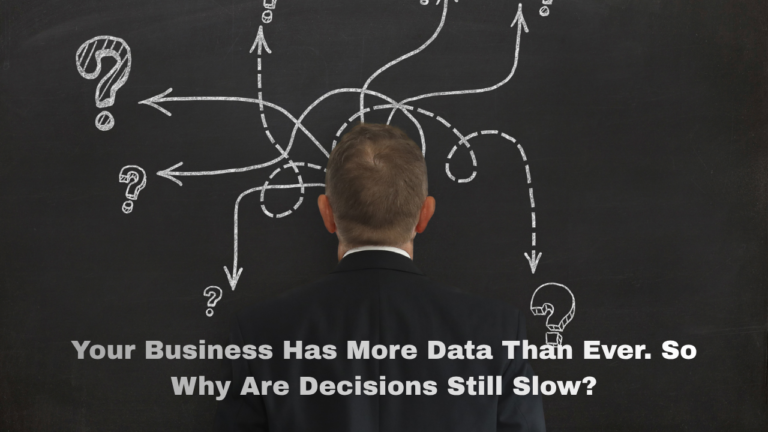
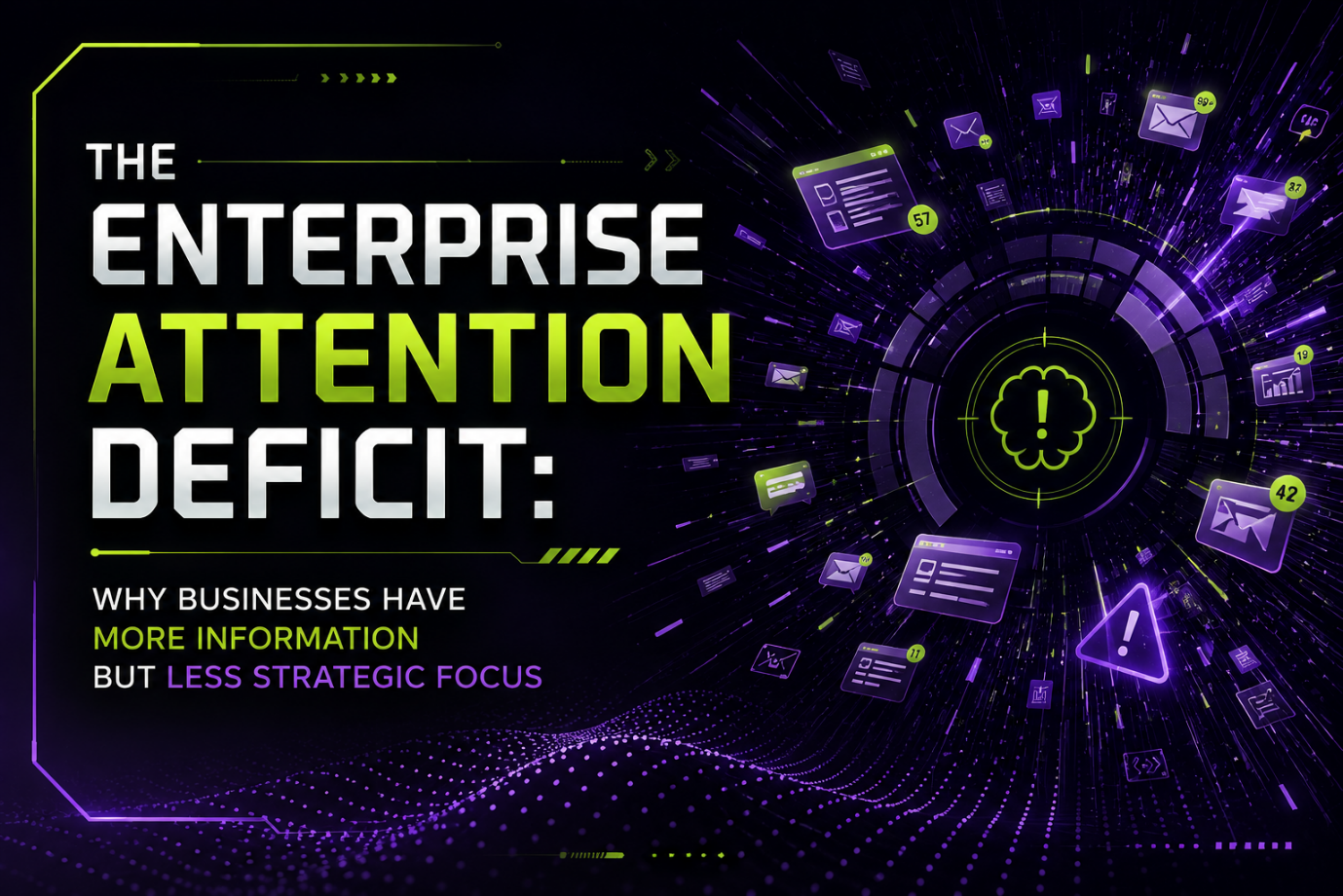
Enterprise Attention Deficit is emerging as a significant challenge for modern organisations. Businesses have more information than ever: dashboards, reports, alerts, forecasts, customer signals, market updates, performance metrics, AI-generated recommendations and internal communications. Yet greater access to information has not created more attention to process it.
The problem is therefore not simply that employees are busy. It is that strategic attention is becoming fragmented across hundreds of competing signals. A CEO may move from a revenue dashboard to a customer escalation, then to an AI-generated market alert, an operational issue and a competitive development before returning to a strategic question that requires uninterrupted thought. The organisation may be exceptionally well informed while becoming less capable of concentrating on the decisions that will shape its future.
This creates a paradox at the centre of modern enterprise management: technology has made it possible to see almost everything, but seeing everything does not mean knowing what deserves attention. As information becomes abundant and AI makes intelligence cheaper to generate, businesses increasingly need to solve a different problem — how to decide what not to focus on.
What Is the Enterprise Attention Deficit?
The Enterprise Attention Deficit describes a situation in which the volume of information, alerts, analysis and decisions competing for organisational attention exceeds the capacity of people to meaningfully evaluate them.
Traditional business intelligence was built around information scarcity. Important data was often trapped inside departments, spreadsheets or delayed management reports. Leaders needed better visibility, and dashboards promised to turn complexity into clarity.
Digital transformation has changed that equation. Most enterprises no longer have a visibility problem. They have a prioritisation problem.
Modern organisations can monitor performance in near real time, analyse customer behaviour, track operational metrics and generate AI-assisted recommendations almost continuously. But every new signal competes with another signal for attention.
This creates several symptoms:
- More dashboards without necessarily better decisions
- More reports without greater strategic clarity
- More notifications competing for executive attention
- More meetings created to coordinate increasing complexity
- More AI-generated analysis requiring human evaluation
- More pressure to respond immediately to visible events
When everything is measurable, everything can begin to appear important. That is where information abundance can become a strategic liability.
Why Information Overload Is Becoming a Strategic Problem –
Information overload in business is not merely a productivity issue. It can directly affect how organisations allocate resources, make decisions and identify emerging opportunities or risks.
A business that continuously responds to whatever is most recent or visible may become highly efficient at reacting while becoming less effective at thinking ahead.
Strategic decisions require a different cognitive environment from operational responses. Resolving a customer issue may require immediate action. Deciding whether to enter a new market, redesign an operating model or make a major technology investment may require hours of uninterrupted analysis.
When both activities compete for the same executive attention, urgency usually wins.
Over time, this can create a pattern in which:
- Operational issues receive immediate attention.
- Strategic questions are repeatedly postponed.
- Employees optimise for responsiveness rather than outcomes.
- Leaders spend increasing time processing information.
- Long-term thinking is squeezed between meetings, messages and alerts.
The organisation remains busy and productive on the surface, but its capacity for strategic thinking gradually weakens.

The Difference Between Information and Strategic Intelligence –
More information does not automatically produce better business intelligence.
The critical distinction is between information summarisation and information prioritisation.
Summarisation reduces the amount of material someone has to read. Prioritisation determines what deserves attention in the first place.
For example, an AI system could reduce a five-page report to five bullet points. That makes the report easier to consume, but the executive may still have five different issues competing for attention.
Strategic prioritisation requires context.
An enterprise needs to understand how a signal relates to:
- Current business objectives
- Strategic priorities
- Customer impact
- Financial and operational constraints
- Dependencies between teams
- Risk exposure
- Competitive conditions
- Regulatory or market changes
A small change in customer retention may be strategically more important than a much larger fluctuation in website traffic. A seemingly minor regulatory development may have greater long-term significance than a short-term revenue increase.
The important question is therefore not simply “What changed?” It is “What changed that deserves our attention?”
Protect Executive Attention as a Strategic Resource –
Leadership attention is one of the scarcest resources in an enterprise.
Yet organisations frequently treat executive visibility as inherently valuable. Leaders are copied on emails, added to communication channels, included in dashboards and notified about events that may have little connection to strategic priorities.
This creates what can be described as attention inflation.
As access to executives becomes easier, more issues are escalated upward. Instead of resolving complexity at the appropriate organisational level, the enterprise transfers more decisions to the people with the least available time to process them.
A stronger approach is to establish filtering mechanisms between information generation and executive attention.
For example, enterprise leaders can define:
- Which decisions genuinely require executive involvement
- Which issues should be delegated
- What constitutes an escalation
- Which signals should trigger immediate action
- Which events should simply be monitored
The goal is not maximum visibility. It is maximum decision value per unit of attention.
Redesign Dashboards Around Decisions, Not Departments –
Many enterprise dashboards are organised according to organisational structures. Finance has its dashboard. Sales has another. Marketing has another. Operations has another.
This can create a fragmented view of the business.
A strategically designed dashboard should instead begin with the decisions leadership needs to make.
For instance, rather than presenting dozens of departmental metrics, an executive decision dashboard could organise information around questions such as:
- Are we on track to achieve the current strategic objective?
- What has materially changed since the previous review?
- Which emerging risks require intervention?
- Which opportunities require resource allocation?
- Which assumptions behind the current strategy are changing?
This approach shifts dashboards from being information repositories to becoming decision-support systems.
The same principle applies to enterprise AI. AI systems should not simply make it easier to retrieve more information. They should help users understand why a particular signal matters and what decision it may affect.
Use AI to Filter Information, Not Just Generate It –
Enterprise AI could intensify the attention deficit before it helps solve it.
AI makes it dramatically easier for departments to generate reports, analyse trends, compare scenarios, summarise documents and produce recommendations. This can create enormous value, but it also introduces a new problem: the cost of generating intelligence is falling faster than the organisation’s capacity to evaluate it.
If every department can produce five insights instead of one, executives do not necessarily become five times more informed. They may simply have five times as many things to consider.
This changes the role of enterprise AI.
The next generation of intelligent systems will need to become more selective. Their value may increasingly depend on their ability to determine:
- Which insight is strategically significant
- Which issue is operationally routine
- Which signals are redundant
- Which events can be handled automatically
- Which developments require human judgment
- Which information can safely be ignored
The most valuable AI system may therefore not be the one that generates the most insights. It may be the one that helps the organisation identify which insights deserve attention.

The first wave of enterprise AI has largely focused on making information easier and faster to create. Employees can ask AI systems to generate reports, analyse trends, summarise documents, compare scenarios, draft recommendations, review customer feedback and interpret operational data. These capabilities can significantly reduce the effort required to produce analysis.
Reduce Organisational Noise –
Enterprises often respond to increasing complexity by adding more coordination mechanisms.
More information leads to more meetings. More meetings create more summaries. More summaries create more communication. More communication creates additional coordination requirements.
The organisation can end up building systems to manage complexity that themselves become part of the complexity.
This is particularly problematic when meetings and reports exist primarily for information sharing rather than decision-making.
A mature organisation should regularly ask:
- Which meetings result in meaningful decisions?
- Which reports actually influence action?
- Which dashboards are still being used?
- Which recurring communications could be automated?
- Which escalation paths create unnecessary executive involvement?
- What information can be stopped rather than simply summarised?
Reducing information production can be as valuable as improving information consumption.
Build a Culture That Values Deep Work –
The Enterprise Attention Deficit is also a cultural problem.
Organisations often reward responsiveness because responsiveness is visible. Managers can see whether someone replied to a message, attended a meeting or reacted quickly to an issue.
Deep thinking is different. Its value is often less visible.
An employee who spends two uninterrupted hours analysing a difficult strategic problem may appear less active than someone responding continuously to messages. Yet the first activity could create considerably more business value.
This creates a risk that enterprises optimise for visible activity rather than meaningful outcomes.
A healthier culture recognises that different types of work require different cognitive conditions. Not every employee needs constant availability, and not every business problem deserves an immediate response.
AI can support this shift when it is used to:
- Automate routine coordination
- Summarise low-priority communications
- Reduce repetitive administrative work
- Filter unnecessary notifications
- Route issues to the right decision-maker
- Protect human attention for complex decisions
Technology should make focused work easier, not simply make communication faster.
Create Clear Rules for What Deserves Attention –
Strategic focus cannot depend entirely on individual discipline.
Telling employees to “focus” while continuing to send them dozens of notifications, invite them to unnecessary meetings and escalate routine decisions does not solve the underlying problem.
Focus has to be designed into the operating model.
Enterprises can establish clearer rules around priority and escalation. For example, teams can distinguish between:
Urgent: Requires immediate action because delay could create material consequences.
Important: Requires attention but can be scheduled and managed deliberately.
Informational: Useful context that does not currently require action.
Automatable: Suitable for handling through technology without human intervention.
This kind of classification can help reduce the number of issues that reach senior decision-makers unnecessarily.
It also encourages employees to think about the purpose of communication before creating another report, meeting or escalation.
Measure Decision Quality, Not Information Volume –
One of the most important shifts for enterprise leaders is moving away from measuring how much information the organisation produces.
More reports, dashboards, alerts and AI outputs are not necessarily signs of a more intelligent organisation.
Instead, leaders should consider whether information is improving decisions.
Useful questions include:
- Are strategic decisions being made faster without sacrificing quality?
- Are executives spending less time processing irrelevant information?
- Are emerging risks being identified earlier?
- Are teams clearer about which priorities matter?
- Are routine decisions being handled at the appropriate organisational level?
- Is AI reducing cognitive workload or creating more information to review?
This reframes business intelligence around outcomes rather than output.
The objective of enterprise intelligence is not to maximise the amount of information available. It is to improve the quality and timing of decisions.
The Role of Enterprise Technology in Protecting Attention –
Technology has contributed to the attention problem, but it can also become part of the solution.
The difference depends on how systems are designed and deployed.
Traditional enterprise technology often optimises for visibility, accessibility and responsiveness. Those capabilities remain valuable, but the next stage of enterprise technology will increasingly need to optimise for relevance.
Imagine an executive environment in which a leader does not receive every operational change. Instead, an intelligent system continuously evaluates signals against strategic objectives and presents only developments that could materially affect a decision.
That system could provide context rather than simply notifications:
What changed → Why it matters → Which strategic priority it affects → What decision may be required → What happens if no action is taken
This model moves enterprise AI from information retrieval toward decision intelligence.
The technology becomes valuable not because it tells leaders more, but because it helps them concentrate on what matters.
Enterprise Attention Deficit and the Future of AI –
The growth of AI will make this issue more important.
As AI systems become better at generating analysis, recommendations and predictions, enterprises will face a paradox: intelligence may become abundant while attention remains scarce.
That means the competitive advantage may shift.
Historically, organisations competed on access to data, computing power, software and talent. Increasingly, they may also compete on their ability to allocate attention effectively.
The organisations that manage this well will be better positioned to distinguish:
- Signal from noise
- Urgency from importance
- Activity from progress
- Information from insight
- Insight from action
- Automation from decisions that require human judgment
This is particularly important for enterprises adopting AI at scale. Deploying more AI tools across departments can increase productivity, but without governance and prioritisation it can also multiply the number of recommendations, alerts and outputs entering the organisation.
AI strategy therefore needs an attention strategy.
What Enterprise Leaders Can Do Now –
Addressing the Enterprise Attention Deficit does not require eliminating information or reducing technology adoption. It requires redesigning how information moves through the organisation.
Enterprise leaders can start by auditing the attention economy of the business.
Identify where executive and employee attention is being consumed, which information creates decisions, and which information simply creates activity.
A practical starting framework includes:
- Audit: Identify major sources of organisational information and attention consumption.
- Prioritise: Define which business signals directly connect to strategic objectives.
- Filter: Establish rules for what reaches executives and what remains within operational teams.
- Automate: Use AI and workflow technology to handle routine information processing.
- Simplify: Remove reports, meetings and notifications that do not influence decisions.
- Measure: Evaluate whether these changes improve decision quality and strategic execution.
The goal is not to create an organisation that knows less.
It is to create an organisation that knows what matters most.
Conclusion –
The Enterprise Attention Deficit is one of the unintended consequences of digital transformation and increasingly capable AI systems. Businesses have solved much of the historical problem of information scarcity, but they are now confronting a different challenge: information is becoming abundant while human attention remains finite.
The answer is not another dashboard, another report or another stream of AI-generated recommendations. It is a more deliberate approach to prioritisation.
The most strategically mature enterprises will treat attention as an organisational resource. They will protect executive focus, design dashboards around decisions, reduce unnecessary communication, automate routine information processing and use AI to filter and contextualise signals rather than simply generate more of them.
Ultimately, the purpose of enterprise intelligence is not to make everyone aware of everything. It is to make the right people aware of the right things at the right time, with enough context to determine what deserves action.
In an environment where information can become virtually limitless, knowing what to ignore may become just as important as knowing what to know.
Frequently Asked Questions
The Enterprise Attention Deficit is the growing gap between the amount of information competing for organisational attention and the limited cognitive capacity available to evaluate and act on it. It can make businesses highly informed while reducing strategic focus.
Information overload can push leaders toward the most recent, visible or urgent issues rather than the most consequential ones. As operational demands consume attention, strategic decisions that require deeper analysis may repeatedly be postponed.
AI can help, but only when it is designed for prioritisation as well as summarisation. AI can filter routine information, identify relevant signals, provide context and automate low-value coordination. If deployed primarily to generate more reports and recommendations, it can increase information overload.
Summarisation makes information shorter or easier to consume. Prioritisation determines which information deserves attention based on business objectives, risks, constraints and strategic context. Enterprises increasingly need both capabilities.
Executives can establish clearer escalation criteria, delegate operational decisions, reduce unnecessary notifications, redesign dashboards around strategic decisions and require teams to provide context about why a particular issue requires leadership attention.