
Introduction
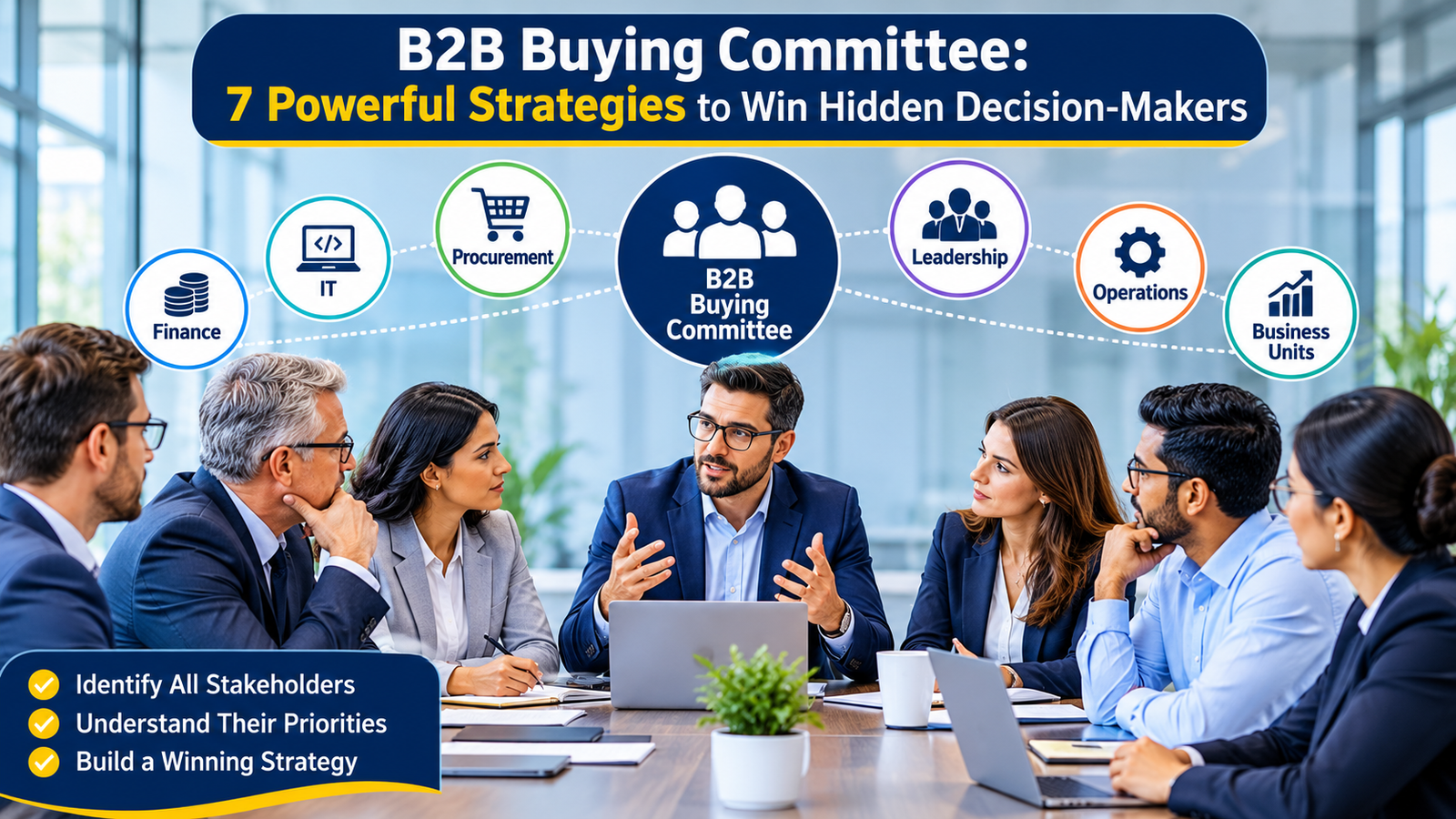
The B2B buying committee is one of the most important yet frequently overlooked elements of modern enterprise sales. Businesses often assume that the person requesting a proposal, attending product demonstrations, or discussing pricing is the individual responsible for making the final purchasing decision. However, in complex B2B environments, the person communicating with a sales representative may only be one part of a much larger decision-making process.
Behind almost every significant enterprise purchase is a network of stakeholders who evaluate, influence, approve, and sometimes reject potential solutions. These individuals may include department heads, financial controllers, IT professionals, procurement managers, compliance teams, and senior executives. Some actively participate in vendor discussions, while others influence purchasing decisions through internal recommendations and approval procedures without ever speaking directly to the vendor. Understanding the B2B buying committee helps sales professionals recognise the different individuals who influence purchasing decisions and determine whether a proposed solution meets organisational expectations.
This creates a significant challenge for B2B sales teams. Building a strong relationship with one prospect does not necessarily mean winning the organisation’s business. Successful selling requires understanding the people behind the purchasing process, recognising their individual priorities, and developing a strategy that addresses the concerns of the entire buying committee.
1. Why B2B Purchasing Decisions Are More Complex Than They Appear
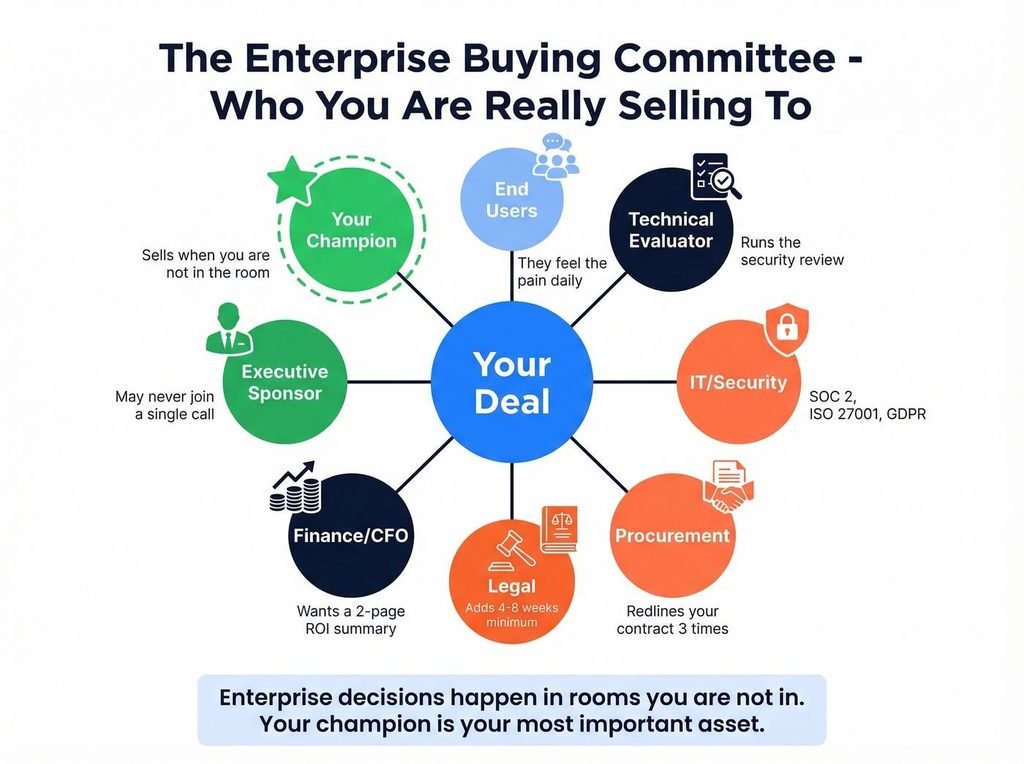
Traditional sales approaches often revolve around identifying a prospect, understanding their requirements, presenting a solution, and negotiating a commercial agreement. While this approach may work for relatively straightforward purchases, enterprise transactions typically involve multiple departments and approval levels. A well-defined B2B buying committee ensures that purchasing decisions consider financial feasibility, technical suitability, operational requirements, and long-term business value.
Consider an organisation looking to implement a new customer relationship management (CRM) platform. The marketing or sales department may identify the requirement and initiate conversations with technology vendors. However, the final purchasing decision depends on several additional considerations.
The finance department must determine whether the investment fits the available budget. IT professionals need to evaluate integration capabilities, cybersecurity requirements, and compatibility with existing infrastructure. Procurement may review contractual terms and vendor reliability, while senior management evaluates the solution’s contribution to broader business objectives.
Each department approaches the same purchase from a different perspective. Consequently, a solution that appears valuable to one team may introduce concerns for another.
Some common factors influencing enterprise purchasing decisions include:
- Financial considerations: Budget availability, total cost of ownership, expected ROI, and long-term operational expenses.
- Technical requirements: Integration capabilities, infrastructure compatibility, cybersecurity, and scalability.
- Operational requirements: Implementation complexity, employee adoption, maintenance, and workflow disruption.
- Commercial considerations: Contract flexibility, service-level agreements, vendor credibility, and support commitments.
- Strategic priorities: Business growth, digital transformation, competitive positioning, and long-term organisational objectives.
Understanding these considerations helps sales teams recognise why the B2B buying committee plays such an important role in enterprise purchasing.
2. The Hidden Decision-Makers Behind Every Enterprise Purchase
One of the biggest challenges in enterprise sales is identifying individuals who influence purchasing decisions without directly participating in vendor conversations.
The primary contact may coordinate discussions and collect information, but other stakeholders often determine whether a proposed solution satisfies the organisation’s requirements.
Finance Leaders: Evaluating Business Value and Financial Impact
Finance leaders are responsible for ensuring that investments support financial objectives and remain within approved budgets. Their evaluation often extends beyond the initial purchase price.
They may examine licensing expenses, implementation costs, maintenance requirements, renewal conditions, and the expected return on investment.
For example, a business development team may prefer an expensive sales automation platform because it offers advanced functionality. However, the finance department may question whether the additional features justify the investment.
Sales professionals should therefore communicate the financial value of a solution rather than focusing exclusively on product capabilities.
IT Teams: Assessing Security and Technical Compatibility
In technology-driven purchases, IT departments frequently play an important role in the evaluation process.
A solution may appear attractive from a business perspective but fail to meet internal technology requirements. IT professionals need to understand how the platform integrates with existing applications, handles sensitive information, and supports organisational security policies.
Their evaluation may include:
- Data security and access management.
- API availability and integration capabilities.
- Cloud infrastructure and hosting requirements.
- System reliability and performance.
- Regulatory and compliance requirements.
- Technical support and maintenance responsibilities.
For B2B technology vendors, engaging IT stakeholders early can help identify potential technical objections before they become obstacles during final approval.
Procurement Managers: Reviewing Commercial and Vendor Requirements
Procurement teams help organisations manage purchasing processes, supplier relationships, and contractual obligations.
Even when a department strongly prefers a particular solution, procurement may evaluate alternative vendors, negotiate commercial conditions, and examine contractual risks.
They may focus on pricing transparency, payment terms, service-level agreements, renewal policies, implementation commitments, and vendor credibility.
Sales teams that overlook procurement until the final stage may encounter unexpected delays or commercial objections.
Senior Executives: Connecting Purchases With Business Strategy
Senior executives generally evaluate purchases from a broader organisational perspective.
Rather than concentrating only on individual product features, they may want to understand how a proposed investment contributes to business expansion, operational efficiency, competitive advantage, and long-term strategic objectives.
A technology solution that improves one department’s productivity may not receive executive approval unless its broader business impact is clearly demonstrated.
Recognising these different responsibilities is essential when engaging the B2B buying committee.
3. The Risk of Assuming That Prospect Interest Means Buying Intent
A common mistake in B2B sales is interpreting positive communication as evidence that a deal is close to completion.
A prospect may attend several meetings, request product demonstrations, discuss pricing, and ask for a detailed proposal. These activities demonstrate engagement, but they do not necessarily indicate that the organisation has reached a purchasing decision.
The primary contact may still be gathering information, comparing competing vendors, or preparing an internal recommendation. They may also support the proposed solution but lack the authority to approve the investment.
This creates a situation where sales teams spend considerable time developing individual relationships without understanding the internal discussions that determine the outcome.
For example, a sales representative may receive positive feedback from a marketing director after demonstrating a marketing automation platform. However, the IT department may subsequently raise concerns about integration, while finance questions the proposed subscription cost.
The salesperson may interpret the delayed response as a loss of interest, even though the actual problem is an unresolved internal approval process.
To avoid misreading buying signals, sales professionals should distinguish between engagement and organisational commitment.
Important questions include:
- Who else needs to evaluate this solution before approval?
- Which departments will be involved in the purchasing process?
- Are there technical, financial, or compliance requirements that must be satisfied?
- What internal approvals are required before a contract can be signed?
- Is there an established evaluation process or purchasing timeline?
These questions help uncover the actual decision-making structure and provide a clearer understanding of the opportunity.
4. Understand the Different Priorities of Every Stakeholder

The B2B buying committee rarely evaluates a solution using one common set of priorities. Each stakeholder has responsibilities that influence how they assess a potential investment.
Sales professionals who deliver the same presentation to every department may struggle to communicate the solution’s actual value.
A more effective approach is to connect product capabilities with the business objectives of each stakeholder.
| Stakeholder | Primary Concern | What Sales Teams Should Communicate |
|---|---|---|
| Finance | Budget and ROI | Cost savings, financial value, and total cost of ownership |
| IT | Security and compatibility | Integrations, architecture, security, and technical support |
| Procurement | Commercial terms | Pricing transparency, contract flexibility, and vendor reliability |
| Department Heads | Operational performance | Productivity, workflow improvements, and departmental outcomes |
| Senior Executives | Strategic value | Business growth, scalability, and competitive advantage |
| Operations | Implementation and adoption | Deployment requirements, employee training, and process improvements |
For example, when selling enterprise software, a sales representative should explain how the platform improves departmental productivity to the business team while providing detailed security and integration documentation to IT.
Similarly, executive presentations should connect the proposed investment with measurable organisational objectives.
This approach makes the sales conversation more relevant and helps the entire buying committee understand why the proposed solution deserves consideration.
5. How to Identify and Engage the Entire B2B Buying Committee
Identifying stakeholders should be an early part of the sales process rather than something that happens when the opportunity approaches contract negotiations.
Sales teams can improve stakeholder visibility by asking questions about the organisation’s purchasing procedures, internal responsibilities, and evaluation requirements.
The objective is not simply to collect additional contact information. It is to understand how decisions are influenced and approved.
Practical approaches include:
- Understand the organisational structure: Identify departments that may be affected by the proposed solution.
- Ask about approval procedures: Determine whether financial, technical, legal, or executive approvals are required.
- Identify potential blockers: Understand which stakeholders may raise concerns about cost, implementation, security, or operational impact.
- Map stakeholder influence: Determine who evaluates the solution, who recommends it, and who has final approval authority.
- Develop relationships beyond the primary contact: Where appropriate, request introductions to relevant technical, financial, and operational stakeholders.
Sales teams can also use customer relationship management (CRM) platforms to document stakeholder relationships, communication history, responsibilities, and approval requirements.
This information helps account executives maintain visibility into complex opportunities and reduces the risk of depending entirely on one contact.
6. Turn Your Primary Contact Into an Internal Advocate
The person communicating with the sales team should not be viewed only as a potential customer. In many enterprise transactions, this individual can become an important internal advocate who helps communicate the value of the proposed solution.
However, becoming an effective advocate requires more than expressing personal interest.
The primary contact must be able to explain the business problem, demonstrate the value of the solution, and address questions from colleagues and management.
Sales professionals can support this process by providing relevant information that makes internal discussions easier.
Useful resources include:
- A detailed proposal explaining the business problem and recommended solution.
- A business case outlining expected benefits and financial considerations.
- Technical documentation covering integrations, security, and implementation.
- A comparison of relevant solution capabilities and requirements.
- An implementation roadmap explaining responsibilities and timelines.
- Answers to common questions raised by finance, procurement, and leadership.
For example, if a marketing director recommends a new marketing automation platform, a structured business case can help them explain how the investment supports lead management, campaign efficiency, and sales alignment.
Providing these resources allows the primary contact to communicate confidently with other stakeholders.
The objective is to move from individual interest towards organisation-wide confidence.
7. Build a Broader Sales Engagement Strategy for Complex B2B Deals
Understanding the B2B buying committee is only the first step. Sales organisations must also develop a structured engagement strategy that addresses the needs of different stakeholders throughout the purchasing journey.
This requires moving beyond traditional product demonstrations and generic sales presentations.
Create Stakeholder-Specific Communication
Different departments require different information to evaluate the same solution.
Rather than sending identical presentations to everyone, sales teams should develop relevant communication material for each stakeholder group.
For example:
- Finance teams should receive pricing breakdowns, ROI explanations, and financial justifications.
- IT departments should receive architecture documentation, security information, and integration details.
- Procurement teams should receive commercial proposals, contractual information, and vendor documentation.
- Senior management should receive strategic business cases highlighting organisational value and long-term opportunities.
Maintain Consistent Communication Across Departments
Although stakeholders have different priorities, they should receive consistent information about the proposed solution.
Conflicting messages about pricing, implementation timelines, product capabilities, or contractual commitments can reduce confidence and create unnecessary objections.
Sales representatives should ensure that all communication remains aligned with the original proposal and the organisation’s actual requirements.
Use CRM and Sales Intelligence to Improve Visibility
Technology can help sales teams understand relationships within target accounts and maintain a clearer picture of the buying process.
CRM platforms can record stakeholder details, track engagement, document objections, and maintain visibility into account-level activities.
Sales intelligence tools can also support account research and help identify relevant business contacts, organisational responsibilities, and potential decision-makers.
When used effectively, these technologies help sales teams move from individual prospect management towards a more comprehensive account-based sales strategy.
Measure Progress Beyond Individual Engagement
A prospect attending multiple meetings should not automatically be considered a highly qualified opportunity.
Sales teams should also evaluate whether the organisation is progressing through its internal decision-making process.
Useful indicators include:
- Identification of key stakeholders.
- Confirmation of technical and financial requirements.
- Engagement from relevant departments.
- Clarity around approval procedures.
- Agreement on evaluation criteria.
- Understanding of implementation expectations.
- Progress towards a documented purchasing decision.
These indicators provide a more realistic view of enterprise sales opportunities and help teams identify risks earlier.
Conclusion
The person you are selling to may not be the person ultimately choosing your solution. In modern B2B environments, purchasing decisions are shaped by an interconnected network of stakeholders who bring different responsibilities, priorities, and expectations to the evaluation process.
Understanding the B2B buying committee allows sales professionals to look beyond the primary contact and recognise the individuals who influence the final outcome. Finance may evaluate the investment, IT may assess technical suitability, procurement may review commercial conditions, and senior executives may determine whether the solution supports broader business objectives.
Successful enterprise selling therefore requires more than delivering an impressive product demonstration or building a positive relationship with one prospect. It requires identifying stakeholders early, understanding their concerns, communicating relevant business value, and helping the organisation develop confidence in its purchasing decision.
Businesses that adopt this broader approach can identify potential objections earlier, improve stakeholder engagement, strengthen internal advocacy, and create more predictable sales opportunities.
Ultimately, winning complex B2B deals is not simply about convincing the person sitting across the table. It is about understanding the entire organisation behind that person and demonstrating why your solution deserves the confidence of everyone involved in the decision.
Frequently Asked Questions
1. What is a B2B buying committee?
A B2B buying committee is a group of individuals within an organisation who participate in or influence purchasing decisions. Members may include department heads, finance leaders, IT professionals, procurement managers, and senior executives. Each stakeholder evaluates a potential purchase from their own professional perspective.
2. Why is identifying the B2B buying committee important?
Identifying the B2B buying committee helps sales teams understand who influences purchasing decisions and what requirements must be satisfied before approval. It also helps businesses identify potential objections earlier, communicate more effectively, and reduce delays caused by previously unidentified stakeholders.
3. Who are the hidden decision-makers in B2B sales?
Hidden decision-makers are individuals who influence or approve purchasing decisions without necessarily participating in direct vendor conversations. They may include finance controllers, IT managers, procurement professionals, compliance officers, department heads, and senior executives.
4. How can sales teams identify hidden decision-makers?
Sales teams can identify hidden decision-makers by asking about internal approval procedures, departmental requirements, technical evaluations, budget ownership, and purchasing responsibilities. Reviewing organisational structures and maintaining stakeholder information in CRM platforms can also improve visibility.
5. Does the primary contact always have purchasing authority?
No. The primary contact may identify a business requirement, coordinate vendor discussions, and recommend a solution without having final purchasing authority. Final approval may depend on finance, procurement, IT, or senior management.
6. How should B2B sales teams communicate with different stakeholders?
Sales teams should tailor their communication according to each stakeholder’s responsibilities. Finance teams generally need financial justification, IT departments require technical and security information, procurement needs commercial clarity, and senior executives prefer strategic business value.
7. What role does CRM play in managing a B2B buying committee?
CRM platforms help sales teams maintain stakeholder records, document communication history, track engagement, record objections, and understand relationships within target accounts. This creates better visibility into complex opportunities and supports coordinated account management.
8. How can businesses reduce delays in enterprise purchasing decisions?
Businesses can reduce purchasing delays by identifying stakeholders early, understanding approval requirements, addressing technical and financial concerns, providing relevant documentation, and maintaining consistent communication throughout the evaluation process.
9. What is the difference between a decision-maker and an influencer in B2B sales?
A decision-maker has the authority to approve or reject a purchase, while an influencer shapes the decision through expertise, recommendations, or organisational responsibilities. Both can significantly affect the outcome of an enterprise purchasing process.
10. Why is stakeholder engagement important for enterprise sales success?
Stakeholder engagement ensures that the concerns of different departments are understood and addressed before a purchasing decision is made. It helps build internal support, reduce unexpected objections, strengthen trust, and improve the likelihood of securing complex B2B deals.