AI agent security is becoming a critical concern for enterprises as artificial intelligence moves from passive tools toward autonomous systems capable of searching databases, communicating with applications, making recommendations, initiating workflows, executing transactions, and interacting with other AI agents. Identity management, passwords, authentication, permissions, role-based access, privileged accounts, and access reviews were all built around the idea that a person is ultimately responsible for an action performed inside the enterprise.
That assumption is beginning to change. AI agents are moving from passive tools that answer questions toward active systems capable of searching databases, communicating with applications, making recommendations, initiating workflows, executing transactions, and interacting with other AI agents. As these systems become more autonomous, enterprises will face a new category of security and governance challenge: determining not only whether a human or machine is authorized to access something, but whether one autonomous system should trust another autonomous system to act on its behalf.
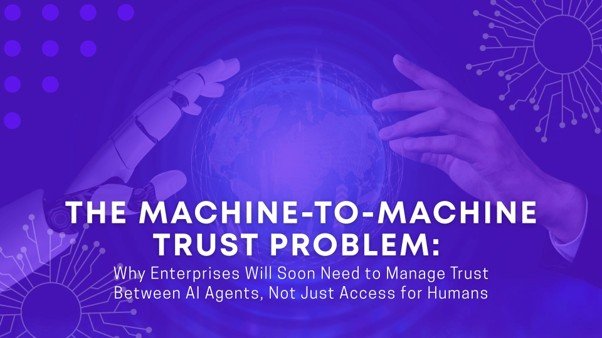
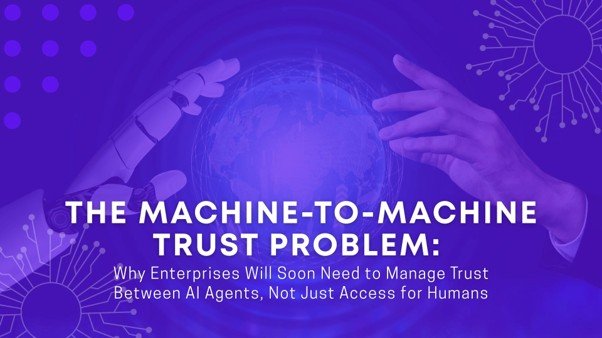
This creates what can be described as the Machine-to-Machine Trust Problem, where the next generation of enterprise security will increasingly depend on managing relationships between intelligent systems rather than simply controlling access for human employees. Enterprise security has traditionally been designed around a relatively simple assumption: humans use systems, systems store information. AI agent security is becoming a critical priority for enterprises as AI agents move from passive tools toward autonomous systems capable of taking actions, accessing data, executing workflows, and interacting with other AI agents. Enterprise security has traditionally been designed around a relatively simple assumption: humans use systems, systems store information.
AI Agent Security: Access vs. Trust
AI agent security requires enterprises to distinguish between access and trust.AI agent security requires enterprises to distinguish between access and trust. Access answers a relatively straightforward question: “Is this entity allowed to perform this action?” Trust asks a much deeper question: “Should this entity be relied upon to perform this action under these circumstances?” A traditional application may have permission to read customer information, but an autonomous AI agent may use that information to make decisions, trigger workflows, communicate with other systems, or delegate tasks to another agent.
The risk therefore does not exist only at the moment of access. It exists across the entire chain of actions that follows. An agent can be technically authorized and still behave in a way that creates unacceptable business consequences. Enterprises will therefore need governance systems capable of evaluating not only permissions but context, intent, reliability, provenance, and the consequences of autonomous actions.This becomes particularly complicated when AI agents begin interacting with one another. Imagine a procurement agent that identifies a supplier and asks a finance agent to validate the vendor.
The finance agent checks financial information, the compliance agent evaluates regulatory requirements, and a contract agent prepares the agreement. Each system performs a specialized task, but none of them necessarily has complete visibility into what the others are doing. If one agent provides incorrect or manipulated information, downstream systems may trust that information and act upon it. The organization has effectively created a digital chain of delegation in which machines depend upon one another’s outputs. The traditional concept of application security does not fully capture this dynamic because the problem is no longer simply whether systems can communicate. It is whether they can reliably delegate decisions to one another.
Human organizations have developed sophisticated ways of managing trust between people. Employees have job titles, reporting relationships, professional qualifications, organizational histories, performance records, and reputations. When someone asks a colleague to perform an important task, they make a judgment based on previous experience and contextual knowledge.
If the person makes a mistake repeatedly, their level of responsibility may change. Autonomous systems do not naturally possess this kind of social context. They may have technical credentials and permissions, but those credentials do not necessarily indicate whether their decisions should be trusted in a particular situation. Enterprise AI governance will therefore need mechanisms that give machines something resembling a verifiable professional identity.
AI Agent Security and Agent Identity
AI agent security depends on knowing exactly which AI agent is operating, what capabilities it has, what information it can access, and what actions it is authorized to perform. An enterprise may need to know which model powers an agent, who deployed it, what data it can access, what tools it can use, what decisions it is permitted to make, how often it has performed successfully, what constraints apply to it, and which other systems it is authorized to delegate tasks to.
Instead of simply identifying an agent as “Procurement Bot,” organizations may need a richer identity profile describing its purpose, capabilities, authority, history, and risk level. The identity of an AI agent may become as important to enterprise governance as the identity of an employee.
Reputation may become another important layer. Humans naturally develop reputational judgments over time. A colleague who consistently provides accurate analysis becomes trusted with more important work. An employee who repeatedly makes errors receives additional oversight. AI agents could eventually require similar dynamic trust mechanisms. An agent that performs reliably under specific conditions may receive broader authority, while one that produces inconsistent results may be restricted to lower-risk tasks or require human approval. Trust would therefore become a continuously evaluated property rather than a one-time permission.
AI Agent Security and Least Privilege
AI agent security also requires enterprises to rethink the traditional principle of least privilege. The concept of least privilege will also need to evolve. Traditional cybersecurity principles recommend giving users and systems only the access required to perform their assigned responsibilities. But AI agents can combine multiple capabilities in ways that humans typically do not. An agent may have access to data, communication systems, APIs, financial tools, and workflow automation simultaneously.
Individually, each permission may appear reasonable. Combined, they may create an unexpectedly powerful system. An agent capable of reading customer data and initiating refunds may have far greater operational authority than either permission suggests independently. Enterprises will therefore need to evaluate the combined capabilities of agents rather than reviewing permissions one by one.
AI Agent Security and Delegation
AI agent security becomes more complex when autonomous agents can delegate tasks to other agents. Delegation creates another layer of complexity. A human manager can delegate a task to an employee while remaining accountable for the outcome. With AI agents, delegation can become recursive. Agent A asks Agent B to perform a task. Agent B may use Agent C. Agent C may retrieve information from Agent D. Suddenly, an apparently simple instruction has created a chain of machine decisions across multiple systems. If something goes wrong, the organization needs to know where responsibility originated, which agent made each decision, what information was available at each stage, and why the chain continued. This makes machine-readable audit trailsessential.
AI Agent Security and Audit Trails
AI agent security requires detailed auditability when autonomous systems make consequential decisions. Auditability becomes particularly important when autonomous systems make consequential decisions. An enterprise cannot simply record that “the AI approved the transaction.” It may need to know which model version was active, what information the model used, which policies were applied, what tools were called, what other agents participated, what confidence level existed, and whether human oversight was available. Without this information, organizations may struggle to investigate incidents, satisfy regulatory requirements, or explain decisions to customers. The audit trail becomes a form of institutional memory for machine activity.
Machine-to-Machine Trust Across Organizations
AI agent security becomes even more challenging when AI agents operate across organizational boundaries. The challenge becomes even greater when AI agents operate across organizational boundaries. A company’s internal agent may need to interact with a supplier’s AI system, a customer’s automated procurement platform, or a third-party service agent. At that point, traditional organizational trust boundaries become less useful. Two machines may need to negotiate, exchange information, and execute transactions without direct human intervention.
How does one organization know that another organization’s agent is legitimate? How does it know what authority that agent possesses? How can it verify that the information received has not been manipulated? Enterprise-to-enterprise AI interaction will require new standards for machine identity, authentication, authorization, provenance, and trust.
This could fundamentally change B2B transactions. Imagine a future in which a company’s procurement agent automatically evaluates thousands of suppliers, communicates with vendor agents, requests proposals, verifies certifications, negotiates commercial conditions within predefined limits, and recommends a final agreement. The human procurement team may review the final recommendation rather than conducting every interaction themselves.
The efficiency gains could be enormous, but the system’s reliability will depend on whether the company’s agent can correctly determine which external agents should be trusted. Vendor reputation may therefore increasingly include not only the reputation of the human organization but the behavior and reliability of its machine interfaces.
AI Agent Security for Enterprise Security Teams
Security teams will consequently need to expand their responsibilities. Traditional identity and access management teams have focused heavily on employees, contractors, service accounts, and applications. The rise of autonomous agents introduces a new population of digital actors. These actors may be temporary, dynamically created, geographically distributed, and capable of taking actions at machine speed. Security teams will need to understand where agents exist, what they can access, which agents communicate with each other, and how their permissions change over time. The enterprise identity graph may become dramatically more complex.
There is also a critical issue of trust inheritance. If an agent is trusted because it was created by a highly trusted organization, does that trust automatically extend to every action it takes? Probably not. A legitimate agent can still make incorrect decisions. A trusted application can still contain vulnerabilities. A reputable vendor can still experience a compromised system. Enterprises therefore need to separate trust in the identity of an agent from trust in a specific action. High-risk actions may require additional validation regardless of who or what initiates them.
AI Agent Security and Risk-Based Oversight
AI agent security will require risk-based human oversight rather than constant human review of every autonomous action. Human oversight will remain important, but the definition of oversight will change. Humans cannot realistically review every decision made by thousands of autonomous agents operating continuously. Instead, organizations will need risk-based oversight.
Low-risk actions can occur automatically. Medium-risk actions may require additional system validation. High-risk actions may require explicit human approval. The intelligence of the governance system will determine where humans enter the loop. The objective is not to eliminate human control but to place human attention where it has the greatest value.
This will also change how organizations design AI systems. Agents should not simply be given broad access and trusted to behave responsibly. Their capabilities should be constrained by clear policies, transaction limits, contextual permissions, escalation mechanisms, and reversible actions. An agent authorized to make a $100 operational purchase should not automatically have the ability to approve a $100,000 transaction. An agent allowed to update customer information should not necessarily be able to delete customer records. Trust must be connected to consequences. The greater the potential impact of an action, the stronger the validation required.
AI agent security ultimately represents a shift from identity-centric security to relationship-centric security. The future enterprise will contain humans, applications, AI agents, external systems, and autonomous services interacting continuously. Knowing who or what an entity is will remain important, but it will no longer be enough. Organizations will need to understand what that entity is allowed to do, why it is doing it, who authorized it, which systems it can delegate to, how reliable it has been, and what could happen if the action is wrong.
The Future of AI Agent Security
The companies that solve this problem early will have a significant advantage as autonomous enterprise systems become more common. They will be able to automate aggressively without surrendering control, create machine-to-machine partnerships without creating blind trust, and allow AI agents to operate at scale while maintaining accountability.
The next generation of enterprise security will not ask only, “Can this AI agent access the system?” It will ask a far more important question: “Should this agent be trusted to act here, right now, under these conditions, and can we prove why?” As machines become participants in business decisions, trust itself will become infrastructure.