Introduction
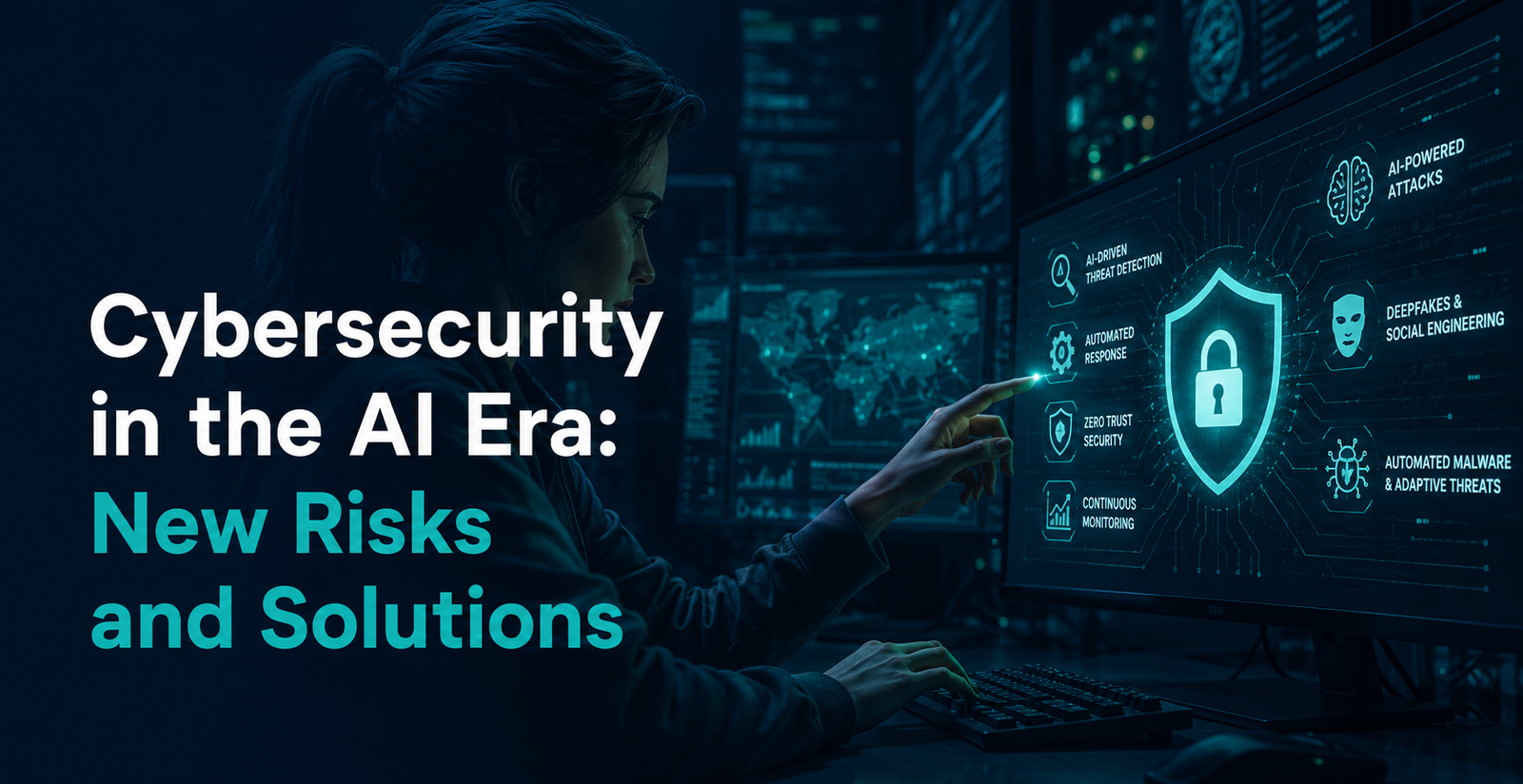
Artificial Intelligence (AI) is transforming the cybersecurity landscape faster than ever before. Businesses across industries are increasingly using AI-powered technologies to improve threat detection, automate security operations, analyze massive datasets, and strengthen digital defenses. AI has become a powerful tool for helping organizations respond to cyber threats with greater speed and accuracy.
However, while AI is enhancing cybersecurity capabilities, it is also creating new security risks and challenges. Cybercriminals are now leveraging AI to launch more advanced attacks, automate malicious activities, create sophisticated phishing campaigns, and exploit vulnerabilities at unprecedented scale. As AI technologies continue to evolve, both defenders and attackers are gaining access to increasingly intelligent tools.
This growing battle between AI-driven cybersecurity solutions and AI-powered cyber threats is reshaping the future of digital security. Organizations must now prepare for a cybersecurity environment where attacks are faster, smarter, and more difficult to detect than ever before.
In the AI era, cybersecurity is no longer only about protecting systems from traditional threats—it is about defending against intelligent, adaptive, and automated attacks.
The Growing Role of AI in Cybersecurity
AI has become a major component of modern cybersecurity strategies because of its ability to process enormous amounts of data and identify suspicious activities in real time. Traditional security systems often struggle to keep up with the increasing complexity and speed of modern cyber threats, while AI-powered systems can continuously learn and adapt to evolving attack patterns.
Organizations are using AI in cybersecurity for several important functions, including:
- Threat detection and prevention
- Automated incident response
- Behavioral analytics
- Fraud detection
- Malware analysis
- Network traffic monitoring
- Vulnerability management
AI-driven security systems help businesses reduce response times, improve operational efficiency, and identify threats that human analysts may overlook.
As cyberattacks continue to grow in sophistication, AI is becoming essential for organizations trying to maintain strong digital defenses.
New Cybersecurity Risks Emerging in the AI Era
While AI offers significant security advantages, it also introduces entirely new categories of cyber risks. Cybercriminals are increasingly adopting AI technologies to improve the scale, speed, and effectiveness of attacks.
The rise of AI-powered threats is forcing organizations to rethink traditional cybersecurity approaches.
AI-Powered Phishing Attacks
Phishing attacks have become far more dangerous with the help of AI technologies. Traditional phishing emails were often easy to identify due to poor grammar, suspicious wording, or generic formatting. However, AI can now generate highly convincing and personalized phishing messages that closely mimic legitimate communications.
AI tools can analyze social media profiles, business communications, and online behavior to craft targeted phishing campaigns that appear authentic.
Modern AI-driven phishing attacks may include:
- Personalized email content
- Realistic chatbot impersonation
- AI-generated voice cloning
- Deepfake video scams
- Automated social engineering
These sophisticated attacks make it increasingly difficult for employees and customers to distinguish between legitimate and malicious communications.
Deepfakes and Identity Manipulation
One of the most concerning AI-related cybersecurity threats is the rise of deepfake technology. Deepfakes use AI to create highly realistic fake audio, video, and images that can impersonate real individuals.
Cybercriminals can use deepfakes for:
- Financial fraud
- Executive impersonation
- Identity theft
- Misinformation campaigns
- Social engineering attacks
For example, attackers may use AI-generated voice cloning to impersonate company executives and authorize fraudulent financial transactions.
As deepfake technologies continue improving, organizations may face growing challenges verifying digital identities and maintaining communication trust.
AI-Driven Malware and Automated Attacks
AI is also enabling cybercriminals to develop smarter malware capable of adapting to security environments and avoiding detection.
Traditional malware typically relies on pre-programmed instructions, but AI-powered malware can:
- Learn system behaviors
- Change attack patterns dynamically
- Evade detection tools
- Exploit vulnerabilities automatically
- Spread faster across networks
These adaptive threats can become significantly more difficult for traditional antivirus and signature-based security systems to detect.
AI-driven cyberattacks may also automate vulnerability scanning and exploit development, allowing attackers to target systems at a much larger scale.
Data Privacy and AI Security Risks
AI systems depend heavily on large volumes of data to function effectively. This creates significant data privacy and security concerns for businesses handling sensitive customer and organizational information.
Poorly secured AI systems may expose:
- Customer records
- Financial information
- Healthcare data
- Intellectual property
- Business analytics
- Authentication credentials
AI models themselves can also become targets for cyberattacks. Attackers may attempt to manipulate training data, steal proprietary AI models, or exploit vulnerabilities within machine learning systems.
Protecting AI infrastructure is becoming just as important as protecting traditional IT systems.
Adversarial Attacks on AI Models
Adversarial attacks are a growing cybersecurity challenge specifically targeting AI systems. In these attacks, cybercriminals intentionally manipulate data inputs to deceive AI models into making incorrect decisions.
For example:
- Image recognition systems may misclassify objects
- Fraud detection systems may fail to identify suspicious behavior
- Autonomous systems may respond incorrectly to manipulated inputs
Even small data modifications can sometimes cause major disruptions in AI decision-making processes.
As businesses increasingly rely on AI-powered automation, adversarial attacks represent a major operational and security concern.
Insider Threats in AI Environments
The growing use of AI systems within organizations also increases the risk of insider threats. Employees, contractors, or privileged users with access to AI systems may intentionally or unintentionally expose sensitive data or misuse AI technologies.
Insider risks may include:
- Unauthorized data access
- AI model manipulation
- Data leakage
- Improper use of AI-generated insights
- Weak security practices
Organizations must ensure that AI systems include strong access controls, monitoring mechanisms, and governance policies to reduce insider-related risks.
Insider Threats in AI Environments
The growing use of AI systems within organizations also increases the risk of insider threats. Employees, contractors, or privileged users with access to AI systems may intentionally or unintentionally expose sensitive data or misuse AI technologies.
Insider risks may include:
- Unauthorized data access
- AI model manipulation
- Data leakage
- Improper use of AI-generated insights
- Weak security practices
Organizations must ensure that AI systems include strong access controls, monitoring mechanisms, and governance policies to reduce insider-related risks.
How AI is Strengthening Cybersecurity Defenses
Despite the growing risks, AI is also providing organizations with powerful tools to improve cybersecurity resilience. AI-powered security solutions can help businesses respond to threats faster and more effectively than traditional systems.
Real-Time Threat Detection
AI systems can continuously monitor networks, endpoints, applications, and user behavior in real time. By analyzing large datasets quickly, AI can identify suspicious patterns that may indicate cyberattacks.
Unlike traditional systems that rely heavily on predefined rules, AI-based security platforms can detect unknown threats through behavioral analysis and anomaly detection.
This helps organizations identify attacks earlier before major damage occurs.
Automated Incident Response
Cybersecurity teams often face overwhelming numbers of alerts and security incidents. AI-powered automation helps reduce response times by automatically handling repetitive security tasks.
AI-driven incident response systems can:
- Isolate infected devices
- Block suspicious traffic
- Trigger alerts
- Prioritize threats
- Initiate remediation workflows
Automation allows security teams to focus on more complex threats and strategic security planning.
Predictive Threat Intelligence
AI can analyze historical attack data, global threat intelligence feeds, and emerging attack trends to predict potential future threats.
Predictive cybersecurity capabilities help organizations:
- Anticipate attack patterns
- Identify vulnerable systems
- Strengthen proactive defenses
- Improve risk management strategies
As cyber threats evolve rapidly, predictive AI tools are becoming increasingly valuable for enterprise security operations.
Behavioral Analytics and User Monitoring
AI-powered behavioral analytics systems monitor how users interact with systems and applications. These tools can identify unusual activities that may indicate compromised accounts or insider threats.
Examples include:
- Unusual login locations
- Abnormal file access patterns
- Unexpected data transfers
- Suspicious account activity
Behavioral analytics helps organizations strengthen identity and access management practices while reducing unauthorized access risks.
Challenges Businesses Face in AI Cybersecurity Adoption
Although AI offers powerful cybersecurity advantages, organizations still face several implementation challenges.
Skill Shortages
Many businesses struggle to find professionals with expertise in both AI technologies and cybersecurity operations.
High Implementation Costs
Advanced AI-powered cybersecurity platforms may require significant investments in infrastructure, software, and skilled personnel.
Complexity of AI Systems
AI security systems can become highly complex, making them difficult to manage, audit, and maintain effectively.
False Positives and Bias
AI security tools may sometimes generate false alerts or inaccurate threat assessments, potentially creating operational inefficiencies.
Organizations must carefully balance automation with human oversight.
Best Practices for Strengthening Cybersecurity in the AI Era
Businesses must adopt proactive cybersecurity strategies to manage AI-related risks effectively.
Key best practices include:
- Implementing Zero Trust security models
- Strengthening identity and access management
- Conducting regular AI security audits
- Encrypting sensitive data
- Monitoring AI models continuously
- Training employees on AI-related threats
- Developing incident response plans
- Using multi-factor authentication
Cybersecurity strategies should evolve continuously as AI threats become more advanced.
The Future of Cybersecurity and AI
The relationship between AI and cybersecurity will continue evolving rapidly in the coming years. AI technologies are expected to become even more integrated into security operations, helping organizations improve threat detection, automation, and resilience.
At the same time, cybercriminals will continue adopting AI to launch increasingly sophisticated attacks.
Future cybersecurity trends may include:
- Self-healing security systems
- Autonomous threat detection
- AI-driven security orchestration
- Advanced deepfake detection tools
- Predictive cyber defense platforms
The future of cybersecurity will likely depend on how effectively organizations can balance AI innovation with strong security governance and ethical practices.
Conclusion
The rise of AI is fundamentally transforming the cybersecurity landscape. While AI provides organizations with powerful tools for threat detection, automation, and predictive defense, it also introduces new risks such as deepfakes, AI-powered phishing, adaptive malware, and adversarial attacks.
Businesses can no longer rely solely on traditional cybersecurity methods to protect modern digital environments. Organizations must adopt advanced AI-driven security strategies while also preparing for the growing sophistication of AI-enabled cyber threats.
Success in the AI era will require continuous monitoring, strong governance, employee awareness, proactive risk management, and ongoing investment in cybersecurity innovation. Businesses that successfully adapt to this evolving threat landscape will be better positioned to protect their systems, customers, and operations in an increasingly intelligent digital world.