Businesses invest considerable time and resources in developing products, improving services, and communicating their value. They create detailed presentations, publish product information, launch marketing campaigns, and train sales teams to explain every important feature. From an internal perspective, the offering may seem straightforward because employees understand how it works, what makes it different, and why customers should choose it.
However, customers do not experience a product with the same level of familiarity. They may visit a website, read a product description, watch a demonstration, or speak with a sales representative and still leave without fully understanding what the business offers. This disconnect creates a customer information gap between what companies believe they are communicating and what potential buyers actually understand.
The challenge is not always a lack of information. In many cases, businesses provide so much technical detail, industry terminology, and promotional messaging that the most important information becomes difficult to identify. Customers may know that a company offers an advanced solution, but they may not understand which problem it solves, how it fits into their existing operations, or why investing in it would make a difference.
Understanding the customer information gap is therefore essential for businesses that want to improve product awareness, strengthen customer relationships, and create more effective B2B marketing and sales experiences. The goal is not simply to communicate more. It is to make important information easier to understand.
What Is the Customer Information Gap?
The customer information gap refers to the difference between the information a business believes it has communicated and the understanding customers actually develop about its products or services.
Companies often evaluate their communication based on what they have published or presented. They may have comprehensive product pages, detailed brochures, technical documentation, and professionally designed presentations. However, the existence of these resources does not automatically mean that customers understand the offering.

For example, a technology company may promote an enterprise software platform by describing its automation capabilities, integration architecture, advanced analytics, and security features. Although these details may be technically accurate, a potential buyer might still have fundamental questions:
- What business problem does this platform solve?
- How will it improve our existing processes?
- Does it work with the systems we already use?
- What benefits can different departments expect?
- Why should we choose this solution over another option?
When these questions remain unanswered, the customer information gap continues to influence the buying decision.
In B2B environments, this problem becomes particularly important because purchasing decisions frequently involve multiple stakeholders. Technical teams, finance departments, business leaders, and procurement professionals may all evaluate the same product from different perspectives.
A successful communication strategy must help these stakeholders understand both the product’s capabilities and its practical business value.
Why Customers Often Know Less About Your Product Than You Think
Several factors contribute to the customer information gap. Recognising these issues can help businesses understand why their marketing communication sometimes fails to create the expected level of customer awareness.
1. Businesses Communicate From an Internal Perspective
One of the biggest reasons for the customer information gap is that companies often communicate from the perspective of people who already understand the product.
Internal teams are familiar with technical terminology, product features, implementation processes, and industry-specific language. These concepts become part of their everyday conversations, making them seem simple and familiar.
However, what sounds straightforward to an employee who has worked with a product for several years may be confusing to someone discovering it for the first time.
Consider an enterprise IT company promoting a cloud infrastructure management solution. Its marketing materials might focus heavily on workload orchestration, infrastructure provisioning, observability, and automated resource allocation.
Although these capabilities may be important, a business decision-maker may be more interested in understanding whether the solution can:
- Reduce the complexity of managing infrastructure.
- Improve operational visibility.
- Help teams manage resources more efficiently.
- Simplify monitoring and troubleshooting.
- Support business growth without unnecessary operational difficulties.
The difference is significant. Technical teams may understand the terminology, but customers need a clear connection between those capabilities and their business requirements.
Practical insight: Review product descriptions from the perspective of someone unfamiliar with your organisation. If the explanation requires extensive background knowledge, simplify the initial message before introducing technical details.
2. Too Much Information Can Create More Confusion
Businesses sometimes assume that providing more information will automatically improve customer understanding. Consequently, they include every feature, specification, service capability, and technical detail in their marketing materials.
However, excessive information can make it harder for customers to identify what matters.
A website with lengthy service descriptions, multiple technical sections, complex navigation, and repeated promotional statements may contain everything a company wants to communicate. Yet visitors may struggle to find the specific information they need.
This is another common reason behind the customer information gap.
For example, a cybersecurity provider might publish extensive information about threat intelligence, endpoint protection, network monitoring, vulnerability management, and incident response. A potential customer may understand that the company offers several security services but remain uncertain about which solution addresses their immediate security concerns.
Instead of presenting all information at the same level, businesses should organise content according to customer needs.
Consider the following approach:
- Start with the problem: Explain the business challenge the product addresses.
- Introduce the solution: Describe how the offering helps resolve that challenge.
- Highlight the value: Explain the operational or business benefits.
- Provide supporting details: Make technical specifications and deeper explanations available for interested buyers.
This approach creates a more logical information journey and reduces the risk of overwhelming potential customers.
3. Product Features Receive More Attention Than Customer Benefits
Another major contributor to the customer information gap is the tendency to explain what a product does without clearly explaining why customers should care.
Businesses naturally take pride in their product features. They want potential buyers to understand the technology, functionality, innovation, and development effort behind their offering.
However, customers are usually more interested in how those capabilities improve their situation.
For example, a business software provider might promote automated reporting, centralised dashboards, and advanced data integration. These features are useful, but their value becomes clearer when the company explains how they help teams reduce manual reporting, improve access to information, and make better-informed decisions.
The difference between feature-focused and benefit-focused communication can be understood through a simple comparison:
| Feature-focused message | Customer-focused message |
|---|---|
| Advanced reporting dashboard | Get a clearer view of business performance |
| Automated workflow management | Reduce repetitive manual processes |
| Centralised data integration | Access relevant information across systems |
| Advanced security capabilities | Strengthen protection across business operations |
| Real-time analytics | Make decisions using more current information |
Features explain functionality. Benefits establish relevance.
When companies connect product capabilities with practical business outcomes, customers can understand why the offering deserves their attention.
4. Different Decision-Makers Understand Value Differently
B2B purchasing decisions rarely depend on one person’s opinion. A solution may be evaluated by technical specialists, department heads, finance professionals, procurement teams, and senior executives.
Each stakeholder approaches the same offering with different priorities.
A technology manager may want to understand integration requirements, infrastructure compatibility, and technical performance. A finance leader may focus on investment considerations, operational costs, and potential returns. A business head may be more interested in productivity, scalability, and the solution’s contribution to organisational objectives.
When businesses communicate only from one perspective, they risk leaving other stakeholders without the information required to evaluate the offering.
This creates an additional dimension of the customer information gap: customers may understand certain aspects of a product while remaining unclear about others.
Businesses should therefore adapt their messaging to different stakeholder requirements.
For example:
- Technical stakeholders: Explain architecture, integration, security, implementation, and operational requirements.
- Financial stakeholders: Clarify pricing structures, resource considerations, and the business case.
- Business leaders: Highlight productivity, business continuity, scalability, and strategic value.
- Procurement teams: Provide clear service descriptions, contractual information, and evaluation criteria.
The objective is to maintain a consistent product message while making its relevance clear to different decision-makers.
5. Marketing Awareness Is Mistaken for Product Understanding

Businesses often measure marketing success through website visits, campaign impressions, enquiries, social media engagement, and lead generation.
These metrics can indicate that people have encountered a brand. However, they do not necessarily demonstrate that potential customers understand the product.
A prospect may recognise a company’s name after seeing several advertisements but still have little idea about its capabilities. Someone may download a product brochure without understanding how the solution relates to their business requirements.
This distinction is important because awareness and understanding are different stages of the buying journey.
For example, an enterprise technology campaign might generate enquiries from professionals interested in digital transformation. However, if the campaign does not clearly explain the services offered, the sales team may receive enquiries from people whose expectations do not match the company’s actual capabilities.
Businesses should look beyond engagement metrics and evaluate whether their communication helps customers develop a meaningful understanding of the offering.
Useful indicators include:
- Questions customers repeatedly ask during initial conversations.
- Product features or benefits that prospects frequently misunderstand.
- Website sections where visitors may struggle to find relevant information.
- The clarity of enquiries received through marketing campaigns.
- How confidently prospects can explain the solution to other stakeholders.
These observations can reveal gaps that traditional marketing metrics may not capture.
How the Customer Information Gap Affects B2B Sales and Business Growth
The customer information gap is not simply a communication problem. It can directly influence sales conversations, purchasing decisions, customer confidence, and long-term business relationships.
When customers do not understand a product, they may hesitate to move forward even when the offering is relevant to their needs.
Longer Sales Cycles and Repeated Explanations
Sales representatives may spend considerable time explaining basic product information that could have been communicated earlier through websites, brochures, or introductory presentations.
Demonstrations may require additional clarification, proposals may need repeated revisions, and discussions may become unnecessarily complicated.
This increases the effort required from both the customer and the sales team.
Difficulty Gaining Internal Approval
In enterprise environments, the person attending a sales meeting is not always the final decision-maker.
An interested stakeholder may need to explain the solution to colleagues, department heads, or senior management before a purchase can proceed.
If the product’s value has not been communicated clearly, that stakeholder may struggle to build an internal business case.
As a result, a potentially valuable opportunity may lose momentum.
Reduced Customer Confidence
Unclear communication can create uncertainty about product capabilities, implementation requirements, and expected outcomes.
Customers may begin questioning whether the solution is suitable for their organisation or whether the business fully understands their requirements.
Clear and consistent explanations help reduce this uncertainty and establish confidence throughout the buying process.
Lost Business Opportunities
Customers frequently compare multiple providers before making a purchasing decision.
When one company communicates its offering through complex terminology and unclear messaging while another explains its value directly, the second company may create a stronger first impression.
The customer information gap can therefore become a competitive disadvantage, even when the underlying product is equally capable or more advanced.
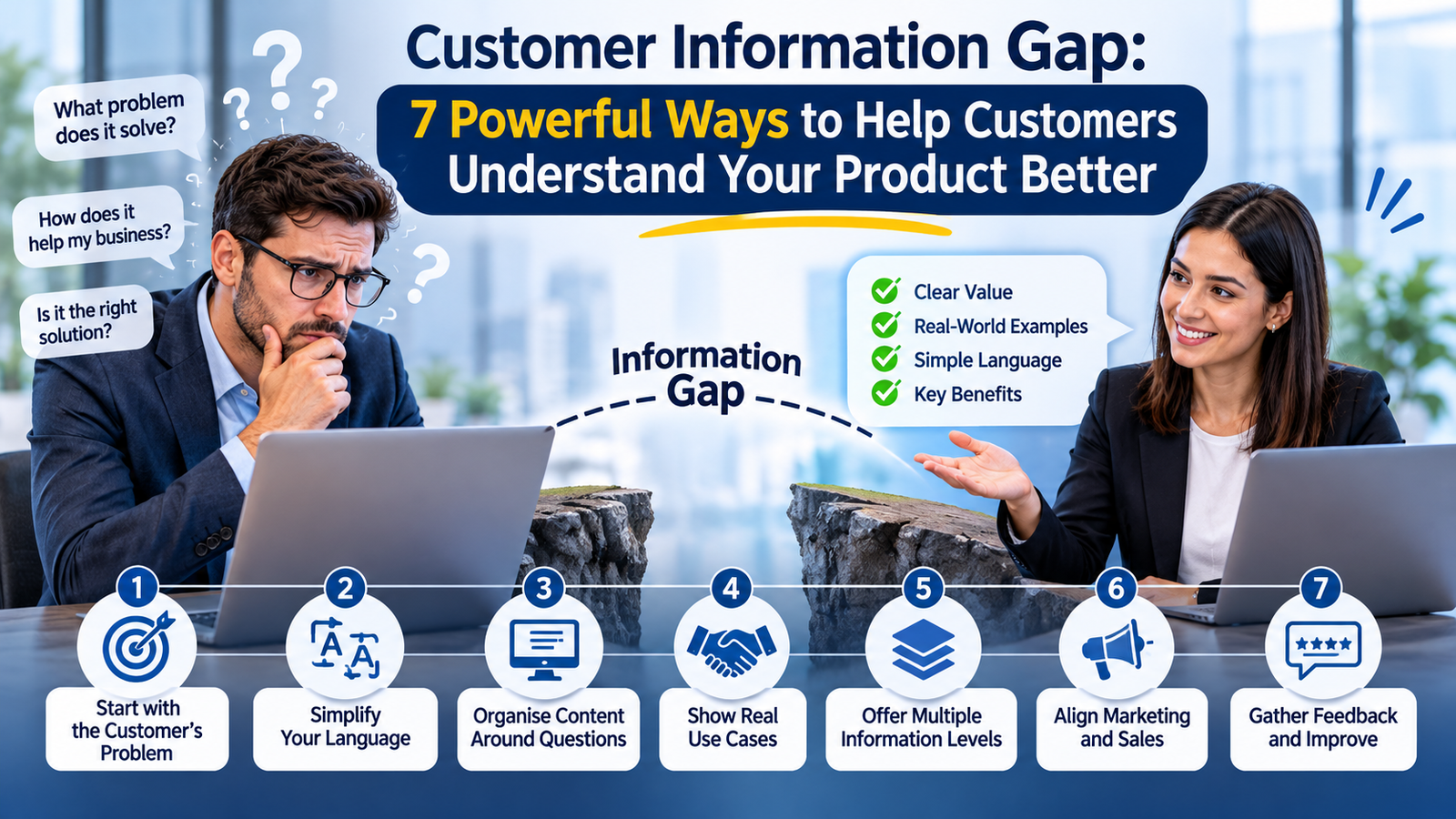
7 Practical Ways to Close the Customer Information Gap
Closing the customer information gap requires businesses to reconsider how they create, organise, and deliver product information.
Rather than measuring communication by the amount of content published, organisations should evaluate whether customers can understand the offering and recognise its relevance.
1. Start With the Customer’s Business Problem
Effective product communication begins with understanding the challenges customers are trying to solve.
Before explaining features, businesses should identify the operational difficulties, business objectives, and practical requirements that influence purchasing decisions.
For example, instead of introducing an IT service through a list of technical capabilities, explain how it helps organisations manage infrastructure complexity, improve operational visibility, or support business continuity.
This gives customers a familiar starting point and makes the product easier to evaluate.
2. Simplify Technical and Industry-Specific Language
Technical accuracy is important, especially when communicating complex enterprise solutions. However, technical terminology should not become a barrier to understanding.
Businesses should explain specialised concepts in language that customers can follow without losing their actual meaning.
This does not mean removing technical information. It means introducing it in a logical way.
For example, a company offering application performance monitoring could initially explain that its solution helps teams identify performance problems and understand how applications behave. More detailed information about monitoring architecture, integrations, and technical capabilities can follow.
Simple explanations make complex offerings more approachable.
3. Organise Website Content Around Customer Questions
A business website should help visitors understand the offering rather than simply display everything the company wants to say.
Organise product and service pages around questions customers are likely to ask.
Important areas may include:
- What does the company offer?
- Which business challenges does the solution address?
- Who benefits from the product or service?
- How does the solution work?
- What makes the approach different?
- What are the implementation requirements?
- How can potential customers take the next step?
Clear navigation, descriptive headings, practical examples, and relevant calls to action can make the information journey easier.
4. Use Real Business Examples and Use Cases
Customers often understand a product more easily when they can see how it works in a practical business situation.
Instead of relying entirely on feature descriptions, demonstrate how the solution addresses a recognisable challenge.
For example, a workflow automation provider could explain how a company uses automation to reduce repetitive approval tasks, improve process visibility, and create more consistent workflows.
Relevant case studies, implementation examples, product demonstrations, and industry-specific use cases help customers connect product capabilities with real business requirements.
However, businesses should ensure that examples accurately represent the solution and avoid promising outcomes that cannot be substantiated.
5. Create Different Levels of Product Information
Not every customer wants the same level of detail at the same stage of the buying journey.
Some visitors need a straightforward introduction, while others want to evaluate technical specifications, integrations, security requirements, and implementation processes.
A well-structured content strategy should support both.
Consider creating different layers of information:
- Introductory content: Product overviews, simple explanations, and key benefits.
- Evaluation content: Use cases, comparison guides, demonstrations, and case studies.
- Technical content: Architecture documents, specifications, integration guides, and implementation details.
- Decision-making content: Pricing information, business cases, FAQs, and procurement resources.
This approach helps businesses provide the right information without overwhelming customers at the beginning.
6. Align Marketing and Sales Communication
The marketing team may describe a product in one way while sales representatives explain it differently during customer conversations.
Even small inconsistencies can create confusion.
For example, marketing materials may position a service as an end-to-end enterprise solution, while sales representatives focus on only a few specific capabilities. Customers may struggle to understand whether both messages describe the same offering.
To reduce this problem, marketing and sales teams should collaborate on:
- Consistent product descriptions and value propositions.
- Standardised explanations of important features.
- Clear messaging for different customer segments.
- Frequently asked questions and objection-handling resources.
- Updated presentations and product documentation.
Regular communication between departments helps maintain a consistent customer experience.
7. Collect Customer Feedback and Improve Continuously
The most reliable way to understand whether customers are confused is to listen to what they actually say.
Customer conversations can reveal which product features are difficult to understand, which benefits are frequently overlooked, and what information buyers repeatedly request.
Sales teams can share recurring questions with marketing departments, while customer success teams can identify misunderstandings that appear after implementation.
Businesses can use these insights to improve website content, product documentation, email campaigns, presentations, and demonstrations.
The customer information gap should not be treated as a one-time problem. Customer expectations, product capabilities, and market requirements continue to evolve, making regular communication reviews important.
How to Measure Whether Customers Actually Understand Your Product
Improving communication is only part of the process. Businesses should also evaluate whether their changes are helping customers understand the offering more effectively.
Traditional marketing metrics remain useful, but they should be considered alongside indicators of customer understanding.
Some practical measurement approaches include:
1. Analyse recurring customer questions
Track the questions prospects ask during initial meetings, demonstrations, and sales discussions. Repeated questions may indicate that existing content does not explain certain aspects clearly enough.
2. Review the quality of enquiries
Evaluate whether incoming enquiries demonstrate an understanding of the product and its intended business applications.
3. Gather feedback from sales teams
Sales representatives interact directly with potential buyers and can identify where communication creates confusion or uncertainty.
4. Evaluate content effectiveness
Review whether product pages, case studies, FAQs, and technical resources address the questions customers actually have.
5. Conduct customer understanding checks
Ask prospects to explain, in their own words, what they believe the product does and how it could help their organisation. Their responses can reveal misunderstandings that engagement metrics cannot identify.
The objective is not to expect every customer to become a technical expert. It is to ensure that the information provided is sufficient for them to evaluate the offering confidently.
Why Simplifying Communication Does Not Mean Reducing Product Value
One common concern among technology companies is that simplifying product communication may make an advanced solution appear less sophisticated.
This concern often leads organisations to rely heavily on technical terminology and detailed explanations.
However, simplicity and technical depth are not opposites.
A company can explain a complex technology in accessible language while maintaining accurate technical documentation for customers who need more detailed information.
For example, an enterprise software provider can introduce its solution by explaining the business challenges it addresses, the teams it supports, and the value it delivers. Technical architecture, integration specifications, security documentation, and implementation details can then be presented through dedicated resources.
This creates a more natural information journey.
Customers can first understand why the solution matters and then explore how it works.
Businesses that follow this approach can maintain technical credibility while making their offerings more accessible to a wider audience.
The Role of Customer-Centric Communication in Modern B2B Marketing
As B2B markets become increasingly competitive, customers have access to a growing range of product information, comparison resources, demonstrations, and industry content.
Simply publishing more information does not guarantee that a business will stand out.
What matters is how effectively a company helps potential buyers understand its offering.
Customer-centric communication places customer requirements at the centre of the messaging strategy. Instead of beginning with internal product knowledge, businesses begin with the questions, challenges, and expectations that influence purchasing decisions.
This approach also creates opportunities for stronger alignment across marketing, sales, product management, and customer success teams.
When these departments share customer insights and maintain consistent messaging, the entire buying journey becomes easier to navigate.
For B2B technology companies in particular, the ability to explain complex products clearly can become an important competitive advantage. It helps potential customers evaluate solutions, communicate their value internally, and make more informed decisions.
Conclusion
The customer information gap is one of the most overlooked challenges in business communication. Companies may invest heavily in product development, marketing campaigns, and sales presentations, but these efforts cannot deliver their full value if customers do not understand what is being offered.
The problem is rarely solved by publishing more content or adding more technical explanations. It requires businesses to understand how customers interpret information, identify where confusion develops, and communicate product value in a more relevant and accessible way.
From simplifying technical language and organising website content to aligning marketing and sales teams, every improvement should make it easier for customers to understand the offering and recognise its business value.
Ultimately, effective communication is not measured by how much a company says about its product. It is measured by how clearly customers understand the message.
Organisations that consistently close the customer information gap can create more meaningful customer experiences, improve the quality of sales conversations, strengthen trust, and support better purchasing decisions.
In a competitive market where customers already have access to more information than ever before, the real advantage is not simply having more information to share. It is making the right information easier to understand.
Frequently Asked Questions
1. What is the customer information gap?
The customer information gap is the difference between what a business believes it has communicated about its products or services and what customers actually understand. It often occurs when companies rely on complex terminology, excessive technical details, or unclear product messaging.
2. Why do customers sometimes misunderstand a company’s products?
Customers may misunderstand products because businesses communicate from an internal perspective, use industry-specific terminology, focus too heavily on features, or fail to explain how their offerings solve practical business problems.
3. How does the customer information gap affect B2B sales?
It can lead to longer sales cycles, repeated explanations, unclear product expectations, difficulty gaining internal approval, and lost business opportunities. Customers may hesitate to purchase simply because they do not fully understand the solution’s value.
4. How can businesses improve product communication?
Businesses can improve product communication by using straightforward language, highlighting customer benefits, explaining real-world use cases, organising website content around customer questions, and providing different levels of product information.
5. Why is customer understanding important in B2B marketing?
Customer understanding helps potential buyers evaluate products, identify relevant business benefits, compare available solutions, and communicate purchasing requirements to other stakeholders. It also supports more meaningful engagement and stronger customer relationships.
6. How can companies identify gaps in customer understanding?
Companies can analyse frequently asked questions, collect feedback from sales representatives, review customer conversations, evaluate enquiry quality, and ask potential buyers to explain what they understand about a product.
7. Does simplifying product information reduce its technical value?
No. Simplifying communication means making information easier to understand without removing technical accuracy. Businesses can provide clear introductory explanations while maintaining detailed technical documentation for customers who need it.
8. What role do marketing and sales teams play in closing the customer information gap?
Marketing teams create content that introduces and explains the offering, while sales teams help customers evaluate its suitability. When both departments share customer insights and use consistent messaging, they can create a clearer and more effective buying experience.
9. How can technology companies explain complex solutions to non-technical decision-makers?
Technology companies should begin with the business problem, explain the solution’s practical benefits, and use relevant examples. Technical specifications can be introduced separately so that non-technical stakeholders can understand the value without needing specialised knowledge.