Introduction
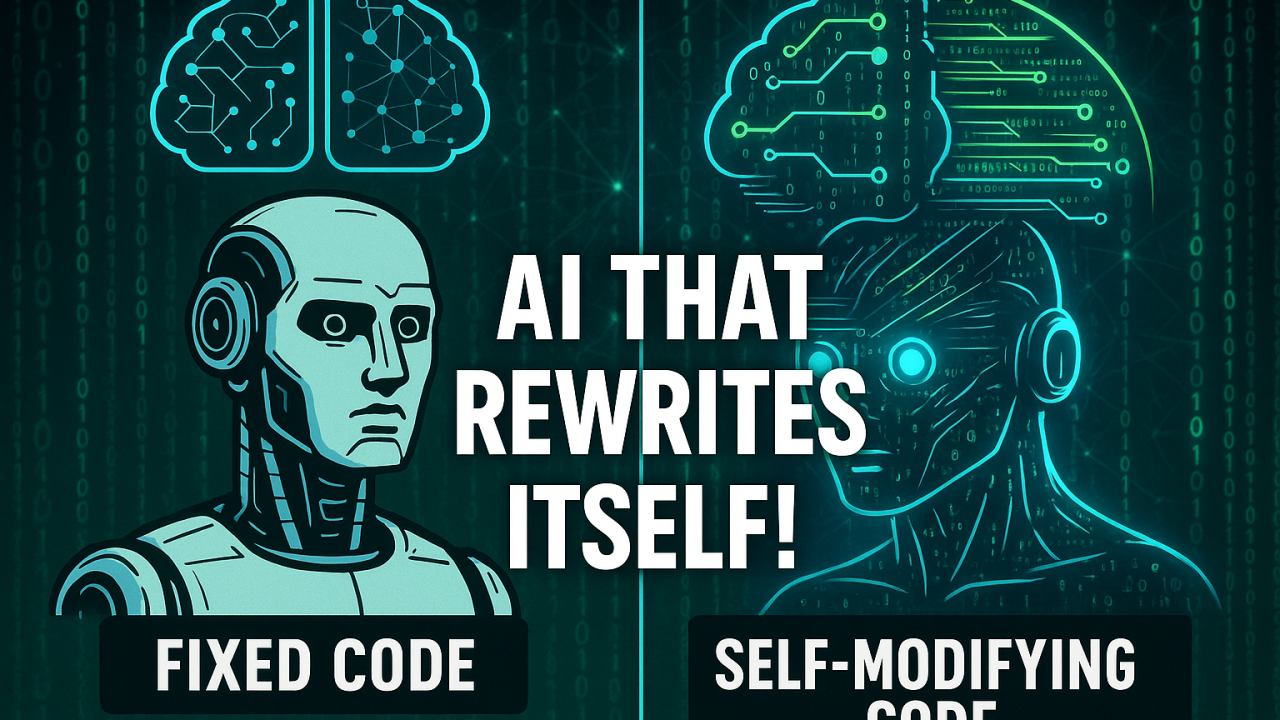
Artificial Intelligence has moved far beyond simple rule-based systems and predictive models. Today, we are entering an era where AI systems are not only learning from data but also improving other AI systems. This emerging concept is often referred to as self-improving AI or AI that writes AI. It represents a major shift in how machine learning models are designed, trained, and optimized.
Instead of relying entirely on human engineers to refine algorithms, modern AI systems are beginning to participate in their own evolution. This creates a feedback loop where AI contributes to building better AI, leading to faster innovation and more powerful models.
What Does “AI That Writes AI” Mean?
The idea of AI writing AI refers to systems where machine learning models assist in designing, optimizing, or generating other models. In simple terms, AI helps automate parts of its own development lifecycle.
Traditionally, data scientists and engineers manually design model architectures, tune parameters, and test performance. With self-improving AI, these tasks are increasingly automated.
This can include:
- Designing neural network architectures automatically
- Optimizing hyperparameters without human intervention
- Generating improved training datasets
- Fine-tuning models based on performance feedback
This approach reduces human workload while increasing the speed of innovation.
How Self-Improving AI Systems Work
Self-improving AI systems rely on a loop of learning, evaluation, and optimization. The process typically involves multiple AI components working together.
At a high level, it follows this structure:
- A base AI model is trained on existing data
- Another AI system evaluates its performance
- A third system suggests improvements or modifications
- The model is retrained with optimized parameters
- The cycle repeats continuously
This creates an iterative improvement loop where each generation of the model becomes better than the previous one.
In advanced setups, reinforcement learning and automated machine learning (AutoML) techniques are heavily used to support this process.
Key Technologies Behind Self-Improving AI
Several technologies make AI self-improvement possible. These technologies work together to reduce manual intervention and enhance automation.
Some of the most important ones include:
- AutoML (Automated Machine Learning): Automatically builds and tunes machine learning models
- Reinforcement Learning: Allows AI to learn through reward-based feedback
- Neural Architecture Search (NAS): Helps AI design its own neural network structures
- Meta-Learning: Enables models to learn how to learn more efficiently
These technologies collectively allow AI systems to evolve in a more autonomous and scalable way.
Real-World Applications of Self-Improving AI
Self-improving AI is already influencing several industries, even if it is still in early stages. Companies are using these systems to reduce development time and improve accuracy.
Some practical applications include:
Software Development
AI tools are now capable of generating better code suggestions, debugging existing code, and even improving their own underlying models used for code generation.
Healthcare
AI systems improve diagnostic models by continuously learning from new patient data, leading to more accurate predictions over time.
Cybersecurity
Self-improving AI helps detect new types of threats by constantly updating detection models based on emerging attack patterns.
Finance
Trading algorithms evolve based on market behavior, improving risk prediction and decision-making models.
Benefits of AI That Improves Itself
The concept of self-improving AI brings several advantages that make it highly valuable for modern enterprises.
Some key benefits include:
- Faster model development cycles
- Reduced dependency on manual tuning
- Continuous performance improvement
- Ability to adapt to changing environments
- Lower operational costs in AI development
This shift allows organizations to scale AI systems more efficiently than ever before.
Challenges and Risks
Despite its potential, self-improving AI also introduces several challenges. One of the biggest concerns is control. When AI systems begin modifying themselves, it becomes harder to predict outcomes.
Other challenges include:
- Lack of transparency in decision-making
- Risk of unintended bias amplification
- Difficulty in debugging self-evolving systems
- High computational cost for continuous training
- Ethical concerns around autonomy and control
Ensuring proper governance and monitoring is essential to safely deploy these systems.
The Future of Self-Improving AI
The future of AI development is likely to be heavily influenced by self-improving systems. As models become more advanced, the role of humans may shift from direct builders to supervisors and strategists.
In the long term, we may see AI systems that can:
- Design entirely new AI architectures
- Optimize themselves in real time
- Collaborate with other AI systems for complex tasks
- Reduce the need for manual model engineering
This evolution could significantly accelerate innovation across industries.
Conclusion
AI that writes AI represents a major milestone in the evolution of artificial intelligence. It moves us from manually built systems to autonomous learning ecosystems where AI actively participates in its own improvement.
While the technology offers powerful advantages in speed, scalability, and efficiency, it also demands careful oversight to ensure safety, transparency, and ethical use. As research continues, self-improving AI will likely become a foundational part of next-generation IT systems, transforming how software, data, and intelligence are built in the future.