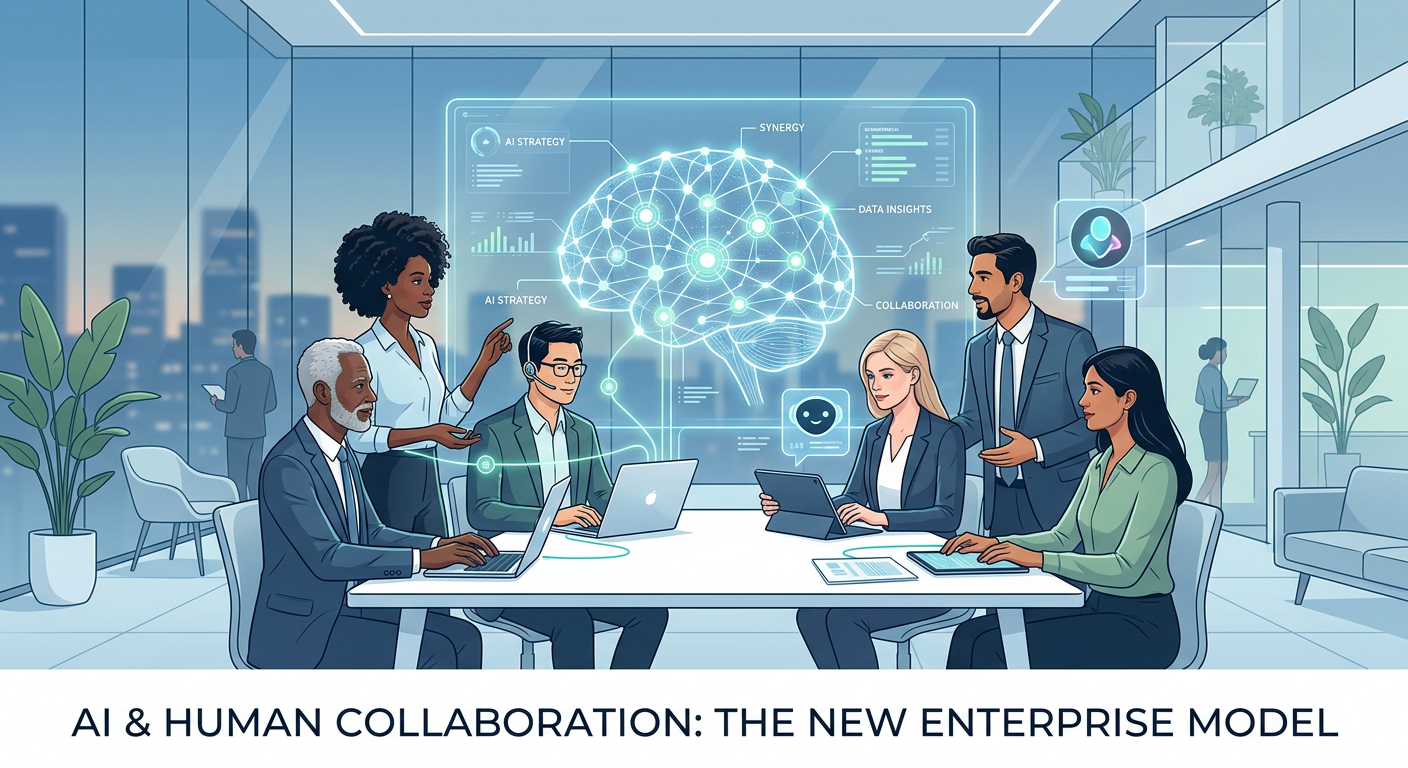
The modern enterprise is undergoing a profound transformation as artificial intelligence becomes deeply embedded in everyday business operations. Rather than replacing human workers, AI is redefining how work gets done by creating a collaborative model where humans and machines complement each other’s strengths. This new enterprise model is not about automation alone—it is about augmentation, where AI enhances human capabilities, improves decision-making, and drives innovation at scale.
As organizations move beyond experimentation, the focus is shifting toward building systems where AI and humans work together seamlessly. This collaboration is becoming a competitive necessity, especially in B2B environments where complexity, customization, and relationship-building are critical.
Understanding the Shift from Automation to Collaboration
Early AI adoption focused heavily on automating repetitive and rule-based tasks. While this brought efficiency gains, it also created concerns about job displacement. Today, the narrative is evolving. Businesses are recognizing that the real value of AI lies in its ability to support and enhance human intelligence rather than replace it.
In this collaborative model, AI handles data-heavy processes such as analysis, pattern recognition, and forecasting, while humans focus on creativity, strategic thinking, and emotional intelligence. This division of roles creates a more balanced and effective workflow.
For example, in a B2B sales environment, AI can analyze customer data and suggest the best leads to pursue, but it is still the human sales representative who builds trust and closes deals. This partnership leads to better outcomes than either could achieve alone.
Key Benefits of AI + Human Collaboration
The integration of AI into human workflows offers several advantages that go beyond simple efficiency improvements. Organizations that embrace this model are seeing measurable gains in productivity, innovation, and decision quality.
Some of the key benefits include:
- Enhanced productivity: AI reduces time spent on repetitive tasks, allowing employees to focus on higher-value work
- Improved decision-making: Data-driven insights from AI help humans make more informed choices
- Scalability: Businesses can handle larger workloads without proportionally increasing headcount
- Innovation acceleration: AI enables faster experimentation and idea generation
This collaborative approach creates a more agile and responsive organization capable of adapting to changing market conditions.
Redefining Roles and Skills in the Enterprise
As AI becomes a core part of business operations, the roles and skill sets required in the workforce are evolving. Employees are no longer expected to perform routine tasks manually; instead, they are expected to work alongside AI systems and leverage them effectively.
This shift is leading to the emergence of new roles such as AI trainers, prompt engineers, and data strategists. At the same time, traditional roles are being redefined to include AI-related responsibilities.
To succeed in this environment, employees need to develop skills such as:
- Data literacy and the ability to interpret AI insights
- Critical thinking to validate and challenge AI outputs
- Creativity and problem-solving for strategic tasks
- Adaptability to work with evolving technologies
Organizations that invest in upskilling their workforce will be better positioned to maximize the value of AI collaboration.
AI as a Decision Support System
One of the most powerful applications of AI in the enterprise is its role as a decision support system. AI can process vast amounts of data in real time, identify patterns, and generate recommendations that would be impossible for humans to produce manually.
However, decision-making should not be fully delegated to AI. Human oversight is essential to ensure that decisions align with business goals, ethical standards, and contextual nuances. This balance between AI-driven insights and human judgment is what defines effective collaboration.
In practice, this means:
- AI provides recommendations based on data
- Humans evaluate these recommendations in context
- Final decisions are made with a combination of both
This approach reduces risk while maximizing the benefits of AI-driven intelligence.
Building a Collaborative AI Infrastructure
For AI and humans to work effectively together, organizations need the right technological and organizational infrastructure. This includes not only AI tools but also systems that enable seamless interaction between humans and machines.
A strong collaborative infrastructure typically involves:
- Integrated platforms that connect data, AI models, and workflows
- User-friendly interfaces that make AI accessible to non-technical employees
- Clear governance frameworks for data usage and AI deployment
- Continuous monitoring and improvement of AI systems
Without these elements, AI initiatives may remain isolated and fail to deliver their full potential.
Overcoming Challenges in AI-Human Collaboration
Despite its benefits, implementing a collaborative AI model comes with challenges. One of the most significant barriers is cultural resistance. Employees may feel uncertain about working with AI or fear that their roles will become obsolete.
Trust is another critical factor. If employees do not trust AI outputs, they are unlikely to use them effectively. Building trust requires transparency, reliability, and consistent performance.
Organizations must also address:
- Data quality and integration issues
- Ethical concerns and bias in AI systems
- The need for continuous training and support
- Balancing automation with human control
By proactively addressing these challenges, companies can create a more inclusive and effective AI-driven environment.
The Future of Enterprise Collaboration
As AI technologies continue to advance, the collaboration between humans and machines will become even more sophisticated. Future enterprises will operate with AI embedded in every function, from marketing and sales to operations and customer support.
We can expect:
- More intuitive AI systems that understand context and intent
- Greater personalization in workflows and decision-making
- Increased reliance on AI for strategic insights
- A shift toward fully integrated human-AI teams
In this future, the most successful organizations will not be those that rely solely on AI, but those that effectively combine human ingenuity with machine intelligence.
Conclusion
AI and human collaboration is redefining the enterprise model, moving beyond simple automation to create a more dynamic and intelligent way of working. By combining the analytical power of AI with the creativity and judgment of humans, organizations can achieve higher levels of efficiency, innovation, and competitiveness.
However, this transformation requires more than just adopting new technologies. It demands a shift in mindset, investment in skills, and a commitment to building systems that support collaboration. Companies that embrace this approach will be better equipped to navigate the complexities of the modern business landscape and unlock the full potential of AI.