Understanding the Build vs Buy Dilemma –
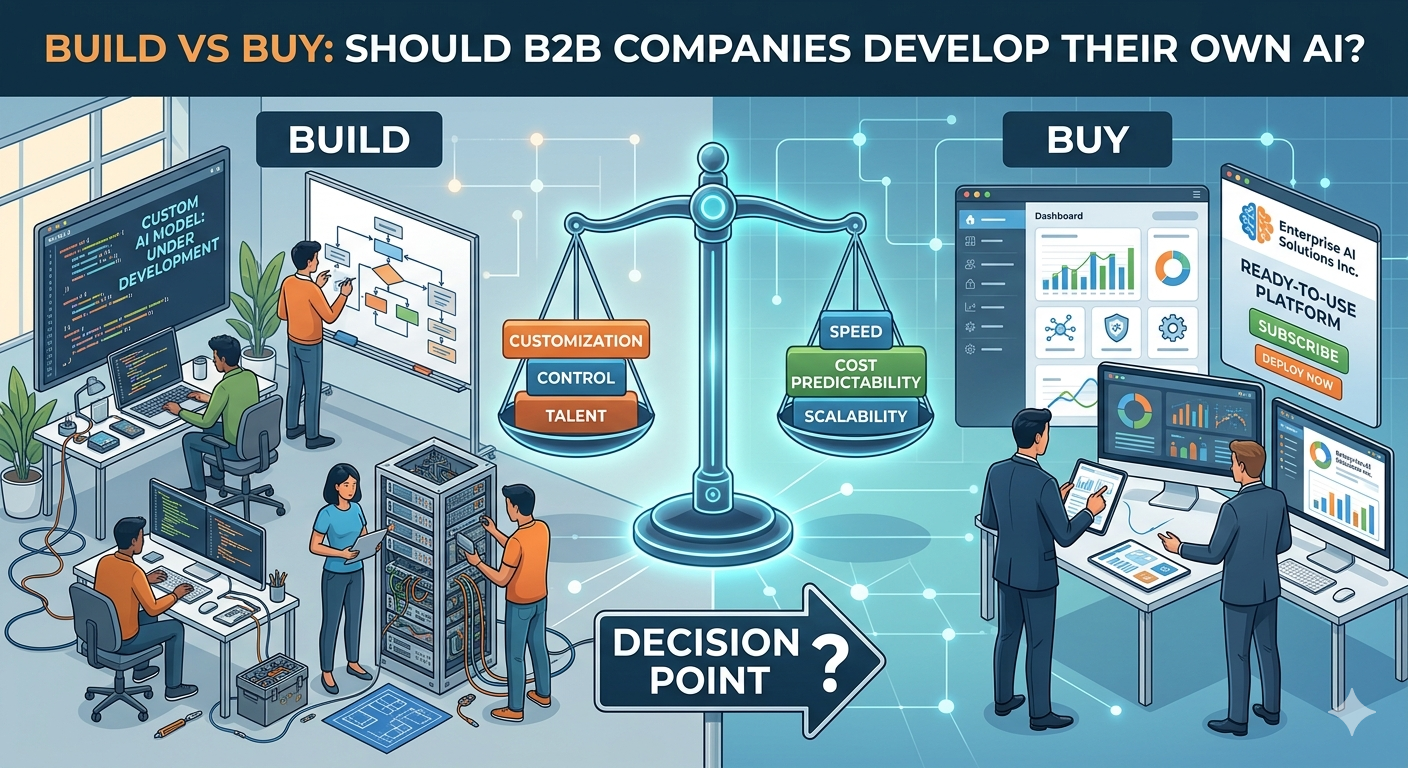
As AI adoption accelerates across B2B industries, companies face a critical strategic decision: should they build their own AI solutions or buy existing ones? This choice impacts cost, speed, scalability, and long-term competitiveness. Building AI in-house offers full control and customization, while buying solutions enables faster deployment. The right decision depends on business goals, technical capabilities, and available resources. Many organizations underestimate the complexity of AI development, leading to delays and cost overruns. On the other hand, off-the-shelf tools may not fully align with specific business needs. A careful evaluation is essential before committing to either path.
- Build offers full customization and control
- Buy enables faster implementation and time-to-value
- Decision depends on budget, talent, and urgency
- AI development requires significant expertise
- Misalignment can lead to inefficiencies and wasted investment
Advantages of Building AI In-House –
Developing AI internally gives companies a competitive edge when done correctly. It allows organizations to create tailored solutions that align perfectly with their workflows and data. Businesses can retain full ownership of intellectual property and maintain data privacy. In-house AI also provides flexibility to evolve models as business needs change. However, this approach requires skilled data scientists, engineers, and infrastructure. It also involves ongoing maintenance and continuous improvement. For companies with strong technical teams, building AI can become a long-term strategic asset.
- Full ownership of AI models and intellectual property
- Highly customized solutions for specific business needs
- Better control over data security and compliance
- Flexibility to adapt and scale over time
- Potential for long-term competitive differentiation
Benefits of Buying AI Solutions –
Buying AI solutions is often the fastest and most cost-effective way to adopt AI capabilities. Vendors provide ready-to-use platforms that can be integrated into existing systems. This reduces development time and eliminates the need for large technical teams. Many AI tools come with pre-trained models and user-friendly interfaces. Businesses can quickly start seeing results without heavy upfront investment. However, purchased solutions may lack deep customization and can create vendor dependency. Despite this, for many B2B companies, buying is a practical starting point.
- Rapid deployment and quicker ROI
- Lower upfront development costs
- Access to proven, tested technologies
- Minimal need for in-house AI expertise
- Vendor support and continuous updates
Key Factors to Consider Before Deciding –
Choosing between build and buy requires a structured evaluation of several factors. Companies must assess their internal capabilities, data maturity, and long-term strategy. If AI is central to the business model, building may be more beneficial. If speed and efficiency are priorities, buying is often the better choice. Budget constraints, scalability needs, and integration complexity also play crucial roles. Risk tolerance is another important consideration, especially when dealing with emerging technologies. A hybrid approach—combining both build and buy—is becoming increasingly popular.
- Availability of skilled AI talent
- Budget and resource allocation
- Strategic importance of AI to the business
- Time-to-market requirements
- Integration with existing systems
The Rise of Hybrid AI Strategies –
Many B2B companies are now adopting a hybrid approach, blending internal development with external solutions. This strategy allows businesses to leverage the speed of ready-made tools while customizing critical components in-house. For example, a company might buy a general AI platform but build proprietary models on top of it. This balances cost, flexibility, and innovation. Hybrid models also reduce risk by avoiding over-dependence on a single vendor. As AI ecosystems evolve, this approach is becoming the most practical and scalable option. It enables businesses to stay competitive while maintaining control over key capabilities.
- Combines benefits of both build and buy approaches
- Enables faster innovation with controlled customization
- Reduces dependency on external vendors
- Allows focus on core differentiating features
- Supports scalable and flexible AI adoption
Conclusion –
The build vs buy decision is not one-size-fits-all—it depends on each company’s goals, resources, and strategic vision. Building AI offers control and differentiation but requires significant investment and expertise. Buying AI delivers speed and efficiency but may limit customization. Increasingly, the hybrid approach is emerging as the most balanced path forward. B2B companies that make thoughtful, informed decisions in this area will be better positioned to harness AI effectively. Ultimately, the goal is not just to adopt AI, but to use it in a way that drives sustainable business value.