Physical Address
304 North Cardinal St.
Dorchester Center, MA 02124
Physical Address
304 North Cardinal St.
Dorchester Center, MA 02124

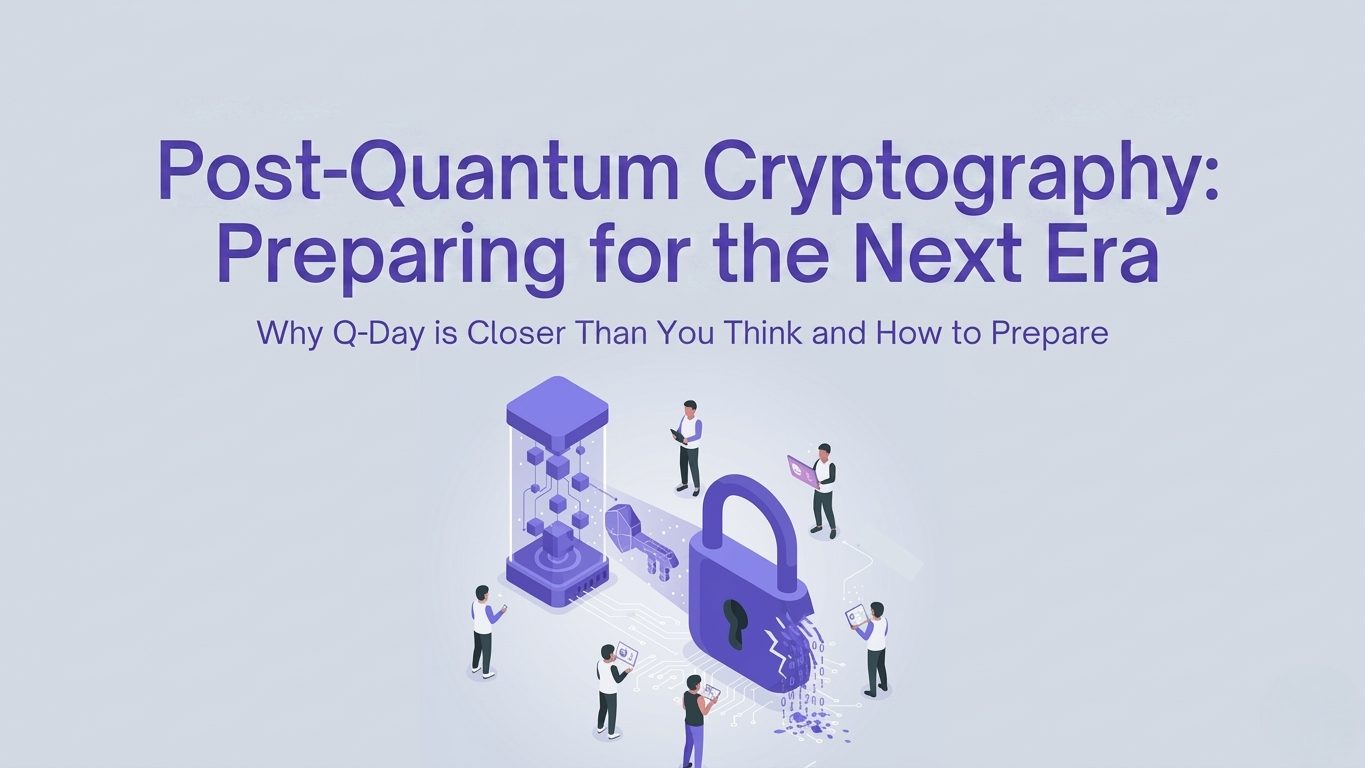
For decades, modern cybersecurity has relied on cryptographic systems that protect everything from online banking transactions to confidential business communications. These systems are built on mathematical problems that are extremely difficult for classical computers to solve. However, a new technological shift is on the horizon—quantum computing—and it has the potential to break many of the encryption methods we depend on today.
In 2025, organizations are beginning to take this threat seriously. The concept of post-quantum cryptography (PQC) has emerged as a critical area of focus, aimed at developing encryption methods that can withstand attacks from quantum computers. While large-scale quantum machines are not yet mainstream, the time to prepare is now.
Post-quantum cryptography refers to cryptographic algorithms that are designed to be secure against both classical and quantum computers. Unlike traditional encryption methods, which rely on problems like integer factorization or discrete logarithms, PQC algorithms are based on mathematical challenges that are believed to be resistant to quantum attacks.
The goal is not to replace current systems overnight, but to gradually transition toward cryptographic standards that can remain secure in a quantum future.
Traditional cryptographic systems such as RSA and ECC rely on the assumption that certain mathematical problems are practically impossible to solve within a reasonable timeframe using classical computers. However, quantum algorithms—most notably Shor’s algorithm—can solve these problems exponentially faster.
This means that once sufficiently powerful quantum computers become available, they could potentially:
Even data that is secure today could be at risk in the future through a strategy known as “harvest now, decrypt later,” where attackers store encrypted data now and decrypt it once quantum capabilities mature.
Although quantum computers capable of breaking modern encryption are still under development, the transition to post-quantum systems will take years—if not decades.
Organizations need to start preparing now because:
Delaying preparation increases the risk of future data exposure.
Researchers are exploring several types of algorithms that are believed to be resistant to quantum attacks. These approaches are based on different mathematical foundations, each with its own strengths and trade-offs.
Some of the most prominent categories include:
These approaches are currently being evaluated and standardized for real-world use.
Transitioning to post-quantum cryptography is not a simple upgrade. It introduces several technical and operational challenges that organizations must address.
One major issue is performance. Many PQC algorithms require larger key sizes and more computational resources, which can impact system efficiency.
Another challenge is compatibility. Existing systems and protocols may not support new cryptographic methods, requiring significant updates or redesigns.
There is also the issue of uncertainty. Since PQC is still an evolving field, organizations must adopt solutions that may change as standards mature.
Additionally, implementation risks—such as incorrect deployment or configuration—can introduce vulnerabilities even in quantum-resistant systems.
To ensure consistency and security, global organizations are working on standardizing post-quantum cryptographic algorithms. Governments, research institutions, and technology companies are collaborating to identify and approve the most secure and practical solutions.
Standardization is essential for:
As standards evolve, organizations will have clearer pathways for adoption.
Preparing for the post-quantum era requires a proactive and strategic approach. While full migration may not be immediate, there are several steps organizations can take now to reduce future risks.
These include:
Early preparation can significantly reduce the complexity of future transitions.
The rise of quantum computing will redefine the field of cryptography. Instead of relying on a few dominant algorithms, the future may involve a more diverse set of cryptographic techniques designed to address different types of threats.
We are likely to see:
Cryptography will become more dynamic, adapting to both technological advancements and emerging risks.
Post-quantum cryptography represents a critical shift in how we approach digital security. While the quantum threat may not be immediate, its potential impact is too significant to ignore.
Organizations that begin preparing today will be better positioned to protect their data and systems in the future. The transition may be complex, but it is necessary to ensure long-term security in an era where traditional encryption methods may no longer be sufficient.
As we move toward a quantum-powered world, the ability to adapt and evolve cryptographic strategies will define the resilience of digital infrastructure.