Physical Address
304 North Cardinal St.
Dorchester Center, MA 02124
Physical Address
304 North Cardinal St.
Dorchester Center, MA 02124

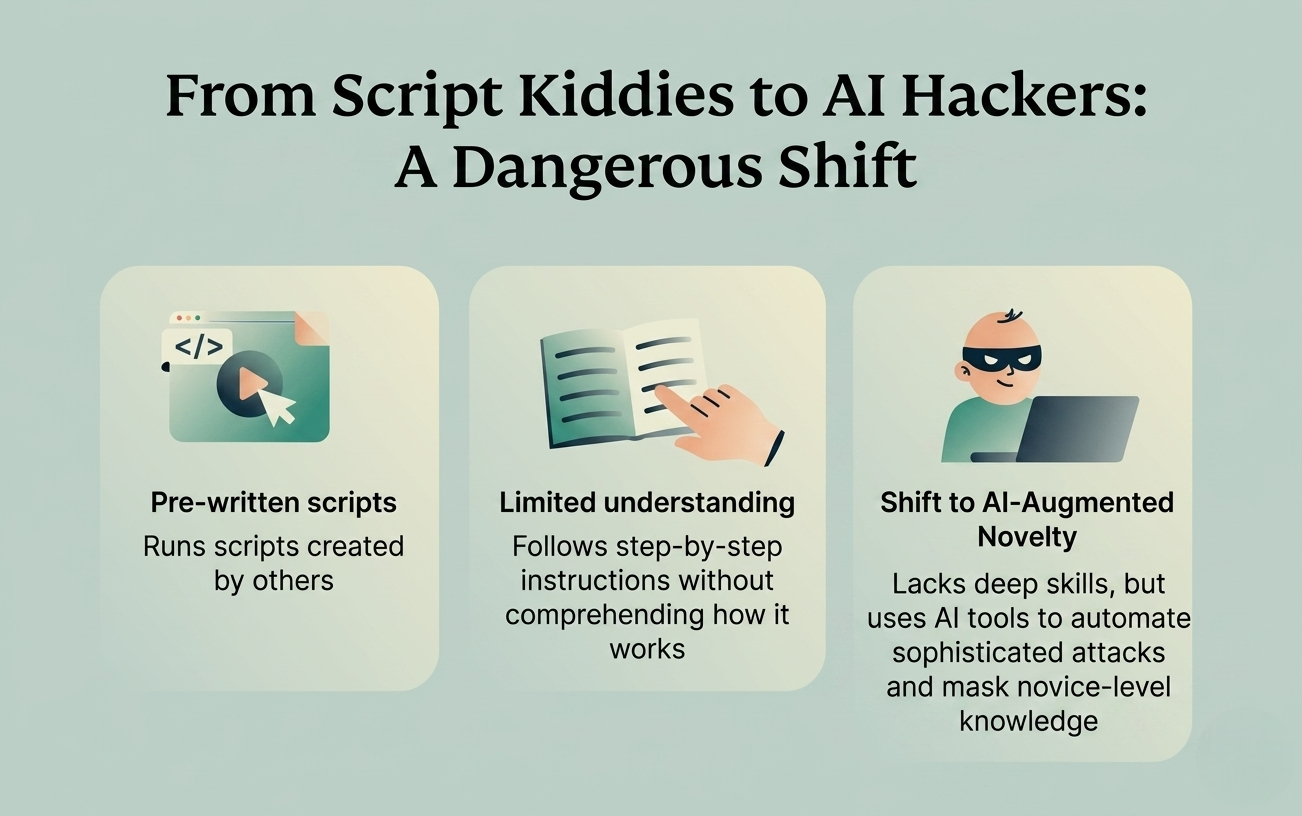
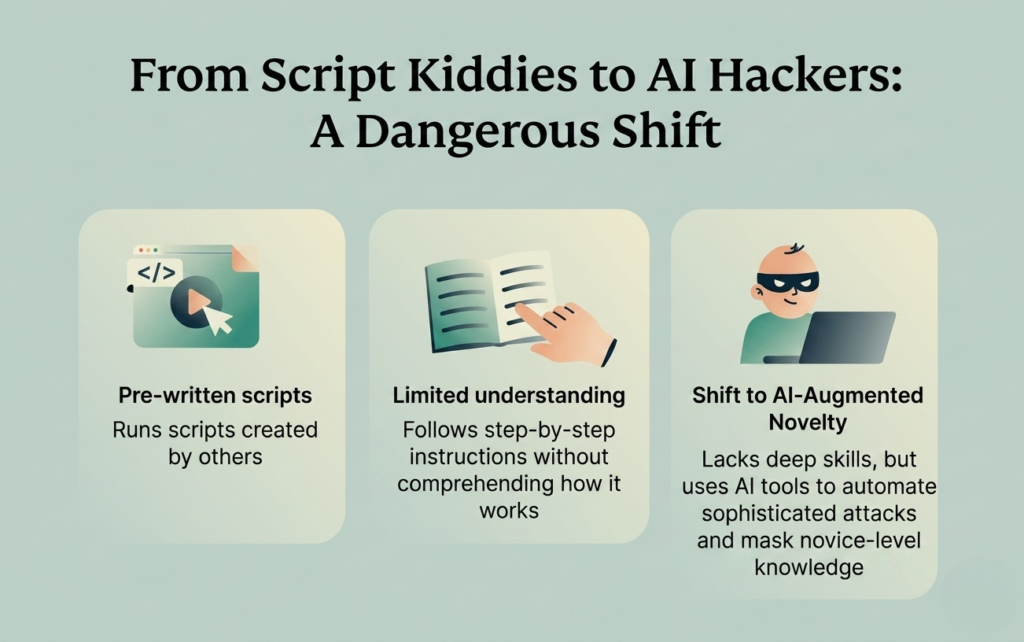
Cybersecurity has always been a race between attackers and defenders. In the early days, many cyber threats came from so-called “script kiddies”—individuals with limited technical skills who relied on pre-written tools and exploits created by others. While these actors posed risks, their capabilities were often constrained by their lack of deep expertise.
In 2025, however, the landscape is changing dramatically. The rise of artificial intelligence is transforming how cyberattacks are executed, giving even low-skilled individuals access to powerful tools. This shift is creating a new generation of attackers—AI hackers—who can launch sophisticated attacks with unprecedented speed and scale.
Script kiddies were typically inexperienced hackers who used existing scripts, tools, and software to exploit vulnerabilities. They did not create their own attacks but instead relied on publicly available resources.
Their activities often included:
While they could still cause damage, their impact was usually limited by their lack of customization and adaptability.
Artificial intelligence is lowering the barrier to entry in cybersecurity attacks. Instead of manually searching for vulnerabilities or crafting phishing emails, attackers can now use AI tools to automate and enhance these processes.
AI systems can analyze vast amounts of data, identify weaknesses, and generate attack strategies in real time. This means that individuals who previously lacked technical expertise can now perform complex operations with minimal effort.
This shift is not just about automation—it is about augmentation. AI does not just execute tasks faster; it makes attackers smarter by providing insights, recommendations, and adaptive strategies.
The integration of AI into cybercrime is changing the nature of attacks in several important ways.
First, attacks are becoming more personalized. AI can analyze social media, public records, and behavioral data to craft highly convincing phishing messages tailored to specific individuals.
Second, vulnerability discovery is becoming more efficient. AI models can scan systems, detect patterns, and identify potential entry points much faster than manual methods.
Third, attacks are becoming adaptive. Traditional attacks follow predefined scripts, but AI-driven attacks can evolve based on system responses, making them harder to detect and stop.
Additionally, AI enables attackers to scale their operations. What once required a team of skilled hackers can now be executed by a single individual using AI-powered tools.
AI hackers differ from traditional attackers not just in tools, but in capabilities. They can operate with a level of efficiency and sophistication that was previously unattainable for low-skilled actors.
Some notable capabilities include:
These capabilities significantly increase both the frequency and effectiveness of cyberattacks.
The transition from script kiddies to AI hackers represents a major escalation in cybersecurity risk. The primary concern is accessibility—advanced attack capabilities are no longer limited to highly skilled individuals or organized groups.
This democratization of cybercrime means:
Another major issue is speed. AI-driven attacks can be launched and adapted in real time, reducing the window for detection and response.
There is also the challenge of unpredictability. As AI systems learn and evolve, their behavior may become harder to anticipate, making traditional defense strategies less effective.
For organizations, this shift requires a fundamental change in how cybersecurity is approached. Traditional defenses, which rely on known threat signatures and reactive measures, are no longer sufficient.
IT and security teams must now deal with:
The workload on security teams is increasing, while the complexity of threats continues to grow.
To counter AI-powered attacks, organizations are turning to AI-driven defense systems. Just as attackers are using AI to enhance their capabilities, defenders must do the same.
Modern cybersecurity strategies now include:
This creates a new paradigm of AI vs AI, where defensive systems must match or exceed the capabilities of attackers.
Addressing the threat of AI hackers requires more than just technology. It involves a combination of strategy, processes, and awareness.
Organizations should focus on:
A proactive approach is essential, as reactive measures are no longer sufficient in this evolving threat landscape.
Looking ahead, the cybersecurity landscape will continue to evolve as AI technologies become more advanced. The line between skilled and unskilled attackers will blur, and the scale of cyber threats will increase.
We can expect:
The battle between attackers and defenders will become more complex, dynamic, and continuous.
The shift from script kiddies to AI hackers marks a turning point in the world of cybersecurity. What was once a domain dominated by skilled experts is now accessible to a much wider audience, thanks to the power of artificial intelligence.
This transformation brings both challenges and urgency. Organizations must adapt quickly, embracing AI-driven defense strategies and rethinking traditional security models.
In 2025, cybersecurity is no longer just about protecting systems—it is about staying ahead in an evolving, AI-powered threat landscape where intelligence, speed, and adaptability define success.