Introduction –
Synthetic Customer Research is changing how businesses understand their customers. Traditional market research methods like surveys, focus groups, and interviews have helped organizations make informed decisions for decades. However, these methods are often slow, expensive, and limited in scope.
With advancements in artificial intelligence, businesses can now create AI-powered customer personas that simulate real buyer behavior using historical data, customer interactions, and market trends. Instead of waiting weeks for survey results, companies can gain predictive insights in minutes.
This article explores how Synthetic Customer Research works, why AI personas are replacing traditional market surveys, and what this shift means for the future of B2B decision-making.
What Is Synthetic Customer Research?
Synthetic Customer Research uses artificial intelligence to create digital customer personas that mimic real-world buying behavior. These AI personas are built using data from CRM systems, website analytics, purchase history, customer support interactions, and market trends.
Unlike traditional buyer personas that remain static, AI personas continuously learn and evolve as new data becomes available. This enables businesses to test marketing strategies, product ideas, and pricing models before launching them.
Key benefits include:
- Faster customer insights
- Real-time market simulations
- Better decision-making
- Lower research costs
Why Traditional Market Research Is No Longer Enough –
Traditional market research remains valuable, but it struggles to keep up with today’s fast-changing markets.
Some common challenges include:
- Long research timelines
- High costs
- Limited sample sizes
- Response bias
- Outdated insights by the time reports are completed
For B2B organizations operating in competitive industries, waiting weeks for customer feedback can delay critical business decisions. AI-powered research provides continuous insights that help teams respond faster to changing customer expectations.
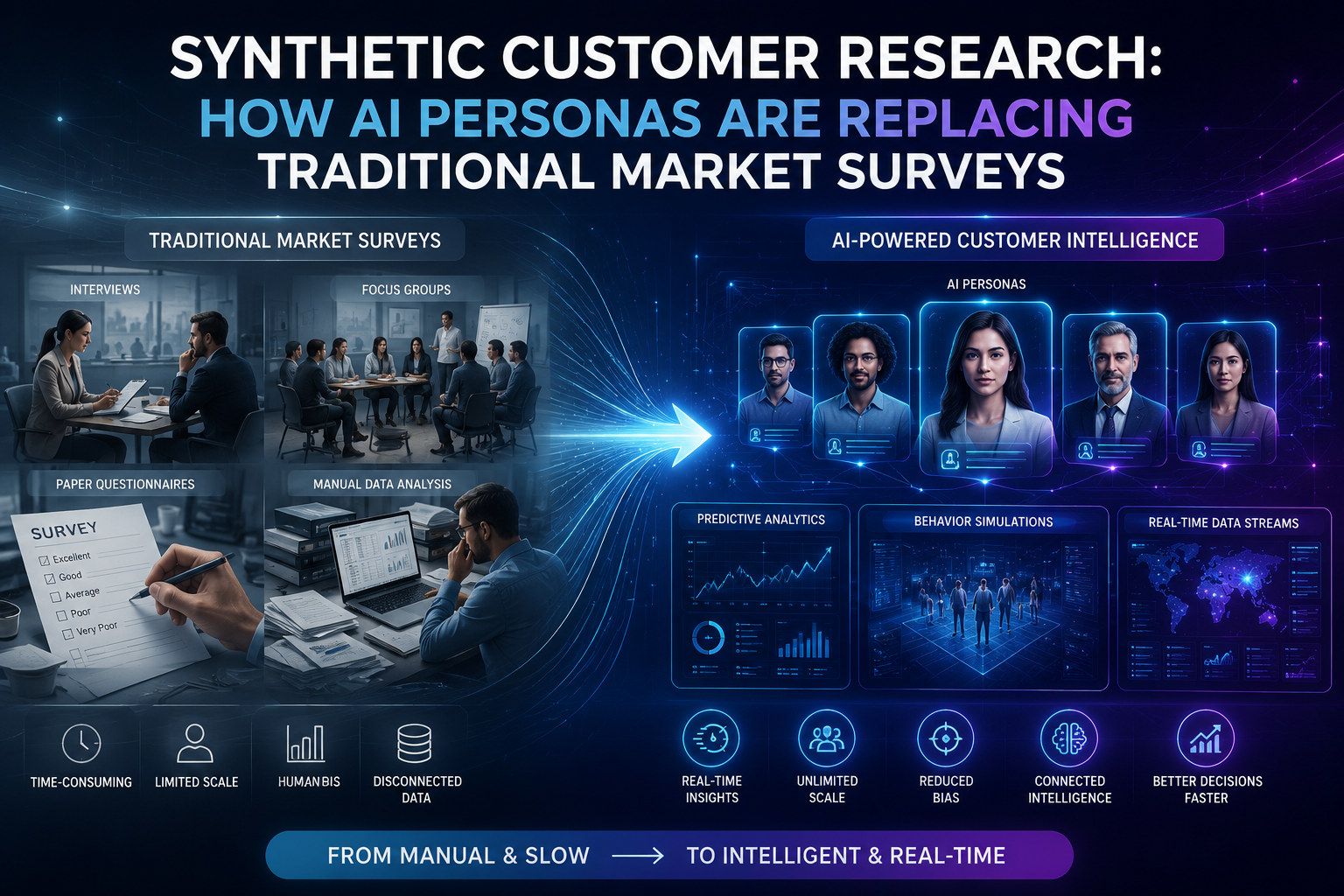
Traditional Market Research vs Synthetic Customer Research: A New Era of Customer Insights
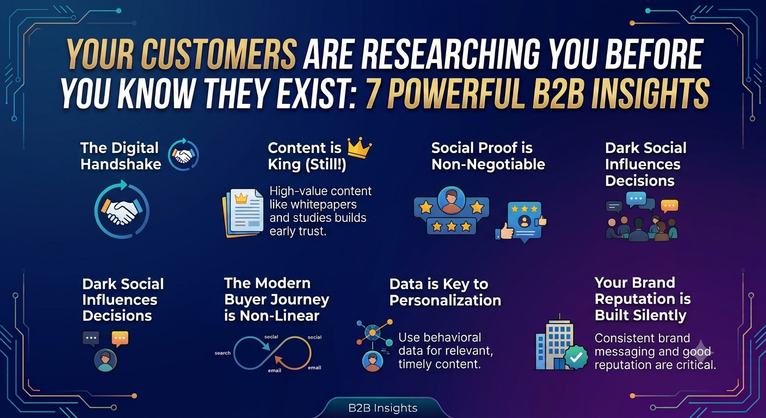
Traditional market research methods such as surveys, interviews, and focus groups have helped businesses understand customers for decades. However, these approaches often require significant time, resources, and manual effort to collect and analyze data.
As customer expectations and markets change faster than ever, businesses need more agile research methods that can deliver deeper insights and faster decision-making. This limitation has created the need for AI-powered approaches like Synthetic Customer Research.

How AI Personas Work –
AI personas are digital representations of real customer segments built using artificial intelligence and enterprise data. Instead of relying on assumptions, they analyze historical customer behavior to predict how different buyers are likely to respond to products, pricing, and marketing campaigns.
These personas are created using data from:
- CRM and sales records
- Website and product analytics
- Customer support interactions
- Email engagement
- Social listening
- Industry and market trends
Because AI personas continuously learn from new data, they remain up to date and reflect changing customer preferences. This allows businesses to test strategies and make informed decisions before investing significant time and resources.
Benefits of Synthetic Customer Research –
Synthetic Customer Research offers several advantages over traditional market research, especially for B2B organizations that need faster and more reliable insights.
Faster Decision-Making :
AI personas can simulate customer responses in minutes, helping teams make quicker strategic decisions.
Better Product Positioning :
Businesses can test different value propositions and identify which messaging resonates with specific customer segments.
Smarter Pricing Strategies :
Companies can evaluate pricing models and understand customer willingness to pay before making changes.
Campaign Optimization :
Marketing teams can test campaign ideas, channels, and messaging to improve engagement and maximize ROI.
Continuous Customer Intelligence :
Unlike one-time surveys, AI personas continuously update as new customer data becomes available, providing ongoing insights into market behavior.
Traditional Market Research: Slow, Limited, and Time-Consuming

Challenges of Conventional Market Research Method
Traditional market research relies on surveys, interviews, and focus groups to collect customer feedback. While valuable, these methods often involve small sample sizes, delayed insights, and manual analysis, making it difficult for businesses to respond quickly to changing customer needs. As markets become more dynamic, organizations are looking for faster and smarter ways to understand customer behavior.
AI Personas vs Traditional Market Surveys –
While traditional market research remains valuable, it often struggles to keep pace with today’s rapidly changing business environment. AI personas provide a faster, more scalable, and data-driven alternative.
| Traditional Market Surveys | AI Personas |
|---|---|
| Weeks to gather insights | Insights in minutes |
| Limited participants | Thousands of simulated customers |
| High research costs | More cost-effective over time |
| Static results | Continuously updated insights |
| Reactive decision-making | Predictive decision-making |
For many B2B organizations, combining AI personas with real customer feedback delivers the most accurate and actionable insights.
Real-World Applications of Synthetic Customer Research –
Organizations across industries are using AI personas to improve business decisions and reduce uncertainty.
Product Positioning :
Test different messaging and identify which value propositions appeal to specific customer segments.
Pricing Strategy :
Simulate customer reactions to pricing changes, subscription plans, and service packages before implementation.
Marketing Campaigns :
Evaluate campaign ideas, content formats, and communication channels to predict engagement and improve ROI.
Buying Committee Simulation :
Model how decision-makers such as CFOs, CIOs, procurement teams, and business leaders evaluate enterprise purchases.
Product Development :
Validate new features and innovations using AI-generated customer feedback before investing in development.
Challenges and Limitations –
Despite its advantages, Synthetic Customer Research is not a complete replacement for human interaction.
Some key challenges include:
- AI models depend on high-quality data.
- Historical bias can influence predictions.
- AI cannot fully capture human emotions or unexpected market events.
- Businesses should validate AI insights with real customer feedback whenever possible.
The most effective approach is to combine AI-driven research with interviews, surveys, and customer conversations for well-rounded decision-making.
Conclusion –
Synthetic Customer Research is redefining how businesses understand their customers. By combining AI-powered personas with enterprise data, organizations can gain faster insights, test strategies with greater confidence, and make smarter decisions without relying solely on traditional market surveys.While human feedback remains essential, AI personas provide a powerful layer of predictive intelligence that helps businesses innovate faster and respond more effectively to market changes. For B2B organizations looking to stay competitive, Synthetic Customer Research is quickly becoming an essential part of the modern decision-making process.
Frequently Asked Questions (FAQ) — Synthetic Customer Research
Synthetic Customer Research is an AI-powered research method that uses digital customer personas to simulate real buyer behavior, preferences, and decision-making patterns. It helps businesses gain customer insights faster than traditional surveys and focus groups.
AI personas analyze data from sources such as CRM systems, customer interactions, purchase history, website behavior, and market trends. Using artificial intelligence, they simulate how different customer segments may respond to products, pricing, messaging, and business decisions.
AI personas can reduce dependency on traditional market surveys by providing faster and scalable insights. However, they work best alongside real customer interviews, surveys, and feedback to validate AI-generated predictions.
B2B companies can use Synthetic Customer Research to understand complex buying journeys, simulate decision-making committees, test pricing strategies, optimize sales messaging, and improve product-market fit.