
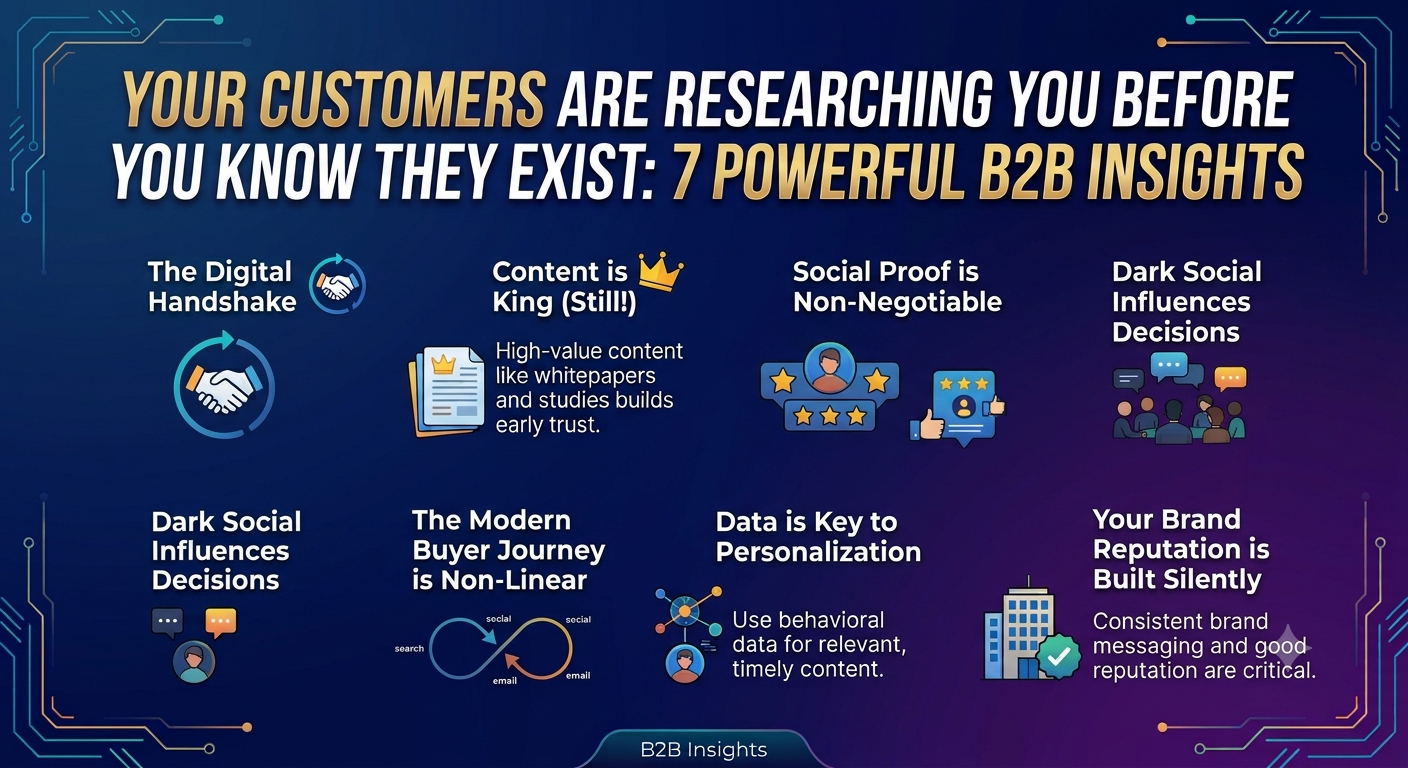
B2B buyer research has fundamentally changed how businesses discover, evaluate, and select service providers. Today’s buyers rarely wait for a sales representative to introduce a solution. Instead, they begin by searching online, reading industry insights, comparing vendors, exploring customer reviews, and using AI-powered tools to understand their options. Much of this activity happens before a business even knows a potential customer exists.
By the time a prospect submits an enquiry, they may already understand their problem, have evaluated competing solutions, and developed a shortlist of providers. They may have visited your website multiple times, reviewed your case studies, discussed your services with colleagues, and formed an opinion about your credibility. Your sales team might see a new lead, but the buyer could be well into the decision-making process.
This shift has important implications for B2B marketing, sales, and digital strategy. Businesses are no longer competing only to generate leads or secure meetings. They are also competing to influence the information buyers discover, the questions they ask, and the confidence they develop before initiating a conversation. The companies that earn attention during this early research stage have an opportunity to become trusted options before the formal sales process begins.
Understanding B2B Buyer Research and the Hidden Buying Journey –
The traditional B2B sales process often focused on identifiable interactions, such as phone calls, email responses, event registrations, and website enquiries. These activities remain important, but they do not capture the full buying journey.
Modern B2B buyer research frequently takes place across multiple channels without any direct interaction between the buyer and the seller. A potential customer might read an educational article, compare pricing models, examine competitor websites, or consult colleagues without revealing their identity. From a sales team’s perspective, that person may appear inactive even when they are actively evaluating solutions.
This creates a gap between visible lead activity and actual buying intent. A downloaded white paper does not necessarily indicate an immediate purchasing decision, just as the absence of an enquiry does not mean a prospect lacks interest.
Why traditional lead generation does not tell the whole story –
Businesses that rely exclusively on form submissions and sales conversations may overlook opportunities to build relationships earlier. Buyers often need time to understand a problem, evaluate possible approaches, secure internal agreement, and establish budget expectations before they are ready to speak with a vendor.
During this period, several activities may influence their decisions:
- Problem discovery: Buyers identify operational challenges, performance gaps, or opportunities for improvement.
- Solution research: They explore different technologies, services, and approaches to determine what might work.
- Vendor evaluation: They compare providers based on expertise, credibility, capabilities, and business relevance.
- Internal discussions: Stakeholders assess risks, budgets, implementation requirements, and expected outcomes.
- Purchase readiness: Buyers narrow their options and determine which providers deserve a formal conversation.
Understanding these stages helps businesses create marketing experiences that match the buyer’s needs rather than pushing every visitor toward an immediate sales enquiry.
The key takeaway is simple: lead generation should not be treated as the beginning of every customer relationship. In many cases, the relationship begins when a buyer first encounters useful information associated with your brand.
Your Website Is a Critical Part of the B2B Buyer Journey –
Your website is often one of the first places potential customers visit when evaluating your business. It is no longer enough for it to function as a digital brochure containing company information, service descriptions, and a contact form.
During B2B buyer research, visitors are looking for evidence that your organisation understands their challenges and can deliver a credible solution. They want to know what you do, who you help, how your approach works, and why your business might be a suitable partner.
A website that communicates these details clearly can help buyers progress through their evaluation independently. Conversely, vague messaging, generic service descriptions, and unsupported claims can create uncertainty and encourage visitors to explore competing providers.
What buyers expect from a B2B website –
An effective B2B website should help visitors answer important commercial and operational questions without requiring them to contact sales for every detail.
Consider whether your website provides:
- Clear service explanations: Describe what you offer, which business challenges you address, and who benefits from your solutions.
- Relevant case studies: Demonstrate how your organisation has approached real challenges and what outcomes clients achieved.
- Implementation information: Explain project stages, integration considerations, onboarding requirements, and ongoing support where relevant.
- Commercial clarity: Provide appropriate information about pricing models, engagement structures, or factors that influence project costs.
- Trust signals: Present genuine testimonials, relevant certifications, team expertise, and other verifiable evidence of capability.
- Useful next steps: Offer appropriate options for learning more, exploring a solution, or contacting your team.
For example, an enterprise software development company could explain its delivery methodology, technology capabilities, security practices, and approach to integrating with existing systems. This information helps technical and business stakeholders evaluate its suitability before requesting a consultation.
The objective is not to turn every website visitor into a lead. It is to make your business easier to understand, evaluate, and trust.
B2B Content Marketing Helps Build Trust Before Sales Conversations –
Content marketing plays an important role in influencing buyers who are still exploring their options. When people search for solutions, they are often looking for answers to specific questions rather than actively seeking a sales pitch.
Businesses that publish useful, relevant information can become part of this research process. Instead of waiting for prospects to contact them, they can help potential customers understand their challenges, assess possible solutions, and make better-informed decisions.
However, publishing a large volume of content does not automatically improve visibility or build credibility. Content must address genuine buyer questions and provide enough depth to be useful.
Create content around real business challenges –
The strongest B2B content strategies begin with the problems customers are trying to solve. Marketing teams can use sales conversations, customer feedback, support requests, and industry developments to identify topics that deserve detailed explanations.
For example:
- IT services companies can publish guidance on cybersecurity risk assessment, cloud migration planning, infrastructure modernisation, and technology cost management.
- Software providers can explain implementation considerations, integration challenges, product comparisons, and workflow improvements.
- Digital marketing agencies can explore demand generation, campaign measurement, customer acquisition costs, and conversion optimisation.
- Consulting firms can develop practical resources on operational efficiency, process improvement, change management, and business transformation.
These topics help potential buyers understand the issues they face while giving them a reason to explore your expertise.
Build a content strategy around buyer questions –
A balanced content library should support different stages of the B2B buyer journey.
- Awareness-stage content: Explain common problems, emerging challenges, and important industry concepts.
- Consideration-stage content: Compare approaches, outline solution options, and discuss the advantages and limitations of different methods.
- Decision-stage content: Provide case studies, implementation guides, technical documentation, and detailed service information.
When B2B buyer research leads prospects to content that answers their questions, your brand has an opportunity to establish familiarity and credibility before a sales conversation takes place.
The goal is to be genuinely helpful. Content that simply repeats common advice or promotes a service without explaining its value is less likely to support meaningful decision-making.
AI-Powered Search Is Changing How Buyers Discover Businesses –
Search behaviour is evolving as AI assistants and AI-generated search experiences become part of the information discovery process. Buyers can ask conversational questions, request explanations of complex business challenges, compare solution approaches, and prepare questions for potential vendors.
Instead of beginning with a list of search results, a buyer might ask an AI assistant to explain the differences between cloud hosting options, identify considerations for selecting a software development partner, or outline the risks involved in adopting a new enterprise platform.
This creates new considerations for B2B digital marketing. Companies need to make their expertise understandable and their information easy to discover across the digital channels their audiences use.
How to improve visibility in AI-assisted discovery –
There is no guaranteed method for securing inclusion in AI-generated answers. However, businesses can strengthen their digital foundations by publishing useful information, demonstrating genuine expertise, and maintaining accurate information across relevant channels.
Consider the following practices:
- Answer specific questions clearly: Structure content around the questions buyers actually ask, using descriptive headings and direct explanations.
- Demonstrate expertise: Include practical examples, relevant experience, detailed methodologies, and evidence that supports your recommendations.
- Maintain factual consistency: Keep service descriptions, company information, product details, and other important facts accurate across digital properties.
- Build a useful content ecosystem: Support articles with relevant service pages, case studies, documentation, and credible external references where appropriate.
- Follow sound technical SEO practices: Make important pages accessible to search engines, use descriptive page titles, and maintain a logical site structure.
AI search optimisation should complement, rather than replace, established SEO practices. Businesses still need useful content, technically accessible websites, clear positioning, and credible information.
Ultimately, the purpose is not merely to appear in an AI-generated response. It is to ensure that when buyers research a relevant problem, they can discover reliable information that helps them understand your business and evaluate your expertise.
B2B Buying Committees Require Content for Multiple Decision-Makers –
In many B2B purchases, the person researching a solution is not the only person involved in the final decision. Buying committees may include business users, department heads, finance leaders, IT specialists, procurement teams, and senior executives.
Each stakeholder evaluates the proposed solution through a different lens. A department manager might focus on productivity, while an IT leader considers integration and security. Finance may examine total cost of ownership, and senior leadership may prioritise strategic value and implementation risk.
A marketing strategy that speaks only to the primary user can therefore leave important questions unanswered.
Align your content with stakeholder priorities –
Businesses should identify the concerns that influence each relevant decision-maker and provide information that helps them assess the proposed solution.
| Stakeholder | What they typically need to understand |
|---|---|
| Business users | Usability, workflow improvements, and practical benefits |
| Department leaders | Operational performance, productivity, and team impact |
| IT and security teams | Integration, security controls, technical requirements, and maintainability |
| Finance and procurement | Pricing structure, costs, contractual terms, and financial justification |
| Senior executives | Strategic alignment, business value, scalability, and risk |
These priorities will vary depending on the organisation, industry, and purchase.
For example, an enterprise considering a new customer relationship management platform may need to understand more than its user interface. The buying committee may also require information about data migration, integration with existing systems, user adoption, licensing, reporting, and long-term support.
Providing these answers early helps stakeholders evaluate the opportunity and communicate its value internally.
It can also improve sales conversations. Rather than spending the first meeting explaining basic capabilities, sales representatives can focus on the prospect’s specific requirements, implementation considerations, and business objectives.
Customer Reviews and Case Studies Strengthen B2B Credibility –
During B2B buyer research, potential customers often look beyond a company’s own marketing materials to understand whether its claims are credible.
They may examine independent reviews, seek recommendations from professional contacts, read customer testimonials, or look for case studies that demonstrate relevant experience. These sources can help buyers assess the likely quality of a business relationship and reduce uncertainty around a significant investment.
A company can describe itself as innovative, reliable, or customer-focused, but buyers may still want evidence that supports those statements.
Turn customer experience into credible evidence –
Reputation management should be an ongoing business responsibility rather than an activity reserved for the final stage of a sale.
Useful practices include:
- Collect honest customer feedback: Invite customers to share their experiences without pressuring them to provide positive reviews.
- Develop detailed case studies: Explain the customer’s challenge, the approach taken, the implementation process, and the outcomes achieved.
- Respond professionally to concerns: Address feedback constructively and demonstrate a willingness to resolve legitimate issues.
- Show relevant experience: Highlight projects, expertise, or industry knowledge that align with the needs of your target audience.
- Support claims with evidence: Use verifiable outcomes, documented capabilities, and specific examples rather than broad promises.
A strong B2B case study should provide enough context for prospective customers to understand whether the experience is relevant to their own situation. If numerical results are included, they should be accurate, properly contextualised, and supported by reliable information.
For example, an IT services provider could explain how it helped a client modernise legacy infrastructure, including the original business challenge, the implementation approach, and the improvements that could be substantiated.
Credibility does not guarantee a purchase, but it can help a business earn consideration when buyers compare their options.
Measure Marketing Performance Beyond Leads and Enquiries –
If businesses measure success only through monthly enquiries, they may overlook activities that influence buying decisions long before a prospect contacts sales.
An educational article might help a buyer understand a problem without generating an immediate conversion. A case study might support an internal business case, while a detailed service page might answer questions that would otherwise delay a sales discussion.
These interactions are not always easy to attribute to a specific marketing activity. Buyers may use multiple devices, revisit a website over several weeks, and consult information from different sources before making a decision.
Nevertheless, businesses can develop a more complete view of marketing effectiveness by combining conventional performance metrics with qualitative evidence about how buyers research solutions.
Practical ways to evaluate your B2B digital presence –
- Website engagement: Examine which pages attract relevant visitors and whether users engage with important service pages, resources, and case studies.
- Search visibility: Monitor organic search performance for topics aligned with customer needs and commercial priorities.
- Lead quality: Assess whether enquiries match your target audience, business requirements, and service capabilities.
- Sales conversion: Track how qualified opportunities progress through the pipeline and identify recurring reasons for delays or lost deals.
- Content influence: Ask sales teams and customers which resources helped explain a problem, answer an objection, or support an internal decision.
- Customer feedback: Speak with existing customers about how they discovered your business and which information influenced their evaluation.
Where appropriate, businesses can also review consented website analytics, CRM records, and marketing attribution data to understand how digital interactions relate to qualified opportunities.
It is important to recognise the limitations of these measures. Website visits do not always indicate purchase intent, and attribution models cannot reliably capture every influence on a complex buying decision.
The objective is not to track every anonymous visitor or claim certainty about hidden buyer activity. It is to combine available evidence to make better decisions about content, positioning, and customer experience.
Align Marketing, Sales, and Customer Experience Around Buyer Needs –
Understanding the modern buying journey requires cooperation across the organisation. Marketing teams may understand search trends and content engagement, while sales teams hear the objections and questions that emerge during active opportunities. Customer service and delivery teams understand the practical challenges customers experience after purchasing.
When these insights remain isolated, businesses may produce content that looks polished but fails to address the issues that influence real buying decisions.
When teams share information, they can build a more coherent digital experience that reflects the questions customers ask throughout their relationship with the business.
Build a connected buyer experience –
Start by establishing a regular process for sharing insights between teams.
- Marketing and sales: Review frequently asked questions, common objections, competitor comparisons, and reasons qualified deals are won or lost.
- Marketing and customer success: Identify recurring customer challenges, successful implementation approaches, and opportunities to create educational resources.
- Sales and technical teams: Develop accurate answers to questions about integrations, security, implementation, and service capabilities.
- Leadership and marketing: Clarify business priorities, target markets, value propositions, and the outcomes the organisation can credibly deliver.
These insights should inform website copy, service pages, FAQs, educational articles, case studies, and sales enablement materials.
For example, if sales representatives repeatedly explain the same integration requirements during discovery calls, marketing could work with the technical team to create a detailed integration guide. Prospective customers would then have access to that information earlier, while sales teams could spend more time understanding individual business needs.
This approach makes content a shared business asset rather than an isolated marketing deliverable.
Conclusion –
B2B buyer research increasingly takes place before businesses receive a direct enquiry. Potential customers use search engines, company websites, educational content, customer reviews, professional recommendations, and AI-powered tools to understand their challenges and evaluate potential providers.
By the time a prospect reaches your sales team, they may already have compared competitors, discussed requirements with colleagues, and formed an opinion about your organisation. Businesses that wait until this point to communicate their expertise risk entering the conversation after other providers have already established credibility.
The answer is not to push buyers into contacting sales sooner. It is to make useful information available when they need it, explain your services clearly, demonstrate genuine expertise, and address the concerns of everyone involved in the purchasing decision.
Frequently Asked Questions
B2B buyer research is the process business customers use to understand a problem, explore potential solutions, compare vendors, and assess purchasing options before making a business decision. It can involve search engines, company websites, industry content, customer reviews, AI assistants, and conversations with colleagues.
B2B buyers often want to understand their requirements, evaluate alternatives, establish budget expectations, and reduce purchasing risk before speaking with a vendor. Independent research helps them prepare questions, compare providers, and determine which businesses are worth considering.
Businesses can influence the buyer journey by publishing useful content, maintaining clear and informative websites, demonstrating relevant expertise, presenting credible customer evidence, and answering common commercial and technical questions. These activities help buyers evaluate their options before initiating a sales conversation.
SEO helps relevant business content become discoverable when potential customers search for problems, solutions, services, and vendor information. A well-planned B2B SEO strategy combines relevant keywords, helpful content, technical accessibility, clear page structure, and credible information to support discovery throughout the buying journey.
AI-powered search tools allow buyers to ask conversational questions, summarise complex topics, compare approaches, and prepare vendor evaluation questions. Businesses can respond by creating clear, accurate, well-structured content that demonstrates expertise and answers relevant customer questions. Inclusion in AI-generated answers, however, cannot be guaranteed.