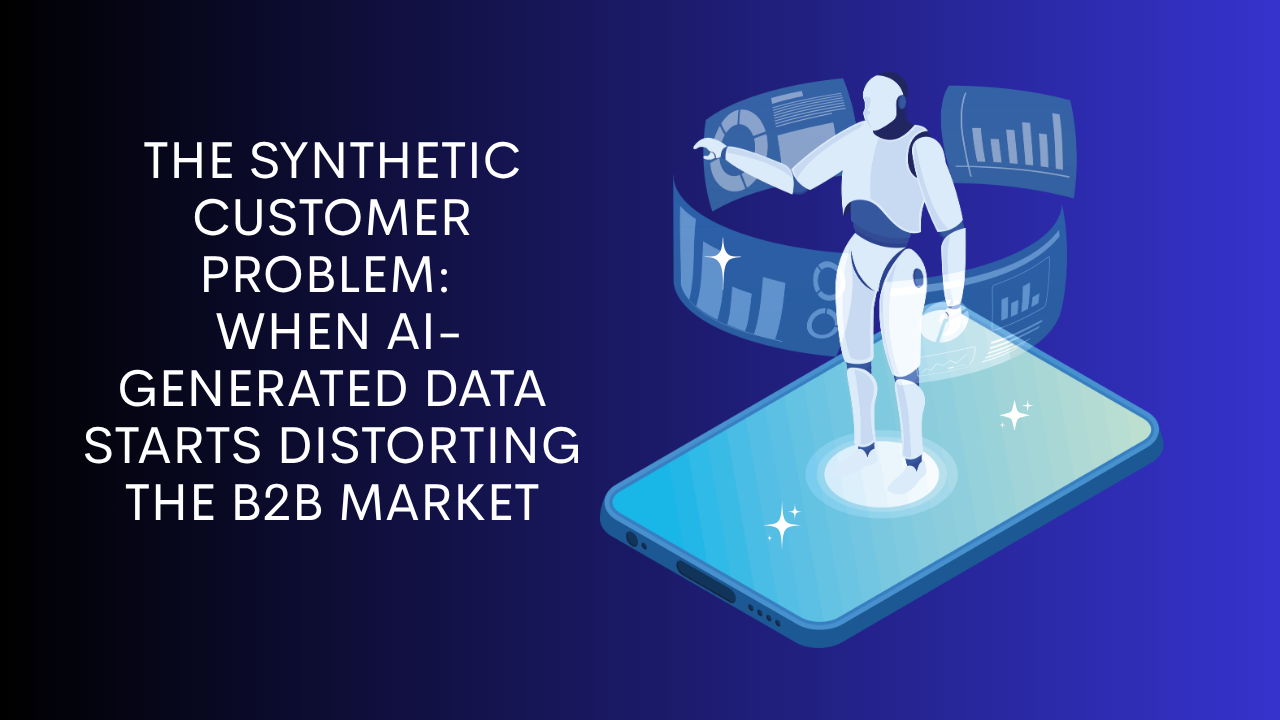
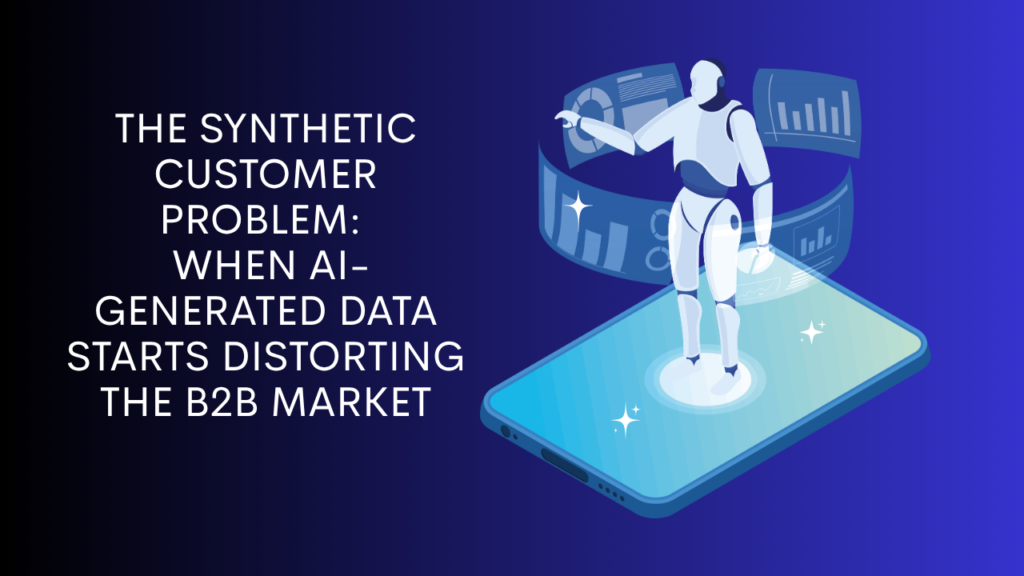
The Synthetic Customer Problem is becoming one of the biggest challenges facing modern B2B marketing as artificial intelligence changes how businesses collect, analyze, and interpret customer data. For decades, B2B marketing has operated on a simple assumption: the digital signals businesses collect are created by real people making real decisions.
AI-generated data in B2B, marketing is creating a new challenge for organizations that depend on customer behaviour analytics. Traditional marketing systems were built around human-generated signals, but the rise of artificial intelligence has introduced new forms of digital activity that are harder to interpret. Businesses must now evaluate whether customer interactions represent genuine buying interest, AI-assisted research, or automated behaviour.
Although these signals were never perfect, marketers trusted them as valuable indicators of customer behaviour.
The Synthetic Customer Problem represents a major shift in how organizations interpret marketing intelligence. As AI-generated activity becomes more common, businesses must rethink how they measure customer behaviour and buying intent.
Artificial intelligence can generate synthetic text, synthetic images, synthetic personas, synthetic reviews, synthetic conversations, synthetic survey responses, and highly realistic synthetic datasets at an unprecedented scale. At the same time, AI-powered agents are beginning to browse websites, compare solutions, analyze information, and perform research activities on behalf of humans.
This creates a new challenge for B2B organizations: what happens when the digital signals used to understand customers are no longer created entirely by customers themselves?
The emerging Synthetic Customer Problem is not simply about fake users or automated traffic. It represents a deeper shift in marketing intelligence—the growing gap between digital activity and genuine human intent.
Companies may have access to more customer data than ever before, but the ability to determine whether that data reflects real market demand is becoming increasingly difficult.
Understanding the Synthetic Customer Problem-
The Synthetic Customer Problem occurs when AI-generated or AI-assisted activity begins influencing the data businesses use to understand customers, measure demand, and make strategic decisions.
Traditional marketing analytics was built around human behaviour. Marketers assumed that actions such as visiting a website, downloading content, reading reviews, or interacting with campaigns represented some form of human interest.
The Synthetic Customer Problem is becoming one of the biggest challenges facing modern B2B marketing as artificial intelligence changes how businesses collect, analyze, and interpret customer data.
An online interaction may come from a potential buyer researching a vendor, an employee using an AI assistant, an autonomous AI agent collecting information, a search crawler, or a completely automated system generating activity.
From the perspective of traditional analytics platforms, these interactions may appear identical.
This creates a major problem: the data may be accurate from a technical perspective, but its business meaning may be unclear.
A company may see increased website traffic, stronger engagement rates, and higher content consumption. But without understanding the source of those actions, marketers may struggle to determine whether they represent genuine buying intent or simply machine-generated activity.
SEO Keyword Mapping by Blog Section-
| Keyword Type | Keywords |
|---|---|
| Focus Keyword | Synthetic Customer Problem |
| Primary Keywords | AI-generated data in B2B marketing, AI impact on B2B marketing, B2B customer intent data, AI-driven marketing analytics, Synthetic customer data |
| Secondary Keywords | AI-generated customer insights, AI agents in B2B buying journey, Customer intent verification, AI-generated buyer personas, First-party data strategy, B2B marketing analytics |
| Semantic Keywords | Machine-mediated customer intent, Marketing signal authenticity, AI-powered customer research, Human intent vs AI signals, Digital customer behaviour, Marketing intelligence, AI automation in demand generation, Authentic customer insights |
| Long-tail Keywords | How AI is changing B2B customer behaviour, How AI-generated data affects marketing decisions, Future of B2B marketing analytics, How businesses verify customer intent in the AI era, Role of AI agents in enterprise buying decisions |
| Industry Keywords | Enterprise AI, B2B digital transformation, Marketing automation, Customer data platforms, Demand generation strategy, Account-based marketing, AI-powered business insights |
| Content Section Usage | Introduction: Synthetic Customer Problem + AI-generated data in B2B marketin |
Why Traditional B2B Marketing Signals Are Losing Their Meaning-
Modern B2B marketing relies heavily on behavioural intelligence. Organizations use intent platforms, account-based marketing systems, customer data platforms, website analytics, lead scoring tools, and predictive models to identify accounts that are most likely to purchase. These systems were designed around the idea that behaviour reveals intent.
A prospect visiting pricing pages, downloading technical documentation, and reading customer stories traditionally suggested that a buying decision was progressing. However, AI is changing the relationship between behaviour and intent.
For example, an enterprise employee may ask an AI assistant to research software providers. The AI system could visit multiple vendor websites, analyze product information, compare features, and summarize recommendations.
The vendor may record multiple sessions, content interactions, and page views. But the human decision-maker may never directly interact with the website. The opportunity is still real, but the signal has changed.
The activity represents machine-mediated intent rather than direct human engagement. This distinction will become increasingly important as AI assistants become more common in business research and procurement processes.
How AI Agents Are Changing the B2B Buying Journey-
The traditional B2B buying journey was designed around human behaviour.
Companies optimized websites for human readers. Content was created to educate decision-makers. Landing pages were designed to encourage people to complete forms, request demos, or contact sales teams. However, the next generation of buying journeys may involve AI systems acting between buyers and vendors.
A business leader may rely on an AI assistant to:
- Research technology providers
- Compare product capabilities
- Analyze customer reviews
- Evaluate pricing models
- Summarize business risks
The AI assistant becomes the first point of interaction.
This changes the role of marketing.
Companies will no longer need to think only about whether their content convinces human visitors. They will also need to consider whether their information can be accurately understood and evaluated by intelligent systems.
Marketing is entering an environment where the audience includes both people and machines acting on their behalf.
How AI Is Changing B2B Marketing for the Modern Tech Buyer-
How AI Agents Are Changing the B2B Buying Journey
Artificial intelligence is transforming how technology buyers discover, evaluate, and purchase solutions. From AI-powered research assistants to automated decision support systems, the B2B buying journey is becoming more intelligent, data-driven, and complex. Marketers must adapt by understanding how AI influences customer behaviour, intent signals, and digital interactions.
The Growing Risk of Synthetic Customer Research-
Customer research has always faced challenges. Surveys can suffer from poor response rates, biased audiences, inaccurate answers, and limited representation of the broader market. Generative AI introduces another challenge: synthetic responses.
AI models can create detailed, realistic answers that appear similar to genuine customer opinions. These responses may be grammatically strong, logically consistent, and highly detailed.The problem is that they may not represent actual customer experiences.
A dataset containing thousands of AI-generated responses could appear more valuable than a smaller dataset built from verified customer conversations. However, quality does not come from volume alone.
The most valuable customer insights come from understanding real experiences, real problems, and real purchasing decisions. The growth of AI agents in the B2B buying journey is changing how companies approach demand generation. These systems can collect information, compare solutions, and summarize vendor capabilities before a human buyer enters the conversation.
When Synthetic Information Creates False Market Signals-
Another emerging concern is the possibility of AI-generated information creating self-reinforcing feedback loops.
A synthetic article may describe an industry trend. Another AI system may summarize that information. A third platform may reference the summary. Eventually, the original assumption may appear across multiple sources. Over time, artificial information can become difficult to distinguish from genuine market intelligence. This creates a new requirement for B2B organizations: understanding where information comes from and how reliable its source is.
Modern B2B customer intent data is becoming more complex because digital engagement no longer always reflects direct human action. Website visits, content interactions, and research activity can now be influenced by AI assistants, automated workflows, and intelligent agents.
How B2B Companies Can Adapt to the Synthetic Customer Era-
The answer is not abandoning automation or ignoring AI. Instead, companies must become better at understanding the origin and meaning of their data.Marketing and sales teams will need stronger alignment around what represents genuine buying intent.
Lead quality will become more important than lead quantity. Customer evidence will become more valuable than digital activity. First-party information will become a competitive advantage. Companies that invest in original research, customer interviews, verified case studies, and real-world performance data will create assets that AI systems cannot easily replicate. As synthetic content becomes easier to produce, authentic customer knowledge will become increasingly valuable.
Conclusion-
The Synthetic Customer Problem is ultimately not about fake customers. It is about the growing distance between digital behaviour and human intent. AI will continue changing how businesses research products, evaluate vendors, and make purchasing decisions. Machines will increasingly influence customer journeys and generate digital signals.
The challenge for B2B marketers will be determining which signals deserve trust. Organizations that succeed will focus on building authentic customer relationships, collecting high-quality first-party data, verifying important marketing signals, and investing in original research.