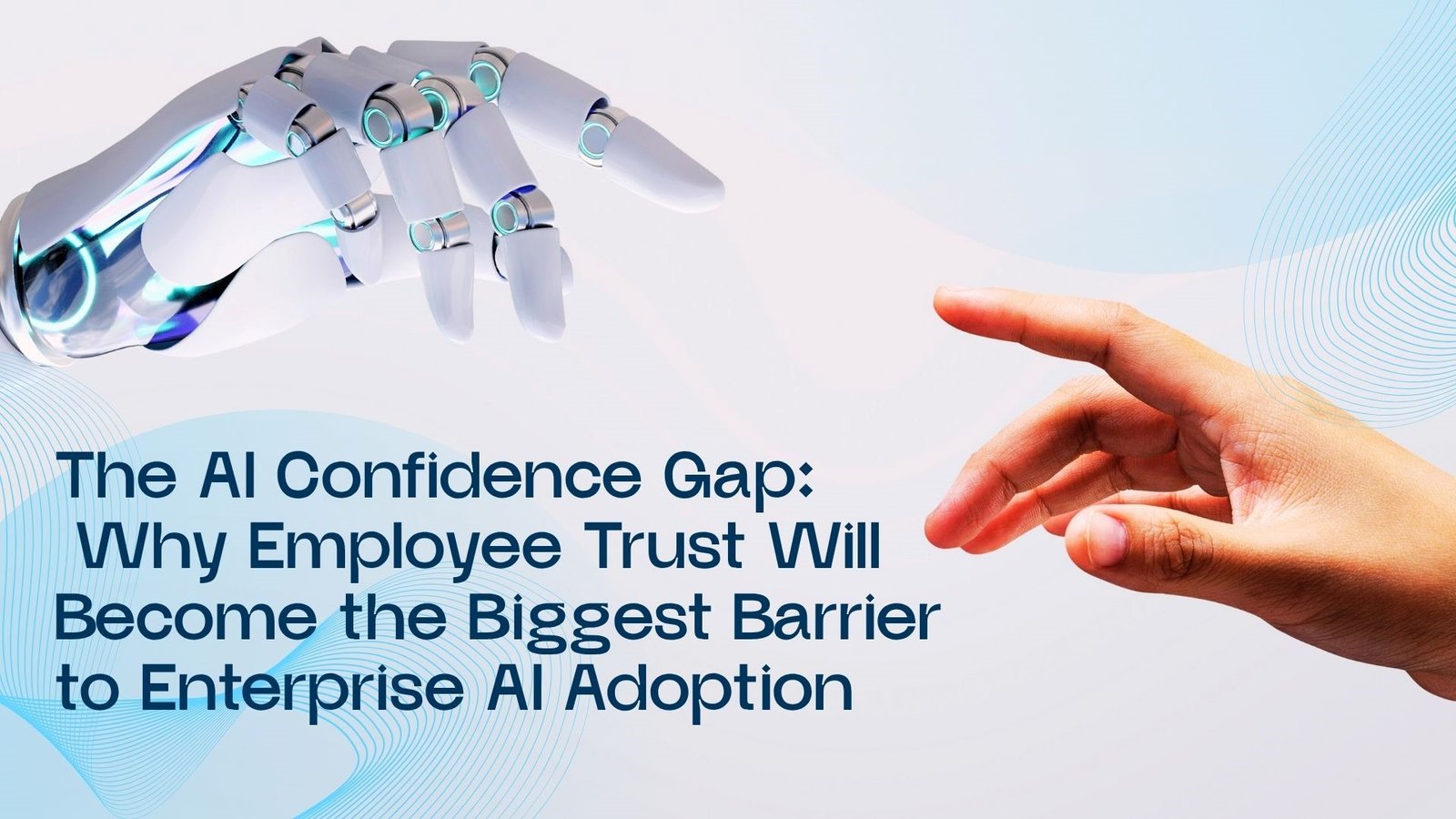
Artificial intelligence has moved rapidly from an experimental technology discussed by innovation teams to an increasingly visible part of everyday enterprise operations. Employees are using AI to write emails, analyse documents, create presentations, summarise meetings, research customers, generate code, interpret data and automate repetitive work. At the same time, organisations are investing in AI platforms with the expectation that these tools will improve productivity, reduce costs and accelerate decision-making. Yet beneath the enthusiasm surrounding enterprise AI, a less visible challenge is emerging: employee trust in AI.
Employees may be willing to use AI without necessarily being willing to trust it. This distinction could become one of the most important factors shaping enterprise AI adoption. An employee may happily use an AI assistant to create a first draft, but hesitate when the same technology recommends rejecting a customer, prioritising a lead, changing a business process or making a decision that could affect professional performance.
The technology may be capable, but capability does not automatically create confidence. As AI becomes embedded deeper into enterprise workflows, organisations will need to understand when employees should trust AI, when they should question it and who remains accountable when an AI-generated recommendation is wrong. The future of enterprise AI may therefore depend not simply on technological capability, but on calibrated employee trust in AI.
Why Employee Trust in AI Will Determine Enterprise AI Adoption –
Traditional enterprise software generally operated within predictable boundaries. Employees understood that a CRM stored customer information, an accounting system processed financial transactions and a communication platform enabled collaboration. When something went wrong, the problem could often be traced to an input, configuration or process.
AI introduces a different relationship between employees and technology. Generative and predictive AI can produce outputs that appear intelligent without always making the underlying reasoning easy to evaluate. An AI-generated response can sound convincing while being incomplete. A recommendation can appear logical while relying on outdated information. An automated classification can look objective while reflecting weaknesses in its underlying data.
This creates a new challenge for businesses: employees are no longer simply learning how to operate software. They are learning how to judge the reliability of systems that can behave intelligently but imperfectly.
Successful enterprise AI adoption therefore requires employees to understand:
- What the AI system is designed to do.
- What information it can access.
- Where its limitations exist.
- How its outputs should be verified.
- Which decisions require human judgement.
- Who remains accountable for the final outcome.
Without that understanding, organisations can fall into two opposing problems: employees may distrust AI so much that they avoid useful tools, or they may trust AI too much because its outputs are delivered quickly and confidently.
The AI Confidence Gap Is a Human and Organisational Problem –
The AI confidence gap is not simply a technology issue. Employees evaluate AI through the lens of their previous experiences with technology, management practices and organisational culture.
If a company historically introduces technology through top-down mandates without explaining its purpose, employees may interpret a new AI initiative as another productivity-monitoring exercise. If leadership communicates AI primarily through cost reduction and workforce efficiency, employees may associate it with job insecurity.
Likewise, if employees are expected to adopt AI immediately without sufficient training or clear usage guidelines, early mistakes can reinforce the belief that the technology is unreliable.
The same technology can be perceived very differently when the organisation provides context and support.
For example, leadership can position AI as a way to remove repetitive administrative work while allowing employees to spend more time on judgement, creativity, customer relationships and strategic activities. This creates a fundamentally different narrative from simply telling employees that AI will make the organisation “more efficient.”
This is why AI trust in the workplace is built by the environment surrounding the technology, not by the AI model alone.
From AI Assistance to AI Influence –
Early enterprise AI adoption largely focused on relatively low-risk activities such as:
- Drafting emails and documents.
- Summarising meetings and reports.
- Brainstorming ideas.
- Searching and organising information.
- Generating initial content.
- Supporting repetitive administrative tasks.
These use cases typically allow employees to review AI output before acting on it. The consequences of an incorrect response may also be relatively limited.
The next stage of enterprise AI is different.
AI is increasingly being connected to workflows, customer interactions, operational processes and business decisions. Depending on the organisation and use case, AI may help qualify leads, recommend actions, prioritise cases, identify potential risks, analyse feedback, support pricing decisions or initiate automated workflows.
As AI moves closer to decision-making, the employee’s relationship with the system changes.
The question is no longer simply:
“Can AI complete this task?”
It becomes:
“Am I comfortable allowing AI to influence an outcome for which I may ultimately remain responsible?”
Why Employee Trust Matters for Enterprise AI Adoption –
The AI Confidence Gap
Employee trust in AI is becoming a critical factor in enterprise AI adoption. As businesses integrate AI into everyday workflows, employees need to understand when AI outputs should be trusted, questioned, or reviewed by a human.
The Accountability Gap Could Undermine AI Trust –
One of the most difficult questions surrounding enterprise AI is accountability.
Imagine an AI system recommends a particular action and an employee follows that recommendation. The outcome is negative. Who is responsible?
Now imagine the employee ignores the AI recommendation and makes the wrong decision. Will management ask why the AI recommendation was not followed?
These situations create uncertainty around the employee’s role.
Employees may become responsible for decisions they do not fully understand if organisations expect them to supervise AI outputs without giving them sufficient visibility or control. That can quickly undermine employee trust in AI.
Enterprises therefore need to define the boundaries between AI recommendations and human authority.
Effective AI governance should clarify:
- Whether an AI recommendation is advisory or mandatory.
- When human review is required.
- Who has final decision-making authority.
- How employees can challenge an AI recommendation.
- How errors should be reported and investigated.
- What happens when human judgement conflicts with AI output.
Trust becomes difficult when technology changes an employee’s accountability without giving that employee corresponding control.
Transparency Is the Foundation of Employee Trust in AI –
Employees do not necessarily need to understand the technical architecture behind an AI model. They do, however, need practical transparency about how the system behaves.
For employees to use AI responsibly, they should have a reasonable understanding of:
- What information the system is using.
- Whether that information is current.
- How much confidence should be placed in the output.
- What types of errors are possible.
- When human verification is required.
- How recommendations can be challenged or corrected.
This represents an important evolution in enterprise AI governance.
Governance cannot focus exclusively on privacy, security and regulatory compliance. It also needs to address how employees understand and interact with AI.
An AI system that provides a recommendation without context may be technically impressive. But an AI system that highlights relevant evidence, communicates uncertainty and enables employees to validate the recommendation can be significantly more useful in an enterprise environment.
The goal is not to make AI appear infallible.
The goal is to make its limitations visible enough that employees know how to use it responsibly.
The Danger of Trusting AI Too Much –
Building employee trust in AI does not mean encouraging employees to accept every AI-generated answer.
In fact, overconfidence in AI can be just as dangerous as distrust.
As AI systems become more capable, employees may increasingly assume that sophisticated outputs are accurate simply because they appear polished. This can create what organisations might view as an automation-confidence problem: employees become comfortable with AI but gradually reduce their own verification discipline.
Consider an employee who receives a detailed customer analysis from an AI system in seconds. If previous analyses have been useful, the employee may be less likely to question the assumptions behind the latest output.
The same pattern can emerge with document summaries, research, data analysis and recommendations.
Successful AI adoption therefore requires employees to learn more than prompting.
They need to learn how to interrogate AI.
That includes understanding:
- Which outputs require verification.
- What evidence should be checked.
- Which questions to ask the AI system.
- What warning signs indicate unreliable output.
- When the available context may be insufficient.
- When professional judgement should override an AI recommendation.
This is where AI literacy becomes strategically important.
7 Powerful Ways Businesses Can Build Employee Trust in AI –
1. Define Where AI Should and Should Not Be Trusted
Employees need clear boundaries rather than generic instructions to “use AI responsibly.”
Organisations should identify which activities are appropriate for AI assistance, which require human review and which should remain primarily human-led.
This creates a practical framework for calibrated trust instead of forcing employees to make those decisions independently.
2. Train Employees to Question AI
AI training should go beyond teaching employees how to write effective prompts.
Employees should understand how to evaluate AI outputs, identify uncertainty and recognise situations where additional verification is required.
A mature AI literacy programme should teach employees both how to use AI and how to challenge AI.
3. Make AI Accountability Explicit
Organisations should clearly establish who owns the final decision when AI is involved.
Employees should not be placed in situations where they are simultaneously expected to follow AI recommendations and independently take responsibility for outcomes without clear guidance.
Clear accountability reduces uncertainty and strengthens confidence in enterprise AI systems.
4. Explain the Purpose Behind AI Deployment
Employees are more likely to engage positively with AI when they understand why the organisation is introducing it.
Leadership communication should explain:
- What problem the AI initiative is solving.
- How employees are expected to use it.
- What benefits it provides.
- What limitations employees should understand.
- How the organisation will measure success.
AI adoption becomes harder when employees have to guess the organisation’s intentions.
5. Give Employees a Way to Challenge AI
Trust does not mean unquestioning acceptance.
Employees should have practical mechanisms for reporting incorrect outputs, challenging recommendations and escalating problematic AI behaviour.
This helps create a culture where questioning AI is treated as responsible behaviour rather than resistance to innovation.
6. Measure AI Confidence, Not Just AI Usage
Traditional technology adoption metrics may focus on logins, usage frequency or productivity improvements.
Those metrics can be useful, but they do not necessarily reveal whether employees understand the technology.
Organisations should also consider whether employees:
- Understand AI’s limitations.
- Know when human review is necessary.
- Feel comfortable challenging AI outputs.
- Understand their responsibilities when using AI.
- Can distinguish low-risk assistance from high-impact decision support.
This represents a shift from measuring AI adoption to measuring AI maturity.
7. Build a Culture of Calibrated Trust
The ultimate objective should not be maximum trust.
It should be appropriate trust.
Employees should trust AI when the system is well suited to the task and the available information is reliable. They should question it when uncertainty, complexity or potential consequences require greater human oversight.
This balanced approach allows organisations to capture the benefits of AI without creating unnecessary dependence.
From AI Adoption to AI Maturity –
Organisations that recognise the importance of employee trust will approach enterprise AI differently from companies that treat AI primarily as a software deployment exercise.
Instead of asking only how many employees are using an AI platform, mature organisations will ask how confidently and appropriately employees are using it.
The distinction is important.
AI adoption asks:
Are employees using the technology?
AI maturity asks:
Do employees understand how to use the technology well?
That difference becomes increasingly important as AI moves deeper into enterprise operations.
The value of AI will not be determined solely by what the technology can technically accomplish. It will also depend on what employees are willing to delegate, what they reserve for human judgement and how effectively the organisation manages the boundary between the two.
Why Enterprise AI Needs a New Definition of Trust –
The strongest organisations will not tell employees that AI is always right. They also will not encourage employees to treat every AI output with suspicion.
Instead, they will build an environment where employees understand when AI deserves confidence and when it deserves scrutiny.
That requires a combination of technology, governance, leadership and culture.
Enterprise leaders should think about AI trust as an organisational capability rather than simply a user sentiment. It influences whether employees adopt AI, how they use it, whether they verify its outputs and whether they are willing to incorporate it into increasingly important workflows.
Trust is also cumulative. Repeated experiences with useful, transparent and controllable AI can strengthen confidence. Conversely, highly visible failures can make employees significantly more cautious about using AI in the future.
For this reason, every AI deployment is also a trust-building exercise.
The Future of Enterprise AI Will Be Built on Confidence –
The future of enterprise AI will depend less on creating systems that employees blindly trust and more on creating systems that employees know how to trust.
Organisations that succeed will establish clear accountability, transparent workflows, practical AI training and governance mechanisms that help employees understand where AI adds value and where human judgement must remain dominant.
The central challenge is therefore no longer whether enterprises can deploy artificial intelligence. They clearly can.
The more important question is whether they can create an environment where employees understand AI well enough to use it confidently, critically and responsibly.
Employee trust in AI may ultimately become one of the defining factors separating organisations that merely implement AI from those that genuinely transform through it.
Conclusion –
Enterprise AI adoption is entering a more complex phase. The challenge is moving beyond giving employees access to AI tools and toward helping them develop the judgement required to use those tools effectively.
Employee trust in AI will be central to that transition. Too little trust can prevent organisations from capturing AI’s potential, while excessive trust can create new operational and decision-making risks. The answer lies in calibrated trust supported by transparency, training, governance and clear accountability.
The organisations most likely to succeed will not simply deploy better AI. They will build better human-AI relationships. They will teach employees when to rely on AI, when to question it and when human judgement must take priority.
In the end, enterprise AI transformation is not just a technology challenge. It is a trust challenge—and the organisations that solve that challenge will be better positioned to turn AI adoption into lasting business value.
Frequently Asked Questions
Employee trust in AI refers to how confidently employees believe they can rely on AI systems, recommendations and outputs while understanding their limitations and knowing when human judgement is required.
Employee trust can influence whether people actually use AI, how much they rely on its outputs and whether they integrate it into important workflows. Low trust can lead to avoidance, while excessive trust can result in insufficient verification.
The AI confidence gap describes the difference between an organisation’s ability to deploy AI and employees’ confidence in using that AI appropriately. A company may have sophisticated AI capabilities without employees fully understanding when or how those capabilities should be trusted.
Businesses can build trust through clear AI policies, practical training, transparent workflows, defined accountability, human oversight and mechanisms that allow employees to challenge or report problematic AI outputs.
Effective AI training can help employees understand both the capabilities and limitations of AI. Training that focuses on verification, critical thinking and responsible use can support more calibrated and informed trust.