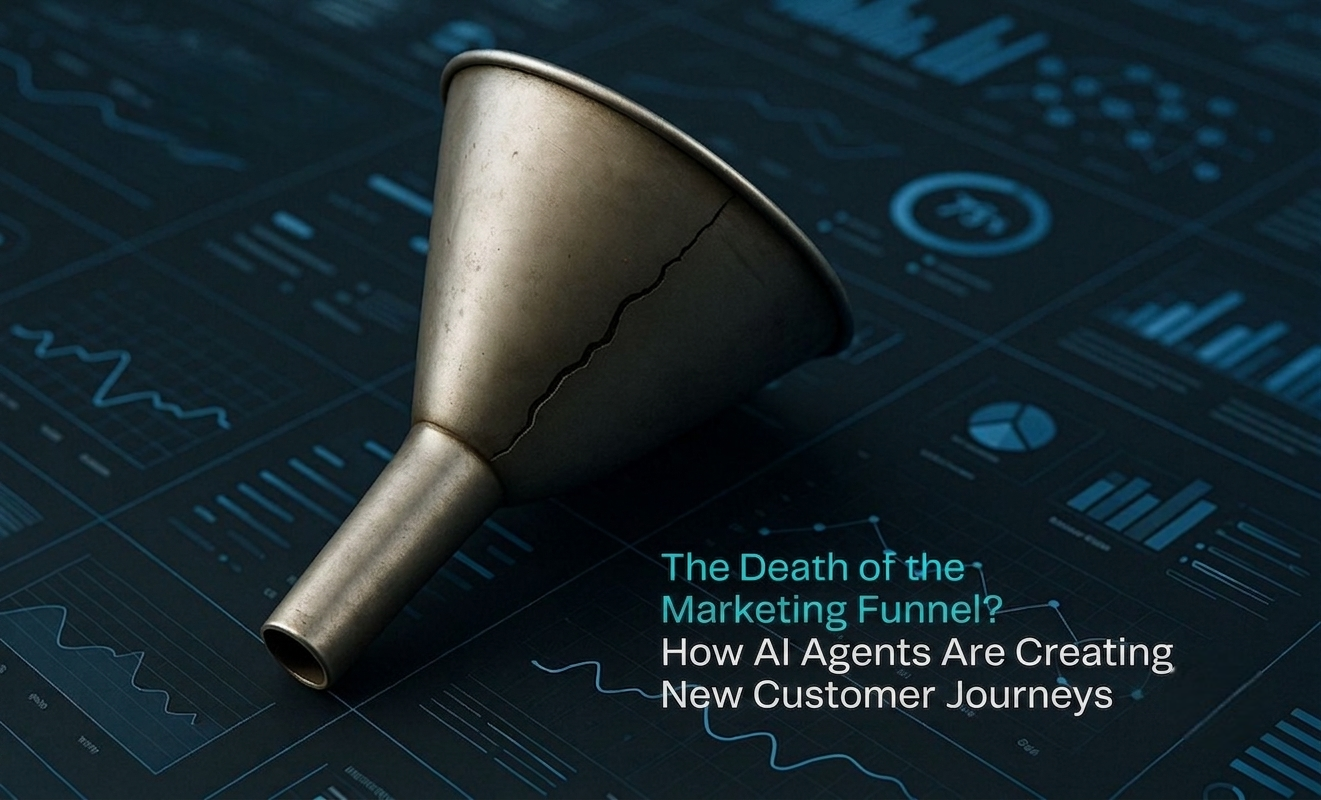
For decades, the marketing funnel has provided businesses with a simple way to understand how prospects move from awareness to consideration and eventually to purchase. Marketers have built campaigns, content strategies, advertising programs, lead-scoring models, and sales processes around this progression. But the rise of generative AI and autonomous AI agents is challenging the assumption that customers must follow a predictable path before making a buying decision. AI Agents in Customer Journeys are creating new ways for prospects to discover, evaluate, compare, and interact with brands.
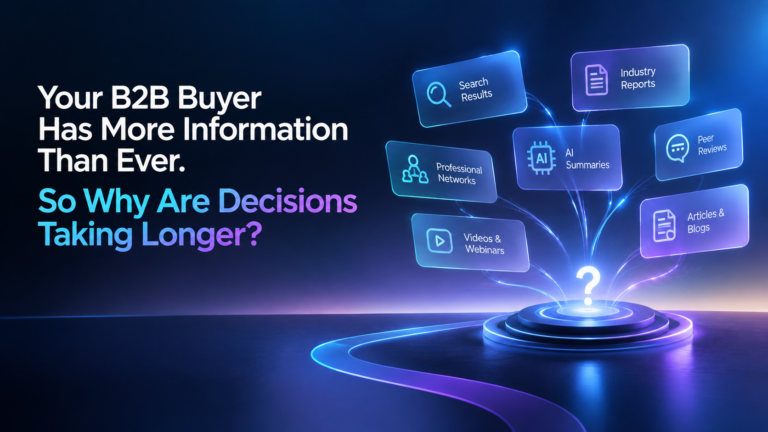
Instead of opening multiple websites, reading dozens of articles, comparing products manually, and contacting several sales teams, a B2B buyer can increasingly use AI to accelerate much of the research process. An AI assistant can help define requirements, summarize information, compare solutions, identify potential vendors, and support decision-making. This does not mean that human buyers have disappeared. Rather, AI is becoming an additional participant in the buying journey.
For B2B organizations, this shift has significant implications. The question is no longer only how to move prospects through the traditional funnel. Companies must also consider how their brand is discovered and represented when AI systems participate in the research and evaluation process. Marketing is moving toward a more dynamic environment where visibility, trust, useful information, and customer intent can matter as much as traditional funnel stages.
Why the Traditional Marketing Funnel Is Under Pressure
The traditional funnel assumes that customers move through relatively recognizable stages: awareness, interest, consideration, decision, and conversion. This model remains useful for planning marketing activities, but modern B2B buying behavior is rarely that simple.
A technology buyer may encounter a company through a search engine, industry community, social platform, analyst content, customer recommendation, or AI-generated answer. They might already understand the problem before discovering a particular vendor. They can also move between research, comparison, validation, and decision-making multiple times.
AI accelerates this behavior because it can reduce the amount of manual research required.
A buyer looking for an enterprise cybersecurity platform, for example, could ask an AI assistant to help identify suitable categories of solutions, compare capabilities, explain technical terminology, and organize questions for vendor meetings. The buyer still makes the final business decision, but AI can influence what information they see and which options they consider.
This creates several challenges for traditional funnel-based marketing:
- Customers may enter the journey with strong purchase intent rather than general awareness.
- AI can reduce the number of individual websites a buyer needs to visit.
- Research and comparison can happen much faster.
- Buyers can move between different stages instead of following a fixed sequence.
- Brand discovery can occur through AI-generated recommendations and summaries.
The funnel is therefore not necessarily disappearing. Its limitations are becoming more visible.
AI Agents in Customer Journeys Are Creating a New Model
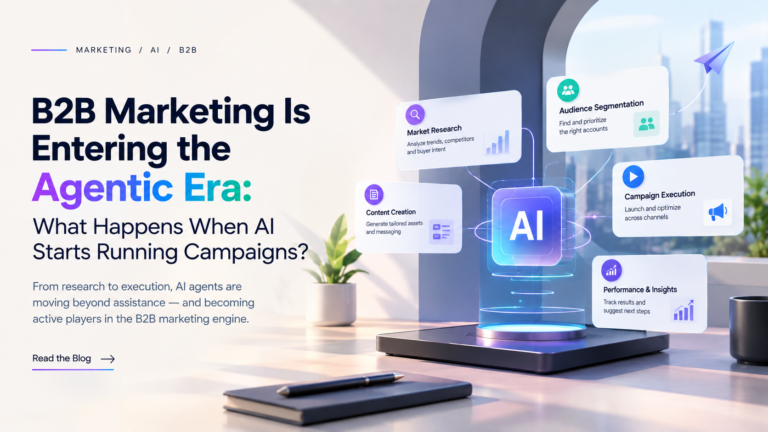
AI Agents in Customer Journeys introduce an important change: AI can participate in the process instead of simply displaying information.
Traditional marketing automation typically follows predefined rules. For example, if a prospect downloads an ebook, the system may send an email. If the prospect clicks a link, another action may be triggered.
AI agents can potentially operate more dynamically. Depending on the systems they are connected to and the permissions they receive, they can interpret context, perform tasks, use information from different sources, and support multi-step workflows.
This creates a shift from automated campaigns toward more adaptive customer experiences.
Consider a B2B software buyer researching customer data platforms. Instead of manually creating a shortlist, the buyer might ask an AI system to identify solutions that fit specific business requirements. The AI could help organize the available information and present a comparison for the buyer to evaluate.
The marketing team’s challenge becomes broader than attracting a click.
The company needs to make sure its information is accurate, discoverable, understandable, differentiated, and trustworthy.
From Linear Funnels to Dynamic Buying Journeys
The traditional funnel is usually visualized as a downward progression. AI-assisted buying journeys are better understood as dynamic networks of interactions.
A prospect can discover a problem, research a solution, compare vendors, return to educational content, ask an AI assistant additional questions, speak with sales, and then conduct another round of research.
The journey may look more like a continuous decision loop than a straight line.
| Traditional Marketing Funnel | AI-Driven Customer Journey |
|---|---|
| Linear progression | Dynamic and non-linear |
| Brand-led messaging | Customer- and AI-assisted discovery |
| Manual research | AI-assisted research |
| Website-centered information | Multiple digital and AI information sources |
| Stage-based campaigns | Intent- and context-driven interactions |
| Manual comparison | AI-assisted comparison |
| Conversion-focused measurement | Journey and influence-focused measurement |
| Human-only decision process | Human + AI-assisted decision process |
This does not make traditional marketing irrelevant. Advertising, content, email, websites, events, sales conversations, and customer relationships remain important. The difference is that AI can increasingly connect information and interactions across these touchpoints.
7 Ways AI Agents Are Transforming the B2B Customer Journey
1. AI Is Changing How Buyers Discover Brands
Brand discovery has traditionally depended heavily on search engines, advertising, social media, referrals, and industry publications. AI-powered interfaces are adding another discovery layer.
A prospect may ask an AI assistant a question such as:
“What are the best CRM platforms for a growing B2B technology company?”
The user may receive a synthesized response containing several potential solutions without manually searching through dozens of pages.
This creates a new marketing objective: becoming a credible and relevant source of information within AI-assisted discovery.
For B2B companies, this makes digital authority increasingly important. Product information, technical documentation, customer experiences, expert content, and third-party references can all contribute to how a company is understood across the broader digital ecosystem.
2. AI Can Compress the Research Stage
B2B buyers often spend significant time researching complex products because enterprise purchases involve multiple stakeholders, technical requirements, budgets, integrations, security considerations, and business objectives.
AI can help buyers process large amounts of information more quickly.
For example, an enterprise buyer evaluating marketing automation platforms might use AI to:
- Summarize product capabilities.
- Compare integration options.
- Identify questions for vendors.
- Explain technical terminology.
- Organize requirements.
- Highlight differences between competing solutions.
The research stage therefore becomes less about collecting information and more about evaluating whether the information is reliable and relevant.
3. AI Is Changing Product Comparison
Comparison has always been an important part of B2B buying. AI can make that process more conversational.
Instead of searching individually for five vendors, a buyer can ask an AI assistant to compare solutions against specific criteria.
For marketers, this means product differentiation becomes critical. Companies need clear information about their capabilities, limitations, integrations, use cases, pricing structures where appropriate, and target customers.
Vague marketing language becomes less useful when buyers can ask AI to compare competing solutions side by side.
4. Personalization Can Become More Contextual
Traditional personalization often relies on information such as industry, company size, browsing behavior, previous interactions, or content downloads.
AI can potentially make interactions more contextual by interpreting the specific questions and objectives expressed by a customer.
For example, two companies may both visit the same software website but have completely different requirements. One may prioritize scalability, another may prioritize integration capabilities.
An AI-assisted experience can potentially respond to these different needs more dynamically.
However, personalization must still be handled responsibly. Businesses need to consider privacy, data governance, transparency, and appropriate use of customer information.
5. AI Is Shortening the Distance Between Research and Action
One of the most significant changes is the possibility of connecting research with execution.
A traditional customer might research a product today, contact sales tomorrow, request a demonstration later, and eventually make a purchase.
AI-assisted workflows can potentially connect some of these steps more efficiently.
For example, an AI system could help a buyer identify potential vendors, prepare questions, summarize available information, and organize the next steps. As agentic commerce and connected business systems develop, the boundary between recommendation and transaction may become increasingly fluid.
For marketers, this means the experience surrounding the purchase can become as important as the promotional message itself.
6. AI Is Changing Customer Expectations
Once customers become accustomed to fast, conversational, personalized experiences, expectations can change across other channels.
B2B buyers increasingly expect businesses to provide useful information without unnecessary friction. They may prefer clear answers over lengthy forms, relevant recommendations over generic campaigns, and immediate access to product information.
This creates pressure on marketing and sales teams to reduce unnecessary complexity.
Companies should examine whether customers can easily find answers to questions such as:
- What problem does the product solve?
- Who is the product designed for?
- How does it integrate with existing systems?
- What differentiates it from alternatives?
- What implementation challenges should buyers expect?
- What evidence supports the company’s claims?
The easier it is to understand the business value of a solution, the easier it becomes for both human buyers and AI systems to evaluate it.
7. Marketing Measurement Is Moving Beyond Clicks
Traditional marketing metrics such as impressions, clicks, website sessions, leads, and conversion rates remain useful. But AI-driven customer journeys create situations where influence can happen without a traditional website visit.
A buyer may encounter a brand through an AI-generated recommendation and later contact the company directly.
That means marketing teams may need to think about a broader set of signals, including:
- AI-driven brand visibility.
- Brand mentions across AI-powered experiences.
- Referral and recommendation patterns.
- Content and source influence.
- Customer questions and intent.
- Assisted conversions.
- Quality of AI-generated brand information.
- The role of AI in the overall buying journey.
The goal is not to abandon existing metrics but to build a more complete picture of how customers discover and evaluate a business.
What Does This Mean for B2B Marketers?
The rise of AI agents does not mean marketers should stop building campaigns, optimizing websites, or producing content. Instead, marketing teams need to rethink how these activities work together.
A strong B2B marketing strategy should increasingly account for both human and AI-assisted discovery.
This means creating an information ecosystem where the company’s value proposition is clear across its website, product pages, technical resources, customer stories, third-party platforms, communities, and other relevant digital channels.
The most important shift is from asking:
“How do we move this lead to the next funnel stage?”
to asking:
“What information or experience does this buyer need to make the next decision?”
That is a much more customer-centric way of thinking about the journey.
The Impact on Content Marketing
Content marketing is likely to experience one of the biggest changes.
For years, companies have created content around keywords, search volume, and funnel stages. Those principles still have value, but AI-assisted discovery increases the importance of content depth and usefulness.
A generic article can be easily replicated. Original insights are harder to replicate.
B2B companies should therefore invest in content that demonstrates expertise and provides genuine value, including:
- Original research.
- Technical guides.
- Customer case studies.
- Product documentation.
- Expert analysis.
- Industry comparisons.
- Implementation guides.
- Frequently asked questions.
- Data-backed insights.
- Practical frameworks.
The objective should not be to create content simply because an AI system can produce it quickly.
The objective should be to create information that customers actually need and that demonstrates why the company deserves their trust.
Why Brand Authority Matters More in an AI-Driven World
AI systems depend on information to generate answers and recommendations. This makes the broader digital reputation of a business increasingly important.
A company’s website is only one part of that reputation.
Potential buyers may encounter information from industry publications, review platforms, communities, customer discussions, technical documentation, analyst resources, partner websites, and social platforms.
For B2B technology companies, brand authority should therefore be treated as an ecosystem rather than a single marketing channel.
Strong authority can be supported by:
- Consistent company and product information.
- Demonstrable subject-matter expertise.
- Credible customer stories.
- Clear technical documentation.
- Independent industry recognition.
- Useful educational resources.
- Positive customer experiences.
- Transparent communication.
This also highlights an important principle: AI cannot compensate for a weak underlying customer experience indefinitely. If a company’s product, service, documentation, or reputation does not meet customer expectations, better AI visibility will not solve the fundamental problem.
How Businesses Can Prepare for AI-Driven Customer Journeys
Companies do not need to completely rebuild their marketing strategy to prepare for this shift. They can start by improving the foundations of their digital customer experience.
Make Business Information Clear and Consistent
Product descriptions, company information, technical specifications, use cases, FAQs, and other important information should be accurate and consistent across digital channels.
Understand AI-Assisted Discovery
Marketing teams should begin evaluating how their brands appear in AI-powered search and conversational experiences. The goal is to understand what information customers may encounter before reaching the company’s website.
Strengthen First-Party Expertise
Companies should publish information based on genuine expertise rather than relying entirely on generic content. Original research, technical knowledge, customer insights, and practical experience can make content more valuable.
Connect Marketing, Sales, Product, and Customer Success
The customer journey does not belong to marketing alone.
AI-driven experiences increasingly connect product information, sales interactions, customer service, analytics, and marketing. Cross-functional collaboration can help create a more consistent customer experience.
Reconsider Funnel-Based Reporting
Funnels can remain useful for reporting, but teams should also examine the broader journey.
Instead of measuring only how many people move from one stage to another, companies can ask:
- Where are customers discovering us?
- What information influences their decisions?
- Which questions repeatedly appear during evaluation?
- Where are customers experiencing friction?
- Which content contributes to meaningful conversations?
- How does AI influence research and vendor selection?
These questions can reveal opportunities that traditional funnel reports may overlook.
Will the Marketing Funnel Actually Die?
Probably not.
The marketing funnel is too useful as a simplified framework to disappear completely. It helps organizations understand broad customer stages and coordinate marketing and sales activities.
What is changing is the assumption that every customer must move through those stages in the same order.
The future is more likely to involve a hybrid model: traditional marketing frameworks combined with dynamic, AI-assisted customer journeys.
The funnel can provide the strategic structure, while AI can help customers navigate the journey in a much more personalized and flexible way.
In this model, marketers are no longer simply pushing prospects downward.
They are creating the information, experiences, trust signals, and interactions that help customers move forward—wherever and whenever those decisions happen.
The Future of B2B Marketing: From Funnel Management to Journey Orchestration
The deeper transformation is not really about replacing one diagram with another. It is about changing the role of marketing.
In the traditional model, marketing often focuses on campaigns: create awareness, generate leads, nurture prospects, and support conversion.
In an AI-driven environment, marketing increasingly becomes an exercise in journey orchestration.
Organizations need to make sure their brand is discoverable, their information is understandable, their expertise is credible, and their customer experience is consistent across the entire decision process.
AI agents may become an important interface between businesses and buyers, but they do not eliminate the need for human trust.
For complex B2B purchases, customers still need confidence in the vendor, product, implementation process, security, service, and long-term business relationship.
That means the winning companies will not necessarily be those that use the most AI.
They will be those that use AI to make the customer journey more useful, relevant, transparent, and frictionless.
Conclusion
The traditional marketing funnel is not dead, but the predictable customer journey it represents is changing. AI Agents in Customer Journeys are introducing a new layer of intelligence between buyers and businesses, allowing customers to research, compare, evaluate, and potentially act with less manual effort.
For B2B marketers, this creates both a challenge and an opportunity. Brands can no longer focus exclusively on rankings, clicks, lead forms, and funnel progression. They need to consider how their products and expertise are discovered, interpreted, compared, and trusted within increasingly AI-assisted buying journeys.
The future of marketing will likely combine the structure of traditional marketing with the flexibility of AI-driven experiences. Businesses that build strong digital authority, useful content, reliable product information, connected customer experiences, and responsible AI strategies will be better positioned for this transition.
The most important question for marketers is no longer simply “How do we move prospects through the funnel?”
It is:
“How do we become the trusted choice when a customer—and the AI helping that customer—starts making a buying decision?”
That may be the real beginning of the next era of B2B marketing.
Frequently Asked Questions
What are AI Agents in Customer Journeys?
AI Agents in Customer Journeys are AI-powered systems that can assist with activities such as information discovery, research, comparison, recommendations, and other customer interactions. They can add an intelligent layer to the traditional buying journey.
Are AI agents replacing the traditional marketing funnel?
Not necessarily. The traditional funnel remains useful as a planning framework, but AI is making customer journeys less linear. Buyers can now move between discovery, research, comparison, and decision-making in more dynamic ways.
How do AI agents change B2B marketing?
AI agents can reduce the time buyers spend researching and comparing solutions. This means B2B marketers need to focus more on clear product information, expertise, brand authority, useful content, and a frictionless customer experience.
What is an AI-driven customer journey?
An AI-driven customer journey is a buying experience in which AI assists with activities such as discovery, research, personalization, comparison, recommendations, or other decision-support activities.
Why is AI search important for B2B marketers?
AI search can change how prospects discover information about companies and products. Instead of receiving only a list of links, users may receive synthesized answers and recommendations. B2B brands therefore need to consider how their expertise and information are represented across AI-assisted discovery environments.
How should companies optimize content for AI-driven customer journeys?
Companies should focus on useful, authoritative, accurate, and well-structured content. Technical documentation, original research, case studies, product information, expert insights, comparisons, and detailed FAQs can help customers understand a company’s capabilities and make informed decisions.
Will AI agents make B2B marketing fully automated?
No. AI can automate and assist with many activities, but B2B marketing still depends on human expertise, creativity, trust, relationships, strategy, and business judgment. AI is more likely to augment marketing teams than eliminate the need for them.
What marketing metrics should businesses track in an AI-driven environment?
Businesses should continue tracking traditional metrics such as leads, conversions, engagement, and revenue while also considering broader indicators such as AI-assisted brand visibility, content influence, customer intent, recommendation patterns, and assisted conversions.
What is the biggest opportunity for B2B marketers in the age of AI agents?
The biggest opportunity is to become a trusted source of information and a preferred solution throughout an increasingly AI-assisted buying journey. Companies that combine strong expertise, useful content, reliable information, and excellent customer experiences can differentiate themselves as AI changes how buyers make decisions.