Artificial Intelligence has rapidly evolved from experimental technology into a core business necessity. Over the last few years, Large Language Models (LLMs) such as advanced generative AI systems have dominated conversations across industries, enabling businesses to automate customer service, generate content, write code, analyze data, and streamline operations. However, as enterprises move beyond experimentation and focus on scalability, cost optimization, speed, and data privacy, a new competitor has emerged in the AI ecosystem — Small Language Models (SLMs).
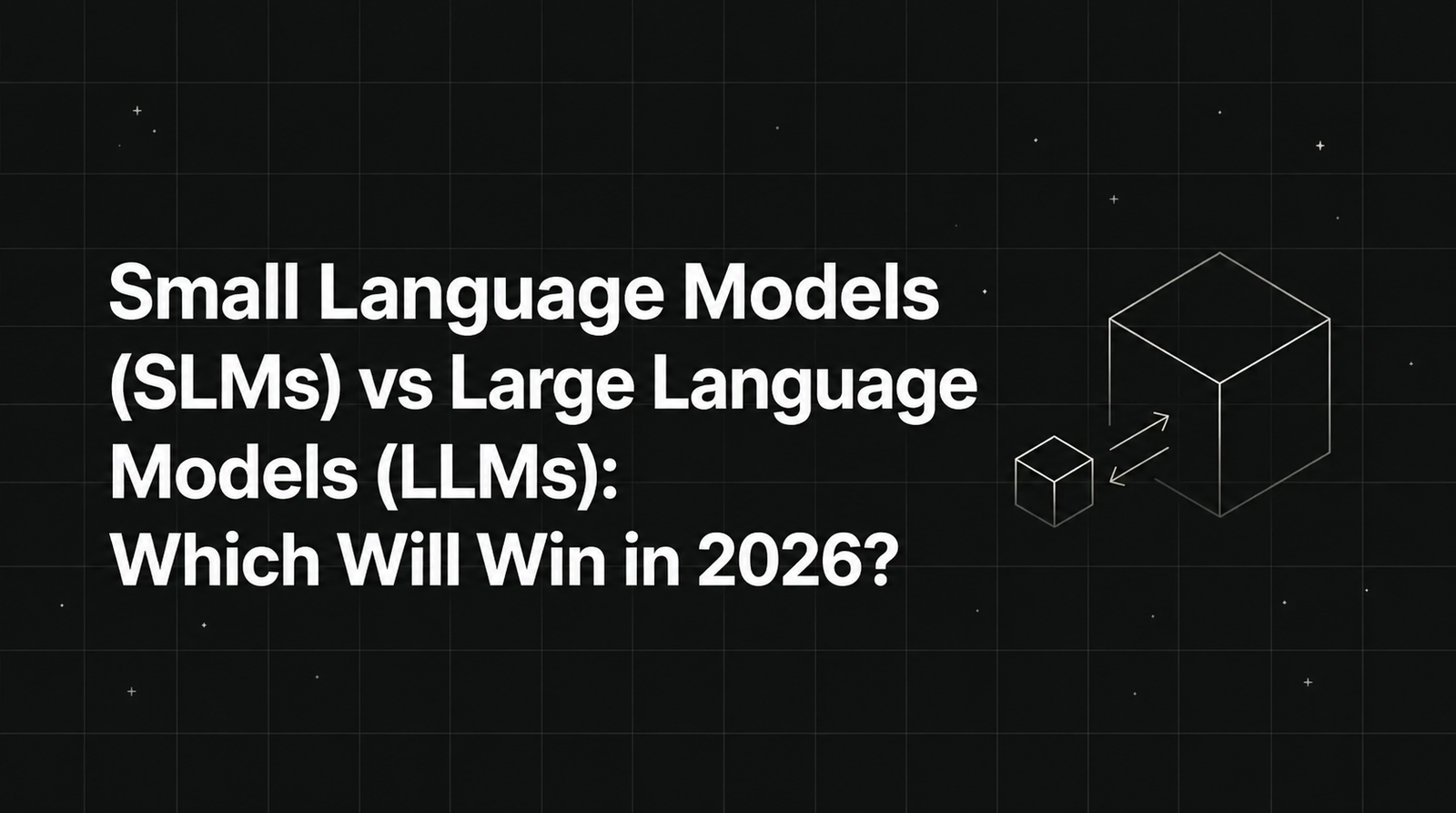
In 2026, the debate between SLMs and LLMs is becoming one of the most important discussions in enterprise AI strategy. Organizations are now asking whether bigger models are always better, or if smaller, specialized AI systems can deliver more practical value for real-world business operations. While LLMs continue to offer unmatched reasoning and generative capabilities, SLMs are gaining attention for their efficiency, lower operational costs, faster deployment, and ability to run on edge devices.
The future of AI may not be about choosing one over the other. Instead, businesses are beginning to realize that both technologies serve different purposes and will likely coexist in the evolving AI landscape.
Understanding Large Language Models (LLMs)
Large Language Models are AI systems trained on massive datasets containing billions or even trillions of parameters. These models are designed to understand, generate, and process human language at a highly advanced level. LLMs power many of the AI tools used today for content generation, intelligent search, virtual assistants, coding support, and enterprise automation.
Their strength lies in their ability to handle highly complex tasks with contextual understanding across multiple domains. Because they are trained on enormous amounts of data, LLMs can generate sophisticated responses, summarize information, answer complex questions, and even perform reasoning tasks that mimic human thinking patterns.
Many enterprises rely on LLMs because they offer flexibility across industries such as healthcare, finance, legal services, software development, education, and customer support. These models can adapt to diverse workflows without requiring extensive retraining.
Some key advantages of LLMs include:
- Strong contextual understanding
- High-quality content generation
- Advanced reasoning capabilities
- Multilingual support
- Ability to perform multiple tasks within a single system
- Better handling of complex enterprise queries
Despite these benefits, LLMs also come with significant challenges. Training and operating these massive models require enormous computing resources, advanced GPUs, high energy consumption, and substantial infrastructure investments. As organizations scale AI adoption, the cost of running LLMs at enterprise level is becoming a major concern.
Additionally, concerns related to privacy, latency, hallucinations, and regulatory compliance are forcing businesses to reconsider whether extremely large AI systems are necessary for every use case.
What Are Small Language Models (SLMs)?
Small Language Models are lightweight AI models designed to perform targeted tasks with significantly fewer parameters compared to LLMs. Instead of trying to understand everything across the internet, SLMs are often trained or fine-tuned for specific business functions, industries, or workflows.
SLMs focus on efficiency rather than scale. These models can run on local servers, edge devices, smartphones, laptops, and enterprise environments without requiring massive cloud infrastructure. Because of their smaller size, SLMs consume less power, respond faster, and cost significantly less to deploy and maintain.
In 2026, SLMs are becoming increasingly popular among enterprises that want practical AI solutions without the complexity and expense associated with large-scale AI deployments.
Businesses are discovering that many enterprise workflows do not require trillion-parameter reasoning systems. For example, internal IT support, workflow automation, customer ticket classification, data extraction, predictive maintenance, and HR automation can often be handled effectively by smaller specialized models.
Key benefits of SLMs include:
- Lower operational costs
- Faster inference speed
- Reduced energy consumption
- Better data privacy through on-device deployment
- Easier customization for industry-specific tasks
- Lower latency for real-time applications
- Improved deployment flexibility
As AI adoption grows globally, SLMs are also supporting the rise of edge AI computing, where intelligent processing occurs directly on devices rather than centralized cloud environments.
Why Enterprises Are Turning Toward SLMs in 2026
One of the biggest trends shaping enterprise AI in 2026 is the shift from experimental AI to production-ready AI systems. Businesses no longer want AI tools that simply generate impressive demos. They want solutions that are reliable, affordable, scalable, secure, and capable of delivering measurable business value.
This shift is creating strong demand for SLMs.
For many organizations, deploying a massive LLM for every task is financially unsustainable. Running large AI systems continuously can generate enormous cloud computing expenses, especially when AI applications serve millions of users or process real-time workloads.
SLMs provide a more sustainable alternative for operational AI.
For example, a customer support company may use an SLM trained specifically for ticket categorization and sentiment analysis. A manufacturing firm may deploy SLMs on factory equipment for predictive maintenance. Healthcare providers may use specialized SLMs for medical transcription and documentation without exposing sensitive data to external cloud platforms.
This targeted approach allows enterprises to optimize performance while maintaining tighter control over costs and compliance.
Another major advantage is privacy. Many industries are facing strict data regulations that limit how customer information can be processed or transferred. SLMs deployed locally within enterprise infrastructure reduce dependency on third-party cloud services, helping organizations improve compliance and security.
Where LLMs Still Dominate
Although SLMs are gaining momentum, Large Language Models continue to dominate areas that require advanced reasoning, creativity, broad contextual awareness, and multi-domain intelligence.
LLMs remain highly effective for:
- Advanced research and analytics
- Enterprise knowledge assistants
- Complex software development support
- Strategic business intelligence
- Long-form content creation
- Multi-language communication
- AI-powered education systems
- Scientific and legal document analysis
These models are particularly valuable in scenarios where users ask unpredictable questions requiring broad knowledge and sophisticated reasoning capabilities.
For example, a global consulting company using AI for strategic analysis across multiple industries may still rely heavily on LLMs. Similarly, AI coding assistants capable of understanding large codebases and generating complex software architectures benefit from the advanced capabilities of large-scale models.
The reality is that LLMs continue to push the boundaries of what AI can achieve. As hardware improves and AI optimization techniques advance, LLMs may become more efficient over time.
The Cost Battle: Efficiency vs Capability
The competition between SLMs and LLMs is ultimately becoming a balance between efficiency and capability.
LLMs deliver exceptional performance but require expensive infrastructure, massive datasets, and ongoing GPU investments. Enterprises adopting large-scale generative AI must also manage issues related to energy consumption and sustainability.
SLMs, on the other hand, focus on delivering practical AI solutions with lower infrastructure requirements. This makes them highly attractive for businesses aiming to integrate AI into daily operations without dramatically increasing IT spending.
Several factors influencing enterprise AI decisions in 2026 include:
- Infrastructure costs
- AI deployment speed
- Energy efficiency
- Regulatory compliance
- Data privacy requirements
- Scalability needs
- Real-time processing capabilities
- Return on investment (ROI)
As economic pressures increase globally, enterprises are prioritizing AI systems that produce measurable operational value rather than simply adopting the largest models available.
Hybrid AI Architectures Are Emerging
Instead of replacing LLMs entirely, many organizations are adopting hybrid AI architectures that combine both SLMs and LLMs.
In this approach, SLMs handle routine, high-volume, low-complexity tasks while LLMs manage advanced reasoning and specialized analysis. This strategy allows enterprises to optimize cost, speed, and performance simultaneously.
For instance, an enterprise AI platform may use:
- SLMs for document classification
- SLMs for chatbot routing
- SLMs for workflow automation
- LLMs for complex customer interactions
- LLMs for executive-level analytics
- LLMs for advanced knowledge generation
This layered AI strategy is becoming increasingly common because it enables businesses to deploy AI more strategically across different operational areas.
The Role of Hardware Innovation
The future competition between SLMs and LLMs is also being shaped by rapid advancements in AI hardware.
Chip manufacturers are investing heavily in specialized AI accelerators designed to improve inference efficiency and reduce power consumption. Edge computing devices are becoming more powerful, allowing SLMs to run directly on enterprise hardware, industrial systems, smartphones, and IoT environments.
At the same time, cloud providers are developing optimized infrastructure for running massive LLM workloads more efficiently.
As hardware evolves, the distinction between SLM and LLM deployment models may continue to blur. Enterprises could eventually use highly optimized versions of large models while still benefiting from the efficiency traditionally associated with smaller AI systems.
Will SLMs Replace LLMs?
The short answer is no.
Small Language Models are unlikely to completely replace Large Language Models, just as laptops did not replace data centers. Both technologies solve different problems and serve different operational needs.
SLMs excel in specialized, cost-sensitive, and real-time applications. LLMs excel in generalized intelligence, creativity, and advanced reasoning tasks.
The real winner in 2026 will likely be organizations that understand how to combine both technologies effectively.
Businesses adopting a balanced AI strategy will gain advantages in:
- Operational efficiency
- AI scalability
- Cost optimization
- Faster automation
- Better customer experiences
- Improved data security
- Competitive innovation
Rather than focusing solely on model size, enterprises are shifting toward outcome-driven AI adoption strategies.
Conclusion
The debate between Small Language Models and Large Language Models represents a major turning point in the evolution of enterprise AI. In the early days of generative AI, bigger models captured most of the attention because they demonstrated extraordinary capabilities. However, as businesses move toward large-scale implementation, practical concerns such as cost, speed, security, compliance, and sustainability are becoming equally important.
In 2026, SLMs are emerging as highly efficient solutions for operational AI workloads, edge computing, and industry-specific automation. At the same time, LLMs continue to lead in advanced reasoning, creativity, and broad contextual intelligence.
The future of AI will not be defined by a single dominant model type. Instead, enterprises will increasingly adopt hybrid ecosystems where SLMs and LLMs work together to deliver optimized business outcomes.
Organizations that successfully balance intelligence, efficiency, and scalability will be best positioned to lead the next phase of AI-driven transformation.