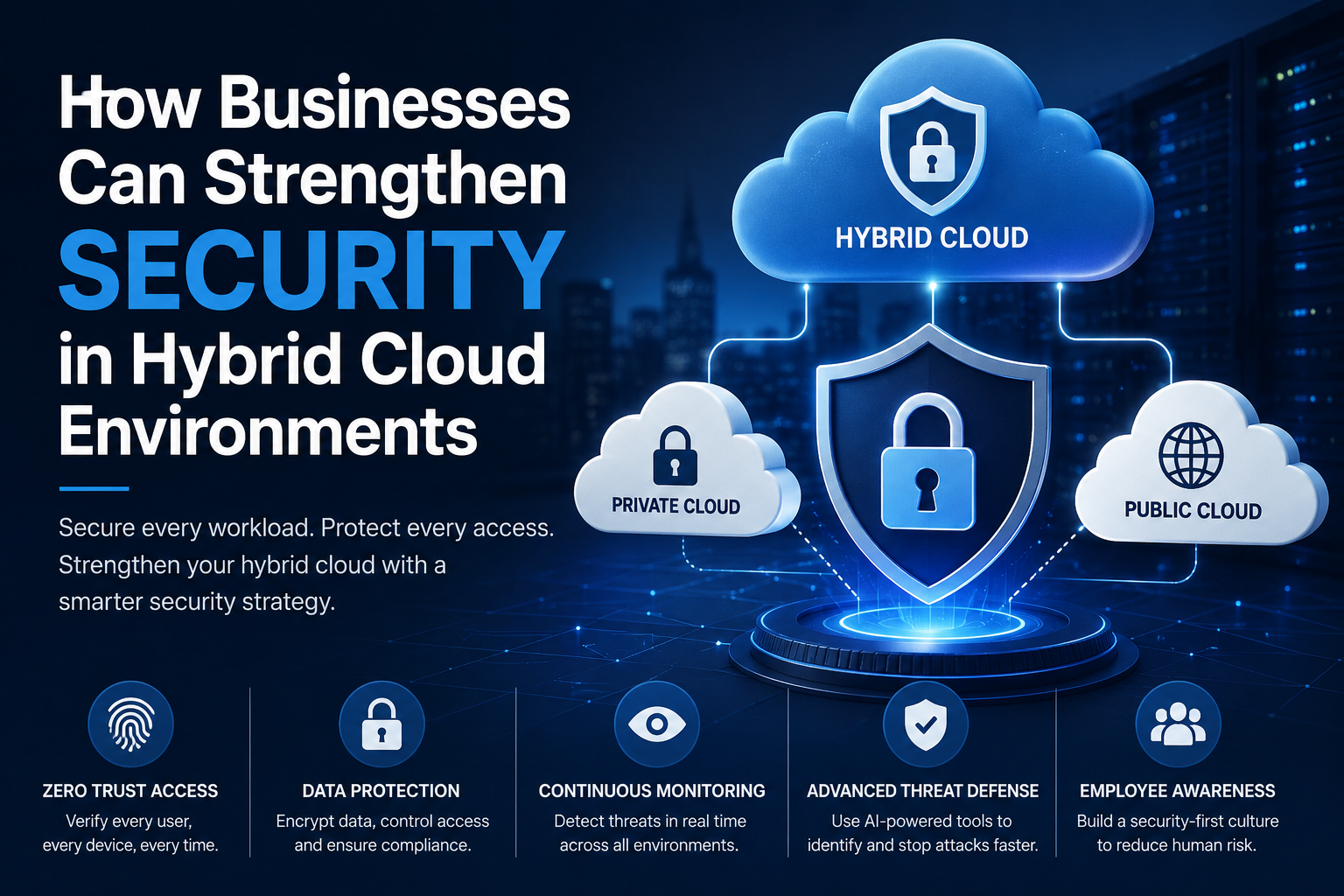
Hybrid cloud environments have become a preferred strategy for modern businesses because they offer flexibility, scalability, and cost efficiency. Organizations can combine private infrastructure with public cloud services to support remote work, digital transformation, and AI-driven operations. However, this approach also introduces complex security challenges. Data moves across multiple platforms, applications operate in different environments, and employees access systems from various locations and devices.
Hybrid Cloud Security focuses on protecting connected systems that operate across both private and public cloud environments. It ensures consistent security controls, access management, and data protection across the entire infrastructure.
Key Challenges:
- Increased attack surface across cloud and on-premises systems
- Lack of centralized visibility and monitoring
- Inconsistent security policies across platforms
- Higher risk of unauthorized access and data breaches
Implementing Zero Trust Security Models-
Implementing a Zero Trust security approach is one of the most effective Hybrid Cloud Security strategies for reducing unauthorized access and protecting distributed environments.
Every access request must be continuously verified based on identity, device status, location, and risk level. This approach helps reduce the chances of unauthorized access and insider threats.
Hybrid Cloud Security has become a critical priority for organizations adopting modern digital infrastructure. As businesses combine private infrastructure with public cloud services, protecting data, applications, and users across multiple environments has become a major cybersecurity challenge.
Key Strategies:
- Use multi-factor authentication (MFA) for all users
- Apply least-privilege access controls
- Continuously monitor user behavior and device activity
- Verify every access request regardless of location
- Secure third-party and remote access connections
Strengthening Data Protection and Encryption-
Data is one of the most valuable assets for any organization, making data protection a top priority in hybrid cloud environments. Sensitive business information often moves between public cloud platforms, private servers, and remote endpoints, increasing the risk of interception or unauthorized access. Businesses must implement strong encryption practices for both stored data and data in transit. Strong encryption and data governance are essential components of Hybrid Cloud Security solutions because sensitive information frequently moves between cloud platforms, private servers, and remote devices.
Advanced monitoring and AI-powered threat detection technologies strengthen Hybrid Cloud Security by identifying suspicious activities across complex cloud environments.
Modern Cloud Data Protection strategies help organizations secure sensitive information across public cloud platforms, private infrastructure, and connected applications. As data moves between different environments, businesses need strong encryption, access controls, and governance policies to prevent unauthorized access.
Key Strategies:
- Encrypt sensitive data across all environments
- Use secure backup and disaster recovery solutions
- Implement strong data governance policies
- Monitor and control data access continuously
Improving Threat Detection and Continuous Monitoring-
Cyber threats in hybrid cloud environments are becoming more sophisticated and difficult to detect. Businesses can no longer rely solely on traditional firewalls or antivirus tools to protect their infrastructure. Continuous monitoring and advanced threat detection technologies are essential for identifying suspicious activities before they cause major damage. Modern security solutions powered by artificial intelligence and machine learning can analyze large volumes of security data in real time, helping organizations detect unusual behavior, malware, and unauthorized access attempts more quickly. Security teams should also implement centralized monitoring systems that provide visibility across both cloud and on-premises environments. Automated alerting and incident response capabilities can significantly reduce response times and minimize business disruption during cyber incidents.
Key Strategies:
- Use AI-powered threat detection systems
- Implement centralized security monitoring platforms
- Monitor user activity and network behavior continuously
- Automate incident detection and response processes
Building a Strong Security Culture and Employee Awareness-
Technology alone cannot fully protect hybrid cloud environments if employees are not aware of cybersecurity risks. Human error remains one of the leading causes of data breaches and security incidents. Employees working remotely or accessing cloud applications from personal devices may unknowingly expose organizations to phishing attacks, weak passwords, or unsafe network connections. Businesses must create a strong security culture where cybersecurity awareness becomes part of everyday operations. Regular employee training programs can help staff identify cyber threats, follow secure practices, and respond appropriately during incidents. Managers and leadership teams should also encourage accountability and promote clear security policies across departments. When employees understand their role in protecting company systems and data, organizations become more resilient against evolving cyber threats.
Key Strategies:
- Conduct regular cybersecurity awareness training
- Educate employees about phishing and social engineering attacks
- Enforce strong password and device security policies
- Encourage reporting of suspicious activities immediately
Conclusion-
Hybrid cloud environments offer businesses the flexibility and scalability needed to support modern digital operations, but they also introduce significant security challenges. As cyber threats continue to evolve, organizations must adopt proactive security strategies that protect data, users, applications, and infrastructure across all environments. Implementing Zero Trust models, strengthening encryption, improving threat detection, and building a strong security culture are essential steps toward reducing risk and maintaining operational resilience. Businesses that invest in comprehensive hybrid cloud security strategies will not only improve protection against cyberattacks but also build greater trust, compliance, and long-term business stability in an increasingly connected world.