
How B2B SaaS Companies Are Reducing Churn with Customer Data Platforms
Introduction –
Customer churn remains one of the biggest challenges for B2B SaaS companies, directly impacting revenue, growth, and long-term sustainability. As customer acquisition costs continue to rise, businesses are shifting their focus toward retention strategies. One of the most effective tools enabling this shift is the Customer Data Platform (CDP). By centralizing and analyzing customer data, CDPs help organizations understand behavior, predict risks, and take proactive actions to retain customers.
Understanding Customer Data Platforms (CDPs) –
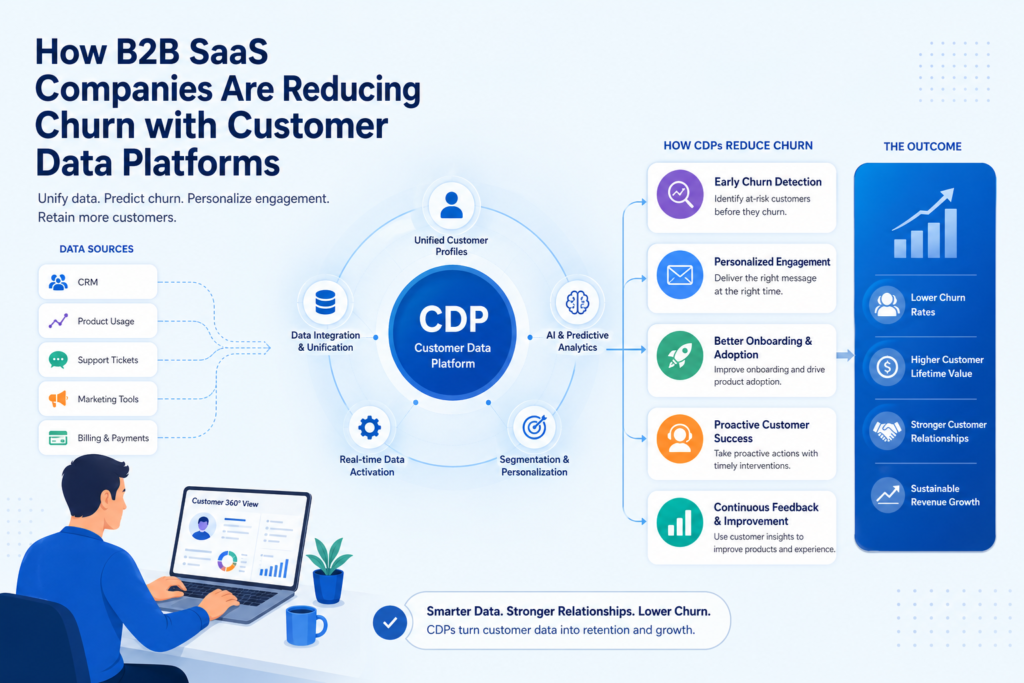
A Customer Data Platform acts as a centralized system that collects, integrates, and manages customer data from multiple sources such as CRM systems, product usage analytics, marketing tools, and support platforms. Instead of relying on fragmented datasets, businesses gain a unified, real-time view of each customer. This comprehensive visibility allows teams across departments to make informed decisions, ensuring consistent and personalized customer experiences throughout the lifecycle.
Key Reasons Behind Customer Churn –
Customer churn in B2B SaaS does not happen randomly; it is often driven by identifiable factors. Poor onboarding experiences can leave customers confused about product value, while low product adoption indicates that users are not fully utilizing the solution. Additionally, lack of timely support, unclear ROI, and pricing concerns contribute significantly to churn. By understanding these underlying issues, companies can use CDPs to detect early warning signs and address them before customers decide to leave.
Leveraging Unified Customer Data for Insights –
One of the primary advantages of CDPs is their ability to provide a 360-degree view of the customer. This unified data helps organizations track engagement patterns, identify high-value accounts, and monitor customer journeys effectively. With access to accurate and up-to-date information, teams can make data-driven decisions that improve customer satisfaction and reduce churn.
Predictive Analytics for Early Churn Detection –
CDPs empower SaaS companies with predictive analytics capabilities, allowing them to identify potential churn risks in advance. By analyzing historical data and real-time behavior, businesses can detect patterns such as reduced usage, fewer logins, or declining engagement. These insights enable teams to intervene early with targeted strategies, significantly increasing the chances of customer retention.
Personalized Customer Engagement –

In today’s competitive SaaS landscape, generic communication is no longer effective. CDPs enable personalized engagement by segmenting customers based on their behavior, preferences, and lifecycle stages. This allows companies to deliver relevant messages, tailored recommendations, and customized experiences. Personalized engagement not only enhances customer satisfaction but also builds stronger relationships, reducing the likelihood of churn.
Enhancing Onboarding and Product Adoption –
The onboarding phase plays a crucial role in determining whether a customer will stay or leave. CDPs help businesses track user behavior during onboarding and identify friction points that may hinder adoption. By leveraging these insights, companies can design guided onboarding experiences, automate training workflows, and ensure users quickly realize the product’s value. Improved onboarding leads to higher engagement and long-term retention.
Enabling Proactive Customer Success Strategies –
Customer success teams benefit greatly from CDPs by gaining access to real-time customer health metrics. These insights allow teams to prioritize accounts based on risk levels and take proactive measures such as scheduling check-ins, offering additional support, or providing training resources. Instead of reacting to churn after it happens, companies can prevent it by addressing issues early.
Continuous Feedback and Product Improvement –
CDPs also play a vital role in collecting and analyzing customer feedback from various channels. This feedback helps organizations identify recurring pain points and areas for improvement. By aligning product development with customer needs, SaaS companies can enhance user experience and deliver greater value, ultimately reducing churn.
Benefits of Using CDPs for Churn Reduction –
Implementing a CDP offers several benefits, including improved customer insights, early churn detection, enhanced personalization, and better alignment across teams. These advantages contribute to higher customer retention rates, increased lifetime value, and sustainable business growth.
Challenges in Implementing CDPs –
Despite their benefits, CDPs come with certain challenges. Integrating data from multiple systems can be complex, and initial implementation costs may be high. Additionally, organizations need skilled professionals to manage and interpret data effectively. However, with the right strategy and execution, these challenges can be overcome.
Conclusion –
Reducing churn is no longer just about customer support; it requires a data-driven approach. Customer Data Platforms enable B2B SaaS companies to transform raw data into actionable insights, allowing them to predict, prevent, and manage churn effectively. By leveraging CDPs, businesses can build stronger customer relationships, improve retention, and achieve long-term success in an increasingly competitive market.