

Fragmented customer experience has become a significant challenge for modern businesses, particularly as organisations expand their operations across multiple departments, digital platforms, and communication channels. Customers rarely think about businesses in terms of internal structures. They do not distinguish between marketing, sales, customer support, finance, or account management. From their perspective, they are interacting with one organisation, and they expect every interaction to reflect a consistent understanding of their needs, preferences, and previous experiences.
However, the reality inside many organisations is considerably different. A customer might receive a personalised marketing email, explain their requirements to a salesperson, repeat the same information to a customer support representative, and later receive a billing communication that appears to come from an entirely different organisation. Although every department may be performing its individual responsibilities correctly, the overall experience can feel disconnected.
This is the growing problem of the fragmented customer experience, where one individual encounters multiple versions of the same company depending on which department or communication channel they interact with. For businesses competing in increasingly customer-centric markets, addressing this challenge is essential to building trust, improving operational efficiency, and maintaining long-term customer relationships.
What Is a Fragmented Customer Experience?
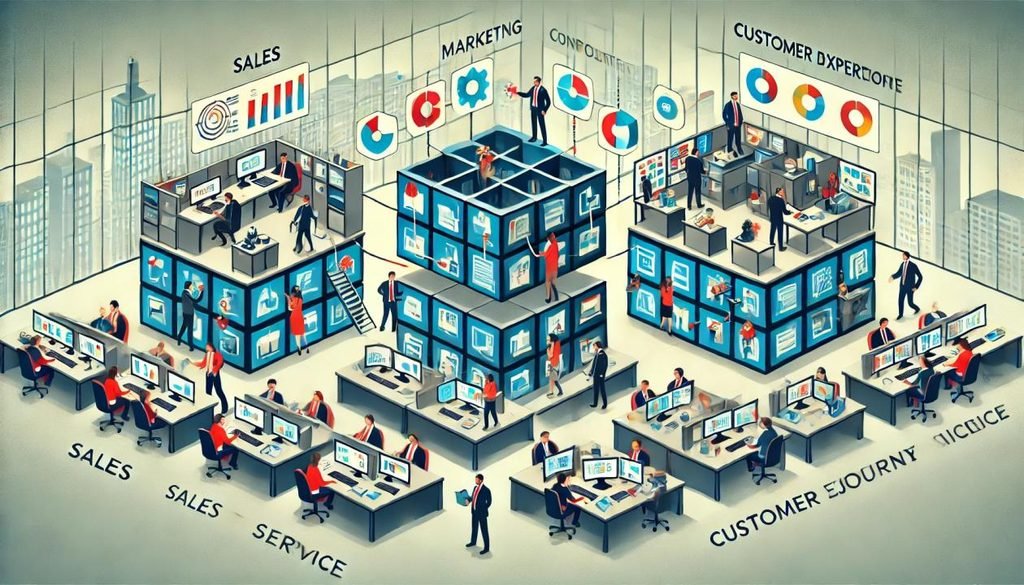
A fragmented customer experience occurs when different departments, systems, and communication channels within an organisation operate without a shared understanding of the customer. Instead of delivering a consistent journey, each department manages individual interactions using its own information, processes, and technology.
For example, consider a business customer who downloads a technology whitepaper after receiving a marketing campaign. The sales team subsequently contacts them to discuss a relevant solution. After purchasing the service, the customer approaches support with a technical issue. However, the support representative cannot access the previous sales conversation or understand the customer’s original requirements.
The customer is then required to explain the situation again.
This example demonstrates how fragmented customer experience can emerge even when an organisation has invested in modern digital infrastructure. The issue is not necessarily the quality of individual interactions but the lack of continuity between them.
Common characteristics include:
- Repeated information requests across different departments.
- Inconsistent communication between marketing, sales, and support.
- Customer records maintained across disconnected systems.
- Conflicting messages, recommendations, or service updates.
- Limited visibility into previous customer interactions.
- Different departments having different understandings of customer requirements.
Ultimately, fragmented customer experience creates a situation where customers must coordinate the organisation’s internal communication themselves.
Why Does Fragmented Customer Experience Happen?
One of the primary reasons behind fragmented customer experience is the way organisations structure their internal operations. Departments are typically established around specialised responsibilities, individual performance targets, and specific operational requirements.
While this structure helps businesses maintain accountability, it can also create information gaps between teams.
1. Departmental Silos and Independent Responsibilities
Marketing focuses on generating awareness and enquiries, sales concentrates on conversions, customer support manages complaints and service requests, and finance handles payments and billing.
Each department has its own objectives and performance indicators. However, when these responsibilities are managed independently, customer information may not move effectively between teams.
For instance, marketing might continue promoting a service that an existing customer has already purchased. Similarly, sales representatives may follow up on an enquiry without knowing that the customer has already discussed the same requirement with another team.
These situations create unnecessary communication and contribute to fragmented customer experience.
2. Disconnected Technology Platforms
Modern businesses frequently invest in multiple technology platforms to manage different operational activities.
These may include:
- Customer Relationship Management (CRM) platforms.
- Marketing automation software.
- Customer support and ticketing applications.
- Enterprise Resource Planning (ERP) systems.
- Billing and payment management applications.
- Email communication and collaboration platforms.
Although these systems support individual business functions, they do not automatically create a unified customer information environment.
When applications operate independently or exchange information inconsistently, employees may work with incomplete or outdated records.
Technology is therefore not always the solution to fragmented customer experience. Without proper integration, governance, and coordination, additional platforms can introduce further complexity.
3. Inconsistent Customer Data Management
Customer information is valuable only when it is accurate, accessible, and relevant to the teams that need it.
Unfortunately, organisations often maintain duplicate customer records, outdated contact details, inconsistent account information, and incomplete interaction histories.
Consider an enterprise customer whose company changes its billing contact. If finance updates the information but the CRM and customer support systems remain unchanged, different departments may continue using different records.
This creates operational confusion and affects the customer’s perception of the organisation.
Effective customer data management requires businesses to establish consistent processes for collecting, updating, maintaining, and sharing information.
How a Fragmented Customer Experience Impacts Business Relationships
Customer experience is shaped by every interaction an individual has with an organisation. A single communication may appear relatively insignificant, but repeated inconsistencies can gradually influence how customers perceive a brand.
When customers repeatedly explain their requirements, receive contradictory information, or encounter communication that ignores previous conversations, they may begin questioning whether the company understands their relationship.
The Impact on Customer Trust
Trust develops when businesses demonstrate reliability, consistency, and an understanding of customer expectations.
A fragmented customer experience weakens these qualities.
For example, imagine a customer who has already submitted a support request regarding a product issue. Before the problem is resolved, the marketing department sends another promotional email encouraging the customer to purchase an additional service.
Although the campaign may have been automatically scheduled, its timing can make the organisation appear unaware of the customer’s current situation.
Over time, these experiences can create:
- Customer frustration: Repeated explanations and unnecessary communication increase effort.
- Reduced confidence: Conflicting information makes the organisation appear disconnected.
- Lower engagement: Customers may become less responsive to future communication.
- Weaker loyalty: Inconsistent experiences can encourage customers to explore alternatives.
- Relationship deterioration: Small operational failures can gradually damage long-term trust.
The Business Cost of Disconnected Customer Experiences
Fragmented customer experience does not affect customers alone. It also creates internal inefficiencies that can increase operational costs and reduce employee productivity.
Sales teams may lose opportunities because they lack visibility into customer support interactions. Customer service representatives may struggle to provide relevant assistance without access to purchase histories. Marketing teams may find it difficult to personalise campaigns when customer information is incomplete or outdated.
These challenges often remain hidden within individual departmental performance reports.
For example, marketing may achieve its lead-generation targets while sales struggles to understand the quality and previous engagement history of those leads. Similarly, support may meet its ticket-resolution targets without having visibility into recurring problems that could be addressed through product or operational improvements.
The wider business consequences include:
- Repetitive administrative work and duplicate communication.
- Reduced visibility across the customer lifecycle.
- Missed sales and cross-selling opportunities.
- Inefficient coordination between business functions.
- Higher costs associated with resolving preventable issues.
- Difficulty measuring the overall customer experience.
A business may achieve strong departmental performance while still delivering a poor overall customer journey.
Five Different Customer Experiences Within the Same Organisation
To understand fragmented customer experience more clearly, consider how one customer might encounter five different versions of the same company.
1. Marketing: Personalised but Disconnected Communication
Marketing teams often use automation platforms to deliver targeted emails, advertisements, and promotional campaigns.
However, when campaign data is not synchronised with customer records, communication may become irrelevant.
An existing customer might receive introductory offers for a service they already use, or a prospect who has recently requested a demonstration might continue receiving generic awareness emails.
2. Sales: Limited Visibility Into Previous Interactions
Sales representatives need access to accurate customer information to understand requirements and recommend appropriate solutions.
When sales teams cannot view previous marketing engagement, account discussions, or support history, they may approach customers without the necessary context.
This can result in repeated conversations, irrelevant proposals, and missed opportunities.
3. Customer Support: Repeated Explanations and Delayed Resolution
Customer support representatives require a complete understanding of previous interactions to resolve issues efficiently.
Without access to purchase details, earlier complaints, and communication history, customers may need to explain the same problem multiple times.
This makes support interactions more time-consuming and can negatively influence customer satisfaction.
4. Finance: Communication Without Relationship Context
Finance departments generally focus on billing accuracy, payment processing, and financial compliance.
However, billing communication can also affect the customer relationship.
For example, an automated payment reminder may be sent even when the customer has already raised a billing dispute with support.
Without coordination between departments, otherwise legitimate financial communication can create unnecessary frustration.
5. Account Management: An Incomplete View of Customer Needs
Account managers are responsible for maintaining relationships and identifying opportunities to improve customer value.
However, if they cannot access information from marketing, sales, support, and finance, they may overlook important relationship developments.
This limits their ability to provide relevant recommendations, identify recurring concerns, and proactively address customer requirements.
Together, these five situations demonstrate how fragmented customer experience can develop across an organisation, even when individual departments operate efficiently.

How Businesses Can Overcome Fragmented Customer Experience
Addressing fragmented customer experience requires more than implementing another software platform. Organisations need to connect their people, processes, and technology around a shared understanding of customer relationships.
The following approaches can help businesses build a more consistent customer journey.
1. Establish a Unified Customer Data Environment
Businesses should work towards creating a reliable and consolidated view of customer information.
An integrated customer data environment allows authorised teams to access relevant details such as:
- Customer profiles and contact information.
- Purchase and transaction history.
- Previous marketing interactions.
- Sales conversations and account activities.
- Customer support tickets and unresolved concerns.
- Communication preferences and service requirements.
This does not necessarily mean storing every record in one physical database. It means ensuring that authorised systems can access consistent, synchronised customer information.
A unified customer view reduces duplication and helps employees understand the context behind each interaction.
2. Integrate CRM and Business Applications
CRM integration plays an important role in reducing fragmented customer experience.
When CRM platforms connect with marketing automation, customer support, billing, and ERP applications, information can move more consistently across business functions.
For example, when a prospect becomes a customer, the relevant status can be updated across connected systems. Marketing can adjust campaign communication, sales can access the latest account information, and support can retrieve relevant customer details when assistance is requested.
Businesses should prioritise integrations based on actual operational requirements rather than connecting systems without a clear purpose.
3. Encourage Cross-Department Collaboration
Technology can improve information availability, but employees must also understand how their responsibilities influence the wider customer journey.
Organisations should encourage marketing, sales, support, finance, and account management teams to collaborate around common customer experience objectives.
Practical measures include:
- Conducting regular cross-functional customer journey reviews.
- Sharing relevant customer insights between departments.
- Establishing clear ownership of customer records.
- Creating consistent communication and escalation procedures.
- Aligning departmental objectives with broader customer outcomes.
When teams understand the complete customer lifecycle, they can make better decisions that benefit the organisation as a whole.
4. Use Artificial Intelligence for Customer Intelligence
Artificial intelligence can help organisations identify patterns and improve their understanding of customer relationships.
AI-powered customer intelligence tools can analyse information from multiple interactions and help employees identify relevant insights.
Potential applications include:
- Summarising previous customer conversations.
- Identifying recurring support issues.
- Highlighting customer engagement patterns.
- Supporting personalised communication.
- Recommending relevant next steps for sales and service teams.
- Identifying inconsistencies across customer records.
For example, an AI-powered CRM assistant could help a sales representative understand that a prospect has previously contacted support, participated in a product demonstration, and discussed specific business requirements.
However, AI recommendations depend on the quality, accuracy, and accessibility of the underlying information. Businesses must also establish appropriate privacy, security, and access controls.
5. Measure Customer Experience Across the Entire Journey
Traditional business reporting often focuses on departmental performance.
Marketing measures campaign engagement, sales tracks conversions, and customer support evaluates ticket resolution.
These indicators remain important, but they do not always reveal the quality of the complete customer experience.
Organisations should also evaluate broader customer journey outcomes through measures such as:
- Customer Satisfaction Score (CSAT).
- Net Promoter Score (NPS).
- Customer Effort Score (CES).
- Customer retention and churn.
- First Contact Resolution (FCR).
- Customer journey completion rates.
- Cross-department response and resolution times.
The objective is to understand whether customers receive a consistent experience from their first interaction through ongoing service and relationship management.
The Role of Integrated Technology in Creating a Unified Customer Journey
A unified customer journey depends on the effective coordination of business applications, information, and operational processes.
Enterprise technology platforms can provide the foundation for this coordination by connecting customer records and supporting consistent workflows across departments.
For example, an organisation can establish a connected environment where:
- Marketing captures customer engagement and enquiry information.
- Sales accesses the interaction history and updates opportunity details.
- Customer support retrieves relevant purchase and account information.
- Finance maintains billing records and communicates relevant payment updates.
- Account management uses the combined relationship history to support ongoing engagement.
This approach helps reduce information gaps and gives employees a clearer understanding of the customer’s relationship with the organisation.
However, successful integration requires more than technical connectivity. Businesses must also consider data ownership, system permissions, information accuracy, integration maintenance, and process standardisation.
A connected technology environment should support a shared customer strategy rather than simply creating additional layers of infrastructure.
Why Customer Experience Must Become an Organisation-Wide Responsibility
One of the biggest challenges in addressing fragmented customer experience is changing how organisations define responsibility.
Customer relationships should not be treated as the exclusive responsibility of marketing, sales, or customer support. Every department contributes to the overall experience.
Leadership teams have an important role in establishing this perspective.
Instead of evaluating success exclusively through individual departmental targets, organisations should consider how different functions contribute to shared customer outcomes.
For example, a marketing campaign should not be considered successful simply because it generates enquiries. Businesses should also evaluate whether those enquiries are handled effectively, whether sales teams have sufficient information, and whether customers receive relevant follow-up communication.
Similarly, customer support should not be evaluated only through ticket-resolution speed. The quality of information shared with other departments and the prevention of recurring customer issues also matter.
A customer-centric organisation requires:
- Shared accountability for customer relationships.
- Consistent customer information across departments.
- Clearly defined operational responsibilities.
- Collaboration between business and technology teams.
- Leadership support for organisation-wide customer experience initiatives.
When these principles become part of the organisational culture, businesses can move beyond isolated departmental interactions and create more consistent customer relationships.
Conclusion
Fragmented customer experience is not simply a communication problem. It reflects a deeper challenge involving organisational structure, disconnected technology, inconsistent information management, and limited collaboration between departments.
Customers do not experience organisational charts, internal reporting structures, or departmental boundaries. They experience the organisation as a whole, and every interaction influences their perception of its reliability, professionalism, and ability to understand their requirements.
Businesses that want to overcome fragmented customer experience must recognise that consistency cannot be created by one department performing exceptionally well. It emerges when marketing, sales, customer support, finance, and account management operate with a shared understanding of the same customer journey.
By integrating business applications, establishing reliable customer data practices, leveraging artificial intelligence, and encouraging cross-functional collaboration, organisations can create a more connected and meaningful customer experience.
Ultimately, the future of customer experience will belong to organisations that connect their people, processes, and technology around a unified view of the customer.
A company may have several departments, multiple platforms, and hundreds of employees, but to the customer, it will always be one company.
Frequently Asked Questions
1. What is a fragmented customer experience?
A fragmented customer experience occurs when different departments or business systems operate with incomplete or disconnected customer information. This creates inconsistent communication, repeated information requests, and disconnected interactions throughout the customer journey.
2. What causes fragmented customer experience in businesses?
Common causes include departmental silos, disconnected CRM and business applications, inconsistent customer data, limited communication between teams, and independent departmental objectives.
3. How does fragmented customer experience affect customer trust?
When customers repeatedly explain their requirements, receive conflicting information, or encounter irrelevant communication, they may lose confidence in the organisation. Over time, these inconsistencies can weaken customer satisfaction and loyalty.
4. How do disconnected business systems contribute to customer experience problems?
Disconnected systems prevent departments from accessing consistent customer information. As a result, employees may work with outdated records, duplicate customer data, or incomplete interaction histories, creating inconsistent experiences.
5. How can businesses improve fragmented customer experience?
Businesses can improve customer experience by integrating CRM and business applications, establishing shared customer records, improving cross-department collaboration, automating information updates, and measuring performance across the complete customer journey.
6. What role does CRM integration play in customer experience management?
CRM integration connects customer information across marketing, sales, support, and other business applications. It helps employees access relevant interaction histories, reduces repetitive work, and supports more consistent communication.
7. Can artificial intelligence help solve fragmented customer experience?
Yes. AI can analyse customer interactions, summarise previous conversations, identify recurring issues, and support personalised recommendations. However, its effectiveness depends on accurate data, appropriate system integration, and responsible implementation.
8. What is the difference between customer data integration and a unified customer experience?
Customer data integration focuses on connecting and synchronising information across different systems. A unified customer experience is the broader outcome in which customers receive consistent, relevant, and coordinated interactions across all business touchpoints.
9. Which business departments should be involved in customer experience management?
Marketing, sales, customer support, finance, account management, operations, and IT should all contribute. Each department influences a different part of the customer journey, making cross-functional collaboration essential.
10. What are the long-term benefits of creating a unified customer experience?
A unified customer experience can help businesses strengthen customer trust, improve employee productivity, reduce repetitive work, increase operational visibility, support personalised engagement, and build stronger long-term customer relationships.