Artificial Intelligence has become the centrepiece of digital transformation strategies across industries. Organizations are investing billions of dollars in large language models, AI co-pilots, intelligent agents, predictive analytics, automation platforms, and enterprise AI assistants with the expectation that these technologies will fundamentally improve productivity and decision-making. Yet, despite rapid adoption, many enterprises are discovering a surprising limitation.
The intelligence of an AI system is rarely determined by the sophistication of the model alone. Instead, it is determined by the quality, accessibility, and relevance of the business knowledge it can retrieve. A cutting-edge AI model connected to fragmented, outdated, incomplete, or poorly organized enterprise information will consistently deliver incomplete answers, unreliable recommendations, and inconsistent business decisions. This emerging challenge can be described as the Enterprise Context Crisis, where organizations possess enormous amounts of information but struggle to transform it into usable knowledge for intelligent systems.
What Is the Enterprise Context Crisis?
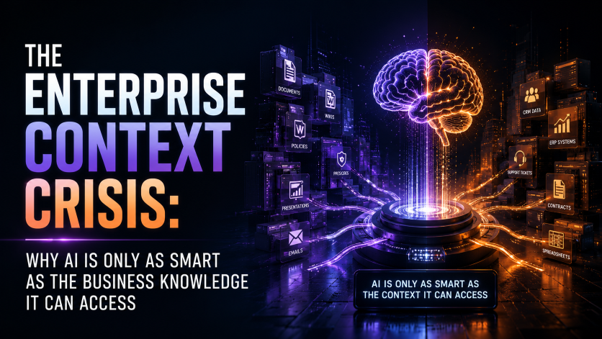
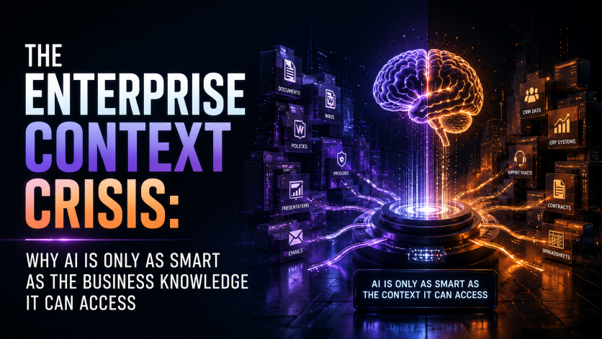
Most enterprises assume they have a data problem when, in reality, they have a context problem. Modern organizations generate massive volumes of information every day. Customer records reside in CRM platforms, financial information is stored inside ERP systems, marketing assets live in cloud storage, technical documentation exists in internal wikis, contracts remain buried inside document management systems, policies are scattered across shared drives, product specifications are maintained by engineering teams, and customer conversations are spread across emails, support tickets, meeting transcripts, and collaboration platforms. Individually, each repository contains valuable information.
Collectively, they create a fragmented knowledge landscape where no single system possesses a complete understanding of how the business actually operates. Humans compensate for this fragmentation through experience, institutional memory, and conversations with colleagues. AI systems cannot. They rely entirely on the information made available to them.
This distinction between data and context is becoming one of the most important concepts in enterprise AI. Data represents isolated facts. Context explains how those facts relate to one another within the business environment. A customer record may contain purchase history, but context explains why that customer selected certain products, which stakeholders influenced the buying decision, what contractual obligations exist, what support issues have occurred, and how the relationship has evolved over time. An AI assistant with access only to raw data may generate technically correct responses while missing the business realities that determine whether those responses are actually useful.
Why the Enterprise Context Crisis Is Limiting Enterprise AI
Many organizations encounter this problem during their earliest AI implementations. Employees ask an enterprise chatbot about company policies, customer history, technical procedures, pricing guidelines, or operational processes and receive answers that appear confident but lack critical organizational details. The issue is often misdiagnosed as an AI capability problem. In reality, the model is functioning exactly as expected. It simply lacks access to the contextual information required to produce reliable enterprise-grade decisions. The intelligence of the system is constrained not by the model’s reasoning ability but by the quality of the knowledge environment surrounding it.
This challenge becomes even more significant as businesses deploy AI agents capable of performing actions instead of merely answering questions. An AI sales assistant may recommend account strategies, an HR assistant may guide employees through organizational policies, a procurement agent may evaluate suppliers, while a customer service assistant may resolve support requests.
Each of these systems depends on understanding not only factual information but also organizational context. If the AI retrieves outdated pricing, obsolete policies, incomplete customer histories, or disconnected product documentation, its recommendations may appear reasonable while quietly introducing operational risk. The more responsibility organizations delegate to AI, the more expensive missing context becomes.
Enterprise knowledge has historically been designed for human navigation rather than machine understanding. Employees know which colleague to ask when documentation is outdated. They recognize informal processes that were never formally documented. They understand exceptions, organizational history, and unwritten rules developed through years of experience. AI systems possess none of these advantages. They interpret only what they can retrieve. Every undocumented process, inconsistent file name, missing policy update, duplicate document, or inaccessible knowledge repository becomes a blind spot for intelligent systems. Organizations therefore discover that their AI initiatives expose weaknesses that existed long before AI entered the business.
One of the most overlooked contributors to the Enterprise Context Crisis is documentation quality. Documentation has traditionally been viewed as an administrative responsibility rather than a strategic asset. Teams often prioritize execution over documentation because documenting work rarely produces immediate commercial value. Processes remain inside employees’ minds, project knowledge disappears when individuals leave, and updates are postponed because operational deadlines appear more urgent. Before AI, these shortcomings were inconvenient but manageable because experienced employees could compensate through conversations and institutional knowledge. AI changes this equation entirely. If knowledge is not documented, structured, searchable, and accessible, intelligent systems cannot use it regardless of how advanced the underlying models become.
Enterprise Context Crisis and Retrieval-Augmented Generation (RAG)
This is one reason Retrieval-Augmented Generation (RAG) has become increasingly important in enterprise AI. Rather than relying solely on information contained within pre-trained language models, RAG enables AI systems to retrieve relevant organizational knowledge before generating responses. Instead of answering from generalized internet knowledge, the AI grounds its responses in company-specific documentation, policies, technical manuals, customer records, and operational procedures. However, RAG is not a magical solution. It retrieves what exists. If enterprise knowledge is outdated, duplicated, contradictory, or poorly organized, retrieval simply delivers higher-quality access to lower-quality information. The effectiveness of RAG therefore depends directly on the maturity of an organization’s knowledge architecture.
How to Solve the Enterprise Context Crisis with AI-Ready Knowledge
Knowledge architecture is rapidly emerging as a strategic discipline rather than an IT housekeeping exercise. It involves organizing enterprise information so that both humans and AI systems can locate, understand, validate, and apply it effectively. This requires consistent documentation standards, metadata, version control, access governance, taxonomy, ownership models, and clear relationships between information sources. Without these foundations, AI implementations often become isolated productivity tools instead of enterprise intelligence platforms capable of supporting business-critical decisions.
The Enterprise Context Crisis also reveals why many organizations overestimate the value of public AI models while underestimating the importance of proprietary knowledge. Large language models possess extraordinary general intelligence because they are trained on vast amounts of publicly available information. However, every competitor can access similar foundational capabilities. Competitive advantage increasingly comes from combining those models with unique organizational knowledge. A manufacturing company possesses decades of engineering expertise. A healthcare provider maintains specialized clinical protocols. A consulting firm develops proprietary methodologies. A logistics company understands unique operational workflows. These forms of knowledge cannot simply be downloaded from the internet. They represent the organization’s intellectual capital, and they become significantly more valuable when AI can access and apply them intelligently.
This transformation also changes the role of IT departments. Historically, IT focused on infrastructure, applications, cybersecurity, networking, and system availability. AI introduces a new responsibility: enabling contextual intelligence. IT teams increasingly become custodians of enterprise knowledge infrastructure, ensuring that information flows securely across systems while remaining accessible to authorized AI applications. Success is measured not only by system uptime but also by whether intelligent systems receive accurate, current, and governed business knowledge.
Security and governance become equally critical. Enterprise context often contains sensitive customer information, confidential contracts, financial records, intellectual property, and regulated data. Organizations must balance accessibility with protection, ensuring AI retrieves appropriate knowledge without exposing confidential information to unauthorized users. Governance therefore extends beyond cybersecurity into knowledge governance, determining which information AI may access, under what conditions, and for which business purposes.
The Enterprise Context Crisis also has profound implications for organizational culture. Knowledge can no longer remain confined within departments, individual experts, or isolated systems. Collaboration increasingly depends on creating shared knowledge ecosystems rather than isolated repositories. Employees become contributors to enterprise intelligence by documenting processes, updating information, validating content, and ensuring organizational knowledge remains current. Knowledge management evolves from an administrative activity into a strategic capability supporting every AI initiative across the business.
Preparing Your Business to Overcome the Enterprise Context Crisis
Executives frequently ask how to improve AI performance through better models, larger investments, or additional automation. Increasingly, the better question is, “How well does our AI understand our business?” The answer rarely depends on computational power. It depends on whether the organization’s accumulated knowledge is discoverable, connected, accurate, and continuously maintained. Companies that neglect knowledge quality may continue purchasing increasingly sophisticated AI systems while seeing only incremental improvements because the limiting factor exists inside their own information architecture.
The future of enterprise competition may therefore depend less on who acquires the most advanced AI models and more on who builds the most intelligent knowledge ecosystem. As foundational AI models become widely available, proprietary business context becomes the true differentiator. Organizations capable of transforming decades of institutional knowledge into structured, searchable, AI-ready intelligence will enable faster decisions, more accurate automation, superior customer experiences, and stronger strategic execution than competitors relying on disconnected information.
Ultimately, the Enterprise Context Crisis reminds us that artificial intelligence does not create business understanding from nothing. It amplifies the knowledge environment in which it operates. If that environment is fragmented, AI amplifies fragmentation. If documentation is inconsistent, AI reflects inconsistency. If knowledge is current, connected, and well governed, AI becomes significantly more reliable and valuable. The future of enterprise AI will therefore be shaped not only by breakthroughs in machine intelligence but by the quality of human knowledge organizations choose to preserve, organize, and share.
Because in the next generation of business, the smartest AI will not belong to the company with the largest model. It will belong to the company whose knowledge gives that model the deepest understanding of how the business truly works.