Introduction –
For decades, B2B marketing was primarily considered a creative discipline. Organizations competed through powerful storytelling, memorable campaigns, strong brand positioning, and content that could influence buyers during their decision-making process. Marketing success was often associated with the ability to create compelling messages that captured market attention.
However, the marketing landscape has changed dramatically.
Artificial Intelligence has transformed the economics of content creation. Businesses can now generate articles, email campaigns, social media posts, videos, product descriptions, sales presentations, and personalized customer communications faster than ever before. Tasks that previously required weeks of planning and multiple teams can now be accelerated with AI-powered tools.
While this advancement has created enormous opportunities, it has also introduced a new challenge: content is no longer scarce, but customer attention is.
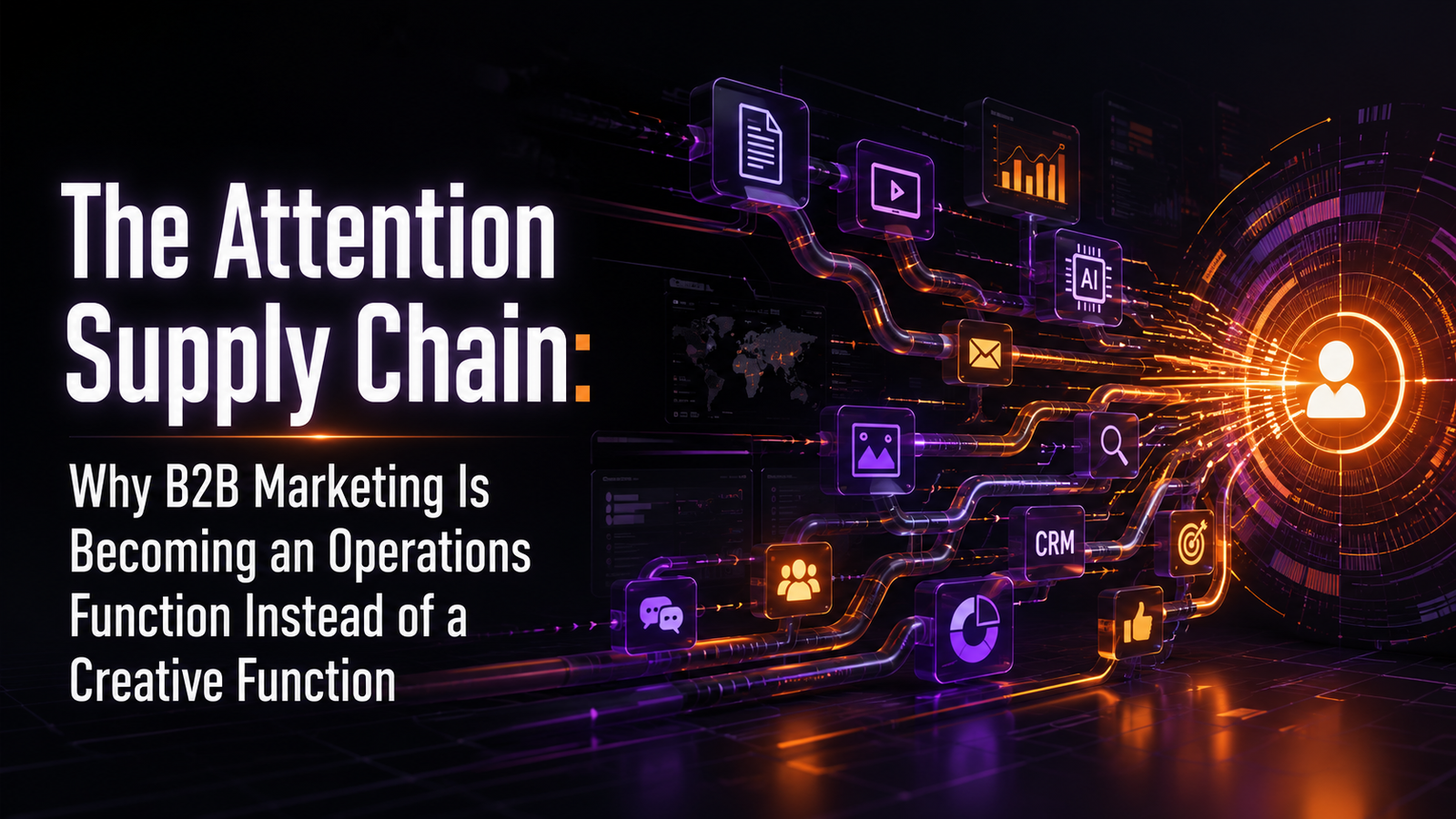
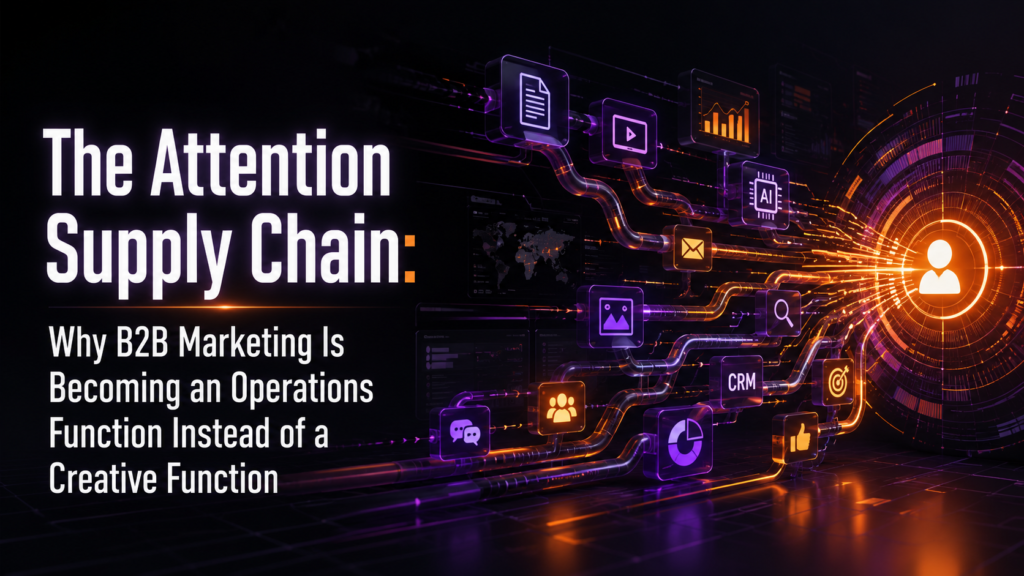
The Attention Supply Chain is becoming a critical framework for understanding how B2B marketing is evolving in the AI era. For decades, marketing success was largely measured by creativity, campaign ideas, and the ability to produce compelling content. However, as artificial intelligence makes content creation faster and more accessible, the biggest challenge for businesses is no longer producing information—it is managing how that information reaches the right audience at the right time.
Today, B2B organizations compete in an environment where customer attention is limited, buyer journeys are fragmented, and digital channels continue expanding. The companies that succeed will not simply be those creating more content, but those that build efficient systems to distribute, personalize, and optimize content throughout the customer journey.
The Attention Supply Chain represents this shift from marketing as a creative production function toward marketing as an operational discipline. It combines AI, automation, analytics, content strategy, and customer intelligence to ensure valuable information moves effectively across every stage of the buying process.
How intelligent systems are helping B2B organizations improve efficiency, personalization, and customer engagement.
AI-Powered Marketing Operations: The New Growth Engine
Artificial intelligence is changing the role of marketing from a content-producing function into a data-driven operational engine. By combining AI, automation, and analytics, businesses can better understand buyer behavior, optimize customer journeys, and deliver more relevant experiences at scale.
The End of Content Scarcity Has Changed Marketing Forever –
For many years, producing high-quality marketing content required significant investment. Organizations relied on specialized writers, designers, agencies, video teams, and marketing professionals to create campaigns that could stand out in competitive markets.
Because content production was expensive and time-consuming, companies carefully selected which assets to create and where to invest their marketing resources.
Artificial Intelligence has changed this model completely.
Today, AI-powered platforms can help businesses create professional marketing assets within minutes. A small marketing team can produce more content in a week than some organizations could produce in an entire month a few years ago.
This creates a new reality where content volume is increasing rapidly across every industry.
The challenge is no longer creating information. The challenge is making sure that information reaches the right audience, builds trust, and contributes to business outcomes.
The biggest changes caused by AI-driven content creation include:
- Content production has become faster, cheaper, and accessible to organizations of all sizes.
- Businesses can create multiple formats, including articles, videos, emails, and sales materials.
- The amount of digital content competing for buyer attention continues to increase.
- High-quality content alone is no longer enough to create differentiation.
- Marketing advantage is shifting from content creation toward distribution and optimization.
Organizations that continue focusing only on producing more content risk becoming part of the noise. The companies that succeed will be those that build systems capable of delivering relevant content consistently across every customer interaction.
Why the Attention Supply Chain Matters for Modern B2B Growth
The Attention Supply Chain has become increasingly important as B2B buyers navigate a growing number of digital touchpoints before making purchasing decisions. Unlike traditional marketing models that focused primarily on campaigns and content creation, the Attention Supply Chain focuses on how effectively organizations move information from creation to customer engagement.
In today’s environment, businesses must ensure that every piece of content reaches the right audience, through the right channel, at the right moment. This requires a combination of AI-powered automation, marketing operations, customer intelligence, and continuous optimization.
Why Customer Attention Has Become the New Competitive Advantage –
The modern B2B buyer journey is more complex than ever before.
In the past, buyers often depended heavily on sales representatives for product information and guidance. Today, most decision-makers complete significant research independently before engaging with vendors.
They search online, read industry discussions, compare solutions, watch demonstrations, review customer experiences, and use AI-powered tools to understand available options.
This means marketing influence begins much earlier than the traditional sales conversation.
A potential customer may discover a company through search, follow its executives on LinkedIn, attend a webinar several weeks later, download a technical guide, and eventually contact sales after building confidence through multiple interactions.
Every touchpoint contributes to the buying decision.
This creates a major challenge for B2B organizations: maintaining relevance throughout a fragmented customer journey.
Modern marketing teams must understand that:
- Buyers interact with brands across multiple digital channels before purchasing.
- A single campaign rarely determines a complex B2B buying decision.
- Customer trust is built through repeated, valuable interactions.
- Marketing must support the entire buying journey, not just lead generation.
- Consistent visibility is becoming more important than one-time campaign success.
The organizations that understand how to capture and maintain attention will have a significant advantage in competitive markets.
The Rise of AI-Powered B2B Marketing Operations –
The future of B2B marketing operations is being shaped by artificial intelligence, automation, and data-driven decision-making. As businesses adopt more advanced technologies, marketing teams are moving away from traditional campaign execution and building scalable AI-powered marketing systems that improve efficiency, personalization, and customer engagement.
Modern organizations are using AI in B2B marketing to analyze customer behavior, identify buying signals, automate workflows, personalize communication, and optimize content performance. However, the real value of AI comes from integrating these capabilities into a broader marketing operations strategy that connects people, processes, technology, and customer data.
A successful AI-driven marketing ecosystem helps businesses:
- Improve customer journey optimization across multiple touchpoints.
- Deliver personalized experiences based on buyer intent and behavior.
- Automate repetitive marketing tasks while maintaining quality.
- Connect marketing activities with measurable revenue outcomes.
- Create scalable processes for enterprise growth.
As competition for customer attention increases, businesses must focus not only on creating content but also on developing efficient systems for managing and distributing that content.
Why modern B2B marketing is shifting from content creation to intelligent operations –
The Attention Supply Chain
As AI makes content creation faster and more accessible, the biggest challenge for businesses is no longer producing more content. The real advantage comes from building smarter systems that distribute, personalize, and optimize content across every stage of the customer journey.
Marketing Operations Is Becoming a Strategic Growth Function –
Historically, Marketing Operations was viewed as a technical support area responsible for managing tools, reporting dashboards, CRM systems, and campaign processes.
That role has changed significantly.
As organizations adopt more marketing technologies and AI platforms, operational complexity has increased. Companies now manage multiple systems for customer data, automation, analytics, content management, personalization, and sales collaboration.
Without proper operational management, these tools can create disconnected customer experiences instead of improving them.
Modern Marketing Operations helps organizations build a structured approach to managing customer attention.
It enables companies to:
- Connect customer data across different marketing and sales platforms.
- Automate repetitive processes and improve campaign efficiency.
- Create personalized experiences based on customer behavior.
- Measure which activities influence revenue outcomes.
How B2B Marketing Is Evolving: From Campaign Execution to Attention Management –
| Traditional B2B Marketing | Attention Supply Chain Model |
|---|---|
| Focuses mainly on creating campaigns and producing more content | Focuses on managing how content reaches, engages, and influences buyers |
| Success is measured through impressions, clicks, and lead volume | Success is measured through engagement quality, buyer intent, and revenue impact |
| Marketing activities often operate in separate channels | Connects content, data, technology, automation, and customer experiences |
| Relies heavily on manual campaign execution | Uses AI, automation, and analytics to improve efficiency |
| Content is often treated as a one-time campaign asset | Content becomes reusable business intelligence that generates value over time |
| Teams focus on visibility and reach | Teams focus on delivering the right |
Insight: The shift from traditional marketing to an Attention Supply Chain model shows that B2B success is no longer defined by how much content a company creates, but by how effectively it manages content flow, customer engagement, and measurable business outcomes.
The Shift From Campaign Management to Customer Experience Management –
Traditional marketing was often organized around campaigns.
A team would create an initiative, launch it, measure performance, and move on to the next activity.
However, modern B2B buying journeys do not operate in campaign cycles. Buyers continuously interact with brands through multiple channels, making customer experience management more important than individual campaign performance.
Marketing leaders must now think about the entire ecosystem:
- How customers discover information.
- How they evaluate solutions.
- How they build trust.
- How they engage with sales teams.
- How they continue interacting after purchase.
This requires marketing teams to operate more like experience architects, designing systems that guide customers through complex decision-making processes.
The future of B2B marketing will belong to organizations that combine creative thinking with operational discipline.
Building the Future of B2B Marketing With Operational Intelligence –
The future of B2B marketing will not be defined by organizations that produce the largest volume of content.
It will be defined by organizations that understand how to manage attention as a strategic business resource.
Artificial Intelligence will continue improving content creation, automation, personalization, and analytics. But technology alone will not create competitive advantage.
The winners will be companies that combine:
- Creative thinking with operational systems.
- AI capabilities with human expertise.
- Data insights with customer understanding.
- Content production with intelligent distribution.
The Attention Supply Chain represents this new approach to marketing. It recognizes that customer attention must be managed with the same discipline businesses apply to financial resources, operational processes, and supply networks.
Conclusion –
The evolution of B2B marketing does not mean creativity is becoming less important.
Creative ideas remain the foundation of meaningful communication. Strong storytelling, original thinking, and unique perspectives will always help brands stand apart.
However, creativity alone is no longer enough.
In an AI-driven world where every organization can produce content quickly, competitive advantage comes from the systems behind that content. The ability to distribute information effectively, personalize experiences, optimize customer journeys, and measure impact will determine which companies earn attention and which ones disappear into digital noise.
The future of marketing belongs to organizations that build intelligent attention supply chains—systems capable of transforming ideas into measurable customer engagement and long-term business growth.
Frequently Asked Questions (FAQs)
An Attention Supply Chain is a modern marketing framework that focuses on how businesses create, distribute, personalize, and optimize content to capture customer attention throughout the buying journey. It treats customer attention as a strategic resource that requires efficient processes, technology, and measurement.
B2B marketing is becoming more operational because businesses now compete in a highly fragmented digital environment. With AI making content creation faster and easier, the competitive advantage is shifting toward managing distribution, automation, customer data, analytics, and personalized experiences effectively.
AI is transforming B2B marketing by enabling faster content creation, predictive analytics, personalization, campaign automation, customer segmentation, and improved buyer insights. However, organizations need strong marketing operations to turn AI capabilities into measurable business results.
SEO (Search Engine Optimization) focuses on improving visibility in traditional search engines by optimizing content for rankings and organic traffic. AEO (Answer Engine Optimization) focuses on making content easier for AI-powered search systems and assistants to understand, summarize, and recommend.
Customer attention is becoming more valuable because buyers are exposed to increasing amounts of information across search engines, social media, AI platforms, webinars, communities, and digital channels. Companies that can effectively capture and maintain attention have a stronger opportunity to influence purchasing decisions.