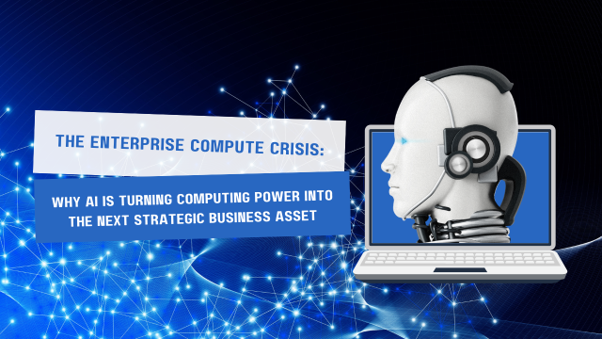
Enterprise Compute Crisis is rapidly becoming one of the biggest challenges facing modern businesses as artificial intelligence transforms computing power into a strategic business asset. For most of the digital era, computing power was treated as an invisible utility. Enterprises invested in servers, expanded cloud infrastructure, upgraded processors, and negotiated contracts with cloud providers, but computing capacity itself was rarely viewed as a competitive differentiator. Today, the explosive growth of generative AI, large language models, autonomous agents, and enterprise automation has fundamentally changed that reality. Organizations are discovering that access to computing power is no longer just an IT concern—it is a critical factor that determines innovation, scalability, and long-term business success.
Artificial intelligence has introduced a completely different demand profile for enterprise infrastructure. Traditional business applications processed transactions, stored records, generated reports, and supported communication. While these systems required reliable infrastructure, their resource consumption remained relatively predictable. AI operates under entirely different conditions. Training advanced models requires enormous computational resources measured across thousands of GPUs operating continuously for weeks or months.
Even inference, the process of generating responses after a model has been trained, demands substantial computing capacity when deployed across millions of users or integrated into enterprise workflows. Every AI-powered customer interaction, predictive analysis, document summary, recommendation engine, code generation request, or autonomous business process consumes computational resources that accumulate rapidly across an organization. As enterprises integrate AI into nearly every department, computing power transitions from an operational expense into a strategic growth constraint.
The consequences of this shift are already becoming visible across industries. Organizations frequently assume that purchasing AI software is sufficient to become AI-enabled, only to discover that the underlying infrastructure cannot support enterprise-scale deployment. Pilot projects demonstrate impressive results, yet broader implementation stalls because inference costs rise unexpectedly, cloud bills multiply, latency increases, and infrastructure teams struggle to allocate sufficient GPU resources across competing business initiatives. Companies discover that AI ambition grows significantly faster than compute availability. This mismatch creates a new organizational bottleneck where innovation is limited not by ideas or talent, but by computational capacity.
One of the defining characteristics of the Enterprise Compute Crisis is scarcity. Unlike traditional cloud resources that can often be provisioned relatively quickly, advanced AI hardware remains constrained by manufacturing capacity, semiconductor supply chains, energy availability, cooling infrastructure, and global demand. High-performance GPUs have become among the most sought-after technological assets in the world, with enterprises, hyperscalers, research institutions, governments, and start-ups competing for limited supply. Access to computational infrastructure increasingly resembles access to strategic natural resources. Organizations capable of securing reliable compute capacity gain significant advantages in AI experimentation, product development, and operational efficiency, while competitors face delays regardless of their technical expertise.
This scarcity has profound implications for enterprise strategy. Historically, competitive differentiation centred around proprietary software, intellectual property, customer relationships, or market positioning. Increasingly, executives must also consider questions that previously belonged exclusively to IT departments. Should AI workloads remain entirely in the public cloud, or should organizations invest in private GPU clusters? Does building proprietary infrastructure provide long-term competitive advantages despite higher capital expenditure? Which AI workloads justify premium compute allocation, and which can operate on lower-cost infrastructure? How should computing resources be distributed across research, product development, customer support, marketing, finance, and operations? These questions are no longer technical implementation details. They are strategic business decisions directly influencing innovation capacity.
What Is the Enterprise Compute Crisis?
As the Enterprise Compute Crisis grows, businesses must treat compute budgets as strategic investments rather than operational expenses.The financial implications are equally transformative. For decades, organizations managed budgets around employees, facilities, software licenses, and operational expenses. AI introduces a new category of resource planning where compute becomes a measurable business asset requiring continuous optimization. Just as financial leaders monitor cash flow and procurement teams manage supply chains, technology leaders increasingly monitor GPU utilization, inference efficiency, workload prioritization, and computational return on investment. Enterprises may soon treat compute budgets with the same level of scrutiny traditionally reserved for financial budgets because every AI initiative ultimately competes for finite computational resources.
Energy efficiency is becoming an essential part of overcoming the Enterprise Compute Crisis.Energy consumption introduces another critical dimension that many organizations underestimate. Computing power does not exist independently of physical infrastructure. Large-scale AI deployments require substantial electricity, advanced cooling systems, resilient data centre architectures, and increasingly sophisticated energy management strategies. As AI adoption accelerates globally, energy availability itself becomes part of enterprise competitiveness. Organizations operating highly efficient AI infrastructure gain economic advantages not only through lower operating costs but also through greater deployment flexibility. Sustainability initiatives, once viewed primarily through environmental lenses, increasingly intersect with AI strategy because computational efficiency directly influences both profitability and environmental impact.
Why the Enterprise Compute Crisis Is Reshaping AI Infrastructure
The Enterprise Compute Crisis also reshapes software development. Engineers can no longer assume unlimited computational resources when designing AI-enabled applications. Optimization becomes a strategic capability rather than merely an engineering best practice. Smaller models, intelligent routing systems, model compression techniques, retrieval-augmented generation, efficient inference pipelines, and workload scheduling all become essential components of enterprise AI architecture. Businesses capable of delivering equivalent business outcomes using significantly less compute achieve meaningful competitive advantages through lower operational costs, faster response times, and greater scalability. In the AI economy, computational efficiency becomes as valuable as algorithmic intelligence.
Organizations that successfully address the Enterprise Compute Crisis through workload optimization gain significant competitive advantages.Perhaps the most significant organizational change emerging from this trend is the growing collaboration between finance and technology leadership. Traditionally, infrastructure investments were evaluated primarily through technical metrics such as uptime, availability, storage capacity, and system performance. AI infrastructure requires broader evaluation frameworks incorporating business productivity, innovation velocity, revenue generation, customer experience, operational resilience, and competitive positioning. Chief Financial Officers increasingly participate in conversations about GPU procurement, cloud optimization, infrastructure amortization, and AI return on investment because computing capacity directly influences future business growth rather than merely supporting existing operations.
The emergence of specialized disciplines such as FinOps has already demonstrated the importance of managing cloud expenditure strategically. The AI era may soon give rise to an equally important operational discipline focused specifically on computational governance. Enterprises will require dedicated capabilities responsible for monitoring compute allocation, forecasting infrastructure demand, optimizing inference costs, balancing AI workloads, and ensuring that computational resources align with business priorities. This evolution reflects a broader reality that computing power is transitioning from a technical resource into an enterprise resource requiring executive oversight.
Enterprise Compute Crisis and the Growing Demand for GPU Infrastructure
The geopolitical implications extend even further. Governments increasingly recognize semiconductor manufacturing, AI infrastructure, and computational capacity as matters of national competitiveness. Investments in domestic chip manufacturing, sovereign AI initiatives, advanced data centres, and digital infrastructure demonstrate that compute has become a strategic asset not only for corporations but also for entire economies. Enterprises operating globally must therefore navigate supply chain uncertainties, regional infrastructure limitations, regulatory considerations, and geopolitical risks that directly influence their long-term AI capabilities.
Forward-looking organizations are already responding by treating compute strategy as an integral component of corporate strategy rather than an extension of IT planning. They evaluate AI projects based not only on business value but also on computational sustainability. Infrastructure roadmaps evolve alongside product roadmaps. AI governance includes resource allocation policies. Leadership discussions increasingly consider computational capacity when evaluating future acquisitions, partnerships, product launches, and digital transformation initiatives. These organizations understand that AI leadership cannot be achieved through software adoption alone. It requires deliberate investment in the infrastructure capable of sustaining intelligent operations at scale.
How Enterprises Can Overcome the Enterprise Compute Crisis
The Enterprise Compute Crisis ultimately challenges one of the most deeply held assumptions in enterprise technology, that computing power is infinitely available whenever organizations require it. In reality, AI has transformed compute into a finite, valuable, and strategically significant resource whose availability increasingly determines the pace of innovation. Businesses may possess exceptional talent, sophisticated algorithms, comprehensive datasets, and ambitious AI strategies, yet still struggle if they lack sufficient computational capacity to operationalize those advantages.
Enterprise Compute Crisis: The Future of AI-Powered Business
The Enterprise Compute Crisis is no longer an emerging trend—it is a defining business challenge. Companies that recognize computing power as a strategic asset will be better positioned to innovate, scale AI initiatives, and remain competitive in the AI-driven economy.
As artificial intelligence becomes embedded across every business function, the companies that lead tomorrow’s economy will not necessarily be those with the most advanced models or the largest technology budgets. They will be the organizations that recognize computing power for what it has become: not merely an IT resource, but one of the defining strategic assets of the AI age.