Introduction: The Shift From Product Evaluation to Trust Evaluation –
For decades, enterprise sales revolved around a relatively straightforward assumption: buyers first evaluated whether a product could solve their business problem and only later determined whether they trusted the company behind it. Demonstrations, feature comparisons, technical specifications, implementation plans, and pricing discussions formed the foundation of the buying process, while credibility was established gradually through meetings, references, and negotiations. This sequence reflected an era when access to information was limited and vendors controlled much of the knowledge surrounding their own products. Today, that buying journey has fundamentally reversed. Enterprise buyers often form strong opinions about a company long before engaging with its sales team.
The Evolution of the Modern Enterprise Buying Journey –
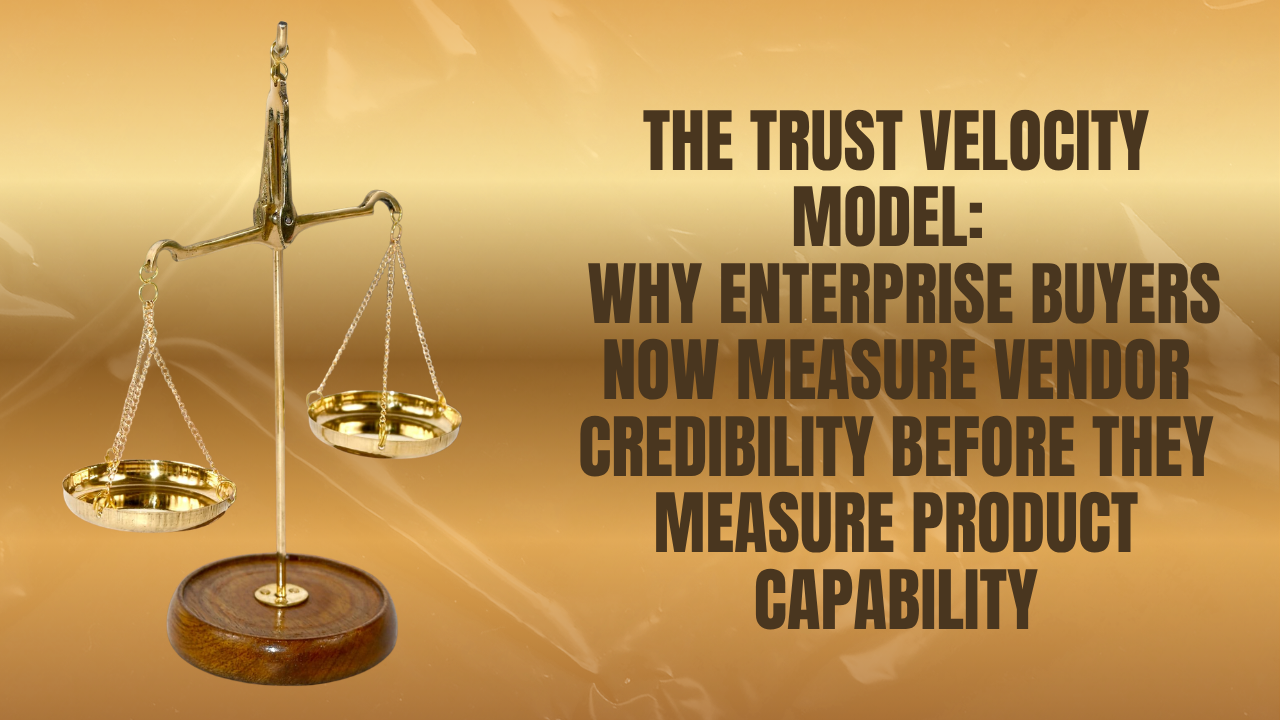
They study executive thought leadership, analyse customer reviews, explore industry discussions, evaluate digital presence, compare analyst opinions, examine employee sentiment, and increasingly rely on artificial intelligence to summarize everything they discover. By the time a first meeting is scheduled, buyers frequently possess a well-developed perception of whether a vendor deserves consideration at all. Product capability still matters enormously, but credibility increasingly determines whether that capability is ever evaluated. This transformation marks the emergence of what can be described as the Trust Velocity Model, where the speed at which organizations establish trust becomes one of the strongest predictors of enterprise growth.
One of the defining characteristics of modern B2B buying is the extraordinary amount of independent research conducted before vendor interaction begins. Procurement teams no longer depend exclusively on product brochures, sales presentations, or corporate websites to understand potential suppliers. Decision-makers consume executive interviews, conference presentations, customer case studies, community discussions, technical documentation, implementation experiences, analyst research, and third-party reviews across numerous digital channels. Artificial intelligence accelerates this process by consolidating vast amounts of publicly available information into concise business recommendations. Buyers therefore arrive at vendor conversations having already developed expectations regarding competence, reliability, innovation, customer experience, and strategic alignment. The traditional first impression no longer occurs during the initial meeting. It occurs across the digital ecosystem months before direct contact.
Why Enterprise Buyers Research Vendors Before Sales Conversations –
This shift fundamentally changes the economics of enterprise sales. Historically, vendors invested heavily in demonstrating product superiority because information asymmetry favoured suppliers. Customers required vendors to explain technical capabilities, market positioning, implementation requirements, and business value. AI has dramatically reduced this information imbalance. Buyers can independently compare products, evaluate architectures, understand industry terminology, and analyse competitor positioning within minutes. Product knowledge is becoming increasingly accessible, making it progressively more difficult to differentiate through features alone. Trust, however, cannot be downloaded, summarized, or automated in the same way. It develops through consistent organizational behaviour, transparent communication, demonstrated expertise, and measurable customer outcomes. Consequently, trust becomes one of the few competitive advantages that cannot be easily replicated by technology.
The Trust Velocity Model recognizes that enterprise buyers increasingly seek confidence before they seek capability. Every significant business investment carries financial, operational, strategic, and reputational risk. Decision-makers therefore ask questions extending far beyond product functionality. Can this vendor execute consistently? Will leadership remain committed after implementation? Does the organization genuinely understand our industry? Can we depend upon their customer support? Are they financially stable? Do other enterprises trust them? These questions influence purchasing decisions because enterprise technology investments often affect multiple departments, executive priorities, regulatory obligations, and long-term business transformation. Buyers are not merely selecting software or services. They are selecting long-term business partners whose performance directly influences organizational success.
How AI Is Transforming B2B Buyer Research and Decision-Making –
Executive branding has consequently become one of the most influential drivers of enterprise trust. Buyers increasingly evaluate leadership visibility as an indicator of organizational maturity and strategic direction. CEOs, founders, product leaders, and subject matter experts who consistently publish original perspectives, participate in industry discussions, contribute meaningful research, and openly discuss market evolution establish credibility that extends beyond corporate marketing campaigns. Their public expertise reassures buyers that the organization possesses genuine intellectual leadership rather than relying solely on promotional messaging. Executive thought leadership therefore becomes a strategic business asset because it accelerates organizational trust before commercial conversations begin.
Customer experience contributes equally to trust velocity. Modern buyers rarely rely on isolated testimonials selected by vendors themselves. Instead, they evaluate patterns across customer reviews, implementation stories, public discussions, analyst commentary, conference presentations, and peer recommendations. AI increasingly synthesizes these signals into overall assessments of vendor reliability, making customer success visible far beyond individual accounts. Every successful implementation strengthens future sales opportunities because customer outcomes become part of the organization’s publicly observable reputation. Businesses no longer create trust exclusively through marketing. They create trust operationally through consistently delivering customer value.
Transparency also becomes increasingly valuable within this environment. Traditional sales strategies occasionally attempted to minimize discussions regarding implementation challenges, product limitations, or organizational risks in order to maintain commercial momentum. Enterprise buyers today often interpret excessive optimism as a warning sign rather than a persuasive technique. Vendors who openly discuss deployment complexity, integration considerations, change management requirements, and realistic implementation timelines frequently establish greater credibility than competitors presenting unrealistically perfect scenarios. Transparency reduces uncertainty because it demonstrates confidence rather than concealment. Buyers increasingly trust organizations willing to discuss imperfections honestly while explaining how those challenges are effectively managed.
Artificial intelligence further amplifies the importance of trust because intelligent systems evaluate consistency across countless public sources simultaneously. A company’s website, executive interviews, product documentation, customer feedback, analyst reports, employee commentary, regulatory disclosures, media coverage, and social presence collectively influence how AI interprets organizational credibility. Inconsistencies between these sources reduce confidence in the vendor’s reliability, while coherent messaging reinforced by independent validation strengthens digital reputation. Trust therefore extends beyond human perception into machine interpretation, influencing how AI assistants recommend vendors during early-stage buying research.
Marketing strategies naturally evolve alongside this transformation. Traditional demand generation focused heavily on attracting leads through campaigns, content, advertising, and search optimization. The Trust Velocity Model encourages organizations to think beyond lead generation toward credibility generation. Original research, proprietary frameworks, customer education, transparent communication, industry collaboration, executive visibility, community participation, and measurable customer success all become essential marketing investments because they contribute directly to organizational trust. The objective shifts from generating attention to generating confidence. Visibility may attract interest, but credibility determines whether buyers remain engaged.
Sales organizations also adjust their priorities. High-performing sales teams increasingly spend less time attempting to convince skeptical buyers and more time reinforcing confidence that already exists. Conversations become more consultative because much of the product education has already occurred independently. Representatives focus on understanding organizational objectives, facilitating stakeholder alignment, addressing implementation concerns, and validating strategic fit rather than delivering highly scripted product presentations. Sales cycles become more productive because trust shortens evaluation rather than persuasion.
The implications extend well beyond revenue generation. Trust influences recruitment, investor confidence, partnership development, customer retention, media visibility, and long-term brand equity. Organizations recognized for consistent credibility attract stronger employees, establish deeper strategic alliances, experience higher customer advocacy, and recover more effectively during periods of market uncertainty. Trust therefore evolves from a sales outcome into a core enterprise capability influencing every aspect of organizational performance.
Looking ahead, enterprise buying will continue becoming increasingly digital, AI-assisted, and independently researched. Buyers will engage vendors later in the purchasing process because intelligent systems will complete much of the early evaluation automatically. Organizations unable to establish trust before direct interaction may never enter meaningful buying conversations regardless of product quality. Competitive advantage will increasingly belong to businesses that invest continuously in credibility rather than attempting to build trust only during active sales opportunities.
Ultimately, the Trust Velocity Model represents one of the most important shifts in modern B2B strategy. Enterprise buyers no longer separate organizational reputation from product evaluation because both influence investment decisions simultaneously. The companies that dominate future markets will not necessarily possess the most advanced products or the largest sales teams. They will be the organizations that earn confidence faster than competitors, because in an economy where every product can be researched instantly, trust becomes the only advantage that compounds before the first conversation ever begins.
Conclusion –
Trust Is the New Competitive Advantage in Enterprise Sales
Enterprise buying has entered a new era where credibility matters as much as capability. Buyers no longer evaluate products in isolation; they evaluate the organizations behind them, their expertise, customer success, transparency, and ability to deliver long-term value.
As AI continues to accelerate research and decision-making, organizations must build trust before the first sales conversation begins. Companies that consistently demonstrate expertise, deliver strong customer outcomes, and maintain transparent communication will create stronger relationships and competitive advantages.