For decades, B2B companies were taught that the strongest competitive advantage was the product. Build something better, faster, cheaper, or more innovative, and the market would eventually notice. Product differentiation still matters, but the economics of competition are changing. Technology is easier to access, software development is moving faster, and AI is accelerating product creation. As a result, competitors can increasingly replicate features and capabilities that once required years of engineering.
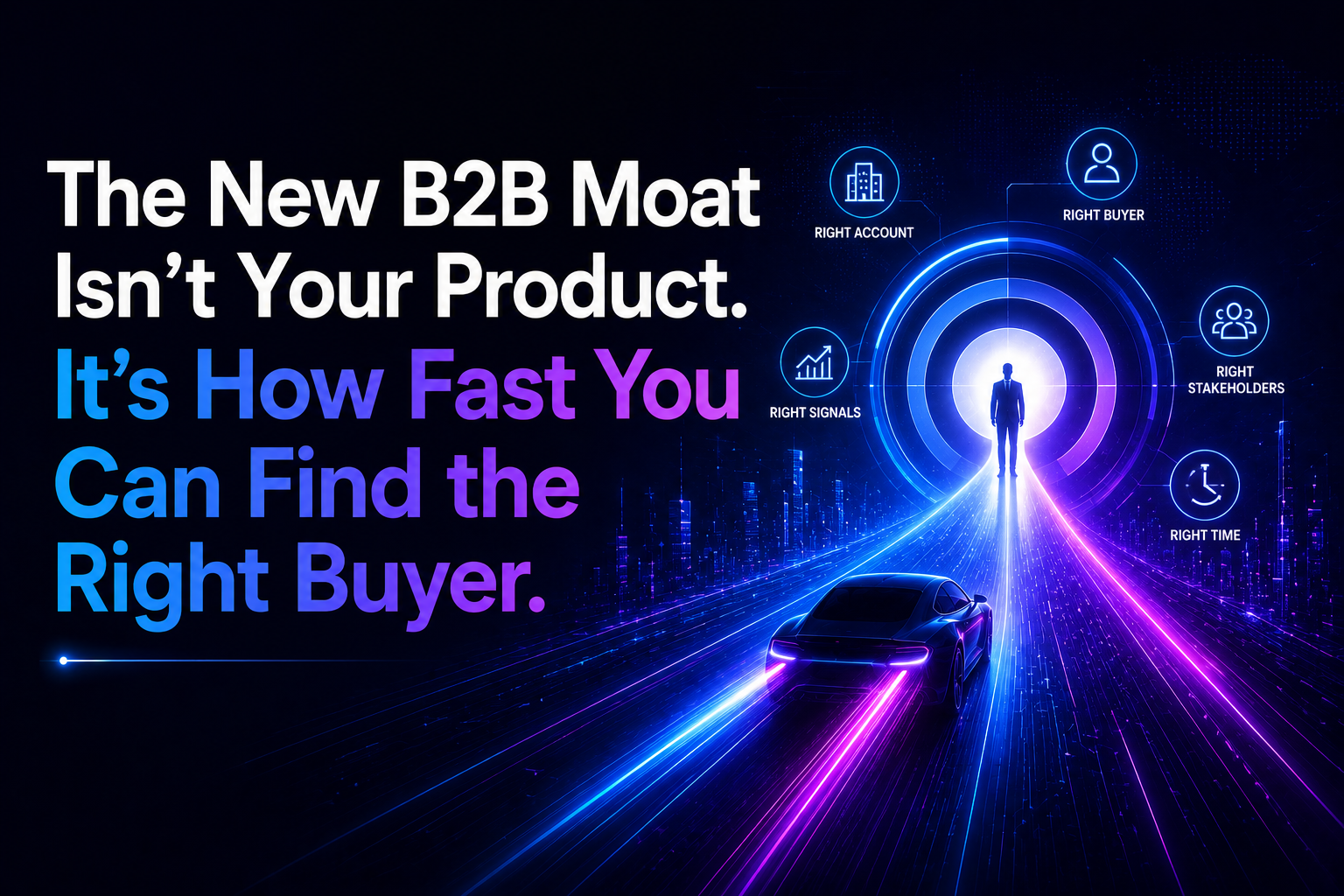
What is becoming harder to replicate is something less visible: the ability to identify the right accounts, find the right decision-makers, recognize the right buying moment, and create a meaningful conversation before competitors do. In other words, the next B2B moat may not simply be what a company sells. It may be how quickly and intelligently it can connect what it sells with organizations that need it.
Speed to Buyer is becoming a critical B2B growth capability because it determines how quickly a company can move from identifying a potential market opportunity to creating relevant engagement with the people who influence the purchase.
Why Speed to Buyer Is Becoming a Competitive Advantage
A product can be copied. A feature can be matched. Pricing can be challenged. Marketing campaigns can be imitated. Even an AI capability that looks revolutionary today can eventually become a standard feature across competing platforms.
But a company’s accumulated understanding of its market can become considerably more difficult to reproduce.
Over time, organizations can build knowledge around:
- Which accounts are strategically important
- Which industries are increasing investment
- Which business events create demand
- Which decision-makers influence specific purchases
- Which buying signals correlate with successful opportunities
- Which accounts resemble existing customers
- Which sales approaches generate meaningful engagement
That intelligence can create an advantage because it enables a company to act earlier.
Consider two companies selling essentially the same enterprise technology solution. Both have strong products, experienced sales teams, and competitive pricing.
The first company waits for prospects to enter its funnel. A buyer fills out a form, downloads content, attends a webinar, or responds to an email. The sales team then begins researching the account and determining whether there is a genuine opportunity.
The second company continuously monitors its target market. When a target account announces an expansion, appoints a new executive, enters a new geography, launches a product, acquires another business, or significantly increases hiring, the company evaluates whether that change could create demand for its solution.
By the time the first company sees a lead, the second may already understand the account and the business context surrounding the potential purchase.
The second company has not necessarily built a better product.
It has built a better path to the buyer. A strong Speed to Buyer strategy allows revenue teams to move beyond reactive lead generation and focus on emerging opportunities. Instead of waiting until an account enters the pipeline, organizations can use account intelligence and business signals to identify where demand may be developing.
1. Speed to Buyer Starts With Market Intelligence
Traditional lead generation generally starts with a person becoming visible.
Someone fills out a form. Someone downloads an asset. Someone registers for an event. Someone clicks an email.
That individual becomes a lead, and the organization works backward to determine whether a commercial opportunity exists.
The problem is that complex B2B buying rarely begins with a form submission. Buyers may research vendors, discuss problems internally, evaluate technologies, build business cases, and involve multiple stakeholders before a formal opportunity appears in a CRM.
By the time the lead becomes visible, much of the buying journey may already be underway.
A more proactive approach starts with the market.
Instead of asking only, “Who has raised their hand?”, revenue teams can ask:
- Which accounts fit our strategic direction?
- Which target accounts are changing?
- What has changed?
- Does that change create a potential business problem?
- Who is likely to influence the response?
- Is this account becoming more commercially relevant right now?
This shift turns market intelligence from a research activity into a revenue capability. Speed to Buyer starts with knowing which accounts deserve attention before they become obvious prospects. Market intelligence gives sales and marketing teams the context needed to prioritize accounts based on business changes, strategic relevance, and potential demand.
Why Account-Level Intelligence Matters
Account-level intelligence provides context that individual lead records cannot.
For example, a technology company may know that an executive at a target organization visited its website. That is useful, but the signal becomes more meaningful when combined with other information.
Perhaps the organization has also expanded into a new region, hired a new technology leader, increased its workforce, and launched a related business initiative.
Each signal may be modest on its own. Together, they can provide a stronger hypothesis about where the business is heading.
That is where Speed to Buyer becomes more than speed. It becomes informed speed.
2. Identify Buyer Signals Before the Buying Process Becomes Obvious
B2B buyers rarely make complex purchasing decisions without some preceding event or business change. These signals are central to Speed to Buyer because they can help revenue teams recognize potential demand before a formal buying process begins. The goal is not to assume that every business event represents an opportunity, but to identify changes that deserve further investigation.
Demand can emerge from many situations, including:
- Geographic expansion
- Leadership changes
- Mergers and acquisitions
- New product launches
- Increased hiring
- Technology adoption
- Organizational restructuring
- New strategic initiatives
- Business growth
- Increased investment in a particular function
These events do not automatically mean a company is ready to buy. They are signals that require interpretation.
The key is to determine which signals are relevant to a specific product or service.
For example, an enterprise cybersecurity provider may care about technology transformation, geographic expansion, regulatory changes, or organizational growth. A workforce technology provider may care more about hiring, geographic expansion, restructuring, and workforce complexity.
The same business event can therefore have very different commercial significance depending on what a company sells.
From Signals to Commercial Hypotheses
The objective should not be to react mechanically to every signal.
Instead, revenue teams can build a hypothesis:
Business event → potential challenge → relevant stakeholder → useful conversation
That approach makes outreach more contextual.
Rather than saying, “We noticed your company is growing,” a seller can develop a more informed perspective around the operational challenges that growth could create.
That is the difference between detecting a signal and understanding its commercial meaning.
3. Build a Strong Data Foundation for Speed to Buyer
Speed depends on data.
But having more data is not necessarily the answer. What matters is having accurate, relevant, connected data. Without reliable data, Speed to Buyer becomes difficult to achieve at scale. Sales teams may identify the right account but struggle to find the right stakeholder. Marketing may recognize a target account but lack the information required to personalize engagement. AI may identify a signal but produce an inaccurate recommendation.
Sales representatives cannot move quickly if they spend hours determining whether contacts still work at a company.
Marketing teams cannot execute precise ABM programs if account records are incomplete.
AI systems cannot reliably prioritize opportunities if the underlying data is outdated.
Revenue leaders cannot respond quickly to market changes if those changes are discovered weeks after they occur.
A modern B2B data environment should ideally connect information about:
- Companies and accounts
- Contacts and decision-makers
- Job functions and seniority
- Organizational structures
- Industries
- Locations and markets
- Technologies
- Business events
- Engagement activity
- Historical sales outcomes
The objective is to move beyond a static database toward an environment that helps revenue teams understand which accounts matter now and why.
Data Quality Is a Revenue Issue
Data quality is often treated as an operational or technical responsibility.
Increasingly, it is a commercial issue.
Bad data creates wasted sales capacity. It can result in incorrect personalization, irrelevant campaigns, missed stakeholders, duplicated outreach, and poor AI recommendations.
In contrast, reliable data allows teams to spend more time on judgment, relationships, and conversations rather than manual research.
4. Use AI to Accelerate Speed to Buyer
AI is changing how revenue organizations research and prioritize accounts. AI can significantly accelerate Speed to Buyer by helping revenue teams research accounts, identify stakeholders, analyze signals, and prioritize potential opportunities. But automation should increase the quality and speed of decision-making rather than remove human judgment from the process.
It can help teams:
- Research companies
- Summarize account information
- Identify relevant contacts
- Analyze engagement
- Detect patterns
- Compare accounts with successful customers
- Surface potential buying signals
- Generate account research
- Recommend potential next actions
This dramatically increases the volume of information that revenue teams can process.
But there is an important limitation.
Speed without accuracy simply produces mistakes faster.
An AI system that identifies the wrong buyer more quickly is not necessarily improving productivity. An automated system that sends irrelevant messages at scale can damage the customer experience rather than improve it.
The strongest model combines three capabilities:
AI speed + reliable data + human judgment
AI can monitor thousands of accounts consistently. Humans can determine whether a signal actually matters, whether engagement is appropriate, and how the relationship should develop.
The goal is not to replace salespeople.
The goal is to give salespeople a head start.
5. Turn Pre-Pipeline Engagement Into a Strategic Capability
Most organizations measure pipeline after an opportunity has been formally created. Speed to Buyer is especially valuable before an opportunity formally enters the CRM. This pre-pipeline period can be where companies establish familiarity, demonstrate expertise, and build relationships before multiple vendors are actively competing for the same opportunity.
But commercially important activity happens before that point.
A target account may be:
- Researching a problem
- Building internal consensus
- Evaluating strategic options
- Discussing technology investments
- Identifying potential vendors
- Forming a buying committee
None of these activities necessarily creates a CRM opportunity.
This is where pre-pipeline engagement becomes strategically important.
Revenue teams can use account intelligence to determine which organizations deserve attention before they formally enter the pipeline.
That might involve thought leadership, executive engagement, educational content, targeted outreach, industry events, account-specific insights, or relevant conversations.
Being First Is Not Enough
There is an important distinction between being first and being useful.
A company that sends a generic sales email immediately after detecting a signal may technically be fast. But speed alone does not create relevance.
A stronger approach is to understand the account’s context and approach the buyer with something useful.
The objective is not:
“Contact the account before anyone else.”
It is:
“Become relevant before the buying process becomes crowded.”
That distinction is critical for modern B2B engagement.
6. Make ABM Dynamic Instead of Static
Account-based marketing is often associated with selecting a list of high-value accounts and creating personalized campaigns for them.
But markets change.
An account that appears low priority today may become highly relevant tomorrow because of a leadership change, acquisition, expansion, new initiative, or technology investment.
This means an effective ABM strategy should be dynamic.
Account priorities can evolve based on:
- Strategic importance
- Business changes
- Buyer activity
- Engagement patterns
- Market conditions
- Expansion opportunities
- Similarity to successful customers
Instead of maintaining a static target-account list, revenue organizations can continuously reassess which accounts deserve attention.
This can improve both efficiency and timing.
Dynamic ABM can strengthen Speed to Buyer because account priorities can change as businesses evolve. A company that was previously a low-priority target can quickly become strategically important after an acquisition, leadership change, expansion, or new initiative.
Dynamic ABM and Account Expansion
The same principle applies after a company becomes a customer.
Existing customers can create new opportunities when they:
- Enter new markets
- Expand their workforce
- Launch new products
- Create new departments
- Adopt related technologies
- Expand usage
- Enter additional business units
These changes can create opportunities for cross-selling, upselling, or broader enterprise relationships.
A strong account intelligence strategy therefore supports more than acquisition.
It supports the entire customer lifecycle.
7. Use Speed to Buyer to Enter New Markets Faster
Market intelligence becomes particularly valuable when a company enters a new geography.
The traditional approach may involve building awareness, generating leads, and gradually learning which organizations are attractive.
A more targeted approach begins with the market itself.
First identify the universe of structurally attractive accounts. Then determine which of those accounts are showing signals relevant to the product or service.
This allows sales and marketing teams to prioritize rather than treat every company in the market equally. For companies expanding into new markets, Speed to Buyer can help determine not only which organizations to target, but which accounts should receive attention first. Instead of treating an entire geography as one large prospect pool, businesses can prioritize accounts based on strategic fit and relevant market signals.
The GCC Example
For companies entering markets such as the GCC, the challenge is not simply finding companies.
The bigger challenge is understanding:
- Which organizations fit the ideal customer profile
- Which businesses are actively investing
- Which stakeholders influence purchases
- How buying structures differ
- Which business developments may create demand
- Which accounts deserve immediate attention
Market entry therefore becomes an intelligence problem before it becomes a lead-generation problem.
A company that enters a new market with a prioritized account universe and relevant buyer intelligence can potentially deploy its sales capacity more efficiently than one that starts with a broad, undifferentiated prospect list.
From Market Intelligence to Revenue Activation
Market intelligence creates the greatest value when it is connected directly to revenue execution.
A quarterly market report may provide useful information. But a revenue organization becomes much more powerful when market intelligence continuously influences day-to-day decisions.
The information should help determine:
- Which accounts sales should prioritize
- Which accounts marketing should target
- Which campaigns should launch
- Which stakeholders executives should engage
- Which opportunities deserve additional resources
- Which accounts require further research
This requires alignment across sales, marketing, data, technology, and RevOps.
The Modern Revenue Data Flow
A modern B2B organization can think about its operating model as a connected flow:
Market signals → Account intelligence → Buyer identification → Prioritization → Engagement → Sales response → Learning
Each stage improves the next.
Sales learns which signals matter.
Marketing learns which accounts are becoming relevant.
Data teams improve the information foundation.
RevOps connects the systems.
AI helps process the increasing volume of information.
Leadership determines strategic priorities.
The result is a revenue organization capable of responding to market movement rather than simply reacting to inbound demand. This is ultimately what a modern Speed to Buyer model is designed to achieve: connecting market intelligence, accurate data, AI-assisted research, buyer identification, and revenue activation into a single operating process.
The New B2B Moat Is Market Access
This leads to a broader question: what does competitive advantage look like when products become easier to build?
It may increasingly involve market access.
A company with a strong market-access capability can identify opportunity, understand context, locate relevant stakeholders, and activate its revenue organization quickly.
That creates several potential advantages:
- Faster identification of emerging accounts
- Better sales prioritization
- More relevant engagement
- Reduced manual research
- Stronger account coverage
- More responsive ABM
- Better use of sales capacity
- Earlier participation in buying conversations
None of these capabilities replaces product quality.
A strong product remains essential.
But product quality alone may not be enough when competitors can increasingly match features and capabilities.
The company that reaches the right buyer with the right context at the right moment can create an advantage that is much harder to see—and potentially much harder to copy.
How PMG Can Help Build the Speed-to-Buyer Advantage
For organizations looking to build this capability, the opportunity lies at the intersection of data, account intelligence, buyer identification, engagement, and AI-enabled activation.
PMG’s solutions can support different parts of that process.
Data Dynamo can help businesses establish accurate and targeted account and contact data.
Prospect Pinnacle can help identify the decision-makers and relevant stakeholders within those accounts.
Impact Sphere can support account-based engagement around high-value organizations.
Inbox Oracle can support targeted communication.
Proffer.ai can bring AI and automation into revenue workflows.
Together, these capabilities support a broader objective: not simply generating more leads, but helping businesses identify the right market opportunities, find the right people, and create meaningful engagement at the right time. In practical terms, this supports Speed to Buyer by helping organizations move from account identification to stakeholder discovery and targeted engagement with less friction.
The strategic objective is straightforward:
Find the right account.
Understand what changed.
Identify who matters.
Create relevant engagement.
Learn from the response.
Move faster next time.
That is the foundation of a modern Speed to Buyer strategy.
Conclusion
The next generation of B2B competitive advantage may not be determined solely by who has the best product.
As technology becomes easier to build, AI accelerates product development, and competitors become increasingly capable of replicating features, the distance between products can shrink.
The distance between market intelligence capabilities, however, can become much more significant.
Organizations that know which accounts matter, recognize emerging signals, understand buying groups, maintain accurate data, and activate revenue teams quickly can create a meaningful market-access advantage.
Speed to Buyer is therefore not simply a sales metric. It is an organizational capability.
It requires the right data, intelligent technology, AI-assisted research, dynamic account prioritization, aligned sales and marketing teams, and human judgment.
The ultimate goal is not to contact buyers as quickly as possible. Companies that deliberately improve Speed to Buyer can create a more responsive go-to-market operation—one that recognizes emerging opportunities, understands the relevant stakeholders, and acts while the opportunity is still developing.
It is to move at the speed of relevance.
Because in a B2B market where products can increasingly be copied, the hardest advantage to reproduce may be knowing where opportunity is emerging, who is ready to act, and how to get there before the competition. That is the real promise of Speed to Buyer.
Frequently Asked Questions
1. What does Speed to Buyer mean in B2B?
Speed to Buyer refers to how quickly a B2B organization can identify a commercially relevant account, recognize a potential buying signal, find the appropriate stakeholders, and create meaningful engagement. It goes beyond responding to inbound leads and focuses on identifying opportunities earlier in the buying journey.
2. Why is Speed to Buyer becoming important for B2B companies?
B2B technology products and features are increasingly easier to develop and replicate. As product differentiation becomes harder to sustain in some markets, the ability to identify relevant accounts and engage buyers at the right moment can become an important competitive capability.
3. How does AI improve Speed to Buyer?
AI can accelerate account research, analyze large volumes of data, identify patterns, surface potential buying signals, summarize companies, identify relevant contacts, and recommend potential actions. However, AI works best when supported by accurate data and human judgment.
4. What is the difference between lead generation and account intelligence?
Lead generation typically focuses on individuals who have demonstrated some form of interest. Account intelligence takes a broader view by examining organizations, business events, stakeholders, technologies, engagement, and other signals to determine which accounts may be becoming commercially relevant.
5. What are examples of B2B buyer signals?
Potential buyer signals can include leadership changes, business expansion, acquisitions, new product launches, geographic expansion, increased hiring, technology adoption, organizational changes, and new strategic initiatives. Their relevance depends on the specific product, market, and customer profile.
6. How does Speed to Buyer relate to ABM?
Speed to Buyer can make ABM more dynamic. Instead of treating an account list as static, organizations can continuously reassess account priority based on business changes, engagement, market conditions, and other relevant signals.
7. Why is B2B data quality important for AI?
AI systems depend on the information they receive. Outdated account or contact data can lead to inaccurate prioritization, incorrect buyer identification, irrelevant personalization, and inefficient outreach. Reliable data provides a stronger foundation for AI-assisted revenue operations.
8. What is pre-pipeline engagement?
Pre-pipeline engagement refers to meaningful sales and marketing activity that occurs before a formal opportunity is created in the CRM. It can include thought leadership, executive engagement, targeted outreach, educational content, events, and account-specific conversations.
9. Can Speed to Buyer help with market expansion?
Yes. Organizations entering a new market can use account intelligence to identify attractive companies, prioritize accounts, understand relevant stakeholders, and identify signals that suggest potential relevance. This can help focus sales resources rather than approaching an entire market without prioritization.
10. Is Speed to Buyer about contacting prospects as quickly as possible?
No. Speed alone is not the objective. The stronger goal is speed with relevance. Reaching an account quickly with generic or poorly timed messaging may be less effective than approaching slightly later with a strong understanding of the account’s business context and potential needs.