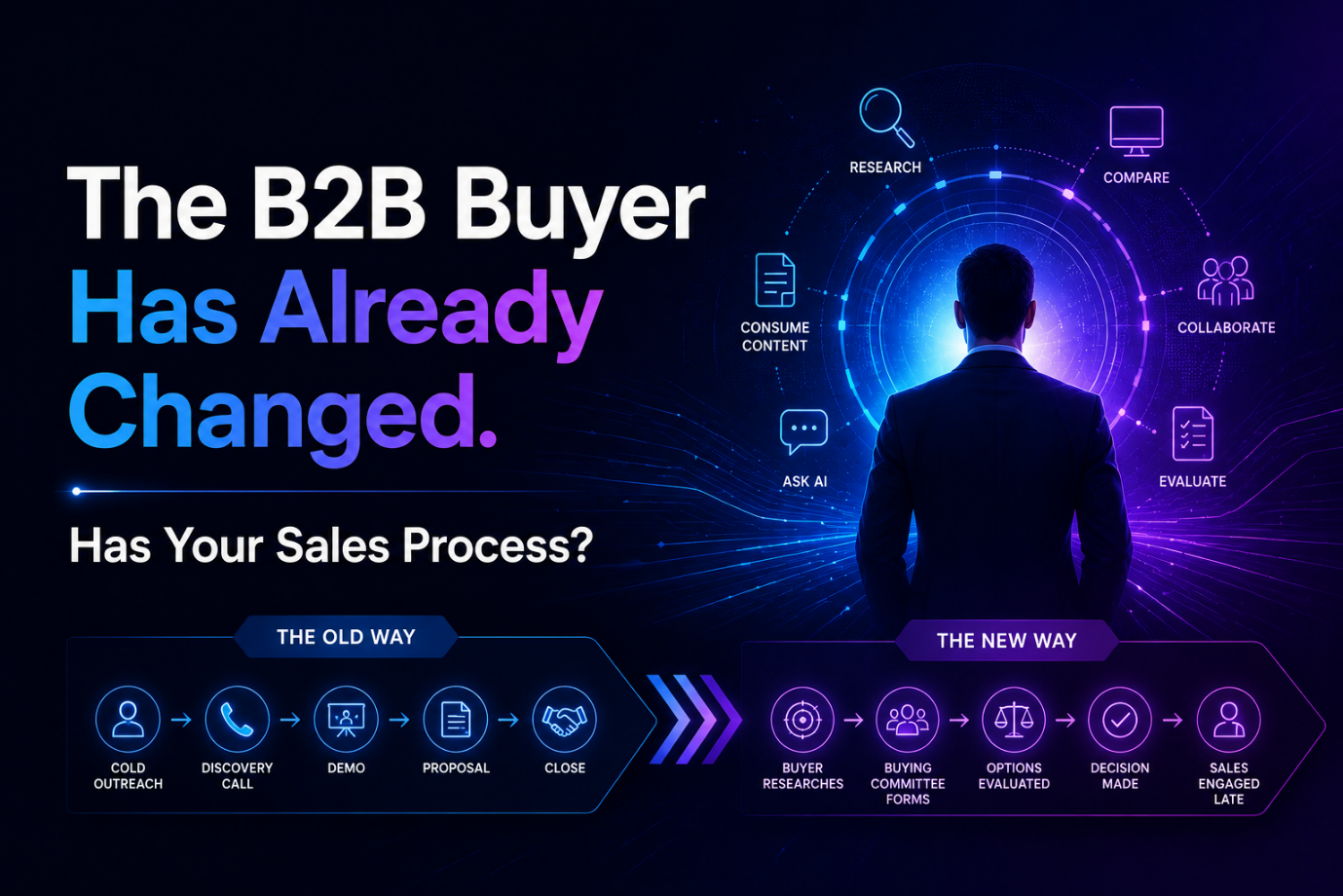
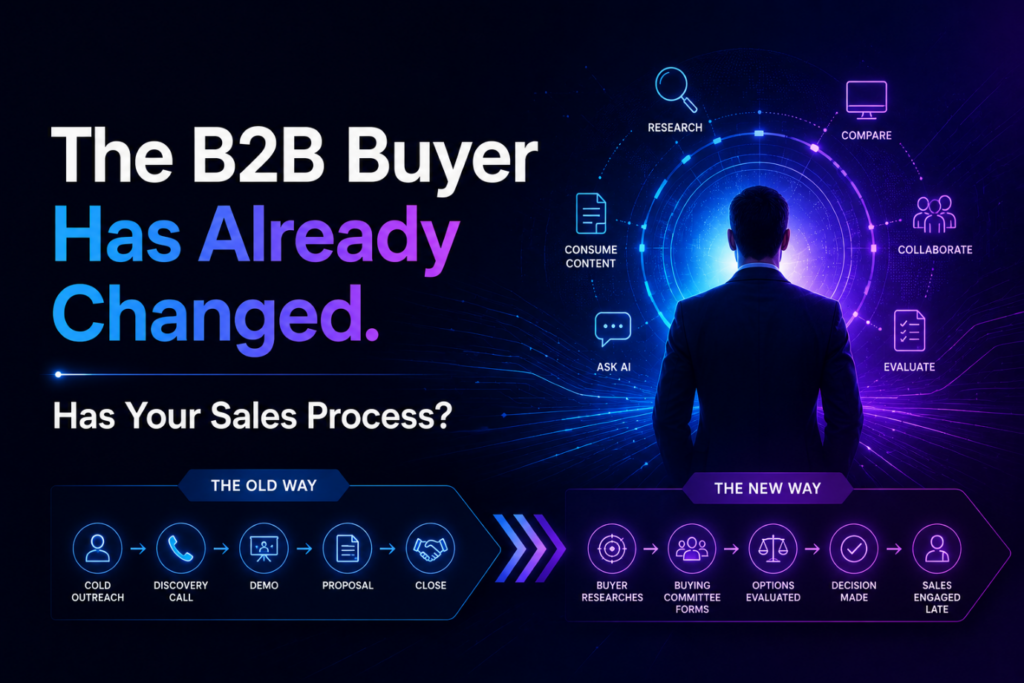
The B2B sales process has changed because the modern B2B buyer has changed. Buyers no longer depend on sales teams to introduce them to a market, explain competing solutions, or provide all the information needed to begin evaluating a purchase. They can research independently, compare vendors, consult colleagues, attend digital events, explore customer stories, and use AI tools to understand complex technology before ever speaking with a salesperson.
That shift creates a fundamental challenge for sales organizations. By the time a buyer submits a form or accepts a meeting invitation, much of the initial evaluation may already be underway. The buyer may already understand the problem, have researched competing vendors, discussed the issue with colleagues, and developed an early view of which solutions deserve consideration.
For B2B organizations selling complex technology, this means the traditional sales funnel is no longer enough. The opportunity is not simply to contact prospects earlier or increase outbound activity. It is to build a B2B sales process that recognizes buying signals, understands accounts and buying groups, and provides meaningful value when sales engagement begins.
Understand How the Modern B2B Buyer Starts the Journey –
The traditional B2B sales model often assumes that sales initiates the buying journey. Prospect lists are created, emails are sent, calls are made, leads are qualified, and prospects are moved through predefined stages.
Today’s buyer can begin almost anywhere.
A potential customer might discover a company through search, social media, industry communities, analyst research, peer recommendations, events, review platforms, or an AI assistant. From there, the buyer can investigate products, compare competitors, read case studies, examine technical information, and share findings with colleagues.
This means the beginning of the buying journey can happen without any direct interaction with sales.
A modern B2B sales process therefore needs to recognize that buyers may already have significant context when they become visible to the organization.
Key changes include:
- Buyers increasingly conduct independent research.
- Multiple stakeholders can participate before sales engagement.
- AI can accelerate research and vendor comparison.
- Buyers can evaluate vendors without identifying themselves.
- Sales conversations often happen after initial vendor preferences have formed.
For example, an enterprise technology buyer researching cloud modernization may first examine technical documentation, read customer experiences, compare providers, and ask an AI tool to summarize competing approaches. The eventual sales conversation may be less about explaining cloud modernization and more about addressing implementation risks, organizational requirements, integration challenges, and business outcomes.
Shift From Lead-Centric Selling to Account-Based Selling –
One of the most important changes in the B2B sales process is the move from thinking primarily about individual leads to understanding entire accounts.
A lead represents an individual. An account represents an organization containing multiple stakeholders, initiatives, priorities, and potential buying paths.
Imagine that one employee downloads a technology report. That activity may be useful, but it provides limited context. Now imagine several employees from the same organization researching related subjects, participating in an industry event, and interacting with different pieces of relevant content.
The second scenario provides a broader account-level picture.
This is why modern revenue teams increasingly need to ask a different question: Is the account becoming qualified for attention?
Rather than relying exclusively on individual lead scores, organizations can consider signals such as:
- Engagement from multiple people within an account
- Changes in organizational leadership
- New business initiatives
- Technology adoption or transformation activity
- Relevant content engagement
- Previous conversations and opportunities
- Changes in business priorities
- Evidence of activity around a specific problem
These signals do not automatically indicate purchase intent. They provide context that can help sales teams prioritize where human attention may be most valuable.
Build the B2B Sales Process Around Buying Groups –
B2B purchases rarely involve only one person.
The person who discovers a solution may not control the budget. The technology evaluator may not own implementation. Procurement may influence commercial terms, while security may determine whether a solution can be approved. Finance and senior leadership may also require a clear business case.
The B2B sales process therefore needs to account for buying groups rather than treating a single contact as the entire opportunity.
Different stakeholders need different value –
Consider an enterprise technology purchase. Different stakeholders may evaluate the same solution from completely different perspectives:
- CFO: financial impact, business justification, and investment risk
- CIO: architecture, integration, scalability, and strategic alignment
- IT: implementation complexity and operational requirements
- Security: risk, access, compliance, and security controls
- Procurement: commercial terms and purchasing requirements
- Business leadership: outcomes, growth, productivity, and competitive advantage
An effective sales process does not necessarily give every stakeholder a completely different story. Instead, it builds one coherent business case while connecting the solution to each stakeholder’s priorities.
This also means sales teams need to identify who else may be involved in a decision and understand where each stakeholder is in the evaluation process.
Use AI to Improve Sales Intelligence, Not Just Outreach –
AI is changing the buyer experience, but simply using AI to generate more sales emails does not necessarily create a better B2B sales process.
Buyers already receive substantial volumes of automated communication. Increasing that volume can make it even harder for relevant messages to stand out.
The more valuable application of AI may be behind the scenes.
AI can help sales teams analyze information across CRM records, account activity, engagement data, organizational changes, previous interactions, and other available signals. Instead of asking AI to replace human engagement, organizations can use it to improve the information available to salespeople before they engage.
Potential applications include:
- Identifying accounts that deserve closer attention
- Summarizing previous account interactions
- Detecting changes within target organizations
- Helping map stakeholders
- Identifying engagement patterns
- Highlighting potential next actions
- Bringing together fragmented account information
The distinction is important.
Automation can create scale. Intelligence can create relevance.
The salesperson still brings judgment, empathy, credibility, business understanding, and relationship-building to the conversation.
Replace Generic Outreach With Contextual Engagement –
For years, outbound sales has often been measured through activity metrics such as emails sent, calls made, contacts added, and meetings booked.
Those metrics are easy to measure, but activity does not automatically equal relevance.
The modern buyer is likely to ask an implicit question whenever an unsolicited message arrives:
Why are you contacting me now?
A strong B2B sales process should help salespeople answer that question.
Relevant context might include a company entering a new market, hiring a new executive, launching a product, adopting a new technology, acquiring another organization, or announcing a transformation initiative.
Other signals may emerge through account engagement and interactions with relevant content.
None of these signals guarantees that a company is ready to buy. Their value is that they can provide a reason to investigate the account and potentially create a more informed conversation.
The goal is not simply more outreach. It is better-timed, better-contextualized outreach.
Make the Sales Process Adaptive Instead of Linear –
The traditional funnel remains useful as a measurement framework, but it does not always reflect how modern buyers actually behave.
A company may research vendors for months without appearing as an active opportunity. Another organization may speak with sales before its business case is finalized. A buying group may pause an evaluation and return later with new stakeholders and a much clearer requirement.
Buyers can also evaluate several solutions simultaneously or involve procurement and technical teams at different points in the process.
That makes rigid stage definitions increasingly difficult to rely on as the only source of truth.
A modern B2B sales process should distinguish between where the CRM says an account is and what the available signals suggest the account may actually be doing.
For example:
- A “cold” account may have several employees researching a relevant category.
- A lead marked “awareness” may already have compared multiple vendors.
- A dormant opportunity may become relevant after an organizational change.
- A “not interested” response may mean “not now” rather than permanent rejection.
- A single contact may represent only one part of a much larger buying group.
The process needs enough flexibility to account for these situations.
Connect Marketing, Sales, Data, and AI –

Technology cannot repair an outdated sales process on its own.
Marketing and sales also need to operate as a continuous intelligence loop rather than separate functions connected only by lead handoffs.
Marketing can help influence buyers before they become identifiable leads through content, digital experiences, thought leadership, customer stories, executive visibility, and targeted engagement.
Sales can then feed information from actual conversations back into marketing and revenue operations.
That information can include:
- The problems buyers are actually discussing
- Recurring objections
- Stakeholders entering buying conversations
- Competitors appearing in evaluations
- Reasons opportunities are delayed
- Patterns among successful accounts
- Questions buyers repeatedly ask
This creates a continuous cycle:
Market signals → Marketing engagement → Account intelligence → Sales action → Sales insights → Improved targeting
This model is particularly valuable for companies selling complex B2B technology such as cloud platforms, cybersecurity solutions, AI systems, data infrastructure, enterprise software, and digital transformation services.
These purchases typically require more than product awareness. They require justification, stakeholder alignment, confidence, and a clear understanding of potential risks.
Why Data Quality Is Essential to a Modern B2B Sales Process –
An intelligent sales strategy depends on reliable information.
If account and contact data is outdated, even sophisticated sales technology can produce poor recommendations. Salespeople may contact former employees, marketing may target the wrong department, and account-based campaigns may focus on organizations that no longer match the company’s strategy.
AI can also amplify poor data if the underlying information is incomplete or inaccurate.
A strong data foundation should help organizations understand:
- Who works at the account
- Which stakeholders may influence the purchase
- How the organization has changed
- What previous interactions have occurred
- Which accounts match strategic priorities
- What relevant engagement signals are emerging
The future of B2B sales therefore depends on more than automation. It requires a combination of accurate data, account intelligence, relevant engagement, AI capabilities, and human judgment.
From Speed to Lead to Speed to Signal –
For years, “speed to lead” has been an important sales concept: how quickly can a salesperson contact someone after that person submits a form?
The modern B2B environment suggests another question may be equally important: How quickly can the organization recognize a meaningful account signal?
Speed to signal means understanding:
- When an account begins showing relevant activity
- Which stakeholders may be involved
- What has changed inside the organization
- What business context could explain the activity
- How quickly sales can respond with relevant engagement
The advantage is not necessarily contacting every prospect faster.
It is recognizing meaningful opportunities earlier and deciding where human attention can create the greatest impact.
How PMG Can Support a More Modern B2B Sales Strategy –
This shift reinforces the value of connecting data, prospecting, account-based marketing, targeted communication, and AI rather than treating each capability as a separate activity.
For PMG, Data Dynamo can support the account and contact data foundation required for modern targeting. Prospect Pinnacle can help identify relevant decision-makers within priority accounts. Impact Sphere can support account-level engagement, while Inbox Oracle can support targeted B2B communication. Proffer.ai can bring AI and automation capabilities into the broader process.
Together, these capabilities can support a more connected approach to demand generation and revenue engagement: identifying relevant accounts, understanding the people within them, recognizing changes and signals, and creating meaningful engagement before an opportunity becomes obvious to everyone.
The objective is not simply to automate more sales activity.
It is to make sales activity more informed, timely, and relevant.
What the Future of B2B Selling Looks Like –
The strongest sales organizations may not necessarily be the ones generating the largest volume of outreach. They will increasingly be the organizations that can identify where buying activity is emerging, understand why it matters, and respond with relevance.
That requires a fundamental change in how sales teams think about their jobs.
The salesperson is no longer simply the person who introduces a buyer to a product or explains the category. Much of that information is already available through websites, digital content, peer networks, and AI tools.
Instead, salespeople can create value by helping buyers navigate complexity.
That can mean bringing contextual knowledge, understanding implementation challenges, helping develop a business case, addressing risk, coordinating stakeholders, and building confidence around a decision.
The technology provides scale and intelligence. The human provides judgment and trust.
That combination can become a powerful foundation for the next generation of B2B revenue organizations.
Conclusion –
The B2B sales process cannot remain built around assumptions from a buyer journey that no longer reflects how modern organizations research and purchase technology.
Buyers now have more information, more channels, more internal stakeholders, and more AI-powered tools available before they ever speak with sales. Trying to solve this change simply by increasing outreach volume misses the larger opportunity.
Sales organizations need to become better at understanding accounts, recognizing buying signals, mapping buying groups, delivering relevant engagement, and using AI to improve human decision-making.
The future of B2B selling is therefore not about finding someone willing to take a sales call.
It is about understanding which accounts are moving, why they are moving, who is involved, and how your organization can become valuable to that decision before the buying process is already underway.
Frequently Asked Questions
A modern B2B sales process is an adaptive approach to selling that accounts for independent buyer research, multiple stakeholders, account-level activity, digital engagement, AI-assisted research, and changing business priorities. It focuses on relevance and context rather than relying exclusively on linear lead stages.
The traditional model assumed that salespeople played a central role in providing information and guiding buyers through the early stages of evaluation. Today, buyers can independently research vendors, compare solutions, consult colleagues, and use AI tools before contacting sales. As a result, sales teams need to create value beyond basic product information.
Account-based selling focuses on organizations rather than individual leads. Instead of treating one contact as the entire opportunity, sales teams identify priority accounts, understand the stakeholders within them, monitor relevant signals, and coordinate engagement across the buying group.
AI can help sales teams analyze account information, identify patterns, summarize interactions, understand stakeholder activity, and recommend potential actions. Its greatest value is not necessarily generating more outreach but helping salespeople make better-informed decisions and have more relevant conversations.
A buying group is the collection of stakeholders involved in evaluating, approving, purchasing, implementing, or influencing a B2B solution. Depending on the purchase, it can include executives, finance, IT, security, procurement, business leaders, and other stakeholders.